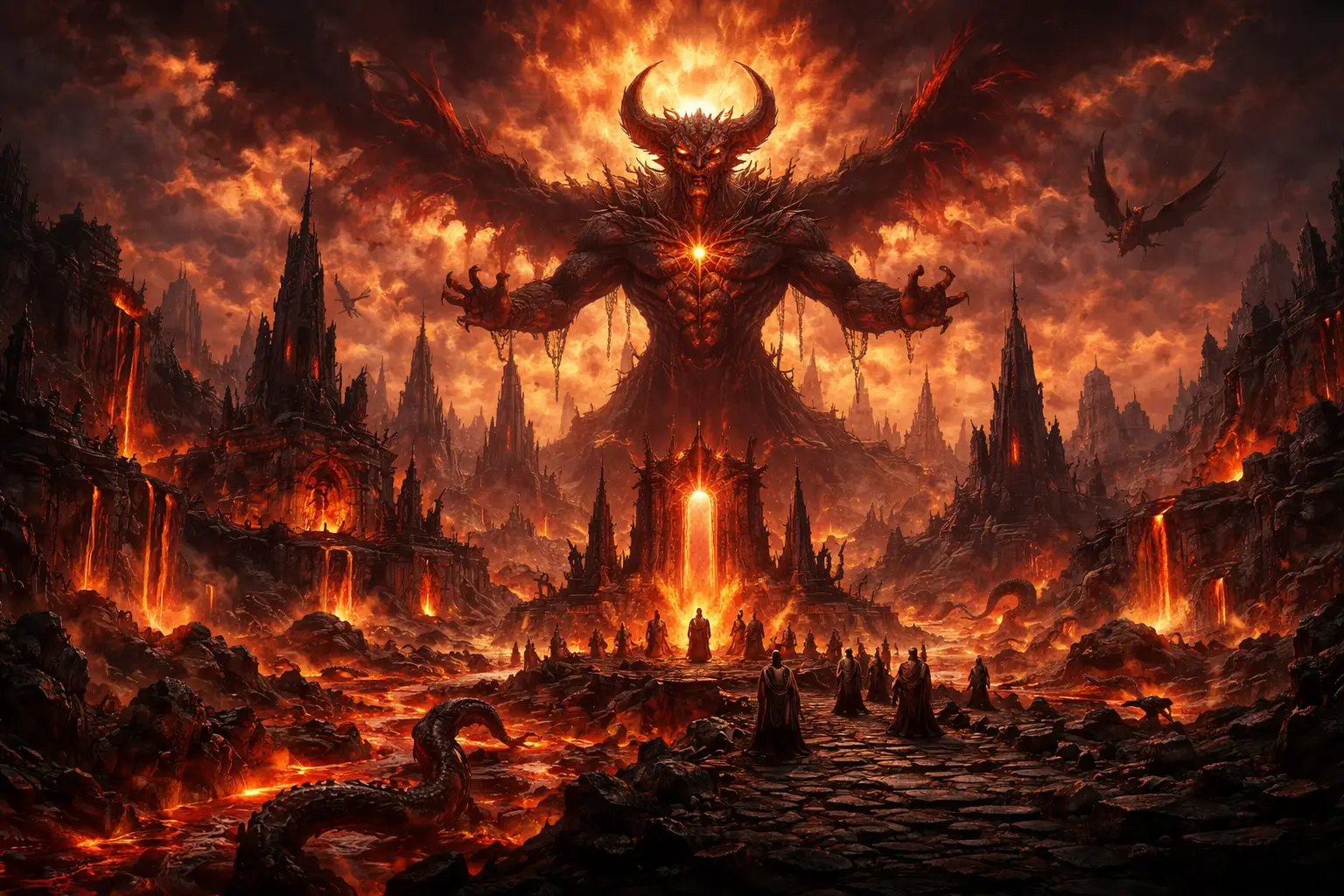
The Age of Demons
Period: More Than 100,000 Years Ago
In the first days of the world, the children of Khyber — fiends, aberrations, and other monsters — rose up from the darkness and claimed dominion. The greatest among these were the overlords, immortal archfiends embodying the evils that plague mortals. Each overlord shaped the world to match its nature, and no civilization could challenge them. It was a time of chaos that lasted for untold millennia.
The Age of Demons ended after an extended war between the overlords and a legendary group of champions — now known to the faithful as the Sovereign Host — who raised an army of dragons and giants, allied with the couatl, native celestials said to embody the last light of Siberys. As the immortal overlords could not be destroyed, countless couatl sacrificed themselves, their spirits combining into a prison of pure celestial energy that could bind the overlords. Even today, the overlords remain bound and the world protected from immense evil by this force, now known as the Silver Flame.
The Age of Demons ended a hundred thousand years ago, long before the foundation of any civilization that exists today. But the time lingers in myth and continues to shape modern life. The overlords are real. Their servants are active. And the war that was fought to bind them, the First War, has never truly ended — it simply moved underground, where it is waged by patient conspiracies and contested through the Draconic Prophecy.
"People say the Age of Demons is ancient history. It is not history at all. It is a current event with a hundred-thousand-year preamble." — Gatekeeper elder, Eldeen Reaches
The Overlords
There were approximately thirty overlords in the Age of Demons, and between them, they dominated the world. Despite their incredible power, the overlords are not gods — they cannot grant divine magic, though a devout follower might draw power directly from Khyber as a result of their faith. They are not a logically arranged pantheon with complementary domains. They are monsters: epically powerful, finite, and embodying specific aspects of evil rather than explaining its existence.
Each overlord's dominion was thematic as much as territorial. Rak Tulkhesh, the Rage of War, is the incarnation of the impulses that drive mortals to battle — fear, greed, hatred. Sul Khatesh, the Keeper of Secrets, embodies the fears and superstitions surrounding magic, from malevolent warlocks to deadly curses. Bel Shalor, the Shadow in the Flame, corrupts from within — it is entirely possible he wanted to be bound and always planned to become the shadow inside the Silver Flame itself. The Wild Heart destroys civilizations and feeds on primal cruelty. Katashka the Gatekeeper thrives on mortal fears of death and the undead. Dral Khatuur, the Heart of Winter, embodies the terrors of endless night and killing frost. The Daughter of Khyber, known to some as Tiamat, embodies the fear of dragons and the endless evil they can do — and her influence can reach any dragon, anywhere in the world.
Some overlords have overlapping domains. Sul Khatesh and Tul Oreshka both hold secrets. Rak Tulkhesh and Tol Kharash both delight in bloodshed, but Rak Tulkhesh is a force of rage while Tol Kharash is a force of tyranny. There could be an entirely different overlord associated with war in Sarlona than the one who fed on conflict in the Five Nations. Each overlord is finite. None explains the totality of evil. Each embodies a piece of it.
"Rak Tulkhesh does not cause wars. Wars cause Rak Tulkhesh. The Last War was a century-long feast for him, and every massacre weakened his bonds a little further. When people ask me why the Treaty of Thronehold matters, I tell them: because something in Khyber was getting stronger every year the fighting continued." — Silver Flame templar, field briefing
The Binding
The end of the Age of Demons was not a single battle. The champions of the first age — whether gods, heroic dragons, or something else entirely — raised an army and waged an extended war against the fiendish hosts.
The dragons and the giants who served them provided force and strategic vision. It is commonly believed that the myths of the Sovereign Aureon might be inspired by the deeds of a dragon named Ourelonastrix. Places and relics tied to the Sovereigns from this age still hold power — the lance Dol Arrah used when battling Katashka the Gatekeeper, the site where she and Dol Dorn flayed the Mockery for his treachery. Whether these artifacts belong to gods or dragons, the power in them is real.
The couatl provided the price. Born from Siberys at the dawn of time, the couatl were celestials of considerable power — but insufficient to destroy the overlords outright. So they sacrificed their collective essence. Countless couatl gave up their individual existences, their spirits combining into the Silver Flame — a divine force of celestial energy capable of binding the overlords. The couatl ceased to exist as individual beings. The Silver Flame endures.
The few couatl that remain on Eberron are devoted servants of the light, most often found guarding the prisons of the overlords. They sometimes act directly to aid adventurers who fight the forces of darkness, but they are vanishingly rare.
The binding did not destroy the overlords. Each was bound in a physical vessel — a Khyber dragonshard — and held in its prison by the power of the Silver Flame. The consciousness of each overlord was severed from its heart demiplane, preventing it from manifesting its avatar or exerting its full power. But the heart demiplanes still exist. The lesser fiends still return there when destroyed. And the overlords' influence still leaks into the regions around their prisons.
"The couatl did not defeat the overlords. They built a lock. Every lock can be picked. The only question is whether anyone is watching the door." — Morgrave lecturer, introductory cosmology
Hearts of Khyber
The overlords are commonly referred to as the children of Khyber. The truth is slightly more complex: they are actually the architecture of Khyber. Beyond the physical tunnels and caverns that extend into the depths, Khyber is a matrix of demiplanes — most scholars believe these are the dreams of Khyber the Progenitor, each reflecting a horrifying vision of a possible reality. The demiplanes tied to overlords are called heart demiplanes, and they are the source of all native fiends in Eberron.
Each heart demiplane reflects the overlord it is tied to. The Bitter Shield — the heart of Rak Tulkhesh — is a crimson fortress with stones soaked in blood and walls studded with rusted iron spikes, where fiends endlessly battle in pointless combat. The Tower of Shadows — the heart of Sul Khatesh — is a tower of black stone traced with silver, lit by three unfamiliar crescent moons, where fiends scribe the books of shadows that may be given to mortal warlocks. Beneath the city of Ashtakala in the Demon Wastes lies a portal to the Tower of Shadows.
Heart demiplanes are relatively small — around the size of a large city. While the overlords are not consciously present in their hearts, their essences permeate them. The lesser servants of each overlord return here when destroyed and reform. If an overlord were ever released, its power would flow out into reality, slowly reshaping the surrounding region to mirror its heart plane. The physical form that mortals can fight is merely an avatar — a projection. Destroying it is only a temporary setback. The overlord's essence flows back into its heart, regenerates, and returns.
This is why the overlords cannot be permanently defeated. They are part of the architecture of reality. They can only be contained.
"You can kill the avatar. It comes back. You can shatter the vessel. The Silver Flame still holds. The only way to release an overlord is to fulfill a specific path of the Draconic Prophecy — which is why two immortal factions have been fighting over that Prophecy for a hundred thousand years." — Chamber scholar, field report (intercepted by Korranberg intelligence)
The Fiendish Servants
Rakshasas and the Lords of Dust
The rakshasas were the primary agents of the overlords during the Age of Demons, functioning as strategists, generals, and administrators. When the overlords were bound, the rakshasas largely disappeared into Khyber — but not all of them. The Lords of Dust are a hidden alliance of rakshasas and other fiends that has manipulated the world since the dawn of time. When the explorer Lhazaar gathered her expedition for Khorvaire, there was a disguised rakshasa advisor at her side.
Each overlord has a prakhutu — a speaker — who serves as its voice in the world. Mordakhesh the Shadowsword is the speaker of Rak Tulkhesh. He was a dragon-slaying specialist in the Age of Demons and now orchestrates schemes across centuries, maintaining agents in armies across Khorvaire. Many of the worst massacres of the Last War were instigated or encouraged by his operatives. Hektula, the First Scribe, is the speaker of Sul Khatesh. She maintains the Library of Ashtakala and writes books of dark magic that serve as vectors for her master's influence.
The Lords of Dust do not serve all overlords equally. Some overlords have no ties to the coalition — the Daughter of Khyber has no involvement, and Dral Khatuur despises all other creatures including other overlords. The Lords of Dust are an arrangement born of convenience, not sentiment. But they are patient in a way no mortal institution can match: they think in centuries, use governments and faiths and bloodlines as tools, and follow procedures laid down before mortal civilization existed.
"The Lords of Dust do not improvise. They execute plans that were old when humanity was young. If you think you have outmaneuvered a rakshasa, you have not yet understood the timeline you are operating on." — Zilargo intelligence analyst, classified briefing
Night Hags
Night hags have been around since the Age of Demons, when they often served as ambassadors and carried messages between the fiends and the dragons. Today, they remain impartial mediators. Adventurers who are about to deal with extraplanar entities might seek the advice of a night hag, though finding one can be quite difficult. The night hag Jabra, an alchemist of exceptional skill, bottles stolen dreams and nightmares and sells unique potions in the Immeasurable Market of Syrania — a reminder that not all survivors of the Age of Demons chose sides.
The Champions and the Sovereigns
The identity of the champions who led the war against the overlords is one of the most debated questions in Khorvairian theology.
The Sovereign Host tradition holds that the nine Sovereigns physically walked the world during the Age of Demons and battled the overlords directly. Vassals believe that when mortal souls pass through Dolurrh, they join the Sovereigns — but this is faith, not evidence.
Many scholars assert that the myths of the Sovereign Host are actually based on the deeds of heroic dragons. The legends of Aureon may be inspired by the dragon Ourelonastrix. The lance of Dol Arrah, the site where the Mockery was flayed — these could be draconic artifacts given divine attribution over a hundred thousand years of retelling.
Some immortals in the planes honor the Sovereigns. A platoon of angels in Shavarath may carry the banner of Dol Arrah. The Librarian of Dolurrh may mention the time Aureon came to borrow a book — but that was almost a hundred thousand years ago. These acknowledgments confirm the most basic myth: that in the first age of the world, a band of champions defeated the overlords. Whether they ascended to become the omnipresent entities many believe them to be is the part that even angels must take on faith.
"Did the Sovereigns fight the overlords? The Vassal says yes. The scholar says they were dragons. The templar says the Silver Flame is what matters, not who held the sword. The Aereni say they have records that predate the question and they are not sharing. Everyone is very confident." — Korranberg comparative theologian
Unbinding
Releasing an overlord is no trivial matter. The prisons of the overlords are as indestructible as the fiends themselves. The only way for an overlord to be released is for a certain path of the Draconic Prophecy to come to pass. For this reason, the actions of the Lords of Dust are enigmatic — they cannot simply release their masters. They must bring history to a particular crossroads, a point at which the planes and moons are aligned and the darkness can rise again.
The Draconic Prophecy is almost always tied to the actions of specific mortals. This is why both the Lords of Dust and the Chamber are so interested in mortal affairs, and why individual people — often people who have no idea they matter — become the fulcrum on which the fate of an overlord turns.
It is possible for an overlord to be partially released, increasing its ability to influence its surroundings without possessing its full power. This state generally occurs when the bonds are almost broken and a single condition stands between the overlord and freedom. The Wild Heart was in this state during the lycanthropy surge that triggered the Silver Crusade — it could amplify the curse and assert control over all lycanthropes, but the Towering Woods were not physically transformed. The Year of Blood and Fire in 298 YK saw Bel Shalor partially released, devastating Thrane until the paladin Tira Miron sacrificed herself to rebind him — an act that established the Church of the Silver Flame.
Even while bound, the overlords gain strength when mortals embrace the dark paths laid down for them. Rak Tulkhesh grows stronger when mortals spill blood. Sul Khatesh whispers secrets to warlocks. The Wild Heart feeds on primal cruelty. The more mortals who succumb to their influence, the greater that influence becomes.
"The binding holds. The binding has held for a hundred thousand years. But it is not a wall. It is a negotiation — between the Flame's strength and the overlord's patience. And the overlords have nothing but time." — Silver Flame theologian, private correspondence
Ashtakala
One of the best documented sites from the Age of Demons is Ashtakala, an ancient city in the heart of the Demon Wastes. It is the last surviving city of the Lords of Dust, and it has endured for a hundred thousand years since the binding. It is immune to divination and surrounded by a deadly storm. The entire region around it is an unnatural wasteland.
Ashtakala is neutral ground where all the Lords of Dust can find sanctuary. Hektula maintains its library. Mordakhesh returns between schemes. The city creates an alternate reality within its storm — it still appears to be at its zenith, and people who enter its influence are altered to fit its narrative.
The dragons of Argonnessen attacked the Demon Wastes tens of thousands of years ago. They laid waste to the region, destroying a humanoid civilization that predated the Carrion Tribes. But Ashtakala's storm repelled magical and elemental attacks. As dragons drew close, their souls were ripped from their bodies and they turned on their allies — dust-stuffed shells that proved to be an ongoing threat for thousands of years. The attacking force was almost entirely wiped out, and the slain fiends simply reformed. The dragons have not returned.
What Survives
Dungeons from the Age of Demons are rare, as few have survived the passage of a hundred thousand years. Any remaining sites would be infused with fiendish or celestial power. A vault created by the couatl could hold a deadly artifact tied to an overlord. An obsidian fortress might be imbued with Rak Tulkhesh's power, and people who settle nearby find themselves consumed by homicidal rage. If a region produces unexplained restless dead, it could be the prison of Katashka the Gatekeeper. If a region is suddenly overcome by ice and snow, the shard-prison of Dral Khatuur may have been brought there.
The overlords are the reason that "ancient evil" in Eberron is not a metaphor. They are contained. They are not gone. And their servants are still working — patiently, methodically, across centuries — to bring the Prophecy to the crossroads where the darkness can rise again.