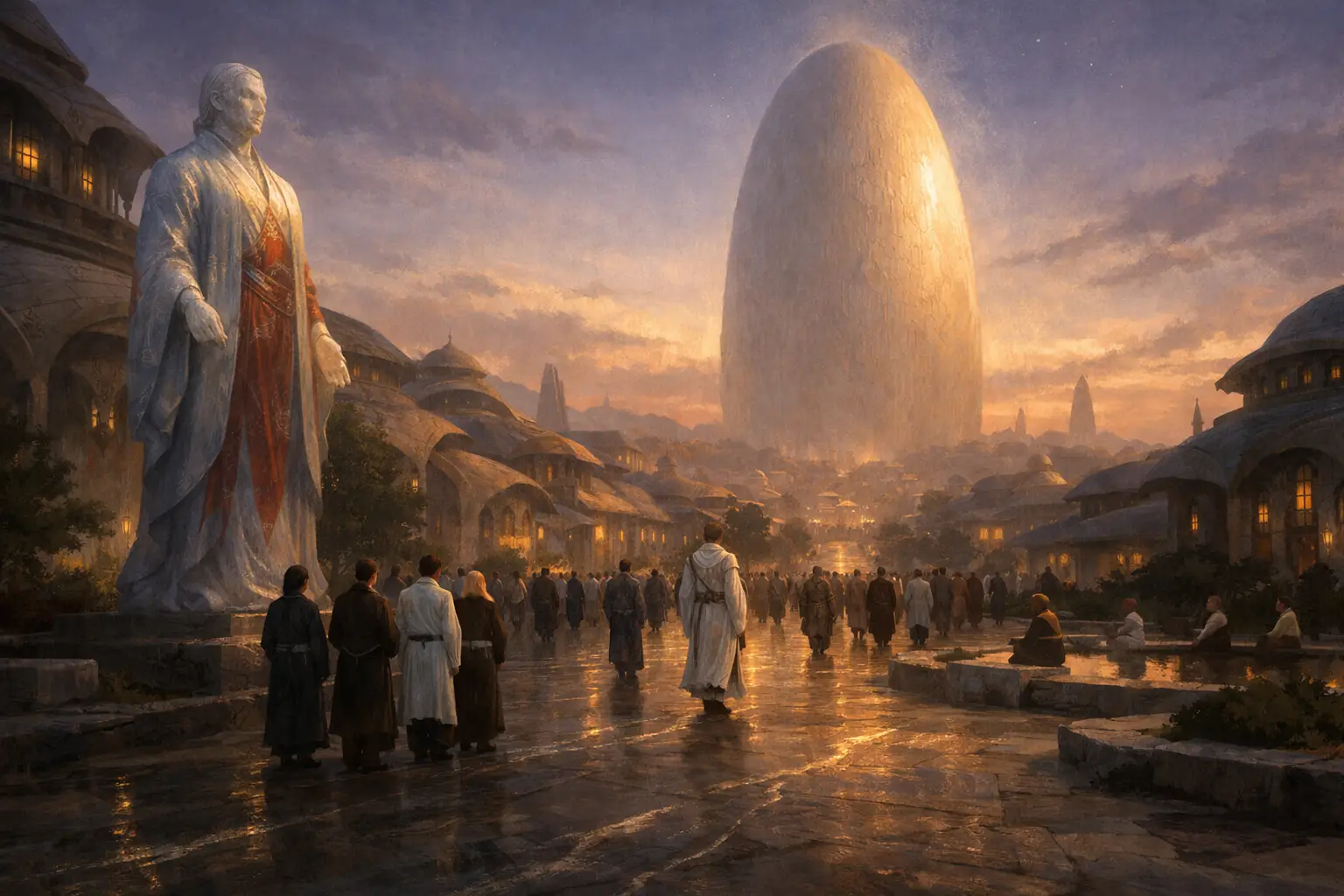
Sarlona
Dominant Power: The Unity of Riedra | Other Regions: Adar, Syrkarn, the Tashana Tundra | Hallmarks: Psionics, the Inspired, ancient lost kingdoms, planar saturation, the birthplace of humanity
"I have been to Sarlona once. The harbormasters were polite. The city was clean. The people were happy. Every single one of them. I have never been more frightened in my life." — Caldros ir'Tharn, Brelish merchant-captain, upon returning to Sharn
Sarlona is the largest continent on Eberron, and the one that Khorvaire knows almost nothing about. It lies across the sea to the east — or the west, depending on which way you sail — and it is the place where humanity began. Three thousand years ago, the first human colonists left Sarlona's eastern shores and crossed the ocean to settle what would become the Lhazaar Principalities, the Shadow Marches, and eventually the Five Nations. Everything that humanity has built on Khorvaire — Galifar, the dragonmarked houses, the Last War, Sharn — began as an echo of something that once existed on Sarlona and was lost.
The continent the colonists left behind no longer resembles the world they knew. Over a dozen independent kingdoms once competed across Sarlona's vast landmass (much as twelve nations currently occupy Khorvaire) — nations of sorcerer-kings, warrior empires, island arcanists, dwarven mountain-holds, and theocracies devoted to faiths that predate every religion practiced in the Five Nations. Roughly sixteen hundred years ago, a period of devastating wars — the Sundering — tore those kingdoms apart. From the wreckage, a new power emerged: the Inspired, beings of extraordinary psionic ability and otherworldly beauty who united the survivors into a single nation. That nation is the Unity of Riedra, and it now controls the vast majority of the continent.
Most people in Khorvaire know three things about Sarlona: it is where humans came from, it is ruled by the Inspired, and outsiders are not welcome. All three are true. The rest is rumor, speculation, and the occasional account from merchants who have visited the single port that Riedra keeps open to foreign trade. What lies beyond that port — what Riedra actually is, what the Inspired actually want, and what happened to the civilizations that humanity left behind — are questions that most Khorvairians have never thought to ask.
The people who have thought to ask tend to come back unsettled.
The Shape of the Continent
Sarlona stretches from southern tropics to northern tundra — over three thousand miles from the mountain monasteries of Adar in the southeast to the frozen wastes of the Tashana Tundra in the north. It is larger than Khorvaire, geographically more varied, and saturated with planar energy to a degree that no other continent on Eberron can match. Manifest zones — regions where a plane of existence bleeds into the material world — are common everywhere on Eberron; on Sarlona, they are everywhere. The continent also contains wild zones, where another plane essentially projects directly into the material, creating pockets of alien reality: a stretch of jungle where Lamannia's primal power causes uncontrollable growth, a valley where Shavarath's eternal battlefield extends into the mortal world, a desert where Mabar's shadow swallows the light. Reality storms — unpredictable surges of planar energy that can warp the landscape for hours or days — sweep across regions with no warning.
The heart of the continent is Riedra: wet southern jungles in the province of Corvagura, harsh northern plains in Dor Maleer, fertile river valleys, dry inland deserts, and the island archipelago of Ohr Kaluun along the eastern coast. Riedra's cities are bastion cities — massive, fortified urban centers that serve simultaneously as military garrisons, transportation hubs (linked by teleportation circles), administrative centers, and seats of Inspired governance. Between the bastions, small farming and mining villages dot the landscape, each serving a specific function assigned by the Unity.
To the southeast, the mountains of Adar rise in nearly impassable ranges. To the west, the deserts and steppes of Syrkarn stretch toward the coast. To the north, the Tashana Tundra sprawls in frozen silence, home to the shifter nations and the betrayed Akiak dwarves.
The Unity of Riedra
Riedra is the dominant power on Sarlona — a single nation encompassing eight provinces, each named for one of the fallen kingdoms whose territory it absorbed. It is older than Galifar, larger than Galifar, and by every external measure, more stable than Galifar ever was. Its citizens are fed, housed, and protected. Crime is nearly nonexistent. The streets are clean. The people are content.
The state religion is the Path of Inspiration, a faith built around the concept of reincarnation and spiritual evolution. By living lives of devotion and service, the faithful believe they improve their spiritual standing in each successive life, eventually ascending to become one of the il-altas — the great spirits that the Inspired are believed to embody. The Inspired are therefore not merely rulers but living saints: mortals of otherworldly beauty who have achieved such spiritual refinement that celestial beings have chosen to inhabit their bodies and guide them. This is what the Riedrans believe. They believe it absolutely.
The government operates through the Unity, a bureaucratic apparatus of seven branches: the Bountiful Horn (agriculture — no Riedran citizen goes hungry), the Industrious Forge (industry), the Sturdy Wall (construction), the Healing Hand (medicine), the Sheltering Hearth (housing), the Guiding Path (education and religion), and the Iron Gate (law). The Harmonious Shield serves as the military; the Thousand Eyes as the intelligence and surveillance service. Each province's bastion city is governed by an Inspired lord, and beneath them the Chosen — humans bred to serve as vessels for the spirits the Inspired embody — fill administrative roles throughout the system. The apparatus is efficient, comprehensive, and leaves almost no aspect of daily life unmanaged.
The silver monoliths that rise above Riedra's cities — the hanbalani — are the most visible symbol of the nation's spiritual achievement. Ovoid structures hundreds of feet tall, clad in shining silver, they are considered sacred monuments that hold the spirits of the dead and broadcast the shared dreams of the faithful. To the people of Riedra, the monoliths are beautiful and holy. To the handful of outsiders who have studied them closely, the monoliths raise questions that the Riedrans do not ask and the Inspired do not answer.
POSTED AT THE DAR JIN TRADE QUARTER — in Common
Welcome to the Unity of Riedra. Foreign nationals are reminded that travel beyond the Jhodra requires authorization from the Iron Gate. Unauthorized movement into Riedran territory is a violation of Unity law and will be treated accordingly.
The Path provides. The Inspired guide. Walk in harmony.
Life in the Unity
A Riedran citizen's daily life is predictable in a way that would unsettle most Khorvairians. You work with the same people in the same building following the same schedule. You eat in your dormitory — there are no restaurants, no taverns, no shops in the Khorvairian sense. You dream the same dreams as your neighbors, receive the same messages from the Voice — a telepathic broadcast system that delivers news and guidance from the Inspired to every citizen within range of a monolith. You know where you are going and what you must do, and you move toward that goal quietly and with purpose.
Riedran cities are not designed for consumers. There are no theaters, no gambling houses, no luxuries built for pure leisure. There are gardens of reflection — meditative spaces where citizens contemplate the Path. There are memorials that share psychic impressions of great triumphs or tragic events. There are plazas where priests inspire crowds and soldiers drill. Every space serves a purpose. The architecture is curved, whorled, beautiful — streets paved with smooth black cobblestones interspersed with squares of clear crysteel that glow softly after dark, buildings of black and white stone with crysteel skylights. It is gorgeous and repetitive: every dormitory looks exactly the same.
Riedran material culture is built on sentira — a crystal that absorbs and stores emotional energy. Sentira weapons, armor, and tools respond to the wielder's emotional state, and sentira architecture can project feelings of calm, awe, or devotion onto anyone in proximity. A statue of an Inspired lord radiates reverence — and a visitor who feels that reverence cannot be entirely certain whether the feeling is genuine or induced. This ambiguity is, depending on your perspective, either the beauty or the horror of Riedran civilization.
Foreigners are permitted in exactly one place: Dar Jin, the trade port on the eastern coast. The Jhodra, the foreign quarter, is where Khorvairian merchants, dragonmarked heirs, and diplomats conduct business in taverns and shops run mostly by the dragonmarked houses — because the Riedrans do not have taverns. Outside the Jhodra, foreigners are watched. Citizens keep their distance, avoid eye contact, and treat outsiders as curiosities at best and threats at worst. The Jhodra is cosmopolitan in the way a terrarium is cosmopolitan: it contains diversity, but the glass walls are very clear.
"Walking through the Jhodra, you have the odd sensation of knowing where you are — of remembering the name of the street even though you have never been here before. You see a statue of an Inspired lord, and you are impressed. But is that your feeling, or just a projection of the statue? And perhaps one of those silent, hardworking Riedrans gives you a look — an odd gesture. What are they trying to convey? Do they want to speak to you alone? Or is it an agent of the Thousand Eyes, testing you?" — from a Sivis trade liaison's journal, Dar Jin
Adar
The mountain refuge of Adar is the only region of Sarlona that has never fallen to the Inspired. Adar occupies a vast stretch of nearly impassable mountain terrain along the continent's southeastern coast — wider than Aundair or Thrane, though far less populated — defended by fortress monasteries whose inhabitants have held against Riedran assault for over a thousand years.
Adar is the homeland of the kalashtar — a people born from the merger of human and spirit, possessing innate psionic abilities and a spiritual tradition called the Path of Light. The kalashtar claim that the spirits who guide the Inspired are fundamentally different from those who guide them — that the Inspired are not what they appear to be, and that the benevolent face of Riedra conceals something far darker. The Riedrans, for their part, consider the kalashtar to be heretics and terrorists who threaten the spiritual evolution of all humanity.
The fortress monasteries hold. The sieges continue. The mountains endure. Adar is insular to the point of xenophobia — direct travel between Adar and Khorvaire is extremely difficult, and the Adarans have little interest in the outside world. Most kalashtar encountered in Khorvaire left Adar generations ago and maintain only a spiritual connection to the homeland. Their warnings about the Inspired are easy to dismiss as the grievances of a fringe religious community — and this, more than anything else, is what keeps the kalashtar from being heard.
Syrkarn
The wild lands of Syrkarn occupy the western reaches of the continent — a region of deserts, steppes, and ancient ruins that Riedra claims as a protectorate but has never absorbed. The Inspired ordered all humans to abandon Syrkarn centuries ago, and the region's current inhabitants are a mix of eneko (half-giant peoples descended from ancient ogre-human unions), scattered human nomads, and hidden communities of yuan-ti who survived the Inspired's purges. Syrkarn is the one part of Sarlona where the Unity's grip is genuinely weak — a lawless frontier where the ruins of pre-Sundering civilizations lie half-buried in sand, where Thousand Eyes agents operate but cannot dominate, and where the planar saturation produces manifest zones, wild zones, and creatures that the Riedrans would rather not fight for territory that has little strategic value.
The Tashana Tundra
The frozen north belongs to the shifter nations — the Chuniigi, the Qiku, and the Saartuk — who have maintained their independence through sheer inhospitability of terrain and a ferocity that Riedra has found more costly to suppress than to tolerate. The Tashana Tundra is also home to the remnants of the Akiak, a dwarven and duergar people whose mountain fortresses were betrayed and broken by the Inspired in an act the dwarves call the Night of Razor Dreams. The Akiak were master psionicists whose techniques were instrumental in building Riedra's infrastructure — and when they had served their purpose, the Inspired turned on them. The Akiak survivors fight a guerrilla war from the Frostblade Mountains, and they have not forgiven and will not forget.
The Lost Kingdoms
Sarlona's history before the Sundering is almost entirely lost — deliberately so. The Inspired have systematically suppressed the old traditions, erased the old names, and replaced the cultures of the fallen kingdoms with the homogeneous devotion of the Path of Inspiration. But fragments survive, and every fragment is a window into a civilization that Khorvaire has forgotten it descended from.
The old kingdoms were shaped by the planes. Corvagura, the heart of modern Riedra, was shaped by Lamannia, Mabar, and Thelanis — its unnatural fertility and its two houses of sorcerers (one drawing on fey glamour, the other on shadow) were the foundation of its power. Nulakesh was the largest pre-Sundering empire — driven by the planar influence of Daanvi and Shavarath, its genius for war and order still echoes in the military discipline of modern Karrnath, whose founders were Nulakeshi colonists. Khalesh was a theocracy devoted to the couatl and the Silver Flame, holding knowledge of that faith that the Church of Thrane has never recovered. Ohr Kaluun, the island chain on the eastern coast, produced arcanists of terrifying power who built war mazes and fortresses that still stand in ruin — and whose dark techniques gave birth to the changelings through the epic magic of their lord Jes. Rhiavhaar produced the coastal reavers and pirates who would become the settlers of Khorvaire — Lhazaar herself was Rhiavhaaran. Pyrine was the birthplace of the Pyrinean Creed — the faith that crossed the ocean and became the worship of the Sovereign Host. Borunan was a nation of ogres and their kin, mighty warriors who once fought alongside angels against fiends in a fragment of the Eternal Battleground that extends directly into the material world.
The settlers who left Sarlona for Khorvaire were not the paragons of these nations. They were pirates, renegades, refugees, and outlaws. They did not carry the best of their civilizations across the sea — they carried fragments, half-remembered traditions, and the desperate hope that the new land would be better than the one they had fled. What the Pyrineans knew about the Sovereigns, what the Khaleshites understood about the Flame, what the sorcerer-kings of Corvagura could do with fey magic — all of this was lost in the Sundering and buried under the Unity. The secrets are still there, in the ruins and the wild zones, waiting.
What Khorvaire Sees
From across the sea, Sarlona is a trading partner, a curiosity, and a low-grade source of unease. Riedra has never attacked Khorvaire. It has never invaded anyone. During the Last War, it offered aid to multiple nations — food, materials, and diplomatic support — and it has established a treaty with the frontier nation of Q'barra. Riedran goods are high quality: crysteel, sentira, textiles, and psionically crafted materials that have no equivalent in the Five Nations. Riedran diplomats are courteous and competent. Riedran ships are well-built and well-crewed. There is, objectively, no reason to be suspicious of Riedra.
And yet. The merchants who visit Dar Jin describe a nation where every citizen is content, where crime does not exist, where no one questions the Inspired and no one seems to want to. The kalashtar insist that the Inspired are not what they claim to be. The dragons of Argonnessen shun Sarlona entirely, treating the continent as a blind spot in the Draconic Prophecy they otherwise monitor obsessively. And the monoliths rise above every city, shining silver in the sun, broadcasting something into the dreams of every person who sleeps beneath them.
Most people in Khorvaire do not think about Sarlona. The ones who do tend to wish they hadn't.
The Sarlonan Character
Two qualities define the experience of encountering Sarlona, and neither of them makes sense until you have been there.
The first is a calm so complete it feels unnatural. The Riedrans are not hostile. They are not aggressive. They are polite, purposeful, and content in a way that no population in Khorvaire has ever been — not in the best years of Galifar, not in the most prosperous cities of Breland or Aundair. Everyone has enough to eat. Everyone has a place to live. Everyone knows what is expected of them and performs it willingly. There is no poverty, no crime, no visible suffering. This is, by any objective measure, an extraordinary achievement. It is also, to every Khorvairian who has witnessed it, profoundly wrong — not because they can point to a specific injustice, but because a civilization of millions in which no one is unhappy contradicts everything they know about what it means to be human.
The second is the sense that someone is always watching. Not the Thousand Eyes — though they are. Not the Harmonious Shield — though the soldiers are never far. Something else. Something that operates on a frequency you cannot quite identify, that touches your dreams if you sleep too close to a monolith, that makes the statues of the Inspired radiate emotions you did not ask to feel. Sarlona is beautiful, orderly, and benevolent, and every instinct you possess tells you to leave.
"Riedra is the most successful nation on Eberron. It has eliminated poverty, crime, and war within its borders. Its people are happy. Its leaders are wise. Its cities are beautiful. I have spent twenty years trying to understand why this makes me so uneasy, and I am no closer to an answer." — Professor Danarath ir'Lain, University of Wynarn, in an unpublished lecture on comparative governance