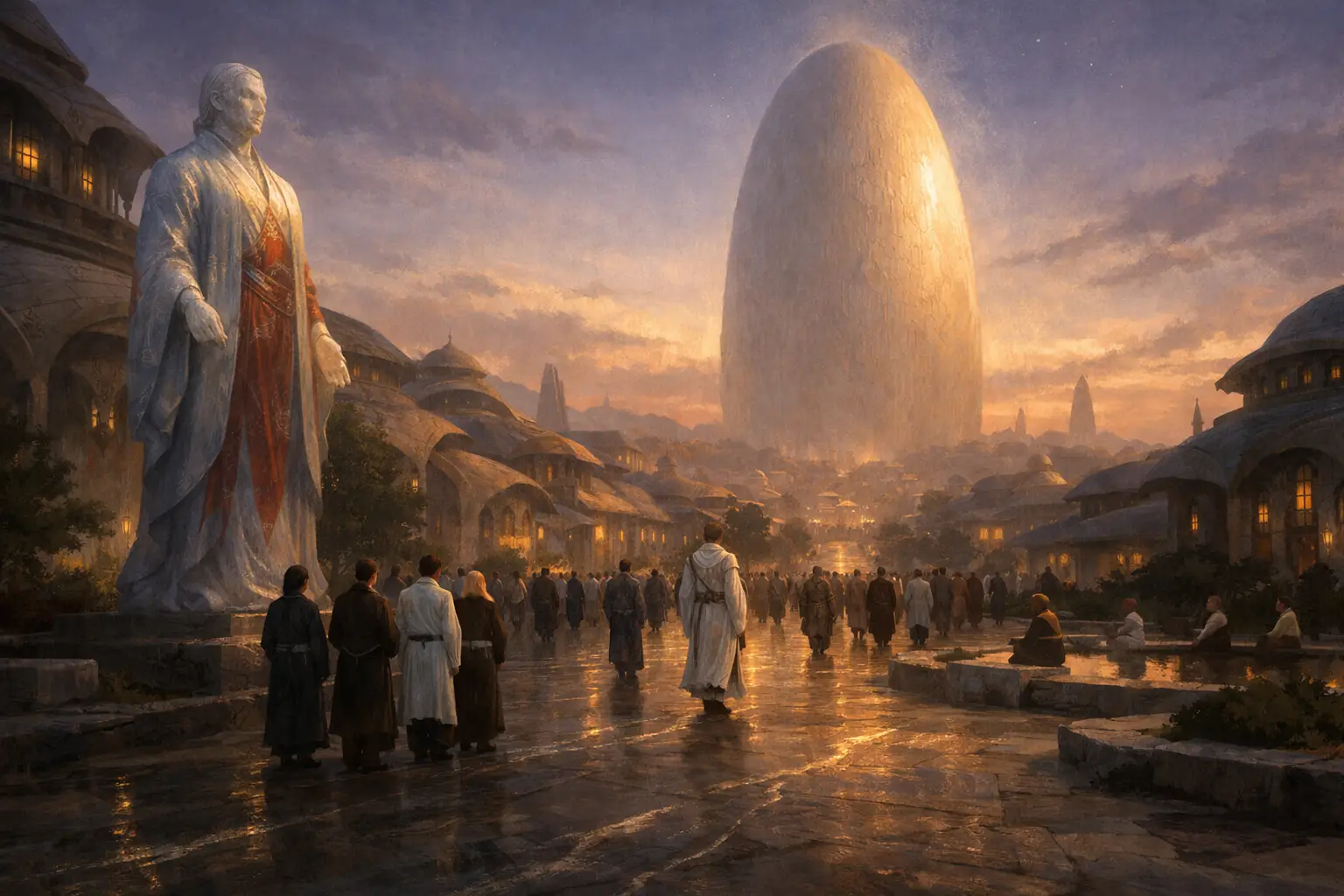
Art & Culture of Sarlona
"I asked a Riedran woman what she did for pleasure. She considered the question for a long time — long enough that I thought she had not understood. Then she said: 'I serve well.' She was not being evasive. She genuinely could not think of another answer." — from a Sivis trade liaison's journal, Dar Jin
Work as Prayer
To understand the culture of Riedra, you must first understand that the Riedrans do not distinguish between work, worship, and daily life. They are the same thing. A farmer tilling a field under the Bountiful Horn is not merely producing food. She is honoring the Inspired, advancing her spiritual evolution along the Path of Inspiration, and contributing to the collective devotion that sustains the Unity. A builder laying crysteel panels under the Sturdy Wall is not merely constructing a building. He is participating in a sacred act — the extension of the Inspired's vision into physical form. When a Riedran invokes the name of an Inspired lord in a moment of difficulty, she is not praying in the way a Thrane prays to the Silver Flame. She is calling on a being she believes is physically present on the same continent, inhabited by a benevolent spirit, who might — if her devotion is sufficient — turn attention to her problem.
This is not faith in the Khorvairian sense. It is closer to the Aereni relationship with the Undying Court — an interaction with something demonstrably real. The Riedrans have seen the Inspired. They have witnessed their beauty, felt the psychic resonance of their presence, experienced the shared dreams the monoliths broadcast. The question of whether the Inspired are what they claim to be does not arise, because the Riedrans have never been given a reason to ask it and the system in which they live provides no framework for asking.
The Path of Inspiration teaches that life is a cycle of reincarnation. Through devotion and service, a soul ascends through successive lives — passing through cycles as beast and human — until it achieves the state of an il-altas, one of the great spirits that guide others toward perfection. The Inspired are believed to be mortals so refined that the il-altas have chosen to inhabit their bodies. To serve the Inspired is therefore to serve the highest expression of spiritual achievement, and to serve well is the surest path to one's own ascension. This belief permeates everything. It explains why Riedrans work without complaint, endure without protest, and accept the absence of luxuries that Khorvairians consider essential to a civilized life. The luxuries are not missing. They were never needed. The work is enough.
The Shape of Devotion
Riedran ceremonial life is structured around communal rituals that reinforce the collective bond between the people and the Inspired. Priests — community leaders selected by the Inspired for their loyalty and devotion — oversee namings, weddings, funerals, and the monthly celebrations of thanks that bring each village together for an hour of hymns, praise, and shared meals. These ceremonies are simple, communal, and serve a dual purpose: binding the community together and focusing the psychic energy that the monoliths collect.
The greatest annual observance is the Feast of the Founding — celebrated on the anniversary of Riedra's unification. The festivities occur within each bastion complex: at dawn, village priests lead processions to the central bastion and to the monolith within it. A lengthy ceremony offers praise to the Inspired for their vision and gratitude for their guidance. Individual worshipers step forward to offer testaments — a sick child who recovered, a failing crop that thrived after the Inspired were invoked. The monolith glows and hums in a low tone throughout the proceedings, and during these moments, the Inspired lord of the region may appear atop a tower, shining with manifested psionic energy and speaking in a voice that carries for miles. The effect on the worshipers is overwhelming — and the question of whether the ecstasy they feel is genuine devotion or psychic resonance from the monolith is one that no Riedran has ever had cause to ask.
"I attended a Feast of the Founding from the walls of the Jhodra. The procession was enormous — tens of thousands of people, moving in silence, their faces calm and purposeful. When the Inspired lord appeared above the monolith, I felt something I can only describe as awe — a physical sensation, like warmth spreading through my chest. I do not know if that was my emotion or his. I still don't." — unsigned letter from a Brelish diplomat, found in a Dark Lantern archive
Clothing and Appearance
Riedran citizens dress in black, white, or brown — simple garments that reflect the Unity's values of purpose and humility. The only adornment is embroidery along the hems, woven in meditative patterns that serve as a form of devotion: the act of stitching the intricate designs is itself a spiritual practice. The patterns are complex but constrained, and their execution is a measure of the wearer's discipline.
The colors blue and red are reserved exclusively for the Inspired, whose robes are covered with labyrinthine patterns of extraordinary intricacy. The Inspired themselves are beings of otherworldly beauty — tall, symmetrical, possessing an almost supernatural grace that sets them apart from the population as visibly as a crown would. When an Inspired walks through a Riedran street, the citizens step aside not out of fear but out of reverence — the way a Thrane might react to the Keeper of the Flame walking past, except that in Riedra, the reaction is involuntary and universal.
Architecture as Ideology
Riedran architecture is the physical expression of the Unity's values: order, purpose, beauty without ostentation, and absolute uniformity. Buildings are curved and whorled — hard angles are few and far between. Streets are paved with smooth black cobblestones interspersed with squares of clear crysteel that glow softly after dark, casting a pale, even light that requires no maintenance and no fuel. Dormitories, workhouses, and storehouses are built from blocks of black and white stone with crysteel skylights. Every dormitory in a bastion city looks exactly the same.
This is deliberate. The architecture teaches that the individual is not the point. The community is the point. The Unity is the point. A Riedran does not express their identity through their living space — they express it through their service, and their service is measured by their devotion, and their devotion is the same as everyone else's. The result is cities that are beautiful in the way a mathematical proof is beautiful: precise, elegant, and entirely without personality.
The exception is the hanbalani monolith — the ovoid silver structure that rises above every major settlement, taller than any other building, visible for miles. The monolith is not merely architecture. It is the sacred center of the community, the "sanctuary of the soul" where spirits await reincarnation, where the shared dreams are broadcast, and where the psychic energy of the faithful is gathered and focused. The monoliths are the most beautiful things in Riedra — luminous, massive, and radiating a calm that visitors describe as either deeply peaceful or deeply wrong, depending on who is doing the describing.
What Is Not There
The most striking feature of Riedran culture is what it lacks. There are no theaters. There is no music performed for entertainment — hymns of praise exist, but they are devotional, not recreational. There is no visual art beyond the embroidery of hems and the labyrinthine patterns on Inspired robes. There are no taverns, no gambling houses, no festivals of excess. There is no alcohol. There is no dreamlily. There are no narcotics of any kind. The Riedrans view such things as symptoms of spiritual corruption — evidence of a civilization that has lost its way and seeks to fill the emptiness with sensation rather than purpose.
Instead, there are gardens of reflection — meditative spaces, usually open-air, where citizens sit in silence and contemplate the Path. There are memorials — installations that share psychic impressions of events, allowing visitors to experience the emotions of a great triumph or a tragic loss directly, without the mediation of language. There are plazas where priests inspire crowds, spaces where soldiers drill or citizens engage in group exercise. Everything serves the Path. Nothing exists for its own sake.
The Culture of Adar
In the mountains of Adar, a different civilization endures — one that resembles Riedra in its discipline but differs from it in every other respect.
The kalashtar follow the Path of Light, a spiritual tradition that teaches that the current age is dominated by a great darkness and that the way to overcome it is through the cultivation of inner light — through kindness, meditation, and the disciplined application of psionic and martial arts. Physical and mental training are forms of prayer. A kalashtar priest conducts services telepathically, using shrines designed to amplify psychic abilities, sharing thoughts and images directly with the congregation. To an outsider, a kalashtar service appears silent and tranquil — dozens of people sitting in a room with their eyes closed, utterly still. To the participants, it is an ecstatic communal experience more vivid than anything words could convey.
The fortress monasteries of Adar are spare, functional, and beautiful in a way that is entirely unlike Riedran beauty. Where Riedran architecture is uniform and imposed from above, Adaran architecture is organic — shaped by the monks and builders of each individual monastery over centuries, reflecting the specific traditions and disciplines practiced within. The corridors are lined with labyrinthine patterns engraved in the floors — aids to walking meditation — and the walls hold crystals that amplify psychic ability. The air is scented with Sarlonan incense. The spaces are open, providing room for the martial arts that are as central to the Path of Light as silent meditation.
The pela — the horned headdress that kalashtar are often depicted wearing — is sculpted from sentira infused with devotion and compassion. Unlike the sentira produced in Riedra, which is generated from the full spectrum of human emotion (including fear, anxiety, and misery), Adaran sentira carries only the emotions the kalashtar consider worthy. The difference is visible: Riedran sentira glows with a cool, neutral light; Adaran sentira has a warmth to it that visitors describe as comforting in a way they cannot fully articulate.
Beyond the Unity
In Syrkarn, culture is survival. The eneko, the scattered humans, and the hidden yuan-ti maintain traditions older than Riedra — fragments of the pre-Sundering kingdoms preserved through oral tradition, ruin-scavenging, and sheer stubbornness. Syrk art is practical: tattoos that mark clan affiliation, weapons decorated with pre-Sundering motifs copied from ruins, and the stories told around campfires in a land where the Thousand Eyes listens but cannot hear everything.
In the Tashana Tundra, the shifter nations — the Chuniigi, the Qiku, and the Saartuk — maintain their own spiritual traditions, tied to the land, the hunt, and the ancestors of their people. The Akiak dwarves preserve the memory of their betrayal in song and stone, carving the names of the dead into the walls of their hidden holds so that the Night of Razor Dreams is never forgotten.
And in the Jhodra of Dar Jin, where Khorvairian merchants drink at dragonmarked-run taverns and Riedran guides smile and offer directions, two civilizations meet and fail to understand each other — the visitors bewildered by the absence of everything they consider normal, the Riedrans bewildered by the visitors' need for things that serve no purpose.
"A Riedran laborer in Dar San told me that he pitied the people of Sharn. I asked him why. He said: 'They have so much, and they are so unhappy. We have nothing, and we are at peace.' I wanted to argue with him. I could not think of a single thing to say." — Caldros ir'Tharn, in a letter to his wife