Economy & Industry of Sarlona
"A Kundarak banker visited Dar Jin to assess the possibility of establishing a branch office. He spent two weeks studying the Riedran economy. When he returned to Krona Peak, his report was three sentences long: 'There is no currency. There is no market. There is nothing for us here.'" — attributed to a Mror trade delegation, circa 985 YK
An Economy Without Money
The economy of Riedra is the largest on Eberron and the most alien. It is a command economy in the purest sense — centrally planned, centrally managed, and centrally directed by the Inspired through the seven branches of the Unity. There is no private enterprise. There are no merchants, no shopkeepers, no artisans selling their wares in market squares. Citizens do not buy food — they receive it. They do not purchase housing — they are assigned it. They do not choose their trade — the Guiding Path, the Unity's education and spiritual direction branch, evaluates every citizen and assigns them the occupation for which they are best suited, the community where they will serve, and in many cases the partner with whom they will be paired. The system is comprehensive, efficient, and leaves almost no economic decision in the hands of the individual.
To a Khorvairian merchant, this is incomprehensible. To a Riedran citizen, the Khorvairian system — where people starve in the streets of Sharn while food rots in warehouses because the poor cannot afford it — is equally incomprehensible. Both sides consider the other's approach to be barbaric. The Riedrans may have the stronger argument.
The Branches as Economic Engines
The Unity's seven branches are not merely government departments. They are the entire economy. Each branch manages a sector of production, distribution, and maintenance, and together they constitute a system that has sustained a continent-spanning nation for over a thousand years without market mechanisms, currency exchange, or significant internal trade.
The Bountiful Horn manages agriculture, food supply, and logistics. Thanks to the tireless labor of its farmers — and the manifest zones of Corvagura, whose Lammannian influence grants the region an almost supernatural fertility — no Riedran citizen goes hungry. Food is grown, processed, and distributed through the Unity's supply chain with an efficiency that the Five Nations, with their dragonmarked houses and lightning rails, have never matched. The Bountiful Horn does not sell food. It allocates it.
The Industrious Forge manages all industry — mining, manufacturing, and the extraction and distribution of raw materials. Riedran industry is not mechanized in the Cannith sense; there are no creation forges, no assembly lines, no arcane factories. Instead, the Forge relies on human labor organized with military precision, augmented by psionic tools and techniques that have no equivalent in Khorvaire. Workers do not earn wages. They contribute, and the Unity provides.
The Sturdy Wall builds and maintains infrastructure — from the dormitories and workhouses of every village to the bastion cities and, most critically, the hanbalani monoliths that rise above every major population center. Construction in Riedra is a matter of civic pride: every Riedran who serves under the Wall's leadership understands that they are building the monuments that sustain the Unity's spiritual foundation.
The remaining branches — the Healing Hand (healthcare), the Sheltering Hearth (housing, sanitation, community maintenance), the Guiding Path (education and spiritual direction), and the Iron Gate (law and foreign affairs) — complete the system. Together, the seven branches handle every function that market economies distribute among thousands of independent actors. The result is a society where no one is wealthy and no one is poor, where production matches need with remarkable precision, and where the concept of economic competition does not exist because the system has no mechanism for it.
POSTED IN A CORVAGURAN VILLAGE DORMITORY — in Riedran, translated
Morning assignments for the third tuern of the season: Field crews report to the Horn overseer at dawn. Forge detail continues repairs on the eastern irrigation channel. All citizens are reminded that the evening meditation is mandatory and that the garden of reflection will close at sunset for maintenance.
The Path provides. The Inspired guide.
Psionic Materials
Riedra's most distinctive products — and its primary exports — are materials that Khorvaire cannot produce.
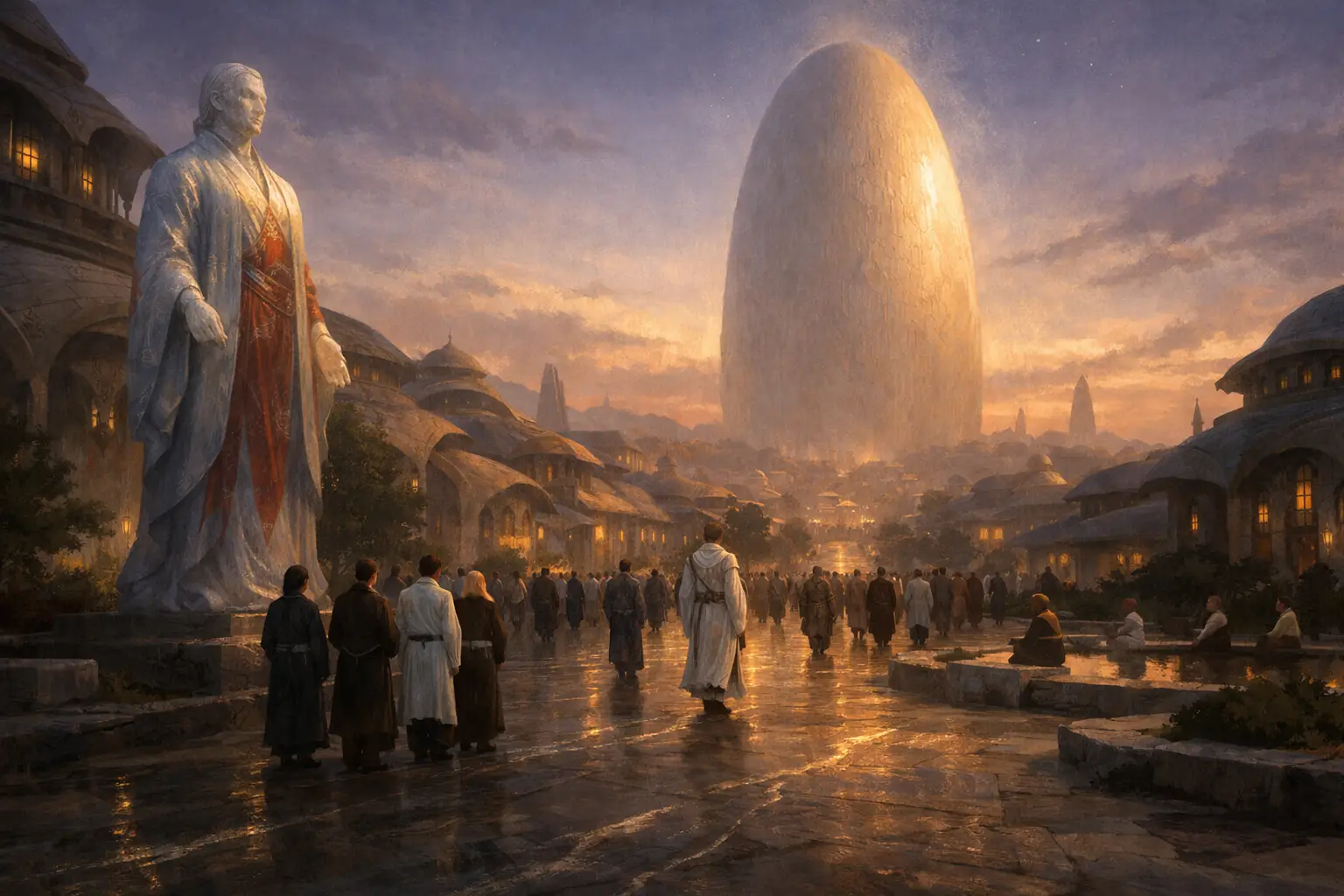
Sentira is a crystal that absorbs and stores emotional energy. It is the signature material of Riedran civilization, used in everything from weapons and armor to architecture and art. A sentira blade responds to the wielder's emotional state, growing sharper or more dangerous when the wielder is focused. Sentira panels in buildings can project feelings of calm, awe, or devotion onto anyone in proximity — and the statues of the Inspired that stand in every bastion plaza radiate reverence that visitors cannot distinguish from their own genuine feelings. Sentira is produced through a process that requires sustained emotional energy; the specific emotions used determine the crystal's properties. Tranquility sentira is common and relatively easy to produce. Fear sentira and hate sentira are rarer and more disturbing to contemplate — because the emotions must be genuine and sustained, not artificially induced. The Adarans also work with sentira, but in far smaller quantities and with very different emotional inputs.
Crysteel is a clear, glass-like crystal that serves as Riedra's primary building material alongside stone. It functions as skylights during the day and glows with a soft light after dark, illuminating Riedran streets with a pale, even radiance that requires no torches, no everbright lanterns, and no maintenance. Crysteel is also used for vaults and secure storage — its properties include a resistance to magical manipulation that makes it valuable for containing sensitive materials.
Deep crystal is mined primarily in Xen'drik, at the Riedran colony of Dar Qat on the western coast of that continent. Deep crystal amplifies psionic power and is a critical component of Riedran infrastructure — from the monoliths to the telepathic communication systems that allow the Inspired to coordinate across the breadth of a continent.
Information storage throughout the Unity relies on crystal repositories — systems similar to the spellshards used in Khorvaire but designed for psionic rather than arcane access. Administrative centers maintain large crystal archives managed by psychic constructs that can retrieve records from across the entire network. The system is faster and more comprehensive than anything the Five Nations have built, and it operates entirely without paper.
Trade with Khorvaire
Riedra's foreign trade is controlled entirely by the Iron Gate and conducted exclusively through Dar Jin, the great port on the eastern coast. A second, smaller port at Dar Ulatesh accepts limited traffic. No other entry point exists for foreign merchants.
Riedran exports include crysteel, sentira, textiles, and psionically crafted materials that have no equivalent in the Five Nations. These goods are high quality — Riedran craftsmanship, while different in character from Aereni artisanship or Cannith industrial production, is precise, consistent, and backed by techniques that Khorvairian artificers cannot replicate. Riedran imports are modest: the Unity is largely self-sufficient, but it accepts raw materials, luxury goods, and — most importantly — intelligence about the world beyond its borders.
During the Last War, Riedra was a surprisingly generous trading partner. It provided food aid to Karrnath during the famines that nearly broke that nation. It offered materials and diplomatic support to Aundair. It established a treaty with Q'barra, providing troops and advisors to help King Sebastes maintain order. In every case, the Riedrans asked for little in return — trade access, diplomatic recognition, and the goodwill of nations that were too desperate to question the motives of a benefactor.
In Sharn, a small Riedran community called Dar San — "Far Port" — occupies a few warehouses in the Precarious district of Lower Dura. Riedran merchants and laborers live there in conditions most Khorvairians would consider squalid, but the Riedrans are a proud people who consider the lowliest laborer of the Unity to be the equal of any Khorvairian duke. They observe a strict social hierarchy among themselves, treat any visiting Inspired as divine royalty, and maintain an irrational hatred of kalashtar. They do not drink alcohol. They do not use dreamlily. They view such behavior as evidence of the corruption that grips Khorvaire.
"I tried to buy a bolt of Riedran silk from a merchant in Dar San. He quoted me a price, took my gold, and handed me the silk without a word. I asked if he wanted to negotiate. He looked at me as though I had asked him to spit on a temple floor. 'The price,' he said, 'is the price.'" — Zil textile buyer, in a letter to her factor in Trolanport
The Economies Outside the Unity
Sarlona is not only Riedra. The regions beyond the Unity's control operate on entirely different principles.
Adar sustains itself through subsistence agriculture in mountain valleys, supplemented by the remarkable martial and psionic disciplines of the kalashtar monasteries. The Adarans produce sentira in small quantities — notably the pela, the horned headdresses that kalashtar are often depicted wearing, sculpted from sentira infused with devotion rather than the emotions the Inspired prefer. Adar has almost no trade with the outside world. Direct travel between Adar and Khorvaire is extraordinarily difficult, and the Adarans have little interest in commerce. What they produce, they use. What they need, they grow. The fortress monasteries are self-sufficient because they have had a thousand years to learn how.
Syrkarn is the one place on Sarlona where something resembling a market economy exists — and it is chaotic, unregulated, and frequently dangerous. The eneko trade in relics scavenged from pre-Sundering ruins, in livestock, and in the raw materials of the desert. Yuan-ti communities that have survived the Inspired's purges trade in psionic artifacts and forbidden knowledge. Syrk merchants occasionally cross into Riedran border provinces, tolerated because they provide goods the Unity does not produce and because the Thousand Eyes finds them useful as unwitting sources of intelligence. The economy of Syrkarn is the economy of a frontier: barter, reputation, and the understanding that a deal is only as good as the parties' willingness to enforce it.
The Tashana Tundra has no economy in any formal sense. The shifter nations — the Chuniigi, the Qiku, and the Saartuk — live by hunting, fishing, and the seasonal migrations that have sustained them since before the Sundering. The Akiak dwarves, fighting their guerrilla war from the Frostblade Mountains, survive on what they can take from sealed Riedran supply lines and what they can produce in the hidden forges of their remaining holds.