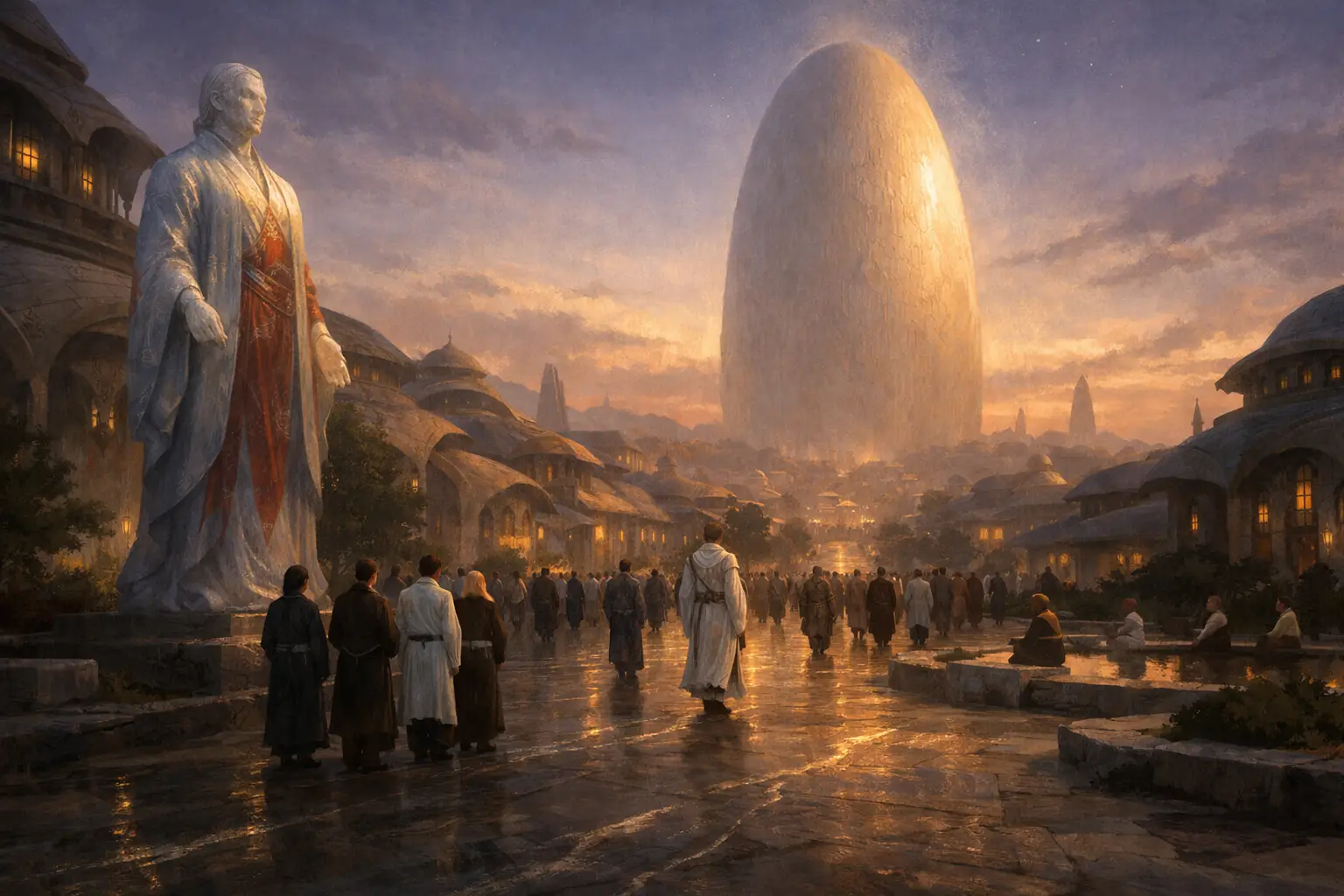
History of Sarlona
"Sarlona is the oldest continent. Not geologically — Argonnessen holds that distinction — but in the way that matters to the people who live there. Sarlona is where humanity learned to speak, to pray, to kill, and to build. Everything Khorvaire has done, Sarlona did first. And then Sarlona forgot." — Professor Danarath ir'Lain, University of Wynarn
The history of Sarlona is, for all practical purposes, the history of humanity — and it is almost entirely lost. The Inspired who rule the continent have spent over a thousand years systematically erasing the cultures, traditions, and memories of the civilizations that came before them. The old names survive as province labels on Riedran maps, stripped of their meaning. The old faiths survive as fragments carried to Khorvaire by refugees who did not fully understand what they were preserving. The old ruins survive because even the Inspired cannot unmake stone — but the Edgewalkers patrol them, the Thousand Eyes watch anyone who shows too much interest, and the histories that would explain what stood there have been burned, suppressed, or replaced by the sanitized narratives of the Path of Inspiration.
What follows is assembled from Korranberg scholarship, Morgrave expedition reports, kalashtar oral tradition, and the fragmentary accounts of Adar's fortress monasteries — the last institutions on Sarlona that remember the old world and refuse to forget it. It is incomplete. It is probably wrong in places. The Inspired would prefer it did not exist at all.
Before the Kingdoms
Long before humanity, Sarlona belonged to other powers. Echoes of lore older than any human civilization describe the continent as a couatl stronghold during the Age of Demons — and some scholars believe Sarlona may have been the birthplace of that noble race. Couatl ruins still dot the islands of Aventus, the steppes of Syrkarn, and the Riedran province of Khalesh. The dragons of Argonnessen, who took an active interest in Xen'drik and Khorvaire, appear to have largely ignored Sarlona for reasons that no one has been able to explain. Even today, the dragons shun the continent, treating it as a blind spot in the Draconic Prophecy — a gap in the pattern that the most obsessive students of the Prophecy find deeply troubling.
When humanity arose on Sarlona, it arose in the shadow of the planes. The continent lies closer to the outer planes than any other landmass on Eberron, and this proximity shaped everything that followed. The manifest zones determined where cities could be built, which forms of magic flourished, and which faiths took root. The wild zones — pockets where another plane projects directly into the material world — created regions of alien beauty and devastating danger. The reality storms that swept across the landscape ensured that no kingdom could ever fully tame its environment. Sarlona was always a place where the boundaries between worlds were thin, and the people who grew up there learned to live with that thinness in ways that the people of Khorvaire never had to.
The Age of the Kingdoms
At its height, Sarlona was home to more than a dozen independent kingdoms — each shaped by the planar energies of its region, each developing its own approach to magic, faith, war, and governance. These were not primitive settlements. They were sophisticated civilizations with sorcerers, divine champions, arcane institutions, and traditions of extraordinary depth. The fact that so little of this sophistication survived the crossing to Khorvaire is a measure of how thoroughly the Sundering destroyed the world that produced it — and how thoroughly the Inspired have buried what remained.
Corvagura was the wealthiest and most fertile region, shaped by the influences of Lamannia, Mabar, and Thelanis. Lamannia's primal energy gave the land an almost unnatural fecundity, while the influences of the other planes manifested in two powerful houses of human sorcerers. The House of the Sun drew power from Thelanis — wild magic that tended toward fey glamour and glory, twisting thoughts and emotions or striking down foes with bolts of flame. The House of the Moon drew from Mabar — shadow magic of concealment, fear, and death. Together, the two houses forged a nation from the city-states of the region and ruled it through sorcerous power for centuries. Their rivalry — Sun against Moon, light against shadow, Thelanis against Mabar — defined Corvaguran politics and produced both wonders and atrocities. Today, Corvagura is the heart of Riedra, home to Dar Jin and Durat Tal, with more hanbalani monoliths than any other province.
Nulakesh was the largest and most powerful of the old kingdoms — an empire that, at its height, dominated much of what is now Pyrine and Dor Maleer. Shaped by the planar influences of Daanvi (order) and Shavarath (war), the Nulakeshi possessed an innate aptitude for martial discipline and a genius for military conquest that was all too often wielded by tyrants. The ancient capital of Nulakar was built in a manifest zone tied to Daanvi's Iron Ward, and accounts suggest that more than one devil passed between the planes to serve as advisor to the Nulakeshi emperors. The empire waxed and waned many times over the centuries, conquering its neighbors and collapsing from within in a cycle that repeated until the Sundering broke it for good. The military traditions of Nulakesh did not die — they crossed the ocean with the settlers and took root in the city-state of Korth, becoming the foundation of the discipline that defines modern Karrnath.
Khalesh was a theocracy devoted to the couatl and the Silver Flame — a faith far older than the Church of Thrane and far deeper in its understanding of the Flame's nature. The Khaleshites were guided by the shulassakar, serpentine beings who served as the secret spiritual leaders of the land. Shaped by the influence of Irian and the Silver Flame, Khalesh was a nation of holy warriors, divine champions, and sacred sites that dated from the Age of Demons itself. The Khaleshites may have known things about the Silver Flame that the modern Church has never recovered. Today, the people of Khalesh are among the most devout followers of the Path of Inspiration, taught that their ancestors were corrupted by demons and that the ruins of the old faith are places of evil to be avoided.
Ohr Kaluun occupied an archipelago off the eastern coast and was the most feared of the old kingdoms. Its lords were driven by paranoia and an all-consuming thirst for power. They studied the darkest paths of magic and bargained with fiends, warping their bodies through mystical rituals and pacts. The sages of Ohr Kaluun created the first changelings through the epic magic of their lord Jes, and they built war mazes — fortified labyrinths of arcane traps that still stand in ruin, fiend-haunted and lethal to anyone foolish enough to enter. Ohr Kaluun was ultimately consumed by the feuds of its paranoid mage-lords and the crusading legions of its neighbors, and scholars consider it the one kingdom whose destruction may have been deserved.
Pyrine was the birthplace of the Pyrinean Creed — the faith that crossed the ocean and became the worship of the Sovereign Host. Most followers of the Host in the Five Nations know the name "Pyrinean Creed" but very few know that it refers to an actual nation that once existed on Sarlona, with temples and priests and traditions that the modern Church of the Sovereign Host has never recovered. The old Pyrinean practices included divine techniques — specific prayers, invocations, and rituals — that may have been more powerful than anything available to modern clerics.
Borunan was a nation of ogres and their kin — not the brutish savages the Five Nations imagine, but mighty warriors who fought alongside angels in an endless struggle against devils. The center of Borunan contains a wild zone to Shavarath where a fragment of the Eternal Battleground extends directly into the material world, and the ogres devoted their civilization to holding that line. The Inspired have largely subdued the people of Borunan, but the Horned Shadow — a resistance movement led by oni — fights back using the same martial traditions their ancestors practiced.
Rhiavhaar occupied the southeastern coast — a land of coastal reavers, pirates, and clan feuds. The Rhiavhaarans were the people who first crossed the ocean to Khorvaire, not as noble explorers but as pirates who had heard there was profit on the far shore. Lhazaar herself was Rhiavhaaran, and her lieutenant Malleon the Reaver earned his name. The settlers who followed were outlaws, renegades, and refugees — not the paragons of their civilization but its outcasts, carrying fragments of culture and half-remembered traditions to a new land where they would have to reinvent everything from scratch.
Dor Maleer was a land of harsh plains and cold deserts, home to the Hual Maleer (a loose federation of human and shifter clans) and the Akiak (a noble nation of dwarves and duergar in the northern mountains). The Akiak were master psionicists who pioneered techniques of psionic engineering that would later be co-opted by the Inspired to build the hanbalani monoliths and other elements of Riedran infrastructure. Khunan was a human nation that was devastated during the Sundering; from its ruins, the yuan-ti rose and established the nation of Syrkarn.
"Most followers of the Sovereign Host in the Five Nations know that their faith is the Pyrinean Creed. Very few know that this means it originated in a Sarlonan nation called Pyrine — a nation whose temples and traditions have been erased from history. The Inspired do not merely suppress the past. They replace it. And what they replace it with fits so neatly into the present that most people never notice anything is missing." — unsigned margin note, found in a Korranberg Library acquisition from Dar Jin
The Sundering (~–1,600 to –1,400 YK)
The catastrophe that destroyed the old kingdoms is called the Sundering, and it lasted approximately two hundred years. What began it is a matter of bitter scholarly debate. What is not debated is what it looked like: a continent-wide eruption of wars, riots, betrayals, and atrocities that shattered every kingdom on Sarlona and killed a significant portion of its population.
The kalashtar — who have their own account of these events — claim that the Sundering was deliberately engineered by forces from beyond the material plane, using infiltration, psionic manipulation, and the amplification of existing tensions to drive the kingdoms against each other. The Inspired's own histories describe the period as a natural consequence of the old kingdoms' corruption, decadence, and spiritual blindness — a time of justified collapse that created the conditions for a better world.
What is visible in the surviving accounts is this: the Sundering did not begin as a single war. It began as dozens of separate conflicts, each of which seemed to have its own local cause, but which somehow escalated simultaneously across the entire continent. The Empire of Nulakesh, at a low point in its cycle, was suddenly fired with imperial ambition and launched campaigns of reconquest against its neighbors. Corvagura's rival sorcerous houses turned on each other with unprecedented ferocity. Khalesh was betrayed — its shulassakar leaders exposed, accused of being serpent-creatures in league with evil, and hunted by the combined forces of Nulakesh and Corvagura. Rhiavhaar's clan feuds intensified until the coastal nation consumed itself. Ohr Kaluun's paranoid lords retreated into their war mazes and were never seen again. And in every kingdom, in every city, in every court, there appeared champions of extraordinary psionic power who offered peace, order, and salvation — if the people would only follow them.
The pattern is clear to scholars who study it in retrospect. It is invisible to anyone living inside it.
The Sundering produced two great exoduses from Sarlona. The first was the wave of refugees who fled to Khorvaire — landing in the Shadow Marches, the Demon Wastes, and the western coast, bringing with them fragments of Sarlonan culture that would eventually reshape the continent they settled. Tiefling and human refugees from the Sundering established the Venomous Demesne in what is now Droaam. The second exodus was internal: survivors fleeing the lowlands for the mountains of Adar, where the terrain was impassable and the psionic champions of the lowlands could not follow — or, more precisely, could not project their power through the mountains' natural defenses.
The Rise of the Inspired (~–1,400 to –1,200 YK)
From the chaos of the Sundering, the Inspired emerged. They presented themselves as saviors — mortals of otherworldly beauty and extraordinary psionic power who offered to unite the shattered nations under a single banner of peace, order, and spiritual advancement. They spoke of a path that would lead humanity beyond the cycle of war and suffering, a path guided by benevolent spirits who had chosen to inhabit their bodies and lead the faithful toward perfection.
The broken, exhausted, traumatized populations of the lowlands accepted. They had been fighting for two centuries. Their kingdoms were rubble. Their leaders were dead or discredited. The Inspired offered food, shelter, order, and an explanation for the suffering — that the old kingdoms had been corrupt, that the old faiths had been misguided, and that the Path of Inspiration was the way forward. For people who had lost everything, this was enough.
The Unification took roughly two centuries more. The Inspired consolidated province by province, absorbing the remnants of each fallen kingdom into the Unity of Riedra. The process was not entirely peaceful — resistance persisted in Borunan, where the ogres fought back, and in Dor Maleer, where the Akiak dwarves initially cooperated before being betrayed. The Akiak's psionic techniques were used to construct the hanbalani monoliths that would become the backbone of Riedran infrastructure. When the monoliths were built and the dwarves had served their purpose, the Inspired launched a devastating preemptive strike — the Night of Razor Dreams — that shattered the Akiak nation and drove the survivors into guerrilla warfare in the Frostblade Mountains.
Syrkarn was never fully incorporated. The Inspired purged the yuan-ti, ordered the human population to evacuate, and declared the region a protectorate — but never occupied it. Why the Inspired chose to leave Syrkarn alone when they absorbed every other fallen kingdom is a question that has no satisfying answer.
The Kalashtar and Adar (~–1,800 YK onward)
The arrival of the kalashtar on Sarlona predates the Sundering by approximately two hundred years — and some scholars believe it is not a coincidence.
Around –1,800 YK, Adaran monks became voluntary vessels for spirits that claimed to be refugees from a conflict beyond the material plane. The merger of human and spirit created the kalashtar — a new people who possessed innate psionic abilities and a connection to a spiritual tradition they called the Path of Light. The kalashtar settled in the mountain monasteries of Adar and began building a civilization devoted to meditation, martial discipline, and resistance to forces they said were working to reshape the world from within.
When the Sundering began, the kalashtar warned that the conflicts were not natural — that something was manipulating the kingdoms from behind, engineering the collapse for purposes the mortal nations could not see. They were not believed. They were, in fact, accused of being part of the problem — the Inspired specifically targeted the kalashtar as heretics whose dangerous spiritual practices had contributed to the Sundering.
The fortress monasteries of Adar became the last redoubt of everyone who refused the Inspired's offer: kalashtar, human dissidents, shulassakar survivors from Khalesh, and anyone else who could reach the mountains before the Unity closed the borders. The Inspired have been besieging Adar for over a thousand years. The mountains have not fallen.
The Long Unity (~–1,200 YK to Present)
Riedra has been stable for over a thousand years — longer than the Kingdom of Galifar lasted, longer than any nation in Khorvaire has managed. The Inspired have eliminated poverty, hunger, crime, and war within their borders. They have built a civilization of bastion cities linked by teleportation circles, governed by a bureaucracy of seven branches, sustained by a faith that teaches reincarnation and spiritual evolution, and unified by shared dreams broadcast through monoliths that rise above every city.
They have also systematically erased the history, the faiths, the traditions, and the cultures of every kingdom that came before them. The old names are province labels. The old religions are heresies. The old ruins are forbidden zones patrolled by the Edgewalkers. The old stories are crimes — the Thousand Eyes watches anyone who tells them.
In the year –3,000 YK, Lhazaar led the first wave of Sarlonan settlers to Khorvaire. In the sixteen centuries since the Sundering, no wave of settlers has returned. The Riedrans do not leave. The Inspired do not encourage curiosity about what lies beyond the sea. And the monoliths broadcast the same shared dreams every night, reminding every citizen that the Path provides, the Inspired guide, and all is well.
The people of Riedra believe this. They believe it completely. Whether they believe it because it is true, or because the monoliths have been telling them to believe it every night for a thousand years, is a question that no Riedran has ever asked — and that the Inspired would prefer no one else asks either.
"The worst thing about Sarlona is not what has been done to it. The worst thing is that it worked. The people are happy. The system functions. The old kingdoms are gone and no one mourns them. If you are looking for a villain, you will not find one — only a continent of content people who dream the same dreams and never wonder why." — Caldros ir'Tharn, in a letter never sent