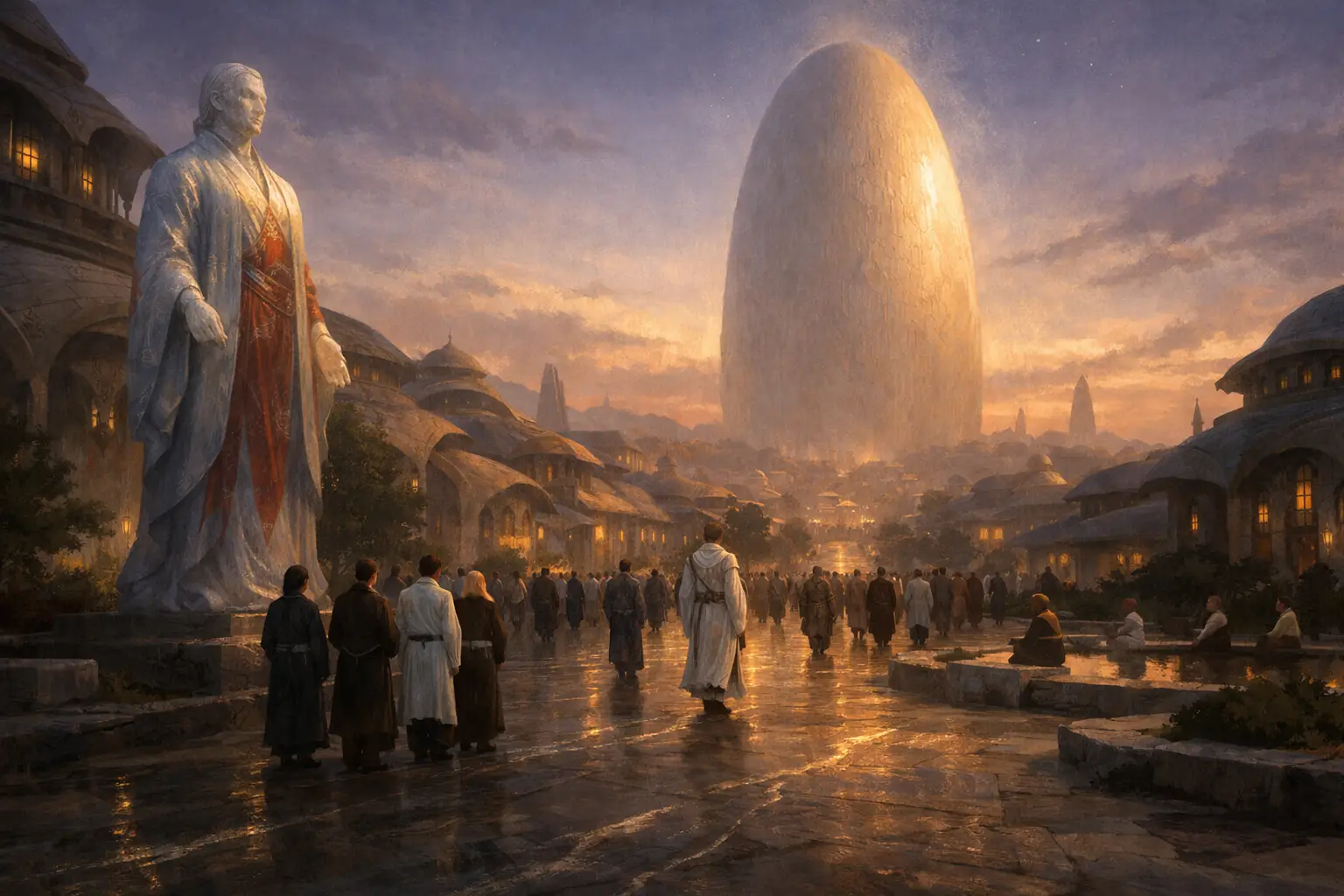
Politics & Government of Sarlona
"A Brelish parliamentarian asked me how Riedra's government works. I told her: the Inspired rule. There is no parliament. There is no opposition. There are no elections. There is no dissent. She asked how that was possible. I said: everyone agrees. She asked how that was possible. I said: I don't know. That is the most honest thing I have ever said about Sarlona." — Caldros ir'Tharn, Brelish merchant-captain
The Inspired Rule
The political structure of Sarlona is, on paper, the simplest of any nation on Eberron. The Inspired rule. Everyone else serves. There is no competing authority, no rival institution, no separation of powers, and no mechanism for changing the government. The Inspired are not elected, appointed, or inherited. They simply are — mortals of otherworldly beauty and extraordinary psionic power who claim to be vessels of benevolent spirits, and who have governed the Unity of Riedra for over a thousand years without interruption, challenge, or any apparent desire on the part of the governed to change the arrangement.
A powerful Inspired lord rules each bastion city — the fortified urban centers that anchor Riedra's eight provinces. Beneath each lord, lesser Inspired serve as generals, ambassadors, inquisitors, and high ministers. The Inspired do not follow a single monarch or emperor; they operate as a hierarchy of peers, some with more authority than others, none claiming absolute supremacy over the whole. The administrative capital at Durat Tal houses the hub of the teleportation circle network and coordinates the bureaucracy, but it is not a throne city in the way that Wroat or Korth is. There is no individual at the top. There is only the system, and the system runs itself.
Beneath the Inspired stand the Chosen — humans who have been bred, over centuries, to serve as vessels for the spirits the Inspired embody. Each Chosen family is linked to a specific spirit, and the honor of being selected for inhabitation is the highest aspiration a Riedran can achieve. The Chosen manage the bulk of day-to-day administration: governing villages, commanding military units, overseeing production, maintaining records. The most trusted Chosen are those who have served as active Inspired — whose spirits have since moved on to other hosts — and whose decades of inhabitation have shaped their minds and loyalties so thoroughly that they are, for all practical purposes, indistinguishable from the Inspired themselves. These former vessels hold the most sensitive administrative positions, and the system's stability rests on their competence.
The common citizens of Riedra serve in one of the seven branches of the Unity or in one of the security services. There is no merchant class, no independent artisan guild, no free press, no civil society outside the Unity's structure. Every citizen is assigned a trade and a partner by the Guiding Path — the branch responsible for education and spiritual direction — and they perform that trade for the rest of their lives. This is not experienced as oppression. It is experienced as purpose.
"The Guiding Path carefully chooses the trade and pairing of every citizen to ensure they can contribute best to their nation. A Riedran does not choose their work. Their work is chosen for them, and they are grateful, because the Inspired know what is best." — from an Iron Gate diplomatic briefing provided to Khorvairian trade delegations at Dar Jin
The Instruments of Control
The Unity's seven branches — Bountiful Horn, Industrious Forge, Sturdy Wall, Healing Hand, Sheltering Hearth, Guiding Path, and Iron Gate — administer daily life. But administration is not the same as control. Control belongs to three other institutions, each operating outside the Unity's structure and answering directly to the Inspired.
The Harmonious Shield is the military. Its forces include standard infantry organized by province — Nulakesh provides the bulk of the soldiers, reflecting the province's ancient martial traditions — as well as specialized units. Fire Soldiers are fast, skilled operatives deployed against Adar. Water Soldiers are scouts and reconnaissance specialists. The Horned Guard is an elite corps of oni — ogre mages — who serve as shock troops and personal bodyguards to the Inspired. The Taskaan Legion and Savage Legion are composed of shifters, who occupy a subordinate position in Riedran society and are considered spiritually inferior by the Path of Inspiration but physically useful. The Harmonious Sail patrols the coasts and inland seas.
The Thousand Eyes is the intelligence and surveillance service. Its agents are embedded throughout Riedran society — in villages, in bastion cities, in the Jhodra, and beyond Sarlona's borders. They monitor for dissent, heresy, unauthorized contact with foreigners, and any behavior that deviates from the patterns the Unity expects. The Thousand Eyes employs psionic techniques for surveillance, interrogation, and — when necessary — the quiet disappearance of individuals who have become problems. In the bastion cities, the Bastion Guard serves as the Thousand Eyes' enforcement arm. Crime is almost nonexistent in Riedra — in part because most citizens have little to steal, and in part because the consequences of deviance are swift, certain, and administered by agents whose psionic abilities make concealment extraordinarily difficult.
The Edgewalkers are an elite order tasked with patrolling the borders of wild zones and manifest zones across Riedra. Their official mandate is to protect citizens from extraplanar threats — and many wild zones do contain genuine dangers. But the Edgewalkers also ensure that no one uses the zones as the old kingdoms once did, and that no citizen is influenced by the planar energies in ways that might undermine the Path of Inspiration.
The Sleeping Sword is unknown to most Riedrans. Its agents are utterly loyal, amazingly skilled, and charged with tasks that require both ruthlessness and discretion. What those tasks are, the Unity does not discuss.
The Monoliths
The hanbalani altas — the silver monoliths that rise above every bastion city — are the most important political institution in Riedra, though most outsiders do not recognize them as such.
The monoliths serve multiple functions simultaneously. They are sacred monuments where citizens worship and offer prayers. They store psionic energy generated by the devotion of the surrounding population. They broadcast the shared dreams that every Riedran citizen experiences each night — the Voice, a telepathic channel that delivers news, guidance, and spiritual instruction from the Inspired. They generate the power that fuels the teleportation circles linking the bastion cities. And they project a field that blocks all attempts to scry into Riedra from outside, shielding the empire from the magical surveillance that intelligence agencies in Khorvaire might otherwise employ.
The Riedrans do not think of dreams as a source of inspiration or creativity. They think of dreams the way a Khorvairian thinks of the morning newspaper: a reliable source of information that everyone receives and that establishes the shared reality of the community. The monoliths ensure that every citizen within range dreams the same dream. This is the foundation of Riedra's unity — not coercion, not military force, but a shared experience of reality so complete that the concept of disagreement barely exists. A citizen who stops receiving the shared dreams — who begins dreaming on their own — has stepped outside the consensus. The Thousand Eyes watches for such people.
NOTICE — inscribed on a plaque at the base of the Dar Jin hanbalani, in Riedran
This sanctuary holds the spirits of those who have walked the Path before us. Through their sacrifice and our devotion, the Unity endures. Offer your prayers. Open your heart. The il-altas receive all who walk in harmony.
Unauthorized meditation within fifty paces of the sanctuary is forbidden.
The Provinces
Riedra's eight provinces — Corvagura, Nulakesh, Khalesh, Pyrine, Borunan, Ohr Kaluun, Rhiavhaar, and Dor Maleer — retain the names of the fallen kingdoms but little else. The Inspired actively discourage provincial nationalism, and the homogenizing effect of the shared dreams, the common architecture, the identical dormitories, and the uniform devotion to the Path has been grinding down regional identity for a thousand years.
It has not entirely succeeded. Nulakesh still produces the best soldiers. Corvagura is still the most loyal — and the most closely monitored. Dor Maleer, sparse and remote, has fewer monoliths and weaker coverage by the Voice, which makes its villages the most independent-minded in Riedra and the most likely to shelter dissidents. Ohr Kaluun's ruined war mazes still attract forbidden curiosity. And in Borunan, where the wild zone to Shavarath's Eternal Battleground still extends into the material world, the Horned Shadow — a resistance movement led by oni — fights back against the Inspired using the same traditions the ogre warriors practiced before the Unity existed.
The Dissidents
Dissent in Riedra is not a political movement. It is a psychiatric event. A citizen who questions the Inspired is not exercising free thought — they are experiencing a spiritual crisis, and the Guiding Path will help them return to the correct state of mind. If the Guiding Path cannot help, the Thousand Eyes will.
Nevertheless, dissidents exist. The Broken Throne are monarchists who dream of restoring the old kingdoms. The Dream Merchants are smugglers and black-market traders who exploit the gaps in the Unity's total control. The Unchained are the most philosophically radical — Riedrans who have discovered the practice of free dreaming, sleeping outside the monoliths' range and experiencing their own unmediated dreams for the first time. The experience is, by all accounts, terrifying and transformative. A Riedran who has never had a nightmare does not know what their own unconscious mind looks like — and the discovery that the mind contains things the Voice never mentioned is enough to shatter a lifetime of certainty.
The Heirs of Ohr Kaluun pursue the forbidden arcane traditions of the island kingdom, seeking power in the war mazes that the Edgewalkers patrol. And in Borunan, the Horned Shadow wages guerrilla war with a ferocity that the Harmonious Shield has not been able to suppress.
These movements are small, scattered, and unable to coordinate across provinces — which is, of course, exactly how the system is designed. The monoliths control communication. The teleportation circles control movement. The Thousand Eyes controls information. A rebellion that cannot communicate, cannot travel, and cannot organize is a rebellion that exists only as isolated acts of individual desperation. The Inspired have had over a thousand years to perfect this arrangement. It works.
Beyond Riedra
Adar is the one place on Sarlona where the Inspired's authority does not reach. The fortress monasteries of the kalashtar have held against Riedran assault for over a thousand years, defended by the Shroud of Adar — a psionic barrier that blocks the Inspired's ability to project power into the mountains — and by the extraordinary martial and psychic disciplines of the Adaran monks. The Inspired have drilled fanatical hatred of the kalashtar into the Riedran population. The typical Riedran farmer believes that if the Harmonious Shield relaxed its guard, the kalashtar would destroy the Inspired and lay waste to the nation. The siege continues. The monasteries hold.
Syrkarn is a protectorate in name only — a lawless frontier that the Inspired claim but do not govern. The eneko, the yuan-ti survivors, and the scattered human nomads of Syrkarn operate outside the Unity's structure entirely. Thousand Eyes agents infiltrate the region, but they cannot dominate it.
The Tashana Tundra belongs to the shifter nations and the Akiak remnants. The shifters' independence is tolerated because the cost of suppression exceeds its value. The Akiak's guerrilla war is a permanent irritant that the Harmonious Shield contains but cannot end.
Foreign Relations
Riedra's foreign policy toward Khorvaire is courteous, generous, and deeply unsettling to anyone paying close attention.
Inspired ambassadors attend every major court in the Five Nations. Riedran goods — crysteel, sentira, textiles, psionically crafted materials — flow through Dar Jin to Khorvaire's markets. During the Last War, Riedra offered aid to multiple nations: Karrnath received Riedran grain during its worst famines, Aundair accepted Riedran support, and Q'barra has formally accepted Riedran military assistance — the Harmonious Shield maintains garrisons around Newthrone, and rumors suggest construction has begun on a hanbalani monolith in Q'barran territory. Small Riedran communities have established themselves in port cities across Khorvaire, and the sale of dreamlily — a Riedran narcotic — has become a major industry in the underworld of Sharn and beyond.
Riedra has never attacked Khorvaire. It has never threatened anyone. It has only ever helped. The kalashtar insist this is the most dangerous thing about it.
"If you are Kaius of Karrnath, who do you trust — the kalashtar refugees spouting conspiracy theories about your most reliable trade partner, or the Inspired ambassador offering thousands of tons of grain to feed your starving people? The answer is obvious. The answer has always been obvious. And that is precisely the problem." — attributed to an Adaran diplomat, speaking to no one who would listen