The Draconic Prophecy
The map to the maze
EXCERPT — CALDYN FRAGMENTS, FRAGMENT VII (PARTIAL), TRANSLATED BY OHNAL CALDYN OF KORRANBERG
When five moons burn above the broken land and the Bear King falls to sorrow's blade, the crown that was forged in fire shall crack, and the kingdom of the pines shall rise from the ashes of two nations. But if the Beggar King takes the Queen of Words to wife, the Daughter shall remain in chains, and the pines shall not know sovereignty for another age of ages.
[Translator's note: I have rendered this as literally as my understanding permits. I confess that after four years of study I cannot determine whether the "Beggar King" and the "Bear King" are the same figure, whether "sorrow's blade" is metaphorical or refers to a specific weapon, or whether any of these events have already occurred. I include this fragment in the hope that future scholars will improve upon my failures.]
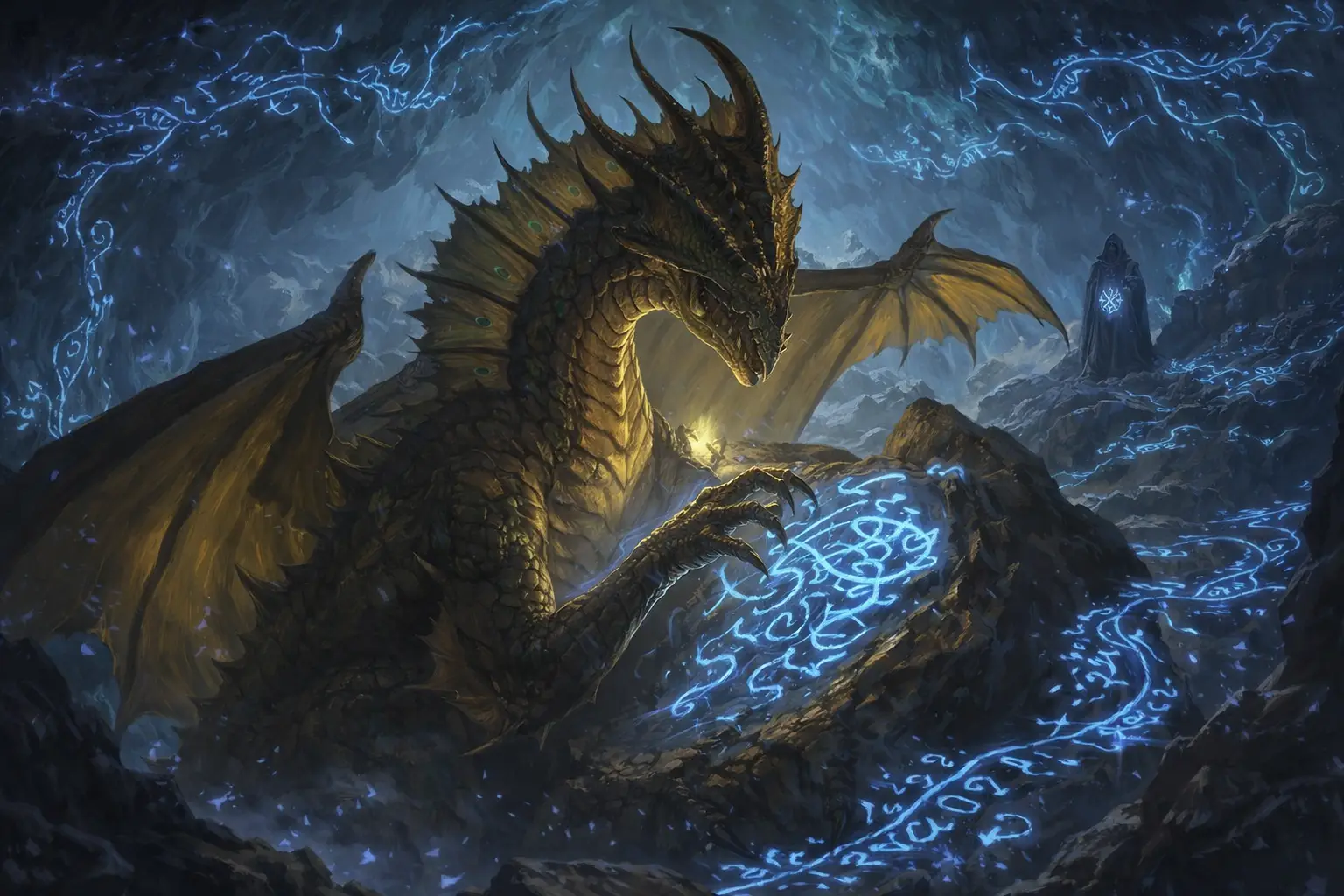
There are patterns hidden in the world. Secrets lie in the conjunctions of the planes and moons, in strange symbols formed by the flowing lava of a volcanic eruption or the fissures caused by an earthquake. Carved in the walls of ancient citadels and on primeval megaliths, knot patterns appear to have meaning that only the contemplative mind — or the ancient dragon — can hope to comprehend. To those who can read them, these myriad events and signs form a map of possible futures, a map that can be used to shape the course of history.
Scholars call this map the Draconic Prophecy, attributing it to the Progenitor Dragons: Siberys, Eberron, and Khyber. The Prophecy is vast and complex, its signs scattered across the world. Few humans or even elves have the time or resources to unravel its secrets — the foremost students of the Prophecy are ancient dragons, immortal fiends, and others who have devoted thousands of years to its study. The discovery of the Prophecy is credited to two figures from the Age of Demons: Ourelonastrix, a blue dragon, and Hezcalipa, a couatl, who worked together over centuries to compare patterns in the sky and stars with mysterious markings that appeared on the earth. Ourelonastrix believed these patterns were the wisdom of the Progenitors themselves — the very blueprint of reality. He called his discovery the Draconic Prophecy, and the insights it provided were instrumental in the defeat of the overlords. Some scholars believe that the myths of Aureon, the Sovereign of Law and Lore, are inspired by Ourelonastrix himself.
To most people in Khorvaire, the Prophecy is barely real. Most have heard the term but know almost nothing beyond the fact that it is a prophecy. When common people talk about it, they are usually thinking of the Caldyn Fragments — a collection of pieces assembled by the Korranberg scholar Ohnal Caldyn, widely available in pamphlet form and about as well understood by the general public as quantum physics is by someone who read the back cover of a popular science book. Most have no idea that the Prophecy is an evolving matrix of conditional elements, or that it is the key to releasing — or containing — the overlords.
"The Prophecy? Sure, I've heard of it. My cousin bought a pamphlet about it once. Something about moons and destiny. He also bought a pamphlet about how king of Karrnath is vampire, so take that for what it's worth." — Darro Whellin, dockworker, Sharn.
How It Works
The Draconic Prophecy does not define a singular path for the future. It is a map that shows many possible futures, along with the steps that must occur to make each future a reality. The Prophecy is a living thing — constantly growing and evolving as the actions of the present open new paths to the future, with those paths revealed in stone and storm, in the convergent motions of moon and plane.
The best metaphor comes from planar theory: imagine time as a maze and the Material Plane as a rat moving through it. The Prophecy does not tell you what will happen, because that has not been decided yet. It is a roadmap to the maze — it reveals that if you take a left turn at "Queen Aurala is assassinated" and then turn right at "Breland becomes a democracy," you will reach "Sul Khatesh is released from her prison." The Prophecy shows the path you need to take to achieve the outcome you desire — or the path you need to block to prevent an outcome you fear.
In practice, the Prophecy operates through three mechanisms:
Conditional statements are the basic unit. A fragment might say: "If the Bear King is slain by a sorrowful assassin in the Shadow of the Mourning, the Crown will fall from his nation." The "Bear King" could refer to King Boranel of Breland, since the bear is Breland's heraldic beast. The "Shadow of the Mourning" could mean the Mournland, or it could mean the anniversary of the Mourning. The passage does not say Boranel will be assassinated. It says that if he is, under these conditions, the monarchy falls. Other fragments cover what happens under other circumstances, or if Boranel dies of natural causes, or if the assassin fails. The Prophecy is a web of thousands of evolving if-then statements, each branching into others.
Anchor events lock in specific consequences. The future is not set in stone, but when an anchor event occurs — a specific action by a specific individual under specific conditions — it ensures a specific part of the future. Anchors do not determine the entire course of history, but once one locks in, seemingly random chance will keep pushing in that direction until the consequence occurs. If the Lords of Dust want Sora Kell to return, they must ensure that King Boranel is slain on the same day that Carralag the gargoyle wins the Race of Eight Winds in Sharn. This will lead to war — and that paves the way for the next convergence they wish to control. If the Chamber can prevent Carralag's victory or Boranel's death, it has staved off this fate — though it might have set another path in motion.
Threads are chains of anchor events spread across vast spans of time, each link requiring specific individuals and conditions. A single thread might require the creation of an artifact by a Dhakaani daashor ten thousand years before a prince uses that artifact to kill a queen in the light of five moons. Each link in the thread was set in motion by someone working toward the final outcome — or, sometimes, by no one at all, through coincidence, ambition, or the kind of accident that history is made of.
Where It Is Written
The Prophecy is not a book. It is not kept in a single location. Its signs are scattered across the world in forms that require interpretation — and often require centuries of context to read.
Mountainsides and cavern walls. The most authoritative fragments are carved directly into the landscape — stone inscriptions in a symbolic language that resists direct translation, found in remote areas of the world. The dragons of Argonnessen have spent millennia studying these, and prophetic chambers carved deep underground contain Draconic runes that are thousands of years old, covering walls from top to bottom with notes, reflections, and meditations on the Prophecy's meaning.
Ancient texts and crumbling ruins. Giant, dragon, and pre-Galifaran sites contain inscriptions or architectural features that encode prophetic information. Books of prophecy recovered from Xen'drik are among the most valuable and dangerous finds an expedition can make — and pages from such texts can fetch a hundred gold each from scholars with an interest in the Prophecy, though attempting to sell this knowledge might attract the attention of the Chamber or worse.
The patterns of moons, stars, and the Ring of Siberys. The movements of the twelve moons correspond to the shifting relationships among the planes, and these shifts are prophetically significant. The Ring of Siberys itself carries information. These patterns are best interpreted at an observatory.
Planar observatories. The Chamber has constructed immense structures of crystal and metal, lined with vast orreries that track and align with the planes and the Ring. These observatories contain enormous dragonshards of all three types. Each must be built at a location balanced between Siberys and Khyber — sites that may take years to find. Several are in Argonnessen; those in Khorvaire are hidden in mountain ranges and remote forest clearings, with crystal roofs or domes that open to allow unobstructed views of the night sky. The Gatekeepers maintain their own Siberys observatories in the Shadow Marches — older, simpler structures that enhance scrying spells and aid communication between the scattered druids.
The skin of a dragonmarked heir. A few thousand years ago — within the estimated lifespan of a gold dragon — the Prophecy revealed itself in a new form: dragonmarks. Traced across the flesh of the younger races, these sigils are more than a source of mystic power. To a student of the Prophecy, the actions of the dragonmarked provide insight into the Prophecy's paths, much as a lesser augur might read hints of the future in the movements of birds. The appearance of the dragonmarks sent shockwaves across Argonnessen — why were the marks appearing on humanoids instead of the far more ancient dragons? Would this give humanoids the power to shift the Prophecy's course? Some dragons urged the Conclave to destroy the dragonmarked before the Lords of Dust could use them. Others argued this was a manifestation of the will of Eberron, and destroying it could have cataclysmic results. The debate was never fully resolved, and it was this crisis that gave birth to the Chamber itself.
Dreams, visions, and natural phenomena. Some individuals hear words from the Prophecy in dreams, see waking visions, or experience fragments surfacing from deeply buried memories. Strange symbols formed by flowing lava, fissures caused by earthquakes, and the patterns of planar conjunctions are all tracked for prophetic significance by those with the knowledge to interpret them.
FIELD REPORT — SELA VARAS, MORGRAVE UNIVERSITY, XEN'DRIK EXPEDITIONARY FILE
I spent four years deciphering a single inscription in a Xen'drik ruin. When I finally translated it, it described an event that had already happened — three hundred years before the inscription was estimated to have been carved.
ATTRIBUTED TO TUURIK OF THE STANDING TREES, GATEKEEPER ELDER, ELDEEN REACHES
"The Prophecy doesn't care if you believe in it. It doesn't care if you study it. It will use you regardless. The only question is whether you know what role you're playing."
What People Know
Most people in the Five Nations have heard of the Draconic Prophecy. They know it exists. They know dragons care about it. Beyond that, their knowledge is essentially zero.
The conspiracy theory that a network of hidden dragons manipulates mortal affairs is on par with the idea that world leaders are secretly reptilian aliens — there are people who believe it, but sensible folk do not take it seriously. The fact that the conspiracy theory happens to be correct does not make it any more believable. It is not that people have never heard of the Lords of Dust — they have heard so many ridiculous stories ("King Jarot was possessed by a demon! The entire Wynarn family are actual demons!") that nobody is going to take your story seriously. While people know that dragons and demons exist, they are sure that all those stories of vast demonic conspiracies are rubbish. Besides, if something like that did exist, surely the Church of the Silver Flame would deal with it.
The Caldyn Fragments — the most widely known collection of Prophecy pieces — give people the impression that the Prophecy is a set of cryptic riddles. It is not. It is a vast, evolving, conditional matrix that describes the mechanics of how the future can be shaped. The fragments are like finding three pages torn from the middle of an encyclopaedia and concluding that the encyclopaedia is a book of puzzles.
The Korranberg Chronicle occasionally publishes stories connecting recent events to Prophecy fragments. A noted scholar named Thausil Kennar has been quoted interpreting events in the Eldeen Reaches as fulfilments of ancient prophetic text. These stories generate interest, briefly, and then people go back to worrying about things they can see.
ANNUAL FUNDING PETITION — PROFESSOR ONDRAS THELN, KORRANBERG CHRONICLE INSTITUTE OF PROPHETIC STUDIES
My department has fourteen researchers, an annual budget that would embarrass a village school, and access to exactly one authenticated Prophecy fragment — which we have been arguing about for nine years. Last month, a farmer in Aundair ploughed up an ancient stone tablet with markings that resolved a question we had debated for six of those years. He had been using it as a doorstop.
What No One Knows
Whether the Prophecy can be destroyed, or rendered unreadable. Whether the daelkyr have already altered it in ways no one has detected. Whether the Mourning was a prophetic event, an accident, or something that broke the Prophecy's structure in ways that have not yet become apparent. Whether the overlords can ever be permanently bound — or whether the Prophecy guarantees, over a long enough timeline, that every single one of them will eventually be released.
The Prophecy does not answer questions about itself. It describes conditions and consequences. What those conditions mean, and who benefits from which consequences, depends entirely on who is reading — and what they are willing to do with what they find.