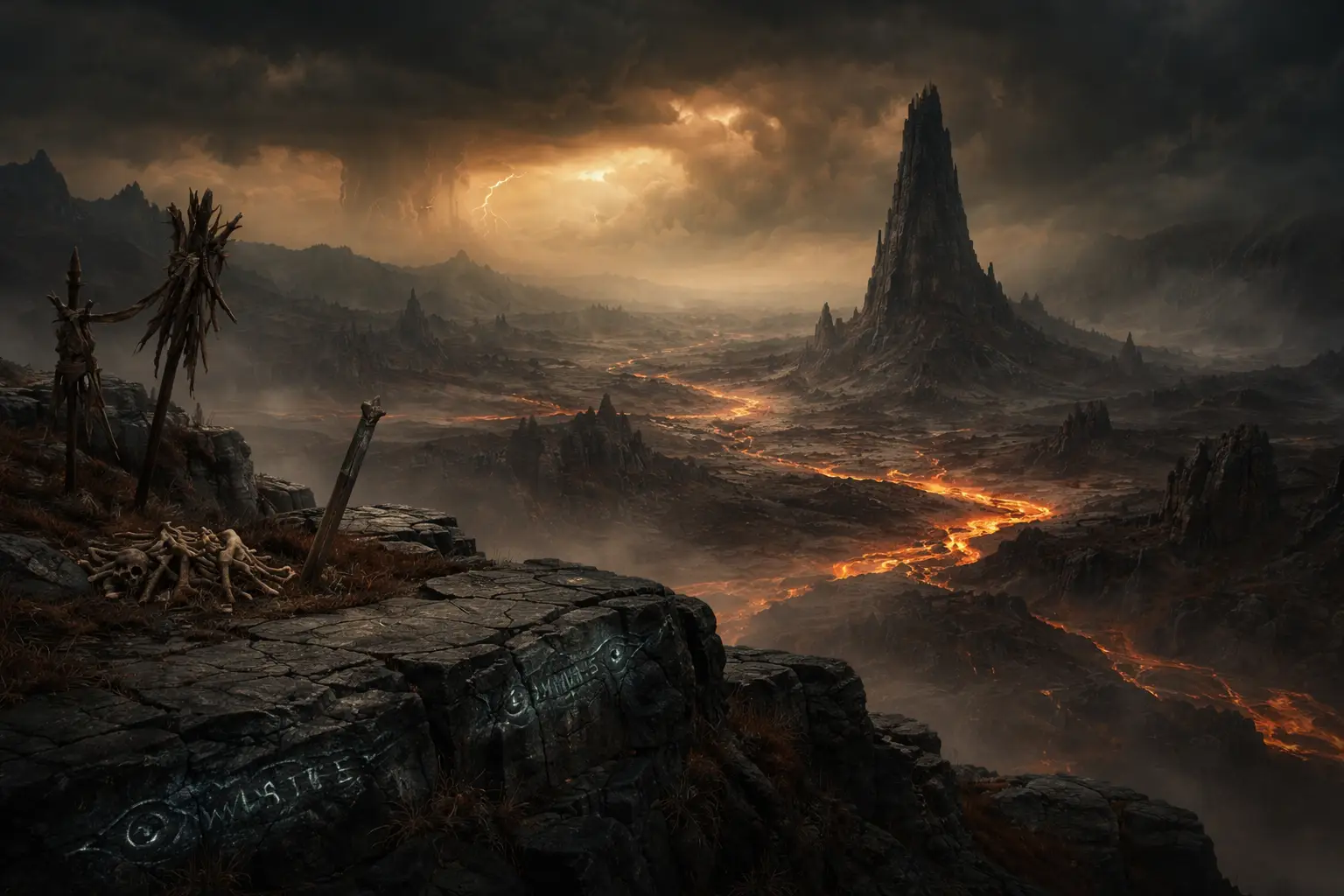
The Demon Wastes
Where the world's first age never truly ended.
You want to know what the Wastes are like? Imagine the worst place you've ever been. Now imagine it's been that way for a hundred thousand years. Now imagine it knows you're here.
— Tharashk prospector, last seen departing Zarash'ak for Bloodcrescent, 997 YK
Rivers of lava cut across plains of black sand and volcanic glass. The only vegetation is blood-red moss and a thick, shimmering slime that clings to stone in oily patches. A jagged rock formation breaks the horizon, and if you squint at the right angle and use a little imagination, you might convince yourself it was once part of a wall — something built, not grown, by hands that were not human and for purposes you would rather not contemplate. Then a wind comes up from the south, hot and sulfurous, carrying the faint sound of something that might be screaming or might be laughter, and you stop squinting and start walking.
The Demon Wastes occupy the northwestern reaches of Khorvaire, a vast expanse of blighted terrain separated from the Eldeen Reaches by the Stone Cage, the Shadowcrags, and the Icehorn Mountains, and further isolated by a great maze of canyons called the Labyrinth. It is the oldest continuously dangerous region on the continent — not a place that was recently ruined, like the Mournland, but a land that has been wrong since before human civilization existed, since before the goblin empires rose and fell, since before the dragons themselves had organized into anything resembling a nation. The Demon Wastes are a scar from the first age of the world, and unlike most scars, this one still bleeds.
The Age of Demons
To understand the Demon Wastes, you must understand what came before — though "understand" is perhaps too generous a word for what any mortal can achieve regarding events that took place a hundred thousand years ago.
In the first age of the world, the children of Khyber — the Dragon Below, the third of the progenitor wyrms — rose from the darkness to reign over Eberron. The greatest among these were the overlords: immortal archfiends of staggering power, each one an embodiment of a fundamental concept of evil. Rak Tulkhesh was the Rage of War, an incarnation of bloodlust and martial fury. Sul Khatesh was the Keeper of Secrets, a weaver of forbidden knowledge and dark arcana. Others embodied pestilence, betrayal, tyranny, fear, and horrors that the common tongues of the Five Nations lack words for. Each overlord commanded a host of lesser fiends — rakshasas, demons, devils, and things stranger still — and together they held dominion over a world defined by suffering.
This was the Age of Demons, and it lasted for an inconceivably long time. The overlords built cities. They shaped reality within their spheres of influence as casually as a potter shapes clay. The Demon Wastes — the entire region — was the seat of power for some of the mightiest among them, and the ruins that survive in the Wastes are not ruins of mortal construction. They were formed by epic magic as opposed to mundane labor: floating towers, monuments carved from living stone, structures made of mist that never drifted apart, fortresses of bone and black iron raised by will alone. Whatever you might imagine a civilisation of fiends to look like at the height of its power, the Wastes held something stranger and more terrible.
The Age of Demons ended when the children of Eberron and Siberys rose against the overlords. Armies of dragons fought the fiendish hosts in a war of almost incomprehensible scale. The overlords could not be permanently destroyed — they are part of the architecture of Khyber itself — but the couatl, celestial serpents tied to the progenitor Siberys, found another solution. In an act of collective sacrifice, the couatl gave up their lives and fused their spiritual essence together into a prison of pure celestial energy: the Silver Flame. This divine force bound the overlords in Khyber, severing them from the physical world and locking them away in prisons of dragonshard deep beneath the earth.
That was roughly a hundred thousand years ago. The bonds still hold. The Silver Flame still burns. But the land the overlords claimed as their seat of power was never healed. The corruption they wove into the earth, the sky, and the very fabric of reality in this region could not be undone by dragonfire or divine light. What was left behind was the Demon Wastes — a memorial to the first age of the world that no one built on purpose and no one has been able to tear down.
The Lay of the Land
The Demon Wastes are hostile in the most elemental sense. This is not a place that was habitable and then spoiled; it is a place where the concept of habitability was never part of the design. The land itself was shaped by overlords who found beauty in horror, and even after a hundred millennia, that aesthetic persists.
The terrain is dominated by plains of black sand, fields of volcanic glass, and stretches of cracked basalt interrupted by rivers of slow-moving lava. What passes for vegetation is limited to tough, unpleasant organisms: blood-red mosses, slimy fungal growths, and the occasional thicket of thorny, ash-colored scrub. There is no agriculture. There is no husbandry. The air smells of sulfur and hot stone, and the sky overhead has a bruised, yellowish quality that never quite resolves into proper daylight.
Scattered across this desolation are the remnants of the fiendish civilisation that once ruled here. Most of these are little more than foundations and fragments — a shattered pillar of basalt, a staircase descending into a collapsed cellar, the faint geometric regularity of a buried wall. These ruins are tens of thousands of years old, and anything not sustained by magic has long since crumbled to dust. But a handful of sites have survived, sustained by the dark energies that created them, and these are the most dangerous places in the Wastes. They are not simply old buildings. They are expressions of overlord power that still radiate malevolence, and entering one is less like exploring an archaeological site than it is like walking into someone else's nightmare.
The Wastes are also riddled with portals to Khyber — not merely the physical underworld, but a host of demiplanes and demonic realms that exist beneath the surface of reality. These inner worlds are astonishing in their variety: the Abyssal Forest of Khar, a primeval woodland where every creature is carnivorous and even the songbirds kill; the Ironlands, an entire landscape formed from metal, where adamantine trees grow razor-sharp leaves and bands of devils and demons wage their own endless wars amid blades of iron grass. There are living oceans, realms of rusted iron, and stranger places still. The Ghaash'kala orcs who guard the Labyrinth actually raid some of these demiplanes, entering the Ironlands to pillage weapons from the warrior fiends who dwell there. These inner realms have their own histories and structures, even if they are entirely unknown to the people of the Five Nations — and they are, without exception, fundamentally shaped by evil.
The Labyrinth
The single most important geographic feature of the Demon Wastes, from the perspective of anyone who lives south of it, is the Labyrinth — a vast network of twisting canyons that lies between the Wastes proper and the mountain ranges separating the region from the Eldeen Reaches.
The Labyrinth is not a natural formation, or rather, it is not merely a natural formation. Ancient warding magic, tied to the Silver Flame itself, permeates the canyon network. These wards do not prevent creatures from entering the Demon Wastes — anyone foolish enough to travel north can do so freely. But they impose a constraint on anything trying to leave: creatures attempting to exit the Wastes must pass through the Labyrinth. There are no shortcuts, no secret passes through the mountains that circumvent the canyons. The wards are ancient, powerful, and apparently self-sustaining, a remnant of the same era of divine magic that produced the Silver Flame.
This means the Labyrinth functions as a bottleneck — the only route by which the horrors of the Demon Wastes can reach the wider world. And it means the warriors who guard its passages stand between civilization and a darkness older than civilization itself.
The Ghaash'kala
The Ghaash'kala — the "Ghost Guardians" — are the most extraordinary people you've probably never heard of.
They are primarily orcs, though their ranks include half-orcs and occasional members of other races drawn to their sacred duty, including humans who grew up in the Carrion Tribes and heard a different calling. They have been guarding the Labyrinth for longer than human civilization has existed in Khorvaire, and they will almost certainly still be guarding it long after you and everyone you know has died. Their vigil predates the Kingdom of Galifar, predates the goblin Empire of Dhakaan, predates the arrival of humans on the continent. It is one of the oldest continuous traditions in the world, and almost no one in the Five Nations knows it exists.
The Ghaash'kala worship Kalok Shash — the Binding Flame. Scholars who have studied the tradition recognize it as fundamentally the same faith as the Silver Flame: a belief in a divine force of celestial energy that gathers the souls of the righteous and holds darkness at bay. But where the Church of the Silver Flame in Thrane has cathedrals and cardinals and theological debates, Kalok Shash is a harsh, stripped-down warrior's faith that requires every able-bodied person to fight in the endless war against the forces of darkness. There is no contemplative monastic tradition. There is no room for philosophical nuance. There is the Flame, and there is the darkness, and you stand between them with a blade in your hand until the darkness takes you, at which point the Flame takes your soul and someone else picks up the blade.
Several tribes make up the Ghaash'kala, each controlling a different section of the Labyrinth. The Maruk are the best known to outsiders, inhabiting the passages nearest the Eldeen Reaches. The Maruk draw recruits from a surprising range of sources: orc barbarians from the Shadow Marches, human scouts from the Eldeen frontier, and even the occasional youth from the Carrion Tribes who hears the call of Kalok Shash and turns away from the darkness that claimed their family. A small outpost of kalashtar lightspeakers has even established a presence near the Maruk watch posts, studying the possible connection between Kalok Shash and the Silver Flame and using divine magic to assist the orc warriors in their struggle.
The Ghaash'kala are not hostile to travelers — they are hostile to evil leaving the Wastes. An adventuring party heading north through the Labyrinth will be stopped, questioned, warned in the strongest possible terms, and then reluctantly allowed to proceed if they insist. A party heading south will be scrutinized far more carefully, and anything that reads as fiendish, cursed, or corrupted will not be permitted through. The Ghaash'kala have seen what happens when evil slips past the Labyrinth, and they would rather die — and kill — than let it happen on their watch.
They consider the people of the south to be weak and naive, soft creatures who have no concept of the horrors that would wash over them without the Ghost Guardians' eternal vigilance. They are not wrong.
My father's father's father stood in this canyon and bled for the Flame. His father did the same. I could trace this line back to a time when there were no humans south of the mountains, when the dar still built their empire, when even the dragons had not finished their war. And still — still — the ignorant ask me, "Why do you stay? Why do you fight?" As if stopping were something one could do. As if the darkness would stop with us.
— Taarka Maruk, clan warden of the Ghaash'kala
The Carrion Tribes
Beyond the Labyrinth, in the Wastes proper, the other mortal inhabitants of this wretched land are collectively known as the Carrion Tribes — semi-nomadic bands of humans and near-humans who descend from explorers and refugees twisted over generations by the pervasive evil of the region.
The Carrion Tribes are not a unified people. Each tribe has been claimed, willingly or otherwise, by one of the archfiends whose influence permeates the Wastes. Some serve overlords of war and revel in bloodshed. Others follow masters of pestilence, carrying diseases that are agonizing and disfiguring but maddeningly slow to kill, because their patron savors lingering suffering. Still others worship overlords whose spheres of influence are too alien or obscure for outsiders to easily categorize. The tribes fight one another as readily as they fight the Ghaash'kala, locked in an endless, purposeless cycle of violence that has persisted for nearly two thousand years.
The Carrion Tribes arrived in the Wastes relatively recently, in historical terms — less than two millennia ago, which makes them newcomers compared to the fiends and orcs who preceded them. Before the Carrion Tribes, a different mortal civilization existed in the Demon Wastes, one that was destroyed when the dragons of Argonnessen launched an assault on the region. Almost nothing is known about these prehuman people; their relics occasionally surface in the ruins, and scholars dream of what secrets their remnants might hold.
Tieflings are notably common among the Carrion Tribes. The fiendish energies saturating the Wastes touch some children in the womb, and the tribes regard these fiend-touched individuals as blessed — chosen by the overlords for some great and terrible purpose. Not all tieflings from the Wastes accept this destiny. Some flee, crossing the Labyrinth (if the Ghaash'kala allow them through) and making their way into the wider world, carrying with them the mark of a homeland that most people in the Five Nations cannot even imagine.
Ashtakala
Legends persist across Khorvaire of a single city of fiends that remains intact somewhere deep in the Demon Wastes — a city of basalt and brass called Ashtakala, shielded by powerful wards and surrounded by a perpetual, deadly storm.
Most scholars treat Ashtakala as a myth, and this is probably the safest attitude to adopt. The stories describe a city immune to divination magic, surrounded by a tempest that repels attack, where an alternate reality exists within the storm — a place that still appears to be at its zenith, populated by tens of thousands of fiends going about their business in a grotesque parody of a living metropolis. Rakshasas, demons, and stranger things are said to walk its streets, and mortal visitors who enter the city's influence are themselves altered to fit its haunted narrative, cloaked in illusion as if the city cannot bear to acknowledge that the world outside has moved on.
Whether Ashtakala exists or not — and the wise do not speculate too loudly — the stories agree on several points. The city has stood for a hundred thousand years. It has never expanded. It is immune to scrying. And the Library of Ashtakala is said to contain knowledge from every age of the world, including secrets of arcane magic that predate human civilization by tens of thousands of years.
For adventurers, the significance of Ashtakala is usually more immediate than historical: certain artifacts, certain curses, and certain threats are said to originate from the Demon Wastes in ways that can only be resolved by traveling there. A weapon forged in the Age of Demons can perhaps only be unmade where it was created. A plague spreading through the Eldeen Reaches might be traced to a fiendish source that can only be confronted in the Wastes. A holy relic lost by a paladin of the Silver Flame who ventured north and never returned might still be recoverable — if you can survive what killed its previous owner.
There is a place in the Wastes where the storm never ends. I have met three people who claim to have seen it. Two of them are dead. The third will not speak of it, and I have noticed that she never sleeps anymore.
— Kessla d'Tharashk, dragonshard prospector, Bloodcrescent
Settlements and Sites
True settlements in the Demon Wastes are vanishingly rare. The Carrion Tribes are semi-nomadic, assembling camps amid the crumbling ruins, and the Ghaash'kala live in fortified watch posts within the Labyrinth itself. Only two locations on the borders of the Wastes approach anything that a citizen of the Five Nations would recognize as a "settlement."
Bloodcrescent. House Tharashk established this tiny port at the end of the Last War, driven by the hope of gaining access to the dragonshard deposits buried in the Wastes. The settlement sits on the northern coast, a fragile collection of wooden structures and Tharashk-marked supply caches that exists in a state of constant, precarious survival. It has held out against the Carrion Tribes and the ambient horrors of the Wastes so far, but few observers give it long-term odds. The dragonshards that drew Tharashk here are real and potentially valuable, but extracting them requires operating in an environment where the earth itself is hostile and the things that crawl out of the ground at night are worse. Bloodcrescent is the closest thing to a staging point for legitimate expeditions into the Wastes, and those who need supplies, guides, or a last hot meal before heading inland will find what little comfort it offers.
Desolate. Known at various times as Greenholt, Newholt, and Kymar's Folly — that last name should tell you something — this outpost on the southern edge of the Wastes has served as an Aundairian settlement, a Thranish hermitage, and an outpost of House Lyrandar. It has fallen three times. Each time, every inhabitant has vanished in a single night, leaving all their possessions behind. No bodies. No signs of struggle. Just empty buildings and uneaten food and silence. Today it is known simply as Desolate, and it waits, with the patient malice of a place that knows someone will try again.
What Lurks in the Wastes
The threats of the Demon Wastes are not random. They are ancient, structured, and in many cases intelligent — the products of a hundred thousand years of fiendish presence rather than the chaotic mutations of a recent catastrophe.
Fiends are the defining hazard. Devils, demons, rakshasas, and other entities spawned by Khyber inhabit the Wastes in numbers that no census could capture. These are not creatures from the Outer Planes — Eberron's fiends are children of Khyber, the Dragon Below, formed in the demiplanes and heart-realms that lie beneath the world's surface. New fiends continue to crawl up from the depths, and the spirits of fiends slain on the Material Plane eventually reform in their masters' domains, making them a threat that can never be permanently depleted. Some fiends roam the surface, hunting for sport or sustenance or simply because cruelty is their nature. Others guard specific sites, bound to their duties by compulsion or devotion. Still others are intelligent, patient, and far more dangerous for their subtlety.
Demonic wildlife fills the ecological niches that natural animals occupy elsewhere. The Wastes support populations of creatures that are not quite fiends and not quite beasts — things born in a land saturated with evil magic that have adapted to an environment no natural creature could survive. Balewolves, fiendish insects, venomous reptiles with too many eyes, and things without easy names populate the badlands and the canyon walls.
The land itself is hostile in ways that go beyond difficult terrain. Certain areas of the Wastes radiate palpable evil — not a metaphor, but an ambient magical effect that corrodes morale, inspires paranoia, and over prolonged exposure can begin to erode a person's moral compass. Staying too long in the Demon Wastes does not merely endanger your body; it threatens who you are. Even the the flora is corrupt, and known to induce uncontrollable rage and hallucinogenics when consumed; the Carrion Tribes are living proof of what happens to mortal populations exposed to this influence over generations.
Ancient traps and wards protect the fiendish ruins. These are not the mechanical traps of a dungeon — they are magical defenses created by overlords who could reshape reality, and they remain active after a hundred thousand years. Entering a demonic ruin without extreme caution is a reliable way to encounter magical effects that no mortal spellcaster has the knowledge or the power to replicate.
The Demon Wastes and the Wider World
For most people in the Five Nations, the Demon Wastes are a distant abstraction — a place name on a map, a setting for fireside ghost stories, the kind of location that is spoken of in the same breath as "the edge of the world." Very few people have been there. Fewer have returned. The Demon Wastes did not feature in the Last War because no army could survive there long enough to fight, and the Labyrinth — guarded by the Ghaash'kala — ensured that nothing came out to complicate matters further.
But the Wastes are not irrelevant to the wider world. The fiends who were spawned there in the first age of the world did not all remain when the overlords were bound. Their agents and servants operate across Khorvaire, and certain threats that surface in the most civilized cities of Sharn or Flamekeep may ultimately trace their origin to the darkness beneath the black sands. Curses, artifacts, plagues, and corrupted bloodlines can all carry the taint of the Wastes into the broader world, and following such threads to their source occasionally requires someone to actually go there.
House Tharashk's interest in the region is the most visible example of outsider engagement with the Wastes. The dragonshards buried beneath the volcanic glass are valuable enough to justify the extraordinary risks of extraction, and Tharashk's agents in Bloodcrescent represent the only permanent dragonmarked presence in the region. But Tharashk is not the only interested party. Scholars dream of studying the prehuman ruins. The Church of the Silver Flame maintains a doctrinal interest in the Ghaash'kala and their interpretation of the Binding Flame. Occasional military planners in Aundair or Thrane speculate about whether the Wastes could be "tamed" — a proposition that everyone who has actually been there finds darkly hilarious.
And then there are the adventurers. Some come seeking artifacts from the Age of Demons — weapons, scrolls, and relics of power that no living artisan could replicate. Others pursue specific quests: a cure for an unnatural plague, a way to break a curse, a means of destroying an artifact that can only be unmade where it was forged. Still others are drawn by the promise of the Khyber demiplanes — entire worlds accessible only through portals in the Wastes, each one holding wonders and terrors that no one in the Five Nations has ever catalogued.
The Demon Wastes are not a place you visit casually. They are not a place you visit at all, if you can help it. But when the thread you are following leads north past the Shadowcrags and into the Labyrinth, there is no substitute for going yourself — because the Ghaash'kala will tell you, with the weary certainty of people who have been saying it for ten thousand years, that whatever you are looking for is almost certainly still in there, and it is almost certainly worse than you expect.
Every generation, some fool from Aundair arrives at the Labyrinth with a map, a theory, and the conviction that they will be the one to unlock the secrets of the Wastes. Every generation, the Ghaash'kala hand back the map and the theory. The fool, they keep.
— Overheard in Delethorn, attributed to an Eldeen Reaches ranger
Characters from the Demon Wastes
Player characters with ties to the Demon Wastes are rare but fascinating, and they carry a weight of history and strangeness that few other backgrounds can match.
Ghaash'kala characters are sacred champions of Kalok Shash, the Binding Flame. A paladin sworn to the Oath of Vengeance, a barbarian on the Path of the Zealot, or a cleric of the Light or War domain all represent natural paths for a Ghaash'kala warrior. The Outlander and Hermit backgrounds reflect the harsh upbringing of a life spent in the Labyrinth, far from civilization. As a Ghaash'kala character, the central question is: why have you left your post? The Ghost Guardians do not abandon the Labyrinth lightly. Are you on a specific mission, guided by divine visions? Have you been exiled for some transgression? Or did something come through the Labyrinth that you must pursue into the wider world?
Carrion Tribe characters emerge from one of the most hostile environments in Khorvaire, shaped by violence, fiendish influence, and a culture that most citizens of the Five Nations would find incomprehensible. Your tribe was devoted to an overlord, and that devotion may have left its mark on you in ways both spiritual and physical — as a warlock's pact, a barbarian's rage, or the fiend-touched blood of a tiefling. The key questions are whether you are still loyal to your dark lord or whether you have broken free, and what drove you to cross the Labyrinth into a world that is utterly alien to everything you know.