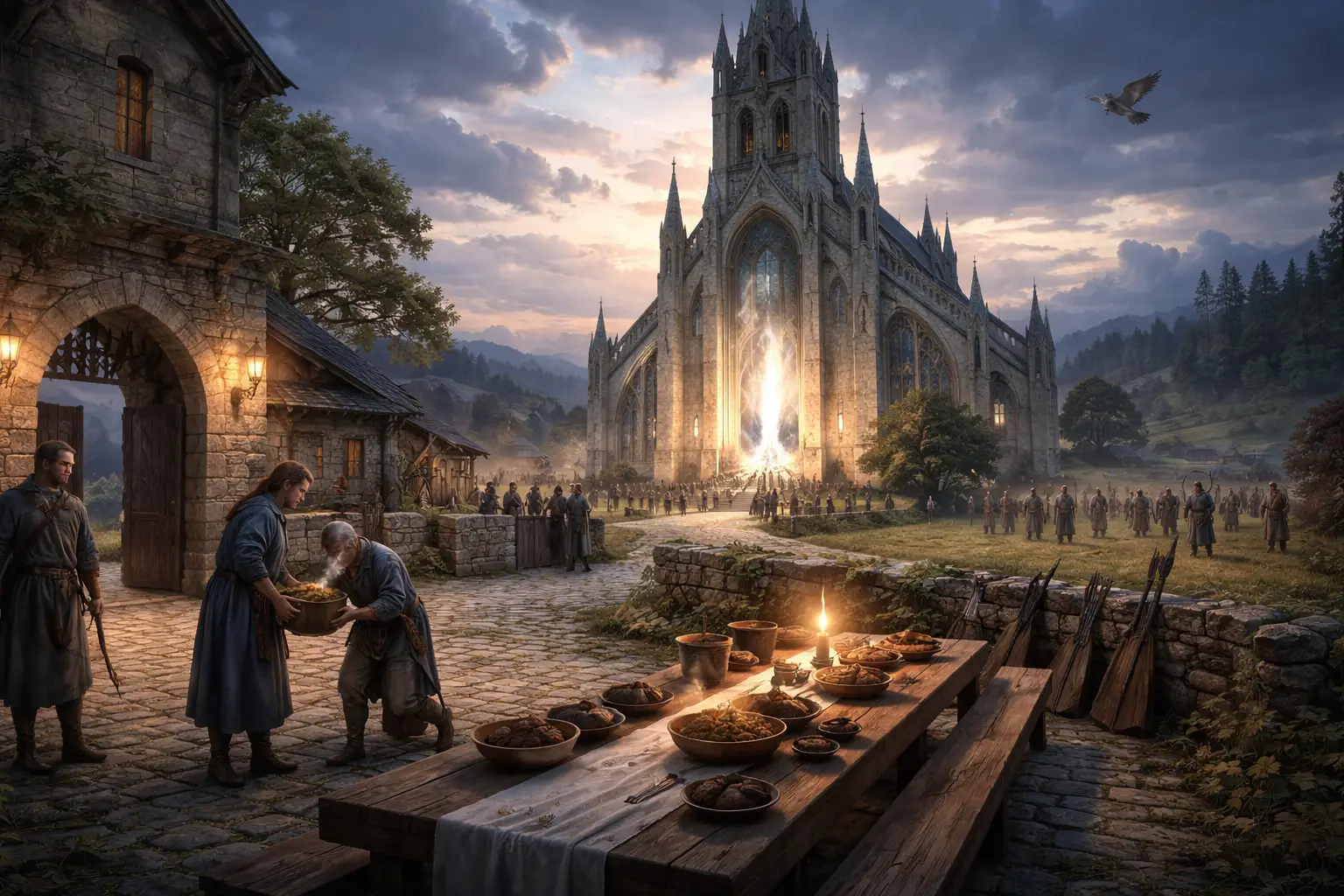
Thrane
Capital: Flamekeep | Ruler: Keeper of the Flame Jaela Daran | Government: Theocracy under the Diet of Cardinals | Hallmarks: Divine magic, fine crafts, fruit, livestock, the Silver Flame, textiles, wool
"I was scorched by the Silver Flame. Growing up on the streets of the Callestan district in Sharn, I learned not to put my faith in anything I couldn't see or hold. But then I found myself in the Chamber of Tira's Sacrifice, a pillar of silver fire marking the spot where one woman gave her life to protect countless innocents. I saw people from all nations joined together in song, celebrating both that ancient sacrifice and the end of our current war. And looking into the innocent eyes of the child priestess, I truly heard the words of that song for the first time: a call for all of us to be better than we are, to protect those in need, to remember that we are all one people in the light of the Silver Flame." — A Sharn correspondent, reporting from the Ascension ceremony in Flamekeep
In 914 YK, with its king dead and the Last War grinding through its twentieth year, the people of Thrane did something unprecedented in the history of the Five Nations: they set aside the monarchy entirely and handed temporal authority to their church. For more than eighty years since, the Church of the Silver Flame has governed the nation — writing its laws, commanding its armies, collecting its taxes, and shaping the daily rhythms of civic life through parish structure and ecclesiastical rank. If Aundair is the nation of wizards and Breland the nation of spies, Thrane is the nation of templars, archery militias, and a people who believe — truly, passionately, sometimes dangerously — that the world can be made better through faith and collective will.
Thrane occupies central Khorvaire, bordered by Aundair to the northwest, Karrnath to the east, Breland to the south, and the Eldeen Reaches to the west. Its communities are built around fortified churches; its cities rise in soaring Flamic stonework; its countryside is a patchwork of farmland, pilgrimage roads, and land scarred by seventy years of war. The nation shares borders with all four of its old rivals and remains resented by many of them — it seized territory from Aundair and Breland, refused to provide a homeland to Cyran refugees, and Karrnath remembers the bombardment of Korth. Thranes therefore live with a constant awareness of scrutiny and hostility from beyond their borders, and that siege mentality, real or imagined, reinforces the faith's hold on civic life.
The Thrane Spirit
The Thrane national character runs on devotion, communal solidarity, and a fierce moral conviction that can shade into zealotry when tested. A village will raise a barn in common, run archery drills on feast days, feed its poor through church kitchens, and drive a fiend from its hiding place before sundown — all as expressions of the same underlying impulse. The five edicts of the Silver Flame are simple in tone even when difficult in practice: trust the Flame, heed the Keeper, fight evil, live nobly, and share the faith. Thranes stand together, and they do so completely. When a Thrane commits to a cause, they tend to commit with an intensity that outsiders find either inspiring or alarming.
The dark side of these qualities is a culture of moral certainty sharpened by decades of war, where the line between defending the innocent and persecuting the inconvenient can blur in the hands of an ambitious priest. Even a good Thrane — faithful, charitable, brave — may carry assumptions about arcane magic, about Karrnathi culture, about anyone who doesn't share the fire, that would never survive scrutiny outside the parish. The same institutional structure that coordinates communal charity also coordinates inquisitors, and distance and deference can shield a bad bishop from accountability for a long time.
The overwhelming majority of Thranes are honest, proud, and passionate people. Most are not mindless zealots. But ideals and practice do not always align, especially in a nation shaped by war, austerity, and clerical power.
"We do not pray for the Flame to protect us. We pray that we might be worthy of protecting others." — inscription above the gates of Flamekeep
The Keeper and the Cardinals
The nominal head of state is the Keeper of the Flame — currently Jaela Daran, selected by the Voice of the Silver Flame in 993 YK at the age of six and now eleven years old. The Keeper serves as the intermediary between the Voice of Tira Miron and the governing Diet of Cardinals, and wields tremendous divine power; she has summoned celestials to her side and resurrected Cardinal Halidor following his assassination. She possesses a poise and wisdom that stuns nearly everyone who meets her. Whether she is a miraculous vessel or a manipulated figurehead is one of the defining political questions of the postwar moment.
Day-to-day governance falls to the Council of Cardinals, and above all to High Cardinal Krozen, its most powerful figure — a brilliant strategist and reclusive administrator who controls most practical levers of state. From the Council, the Diet of Cardinals is drawn as the actual ruling body of the nation. Below them, the hierarchy cascades through archbishops who oversee regions, bishops who hold authority over cities, and parish priests who administer everything from tax collection to minor disputes. Every community large enough to have a mayor also has a priest who outranks them.
The feudal nobility of the old Galifaran model remains formally in place, but all ultimate authority flows through the church. Queen Diani ir'Wynarn holds the title of "blood regent" — a symbolic position that preserves the monarchy in form while stripping it of all governing function. She resides in Thalingard, the ancestral palace in Flamekeep, and serves as a diplomatic necessity for foreign courts still accustomed to dealing with crowned heads. A small but persistent monarchist faction would like to see the old balance of crown and church restored — some nostalgic traditionalists, others active conspirators.
The military is inseparable from the faith. The templar orders serve as both army and constabulary, organized through ecclesiastical rank. Every town maintains an archery militia as a matter of devotional practice — archery in the Silver Flame tradition is both a martial art and a form of meditation. The church's covert arm is the Argentum, originally an order dedicated to recovering and destroying dangerous magic items, now repurposed as the espionage apparatus of the Silver Flame with broader reach than Thrane's formal diplomatic corps. The Knights of Thrane (Crown Knights), an older order pledged to the monarchy, now serve Queen Diani in name but answer to the Council of Cardinals in practice — an elite force used for special missions and troubleshooting.
Thrane's military weakness is financial. The treasury is thin, the people are overtaxed, and decades of war left infrastructure and agriculture badly damaged. Thrane fields faith and discipline where other nations field gold.
The Shape of the Nation
Flamekeep, the capital, is a massive fortress city and the spiritual heart of the Silver Flame. At its center stands the Cathedral of the Silver Flame — formerly a castle, now grown to the size of a small town and entirely self-sufficient — which houses the pillar of argent fire born when Tira Miron sacrificed herself to bind the demon overlord Bel Shalor. The cathedral is the seat of the Council of Cardinals, the primary templar garrison, and the site of the Chamber of Tira's Sacrifice, where the silver flame still burns at the precise point of her death. Beside it, Thalingard serves as the queen regent's residence.
Thaliost is an open wound. An ancient Aundairian city seized during the Last War and formally ceded under the Treaty of Thronehold, it was placed under Archbishop Solgar Dariznu, an Aundairian follower of the extremist Pure Flame sect. The appointment was intended to bring Pure Flame followers within Flamekeep's authority; instead, Dariznu has taken brutal action to suppress Aundairian opposition, and the city has become a haven for zealots even as its original population chafes under occupation. Violence breaks out regularly. Aundair has never forgiven the loss, and pressure on Queen Aurala to retake the city by force is permanent.
Shadukar, once called the Jewel of the Sound, was destroyed in a Karrnathi siege. The ruins are haunted by Thrane ghosts and Karrnathi undead left behind after the retreat. It has not been reclaimed. Daskara — the heart of the pre-Galifaran nation that would become Thrane — Morningcrest, Fort Light, and other sites serve as the working bones of Thrane's interior: administrative centers, templar garrisons, and pilgrimage waypoints along the roads between Flamekeep and the nation's productive farmland.
PASTORAL NOTICE — posted at parish churches across Thrane, Therendor 998 YK
All able-bodied citizens of the parish are reminded that militia archery practice resumes on the first Dol Arrah feast day of the season. Attendance is expected. The parish will provide arrows; bring your own bow if you have one. Those who demonstrate proficiency will be recognized at Silvermass. Those who do not attend will be visited by the deacon.
The Flame shelters those who shelter each other.
Faith and Culture
The Silver Flame is not merely the faith most citizens practice — it is the framework through which law, education, justice, and civil life are administered. The church's three orders of clergy — ministers who tend congregations, friars who wander the world spreading the faith through compassion and charity, and templars who fight evil in the flesh — form the institutional skeleton of the nation. Church doctrine urges the faithful to act with empathy and compassion, to resist responding to anger with anger, and to turn to violence only as a last resort. Even during the Last War, Thrane templars would cross into enemy territory to fight a demonic threat alongside the locals they had been fighting the week before. This is the faith at its best.
Thrane culture emphasizes restraint, modesty, and intensity held under control. Citizens are expected to be reverent toward elders and authority; open shouting and public loss of temper are considered rude. Fashion is simple and functional above all — long coats, practical boots, blue and silver as the colors of the faith. There is no shame in mended clothing; the common templar wears a patched cloak without embarrassment. Architecture is dominated by the Flamic style: soaring arches, stained glass with silver filigree, cathedrals designed to admit light, and mosaic floors centered on a representation of the Flame with a real silverburn fire that is never allowed to gutter out. Even ordinary settlements feel like extensions of ecclesiastical space.
Where Aundair relies on arcane magewrights for everyday services, Thrane has divine adepts — the divine equivalent of magewrights — who channel the power of the Flame to cleanse clothes, lock doors, heal the sick, and amplify a singer's voice. For a Thrane adept, mundane work done through the Flame's power is an expression of faith. Arcane magic is not forbidden, but it is treated as secondary; there are fewer magewrights here than in other nations, and excessive devotion to arcane study is seen as a distraction. The dragonmarked houses operate in Thrane only carefully, and always under the watch of authorities who suspect worldly influence.
Postwar Tensions
Three fault lines dominate Thrane's postwar politics. The first is theocratic legitimacy: even among the devout, a meaningful minority fears that temporal power distracts the church from its mission and invites corruption. When the theocracy was established in 914 YK, the move divided the faithful across Khorvaire; the priests of Stormreach condemned it outright and severed ties with Flamekeep. Monarchist sentiment persists around Queen Diani, and within the church itself, the system allows ambitious figures to govern in the language of righteousness.
The second is Thaliost. The city is ungovernable in its current form — a Pure Flame stronghold atop a population that considers itself Aundairian. Dariznu's suppression has made things worse. Aundair's pressure on Thrane over the city is a near-permanent diplomatic crisis, and the Council's decision to appoint Dariznu reads as a significant miscalculation.
The third is the relationship between inclusive ideals and a human-dominated hierarchy. Nonhuman citizens who feel excluded from power have produced reform movements, conspiratorial societies, and occasional violence. The church's formal doctrine holds that all who seek the light are welcome; the practical distribution of authority tells a different story.
Beyond these three, the Whispering Flame cult operates through scattered cells and convoluted plots involving relics and old war secrets. Thrane's enemies are not all outside its borders.
External Relations
The enmity between Thrane and Karrnath runs deeper and longer than the Last War — the bastion of the Silver Flame versus the nation that fielded undead armies and made compacts with the Blood of Vol. Both accepted the Treaty of Thronehold, and Karrnath's king has forsworn new undead soldiers, but the treaty has done nothing to ease the hatred. Thrane's bombardment of Korth remains in Karrnathi memory; Karrnath's undead remain in Thrane's.
Relations with Aundair are defined entirely by Thaliost. The city poisons everything else. The border zone between them remains scarred by wartime magic — the Crying Fields, farmlands permanently blighted by arcane weapons and haunted by restless spirits.
Breland is complicated. The Thrane assault on Starilaskur in 916 YK remains a bitter Brelish memory, but the Silver Flame has a strong presence in Breland, and the church's agents — friars, ministers, and Argentum operatives — operate more freely there than Thrane's diplomats. The church's reach in Breland is more durable than any formal alliance.
Thrane refused to provide a homeland to Cyran refugees after the Mourning. That refusal sits uncomfortably beside the church's stated mission of compassion to all innocents, and it is a contradiction that Thrane's critics are in no hurry to let the nation forget. It has also caused turmoil within its own faithful following, who have identified the hypocrisy in their leadership.
The Thrane Character
Two instincts define the Thrane national character. The first is an unshakable commitment to community — the bone-deep conviction that you do not face the darkness alone, that your neighbor's crisis is your crisis, and that the person standing beside you in the militia line matters more than whatever title they carry. This produces villages that rebuild together after a siege, templars who cross enemy lines to fight a demon alongside foreigners, friars who wander into the worst slums of Sharn to do charity work, and ordinary farmers who practice archery every week because they believe — not theoretically but practically — that one day something terrible will come, and when it does, they intend to be ready.
The second is a moral seriousness that outsiders sometimes experience as rigidity. Thranes do not separate the sacred from the civic; the parish is the community and the community is the parish, and the line between spiritual health and public order is thinner here than anywhere else in Khorvaire. A Thrane will debate religion with you, and they will mean it. They will judge you, gently or not, by whether you live according to principles — not necessarily theirs, but some. The Brelish find this exhausting. The Aundairians find it provincial. The Karrns find it hypocritical. The Thranes don't particularly care what any of them think, because they answer to the Flame.