History of Thrane
"Those who believe the lycanthropic purge was a church-sponsored massacre never experienced its horrors for themselves." — Prelate Aravash, Veterans of the Crusade Memorial, Flamekeep
Every child in Thrane knows the story of Tira Miron — the paladin who gave her life to bind a demon and whose sacrifice lit the pillar of silver fire that still burns in Flamekeep's cathedral. But Thrane's history neither begins nor ends with Tira. It stretches back to the pre-Galifaran city-state of Daskara, passes through dragon-fire and divine sacrifice, survives a crusade that left scars across half a continent, and arrives at the present day through a century of war that reshaped the nation into something its founders would barely recognize: a theocracy, wounded and defiant, governed entirely by its church and led by a child.
Before the Flame (Pre-Galifar)
The territory that would become Thrane began as Daskara — one of the five great human city-states predating Galifar, a settlement devoted to the Sovereign Host, organized around river trade and the fertile lowlands between the Burnt Wood and Scions Sound. The people of Daskara were not warriors in the way the Karrns were warriors, and they were not merchants in the way the people of Wroat were merchants. They were devout — committed to their faith, whatever that faith happened to be, with an intensity that other city-states found admirable at a distance and slightly uncomfortable up close. When Galifar I unified the Five Nations in 1 YK, Daskara was rechristened Thrane after one of the king's sons. The old devotional character ran deep, and it would prove to be the nation's most enduring trait long before the Silver Flame ever burned.
In 22 YK, the rogue blue dragon Sarmondelaryx destroyed Prince Thrane's army in what became the Burnt Wood. The prince was swallowed whole. The "Bane of Thrane" survives in the national memory not merely as a historical event but as a founding wound — a reminder woven into nursery rhymes and parish sermons that dragonkind is to be feared, and that even the bravest army can be scattered by a force it does not understand. Sarmondelaryx was never seen again, and the Burnt Wood remains a blasted landscape to this day.
HYMN — sung at parish services across Thrane on the anniversary of Prince Thrane's death, melody predating the Silver Flame
"The dragon came with thunder's voice / The prince rode out at dawn's own choice / The wood still burns, the prince is gone / But Thrane endures, and Thrane sings on."
The Founding of the Silver Flame (298–299 YK)
In 298 YK — the Year of Blood and Fire — the overlord Bel Shalor partially broke free of the bonds that held him in Khyber, and fiends poured across Thrane. The devastation was real and documented: communities destroyed, populations scattered, a nation that had known peace for nearly three centuries suddenly plunged into a horror that no army could fight with conventional weapons.
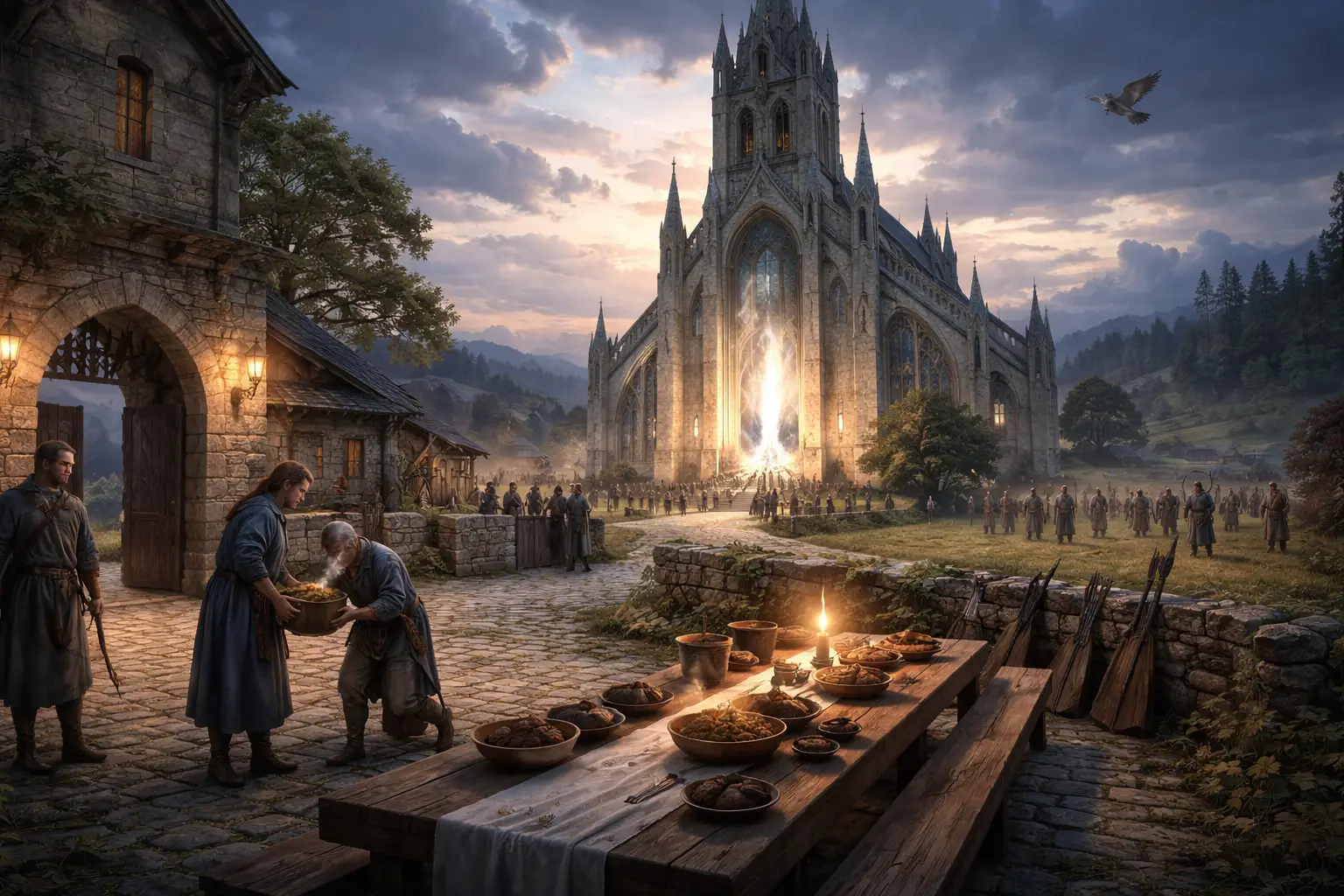
Tira Miron was a paladin of Dol Arrah — a warrior, not a mystic — called by a couatl to the silver fire and given a vision of what was required. She rallied an army. She fought the overlord directly. And when it became clear that Bel Shalor could only be bound, not destroyed, she gave her life — her spirit merging with the Silver Flame and the couatl's essence to restore the demon's chains. The pillar of argent fire that marks the point of her sacrifice still burns in Flamekeep's cathedral, a manifestation of the Flame's power in the material world, though not its source — the Silver Flame itself stretches across Eberron, binding overlords on every continent.
Less than a year elapsed between Tira's vision and her death. She did not write the church's doctrines. She did not establish its hierarchy. She did not appoint cardinals or draft scripture. Her surviving companions — the adventuring party turned disciples who had fought alongside her — founded the Church of the Silver Flame in 299 YK, building the cathedral around the pillar of fire and establishing the traditions that would define the faith for centuries. The doctrines were refined by priests who never met Tira, guided — the faithful believe — by the Voice of the Flame: Tira herself, speaking from within the fire to those with the faith to listen.
There is a complication. Anyone who listens for the Voice can also hear, if they are not careful, the whispers of the Shadow in the Flame — Bel Shalor himself, bound within the very power meant to contain him. The church was born from an act of sublime sacrifice. It has carried its enemy inside it from the very first day.
The Time of Two Keepers (497 YK)
In 497 YK, a peasant woman calling herself Melysse Miron appeared in Flamekeep, claimed to be Tira's direct descendant, and challenged the sitting Keeper for control of the church. She challenged established doctrines. She attracted followers. And — shockingly — she wielded the power of the pillar of fire itself, performing miracles no lesser priest could match.
The resulting schism lasted years and nearly tore the church apart. Melysse was eventually revealed to be the chosen instrument of Bel Shalor — the Shadow in the Flame, not the Flame itself, that strengthened her power. Because killing her risked allowing the overlord to choose a new vessel, Melysse was magically petrified rather than destroyed and imprisoned in island prison of Dreadhold, where she remains to this day.
The Time of Two Keepers left the church with a permanent wariness of charismatic outsiders claiming divine authority, a deepened understanding of how the Shadow in the Flame operates — through sincerity, not obvious evil — and a question that has never been fully answered: if the Shadow can empower a false Keeper convincingly enough to fool the faithful for years, how certain can any generation be that the Voice they are hearing is the right one?
The Silver Crusade (832–882 YK)
Around 830 YK, something changed in the Towering Wood of the Eldeen Reaches.
The lycanthropic curse — a persistent but manageable threat in western Khorvaire — transformed. Afflicted lycanthropes gained the ability to spread the curse actively, a rare mutation of the curse, and the change was not gradual. It was a surge — sudden, widespread, and guided by something that the church's scholars could not identify but could not dismiss as natural. Communities in western Aundair suffered wave after wave of attacks, slaughtering and transforming entire villages in a series of weeks without challenge; the threat was real, visceral, and escalating.
Keeper of the Flame Jolan Sol launched the Silver Crusade in 832 YK, dispatching an army of templars into Aundair. Sol's motives were not purely defensive — the Keeper saw an opportunity to strengthen the Silver Flame's influence beyond Thrane's borders, and he proclaimed that lycanthropy corrupted the soul itself, a doctrinal position that justified the widest possible interpretation of the threat.
The Crusade became a tragedy compounded by sabotage. Wererat demagogues infiltrated rural villages and templar deployments, worked both sides — inflaming paranoia among the templars while warning shifter communities that foreign religious soldiers were coming to slaughter them indiscriminately. The results worked exactly as intended: shifters who might have been allies became bitter enemies, and frightened templars, unable to distinguish cursed lycanthropes from innocent shifters, killed thousands of people who had never harmed anyone. The inquisitors had no good lycanthropes to study — these were rare to begin with, and most had fallen into evil because of the curse. The physical similarities between werebeasts and fiendish rakshasas convinced the templars that all lycanthropes were innately evil. And because curing lycanthropy was extraordinarily difficult, nigh unheard of, they assumed it was impossible.
House Medani eventually produced a dragonshard focus item capable of detecting true lycanthropes, heralding the end of the indiscriminate killing. The war turned to the side of the templars and Keeper Jovor Daran declared the Crusade over in 882 YK.
The Crusade left the church battle-hardened and experienced in cross-border military operations — expertise that would serve it in the Last War. It also left a legacy of justified bitterness among shifter communities across Khorvaire, a politically empowered Pure Flame faction in Aundair that treated violence rather than compassion as the primary tool for fighting evil, and an open question that the church has never answered: what dark power surged the curse in the first place? The church assumes it was a natural manifestation of evil. Others wonder whether something deliberately engineered the crisis — and whether it got exactly the result it wanted.
"We did not go to Aundair to murder the innocent. We went because the innocent were being devoured. That we failed to distinguish the cursed from the clean is the tragedy. That we stopped looking for the distinction is the sin." — from the personal journals of an unnamed templar, recovered in 997 YK
The Last War and the Birth of the Theocracy (894–996 YK)
King Jarot died in 894 YK. His son Thalin of Thrane rejected the succession of his eldest sister Mishann of Cyre, alongside Kaius of Karrnath and Wroann of Breland. The Last War began.
Thrane and Karrnath started the war as allies — a fact that surprises anyone who knows only the bitter hatred between them today. The alliance lasted two years. When Karrnath embraced the Blood of Vol and began fielding undead soldiers in 896 YK, Thrane broke the pact immediately. The rupture was absolute. From that point onward, the two nations fought the sharpest and most personal conflict of the war — Thranish wyvern assaults on Korth and Rekkenmark, the Karrnathi destruction of Shadukar (once called the Jewel of the Sound), and decades of pitched naval battles in Scions Sound. The hatred between Thrane and Karrnath is not a political disagreement. It is a theological conviction on one side and a national grievance on the other, and neither the treaty nor the passage of time has softened it.
In 914 YK, Thalin died. The people of Thrane — or more precisely, the senior clergy of the Church of the Silver Flame — took a step that reshaped the nation permanently. Rather than crown a successor, they invested temporal authority in the Keeper of the Flame, Serrain, and placed the government in the hands of the church. Noble holdings were stripped. Viscountships were dissolved. Church functionaries replaced the civil administration. The monarchy survived in form — the blood regent remained as a symbolic advisor — but not in function. Thrane became a theocracy.
The decision divided the faithful across Khorvaire. Many celebrated the idea of a kingdom founded on the noble principles of the church. Others — including many devout followers of the Flame — believed that investing priests with political power distracted the church from its proper mission and served as an invitation to corruption. The priests of Stormreach condemned the theocracy outright and severed ties with Flamekeep. Foreign templars who fought against Thrane in the Last War argued that they respected the Keeper's spiritual authority but that the church had no business ruling a nation — a position that provided convenient justification for fighting against their own faith's nominal leadership.
Thrane fought the war as a holy enterprise. Under cover of troop movements, the church launched strikes against Dark Six temples and Dragon Below cults in enemy territory — sorties that would have been acts of war if war were not already ongoing. The more violent factions wiped out communities of Sovereign Host worshipers who stood in the path of Purified expansion. The church punished those who were discovered. Many were not discovered.
The Treaty of Thronehold in 996 YK confirmed Thrane's status as a sovereign theocracy and ratified its borders — including Thaliost, an ancient Aundairian city seized during the war whose population bitterly opposes the Thrane occupation.
The Child Keeper (993 YK–Present)
In 992 YK, Keeper Lavira Tagor issued her final significant act before her death: a ruling that the church must reevaluate its classification of innate evil, directing templars to judge creatures by their actions rather than by blanket assumptions about their nature. The ruling touched on the status of Droaam's monstrous citizens, the warforged, and other postwar populations whose existence challenged the church's traditional taxonomy of good and evil. The Council of Cardinals has been debating the matter since. No final ruling has been made.
Tagor died under circumstances that many regard as suspicious. In 993 YK, the Voice of the Flame called a new Keeper — Jaela Daran, a child of six.
Jaela wields genuine divine power. She has summoned celestials to her side and resurrected Cardinal Halidor after his assassination. Her poise and wisdom exceed her years in ways that the faithful attribute to the Flame's guidance and the skeptical attribute to excellent handlers. She is, by every credible account, a genuinely remarkable person — earnest, compassionate, and possessed of the kind of moral clarity that adults find both inspiring and faintly unsettling.
But behind the child stands High Cardinal Krozen — a brilliant strategist, a ruthless political operator, and the man who controls most of the practical levers of state. Some whisper that Krozen was behind Tagor's death, and that he supported the child Keeper precisely because a child cannot effectively challenge his authority. Whether Jaela is the genuine divine selection or a figurehead for Krozen's ambitions is the defining political question of the era — and the answer may depend on which voice Krozen is listening to.
The Treaty is signed. The war is over. But the questions the war left behind — who truly governs Thrane, what the church has become, whether a nation built on faith can survive the politics that faith now demands, and whether the Shadow in the Flame has already found the cracks it needs — have only just begun to be asked.
"I was in Flamekeep for the Ascension. I saw people from all nations joined together in song, celebrating both that ancient sacrifice and the end of our war. And looking into the innocent eyes of the child priestess, I truly heard the words of that song for the first time: a call for all of us to be better than we are, to protect those in need, to remember that we are all one people in the light of the Silver Flame. I do not know if this is true. I know that I wanted it to be." — Sharn Inquisitive correspondent, reporting from Flamekeep