Economy & Industry of Thrane
"A Brelish merchant sees a market. A Thrane farmer sees a parish. They are looking at the same village, and neither understands why the other sees what they see." — Dera Kanthas, House Orien trade liaison, Flamekeep office
The Parish Economy
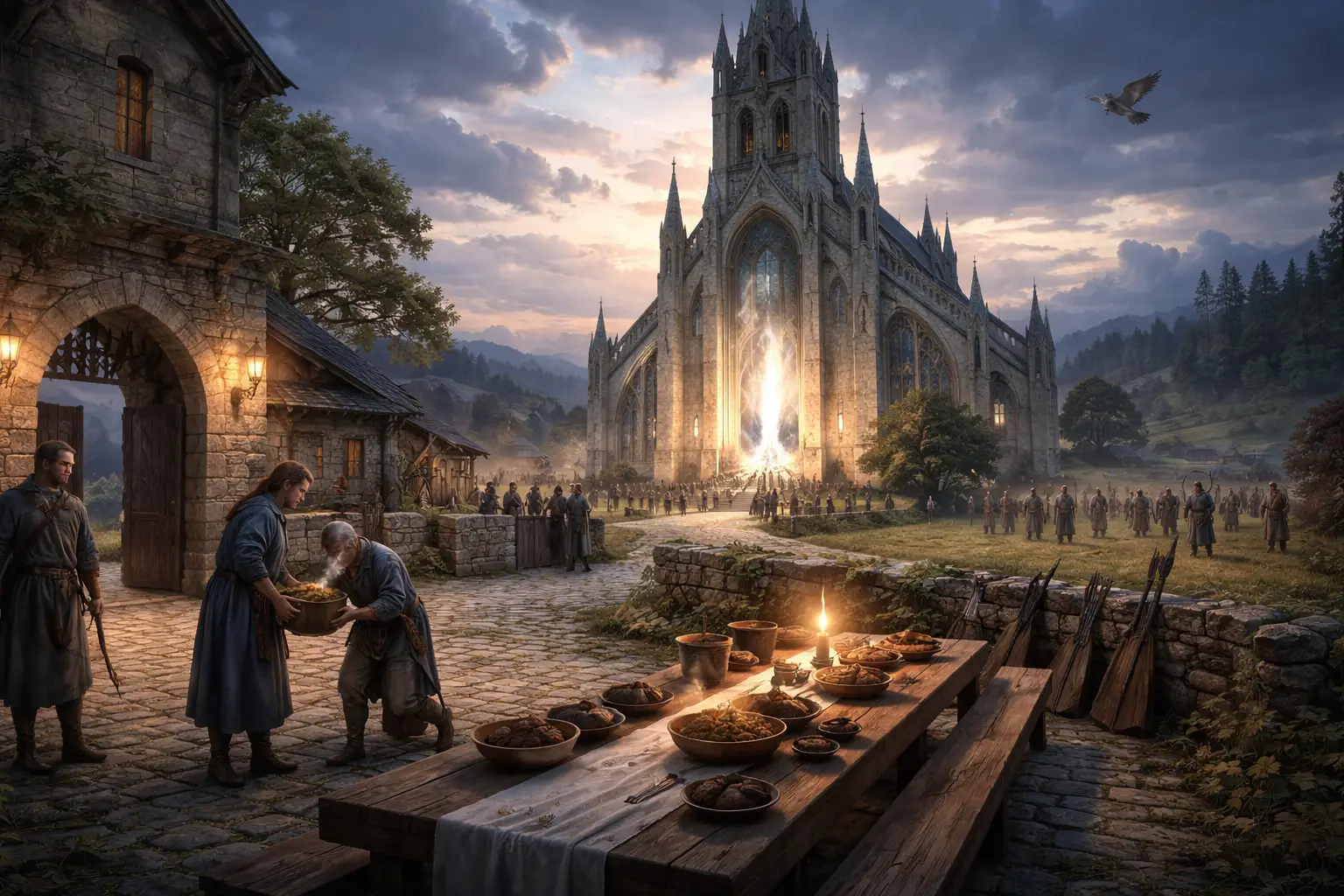
Walk into any village in Thrane and you will find the same things: a fortified church at the center, a granary beside it, an archery range behind the commons, and a priest who can tell you the grain reserves to the bushel. The everbright lanterns lighting the main street were made by an adept of the Silver Flame who considers the work a devotional act. The silverburn that tints the shrine fire — an alchemical compound that gives the flame its signature silver glow and that must never be allowed to gutter out — was prepared by a friar who learned the recipe from a friar before him. If your horse throws a shoe, the blacksmith who fixes it may whisper an invocation to the Flame as she works. This is Thrane's economy in miniature: productive, communal, self-contained, and organized around the parish rather than the marketplace.
Thrane's hallmarks — divine magic, fine crafts, fruit, livestock, textiles, and wool — reflect an agricultural and artisan base that measures strength in sufficiency rather than throughput. Where Breland counts output and Aundair counts patents, Thrane counts days until the next harvest and sleeps soundly if the number is small. The nation feeds itself well. It feeds its templars. It feeds the pilgrims who travel the roads to Flamekeep. Whether it can also finance the reconstruction of war-ravaged border regions, maintain a standing military, fund the church's global operations, and modernize its infrastructure without breaking the parish system that holds it together — that is a question to which the Diet of Cardinals has not yet produced an ecclesiastical pronouncement.
Agricultural Base
Agriculture is Thrane's foundation, and the foundation is sound. The interior remained largely secure during the Last War, allowing consistent harvests across decades of conflict — a luxury no other combatant nation enjoyed. Grain, wool, meat, dairy, and fruit exceed internal demand, and agricultural surplus has long been a primary export. The orchards of the interior are particularly productive, and Thrane fruit — fresh, dried, and preserved — appears in markets across Khorvaire with a regularity that reflects the nation's one genuinely reliable source of trade income.
Farmland operates within the parish system. Village communities organize labor communally, with barn-raisings and field-clearings conducted as collective religious acts. The Silver Flame urges its followers to stand together, and in the agricultural villages of the interior, "standing together" means hauling your neighbor's grain because his daughter is sick and the parish priest said the Flame does not distinguish between your field and his. This model produces reliable yields without requiring the market incentives that drive Brelish agriculture; it is slower to adapt but slower to collapse, and a community where the priest manages the granary and every family contributes is a community that does not starve unless the entire harvest fails.
Thrane's wool and textiles are considered fine goods on the continental market — quality driven by centuries of artisan tradition rather than industrial scale. Livestock and dairy supplement the grain economy. And preserved foodstuffs travel the pilgrimage and trade roads into Breland and Aundair, often in the same wagon trains that carry pilgrims toward Flamekeep.
PARISH LEDGER — excerpt from the records of a village church near Sigilstar, Aryth 997 YK
Grain reserves: 340 bushels (sufficient through Zarantyr). Wool bales delivered to Sigilstar factor: 18. Tithe to the diocese: 12 bushels grain, 2 bales wool, 3 head cattle. Community archery drill: conducted on schedule. Everbright lanterns on the main road: all functional, maintained by Sister Kellas. Notes: the eastern field produced less than expected. Recommend early planting next season. The Flame provides, but the soil requires attention.
Divine Magic as Industry
No economic feature of Thrane is more distinctive — or more disruptive to the continental business model — than its integration of divine magic into commercial life.
Thrane produces more clerics and paladins than any other nation in Khorvaire; an economic force that reshapes the service sector of the entire nation, because what it means in practice is that the services most people across the Five Nations purchase from the dragonmarked houses are, in Thrane, provided by the church — often for free.
In most of the Five Nations, you pay House Jorasco for healing and House Cannith for the everbright lantern that lights your shop. In Thrane, many of these services are provided by divine adepts — the divine equivalent of arcane-trained magewrights — who channel the Silver Flame to heal the sick, ward doors, cleanse clothes, purify water, and maintain the lanterns that light the streets. For a Thrane adept, mundane work done through the Flame's power is an expression of faith. They take payment because they need to eat, but faithful citizens who genuinely cannot pay are rarely turned away. The practical result is that Thrane's ecclesiastical economy competes directly with the dragonmarked houses in service sectors those houses dominate everywhere else — and wins within the church's home territory.
The Crucible of Thrane — a small order of adepts and artificers developed during the Last War — crafts magic items drawing on the Silver Flame rather than arcane science. Crucible potions shimmer silver. The command word for a Crucible wand is an invocation to the Flame. It is not House Cannith and does not pretend to be — the volume is small, the prices are not competitive, and the items carry a devotional quality that makes them unsuitable for anyone who finds religious inscription on their gear uncomfortable. But the Crucible's existence demonstrates that divine artifice is a viable economic model, and the houses regard it with the particular wariness that established businesses reserve for proof-of-concept competitors.
The Cathedral Economy
The Cathedral of the Silver Flame in Flamekeep is not merely a church. It is a self-sufficient economic zone — formerly a castle, now grown to the size of a small town, housing artisans, soldiers, gardens, sanctuaries, libraries, and production facilities capable of sustaining its several hundred inhabitants for months if cut off from the outside world. A great fire burns atop the building every hour of every day, 336 days a year, mystically protected from rain and wind and never allowed to die. It burns directly above the Chamber of the Flame, creating the illusion that the Silver Flame itself rises through the ceiling into the night sky — illuminating the surrounding neighborhoods so thoroughly that the districts nearest the Cathedral never experience true darkness.
When the Keeper of the Flame dies, the fire is treated with an alchemical substance that turns it deep blue — the color of mourning — and it remains blue until the Voice calls a new Keeper and the Diet confirms the appointment. Only then does the fire return to silver. The fire's color is visible for miles, and a traveler approaching Flamekeep at night can see the state of the church before they reach the gates.
The Cathedral's self-sufficiency makes it a fortress as well as a sanctuary, and the economic independence it represents — a community that does not need the marketplace to survive — is the purest expression of the ideal the parish system was built to achieve. Whether the rest of the nation can match that ideal is another question.
Fine Crafts and the Flamic Tradition
Thrane's artisan sector concentrates in goods with religious application: ecclesiastical regalia, stained glass with silver filigree, Flamic stonework, and embroidered textiles. The silver arrowhead tokens worn by the faithful across Khorvaire — a stylized flame inlaid with silver, etched onto an arrowhead pendant — often originate in Thrane's workshops, and their production is a modest but steady export industry.
Archery is a devotional practice of the Silver Flame — used both as meditation and martial art — and every community maintains an archery range and a militia of peasant archers. The arrows they practice with, the bows they train on, and the silver-tipped shafts the templars carry into battle against fiends and undead all require consistent artisan production. Templar orders demand a steady supply of arms, armor, and ecclesiastical equipment, and postwar reconstruction has created sustained demand for Flamic architecture — the soaring arches, flying buttresses, enormous windows, stained glass, and mosaic floors that define the church's building tradition. Stonemasons and glassworkers remain employed when other sectors are depressed, because the church is always building, always repairing, always expanding the physical space that the Flame inhabits.
The Flamic style's decorative palette is codified: whites and silvers as the primary colors, augmented with deep blue in times of mourning and red and gold in times of active war. The priesthood seeks out manifest zones tied to Syrania and, to a lesser extent, Irian for the sites of its greatest cathedrals — only a tiny handful of such zones exist, but the preference shapes where the church invests its most ambitious construction.
WORKSHOP NOTICE — Flamekeep Stained Glass Artisans' Guild, permanent fixture
All commissions for ecclesiastical glasswork must be accompanied by a design approval from the diocesan bishop. Colors, iconography, and silver filigree patterns are subject to doctrinal review. The Guild reminds artisans that the representation of the Flame in mosaic and glass is a sacred act and will be treated as such.
Secular commissions are accepted on a case-by-case basis. The waiting list is currently fourteen months.
The Pilgrimage Economy
One of Thrane's more reliable postwar revenue streams requires no factory, no export license, and no dragonmarked house — only roads, inns, and the faith of people who want to see the pillar of fire where Tira Miron gave her life.
The pilgrimage economy is substantial and growing. Faithful from across Khorvaire travel to Flamekeep for the Ascension and other holy observances, and the infrastructure that supports them — inns, food stalls, souvenir workshops producing arrowhead tokens and illuminated texts, guided tours of the Cathedral, and the simple commerce of feeding and housing thousands of travelers — generates income that flows directly into the parishes along the pilgrimage roads. The same roads serve military logistics and trade caravans, which means the investment in pilgrimage infrastructure doubles as investment in the nation's commercial and military transit networks. It is one of the few areas where faith and commerce align without friction.
Trade and Transit
The lightning rail has connected Flamekeep to Khorvaire's network since 811 YK — the first line built, linking Flamekeep to Fairhaven, and one of the oldest pieces of infrastructure on the continent. House Orien manages the Thrane lines with the institutional patience of two parties who need each other but do not trust each other — the church cannot expel the house without significant cost, and the house knows not to push its luck. Orien teamsters and conductors operating in Thrane accept levels of ecclesiastical oversight they would not tolerate in Breland, and in return they enjoy a network that has been continuously maintained through war and reconstruction.
Thaliost controls rail access between eastern and western Khorvaire and is therefore the most strategically important transit point in Thrane's territory. The ongoing violence under Archbishop Dariznu's governance disrupts commerce with every passing month — merchants reroute shipments to avoid the city, Aundairian traders refuse to cross the border, and the economic damage compounds the political damage in a cycle that benefits no one except the Pure Flame's ideology of isolation. A Thaliost that functioned as the trade hub its geography demands would be one of Thrane's greatest economic assets. The Thaliost that exists — occupied, violent, governed by a zealot — is an economic wound the nation inflicts on itself.
Internal roads serve both military logistics and the pilgrimage economy. The church's investment in pilgrimage infrastructure means that Thrane's road network is better maintained than its treasury would otherwise permit — another case where faith and commerce produce results that neither could achieve alone.
The Dragonmarked Houses
The houses operate in Thrane under conditions they face nowhere else. The church views them as powerful worldly institutions that owe loyalty to no Keeper and answer to no Cardinal — necessary but suspect, tolerated but watched.
House Jorasco competes directly with parish healers. Its enclaves are busy with outsiders and the unaffiliated, but quiet in smaller cities where a parish cleric provides equivalent services for free. The house maintains its presence because it cannot afford to abandon a market, but it does not thrive.
House Cannith is limited to standard manufacturing. Warforged have no significant presence in Thrane, nor would they be welcomed if they came, and the church's doctrinal wariness — tied to Keeper Tagor's unresolved ruling on whether constructs possess souls — adds a theological dimension to what is elsewhere a purely commercial question. Cannith operates carefully, aware that a single doctrinal ruling could transform its business from tolerated to prohibited.
House Orien manages the lightning rail and trade roads. House Sivis, House Kundarak, and House Ghallanda maintain minimal footprints — providing services to travelers and the houses' own operations rather than competing for the broader market.
The dragonmarked houses in Thrane operate the way a careful guest behaves in a strict household: politely, quietly, and with one eye on the door.
Postwar Pressures
The war's cost fell unevenly. The interior farmlands are intact and productive — a genuine blessing that no other combatant nation can match. The border regions represent economic losses that may not be recouped for decades. The Crying Fields along the Aundairian frontier — a wasteland created by Aundairian war magic — are agriculturally dead. Shadukar, once the Jewel of the Sound, was destroyed in the Karrnathi siege and remains a ruin, haunted by Thrane ghosts and Karrnathi undead left behind after the retreat. The eastern farm communities between Flamekeep and the Karrnathi border were devastated, and the undead that linger in the abandoned fields are not a metaphor.
The church's tithe system prevents the worst outcomes. Parishes maintain food reserves, and widespread destitution is genuinely rare — the communal model ensures that no family starves while its neighbors eat. But the overtaxation required to fund reconstruction, a standing templar military, and the church's global operations is a direct consequence of asking a war-thinned population to carry the full weight of a modern state. The treasury is thin. The people are taxed heavily. And the church asks them to consider the tax a tithe — a contribution to the Flame's work in the world — which most of them do, sincerely, while also noticing that their granaries are lighter than they used to be.
Whether divine self-sufficiency and agricultural productivity are enough to finance a nation that aspires to be both a country and a church — that remains one of the genuinely open questions of postwar Thrane.
"You want to know the difference between doing business in Breland and doing business in Thrane? In Breland, you bribe the inspector. In Thrane, the inspector is a priest — and the bribe is a sin." — overheard at a House Orien way station, Flamekeep-Sigilstar road