Art & Culture of Thrane
"I thought so, too. But then I found myself in the Chamber of Tira's Sacrifice, a pillar of silver fire marking the spot where one woman gave her life to protect countless innocents. I saw people from all nations joined together in song, celebrating both that ancient sacrifice and the end of our current war. And looking into the innocent eyes of the child priestess, I truly heard the words of that song for the first time: a call for all of us to be better than we are." — Sharn Inquisitive correspondent, visiting Flamekeep for the Ascension, 997 YK
The Fire That Never Goes Out
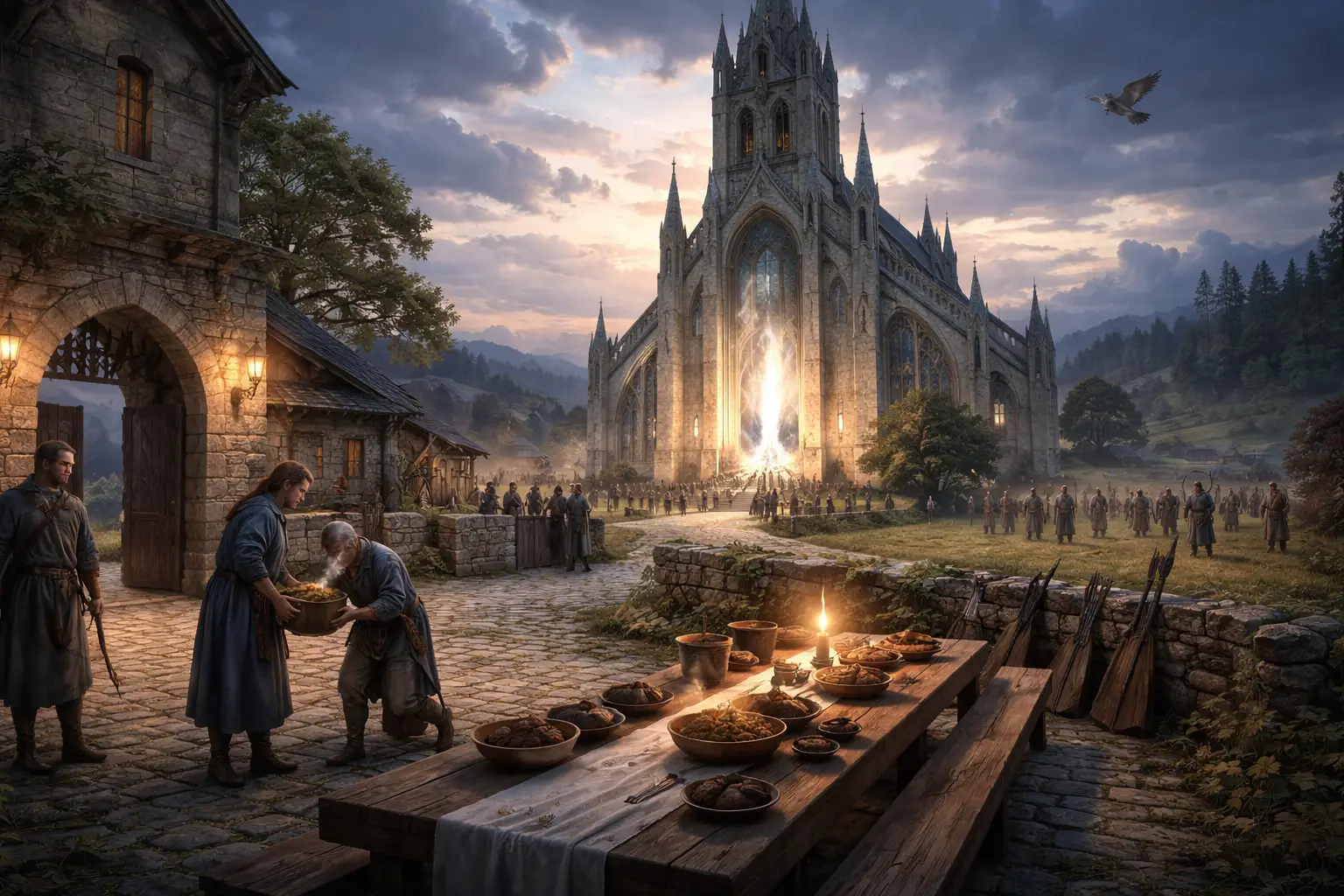
Step into a Thrane village on any feast day and the culture announces itself before you clear the gate. The fortified church at the center — stone, soaring arches, stained glass with silver filigree — has a mosaic floor with a flame at its heart, and above it a real fire burns, tinted silver with silverburn, that has never been allowed to gutter out. The people are dressed in practical wool and linen, most in shades of blue and silver, many wearing a silver arrowhead token at their throat. Someone is singing a hymn. Someone else is drawing a bow in the archery field behind the parish hall. The smell of thrakel-spiced stew drifts from the kitchen where tonight's communal meal is already simmering.
This is what Thrane's culture looks like from the inside: not the grim theocracy that Brelish editorials describe, but a community organized around shared conviction, where the fire at the center of the church and the fire at the center of the household serve the same purpose — to keep the darkness out, and to remind the people gathered around them that keeping it out is everyone's responsibility. The Purified honor the Flame by living virtuous lives rather than through constant ritual — "a life of virtue," states one of the faith's greatest axioms, "is the greatest gift a mortal has to offer." They light a silverburn candle before a meal and say thanks. They attend services on the twelve high holy days. They teach their children to draw a bow and stand together when something threatens the village. And they do not pray constantly, because the Flame does not need constant prayer. It needs you to live well, act with compassion, resist the evil within, and be ready to fight the evil without. The overt worship that outsiders expect from a theocracy is largely absent — which leads those outsiders to misread Thrane as less devout than it is, when in fact the devotion simply takes a form they are not looking for.
The five broad edicts of the faith are simple in tone even when difficult in practice: trust the Flame, heed the Keeper, fight evil, live nobly, share the faith. Everything the culture produces — the architecture, the music, the food, the clothing, the calendar — flows from these five commandments the way water flows from a spring, and the spring has not run dry in seven hundred years.
Light and Stone
The Flamic architectural style is the visual language of the Silver Flame made physical, and it dominates Thrane's built environment with a totality that no other nation's aesthetic achieves. True temples are stone, with abnormally high ceilings, enormous arches, flying buttresses, and stained glass with silver filigree that throws fractures of colored light across the mosaic floors. The decorative vocabulary is geometric — stylized cubes, triangles, and luminous religious imagery, each shape carrying doctrinal meaning that the Purified absorb from childhood. Whites and silvers predominate, shifting to deep blue in mourning and red and gold in war. The priesthood builds its greatest cathedrals on manifest zones tied to Syrania or Irian when such sites can be found — the Cathedral of the Silver Flame in Flamekeep, built around the pillar of fire that marks Tira Miron's sacrifice, is the grandest structure in the nation and one of the most awe-inspiring buildings in Khorvaire.
Even ordinary villages feel like extensions of ecclesiastical space. Icons of the Flame and images of Tira Miron appear on walls, doorways, bridge parapets, and inn signs. Every family shrine requires only a spot for a fire — preferably tinted with silverburn — sufficient to light the entire space. The sacred and the civic are not separate registers. They are the same stone.
The Pre-Kingdom style is the significant countercurrent — a visual tradition that rejects Flamic luminous abstraction in favor of rawer, more human, more emotional subjects. Pre-Kingdom artists work in sacred subjects but treat them as events that happened to real people rather than theological diagrams. The style has found particular support in postwar Thrane, where the war's grief does not fit easily into stained glass and silver light. A Pre-Kingdom painting of a woman at the Shadukar road carrying an empty basket and looking back — grief without theology, loss without redemption — was asked to be removed by the Archbishop's office. The gallery refused, citing Keeper Serrain's proclamation on sacred expression. The Archbishop hasn't pushed it. Yet.
The exchange tells you where the fault line in Thrane's cultural life runs: between the faith that sustains and the faith that constrains, and the growing number of people who are trying to honor both without pretending the tension does not exist.
Reconstruction after the war has itself become a cultural project — church-sponsored rebuilding that shapes both infrastructure and aesthetics, turning devastated border regions into demonstrations of Flamic principle. The scars of the Crying Fields and the ruins of Shadukar do not fit the Flamic vocabulary of light and triumph. How the nation builds on top of what the war destroyed — whether it covers the scars with silver or lets them show — is among the most visible cultural negotiations of the postwar age.
The Twelve Days and the Weekly Fire
The Silver Flame's calendar structures civic and social life from the parish level upward. There is a weekly Day of Cleansing Fire — the first day of each week, a fast day for ordinary Purified (one meal skipped in favor of prayer) and a day of full fasting for priests and the especially devout. Many shops close. The service always begins with a recitation of the Nine Miracles of the Silver Flame spoken in Draconic:
Bringing light to the world. Imprisoning demons. Offering souls an afterlife beyond Dolurrh. Granting divine magic. Bonding with Tira Miron. Transforming Thrane into a holy nation. Binding of community. And the promise of the end of evil, and the creation of a better world to come.
The precise wording varies from sect to sect and church to church, but the structure is universal. The ninth miracle — the promise — is the one that matters most, because it is the one that has not yet been fulfilled, and the Purified carry it forward not as certainty but as obligation.
And then there are the twelve high holy days — the spine of the Thrane year, each layered with prayer, specific rites, and meaning that the Purified absorb from childhood:
Name | Date | Purpose |
Rebirth Eve | 14 Zarantyr | The Purified new year, held on the winter solstice — an all-night vigil against the longest darkness, the faithful staying awake until dawn breaks. The symbolism is literal: you stand against the dark until the light returns. |
Bright Souls' Day | 18 Olarune | Honors every follower of the Flame who died fighting evil. The Purified are forbidden to use artificial or magical light, accepting the fall of night as the dead accepted death. This day has grown heavier since the war. |
Tirasday | 5 Therendor | Celebrates the planting season and Tira Miron's birth — the most popular date for marriages and gift-giving. A day of joyous celebration after the morning work is done — the closest Thrane comes to uncomplicated happiness. |
Initiation Day | 11 Eyre | Marks the church's formal independence from the Sovereign Host; the traditional date for cathedral groundbreakings and seminary graduations. |
Baker's Night | 6 Dravago | The most beloved popular holiday — families sharing magnificent pastries in a confectionery tradition whose origin is unknown even to the Cathedral's archives. Children love it. Puritanical communities are letting it fade. Everyone else holds on, fiercely. |
Promisetide | 28 Dravago | Honors the Flame's promise of paradise and offers thanks to the Sovereign Host for creating the world the Flame would complete — a theological position that many non-Purified find presumptuous and that the Purified consider simple acknowledgment of fact. |
First Dawn | 21 Nymm | Commemorates the church's assumption of governmental control in 914 YK. Some Thranes celebrate it as divine destiny fulfilled. Others observe it with complicated silence. |
Victory Day | 9 Barrakas | Commemorates the end of the Silver Crusade. Children reenact battles while adults hear sermons on the campaign's questionable methods — the church's most honest annual reckoning with its own history. |
The Ascension | 1 Sypheros | Honors Tira Miron's sacrifice and draws pilgrims to Flamekeep from across Khorvaire — the nation's largest holy day and its most significant pilgrimage event. |
Saint Valtros's Day | 25 Sypheros | The least of the holy days, honoring the first paladin called to serve. |
Rampartide | 24 Aryth | A day of fasting and repentance as winter closes in — a time to atone for the evil within. Second only to the Silvertide in its austerity. |
Khybersef | 27 Vult | "Khyber's Eve" — when the demon bonds are thinnest and the faithful hold intense prayer vigils. Many quests begin on this night, when the darkness is closest and the call to face it is strongest. |
OVERHEARD — parish kitchen, village of Lessyk, Baker's Night 997 YK
"The Archbishop says Baker's Night has no doctrinal basis and should be observed with restraint. My grandmother says the Archbishop can come to Lessyk and tell her that to her face, and in the meantime, eat your pastry."
Rites of the Living
The Purified mark the passages of life with rituals that are fewer and more deliberate than outsiders expect. Funerals are minor rites — brief and purposeful, because the dead are with the Flame and do not need elaborate ceremony. The two events that require major priestly attention are births and weddings.
Weddings are always conducted during one of the twelve holy days — never as independent ceremonies. The marriage becomes part of the day's observance, woven into the larger celebration. Tirasday is the most popular choice.
Birth ceremonies are the only major rite that is not strictly defined by doctrine. The priest must say certain prayers and light silverburn candles in a particular pattern, but the remainder — hymns, dances, specific sermons — is up to the parents. Expecting couples meet with their priest months in advance to arrange the service as they wish. The symbolism is clear: not even the greatest priest can foretell what will happen in life, so it is not the church's place to determine how a child enters the world. In a faith that structures nearly everything, the deliberate openness of the birth rite is one of its most humane qualities.
A Purified who is injured by an evil creature is required to sprinkle silver into the wound and cauterize it with a silverburn flame if magical healing is not available — a gesture symbolizing the will to resist corruption and petitioning the Flame to prevent evil from reaching the soul through the body. The rite is practical, painful, and sincere.
Song, Bow, and Restraint
Music in Thrane is liturgical at its core. Major temples employ full choral ensembles trained from childhood in cathedral schools, and formal prayers almost always involve song — voices rising together in the high-ceilinged sanctuary, the silver-tinted firelight shifting on the stained glass, the sound filling the space the way the architecture was designed to let it fill. Liturgical music is Thrane's most distinctive cultural export, and visiting Flamekeep during the Ascension to hear the Grand Cathedral's choir is an experience that has converted skeptics. Outside the cathedrals, parish hymns — simpler, communal, sung by everyone rather than performed by a trained choir — anchor the daily and weekly worship. The hymn tradition is the thread that connects the simplest village to the grandest cathedral: the same songs, the same purpose, the same fire.
Archery competitions at holy day festivals serve simultaneously as celebration, military drill, and devotional act. The faithful say the rainbow-feathered arrows represent the couatl defending the innocent — though the longbow also reflects the pragmatism of remaining as far away from danger as possible, particularly when fighting fiends and rakshasas vulnerable to piercing weapons. The skill of the parish archers is a matter of genuine civic pride, and a visitor who watches the tournament and sees only a festival is missing the fact that every participant is training for the day the dolgrim come out of the ground.
House Phiarlan and House Thuranni maintain a more limited performance presence in Thrane than elsewhere — traveling entertainers are tolerated but watched, and the consequence is a performance culture more locally generated, rooted in parish traditions and the Flame's calendar rather than the house-sponsored entertainment that dominates Breland and Aundair. Thrane's performing arts are not spectacular. They are sincere, which is harder and rarer.
Thrane's cultural style emphasizes restraint, modesty, and intensity held under control. Open shouting and public loss of temper are considered rude. Opposition is expressed briefly, precisely, and with more heat than volume. Beneath that control lies real passion — when a Thrane commits to a cause, they commit completely, and the quiet conviction of a Thrane templar walking into danger for the sake of strangers is one of the most compelling things the culture produces. The Purified are not cold. They are contained, which is a different thing entirely, and misreading the containment as absence is a mistake that outsiders make exactly once.
Dressed for the Work
Thrane fashion is conservative, practical, and symbolic. Blue and silver are the colors of the faith. Long coats and dusters are ubiquitous — simple, durable, versatile. Boots are made for rough roads. There is no shame in mended clothing; wearing a father's coat taken in to fit is frugality the culture admires. Civilians carry the faith on their persons: silver arrowhead tokens, embroidered patches, Flame iconography across all class levels. Elaborate ornamentation for its own sake signals priorities the culture treats with suspicion.
Silverburn — the alchemical substance that causes flames to burn silver — is used in many rites, and the faithful who can afford it are under religious obligation to use it. Those who cannot afford silverburn substitute iron filings, glass shards, or sweet-smelling oils — less luminous but no less sincere. The compromise itself is doctrine: the Flame does not ask for what you cannot give. It asks for what you can.
At the Parish Table
Thrane food is one of the nation's great quiet pleasures — and the one aspect of Thrane culture that surprises every visitor, because the food is not restrained at all.
Thrakel spice defines the Thrane palate — a pungent, warming, assertive spice native to the region that builds heat the way a good argument builds heat: gradually, then all at once. Thick sauces. Rich meat dishes — lamb, venison, river fish. Vegetable skewers charred over open flame. Fish stews from the coastal communities, with thrakel stirred in until the broth glows amber. And cold sweet desserts meant to offset the main course's fire — cream pastries, honeyed fruits, the celebrated Baker's Night confections whose recipes are parish secrets guarded with the seriousness other nations reserve for military intelligence.
The communal dining tradition makes food inseparable from the ritual texture of daily life. Meals at parish gatherings begin with a silverburn candle lit and thanks spoken. Household suppers follow the same pattern in miniature. Nothing is wasted. The frugality of the kitchen mirrors the frugality of the wardrobe, and both mirror the faith: use what you have, share what you can, and do not take more than you need.
The food is not luxurious. It is not designed to impress. It is warm, and filling, and there is always enough, and the people who made it are glad you came. A visitor who sits at a parish table and eats thrakel lamb stew with dark bread and follows it with a Baker's pastry and washes it all down with a mug of cider will leave with a full stomach and the nagging suspicion that they have just experienced the most honest hospitality on the continent — and they will not be wrong.
Cyran refugees in particular have embraced thrakel — Cyran fusion chefs in Sharn blend Thrane's signature spice with Karrn stews and Aundairian pastries, and the spice appears in markets across Khorvaire with increasing regularity. The thrakel trade is modest but growing, and Thrane's preserved fruits — dried, sugared, pickled — travel the pilgrimage roads as both provisions and export.
PARISH KITCHEN MENU — Silvertide Feast, Cathedral of the Argent Star, 997 YK
Thrakel lamb stew with root vegetables and dark bread. Grilled river fish with herb butter. Roasted squash with honey and cracked pepper. Archer's pie (venison, onion, potato, gravy). Baker's pastries (three varieties: apple-custard, walnut-honey, and the Keeper's Tart, whose recipe is a cathedral secret and whose filling is a matter of annual speculation).
Silverburn candles will be lit at the second bell. All are welcome. Donations accepted but not required.