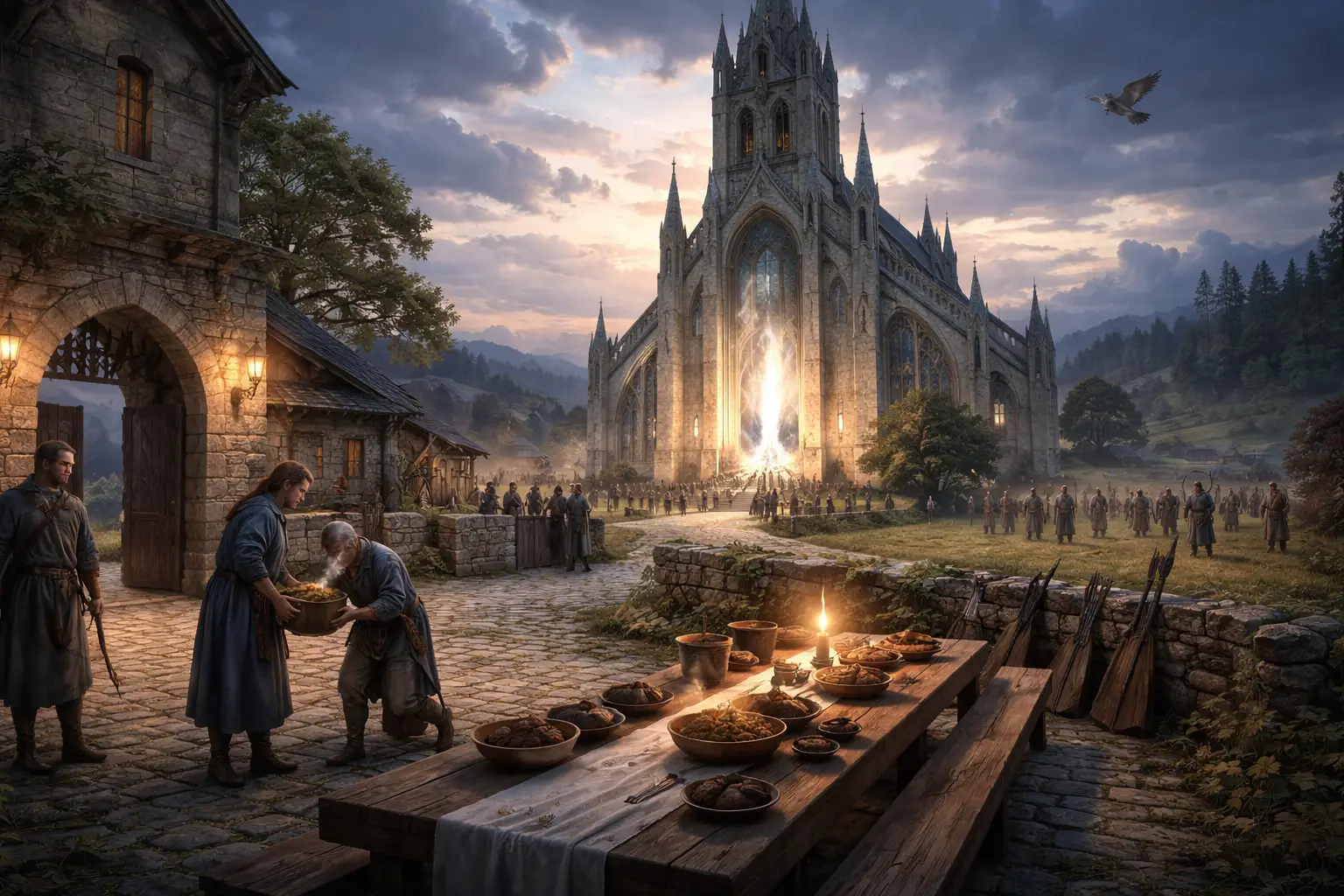
Politics of Thrane
From the private journal of a Brelish diplomatic attaché, Flamekeep, Sypheros 997 YK:
I have been in Thrane for six weeks. In that time I have attended four services, two audiences with the Diet, a military review by the templars, and a banquet at which every toast was a prayer and every prayer was a policy statement. I have learned that criticizing a tax decree in Thrane is not political dissent. It is heresy, because the decree was issued as an ecclesiastical pronouncement under the Keeper's seal, and questioning it is questioning the will of the Flame.
I have also learned that the eleven-year-old girl who leads this nation may be the most genuine person in the building, and that the man standing behind her may be the most dangerous. I cannot tell whether they are allies. I cannot tell whether she knows.
A Church That Became a State
Every political act in Thrane is simultaneously an act of theology. The Diet of Cardinals does not pass laws — it issues ecclesiastical pronouncements under the Keeper's seal. Debates over taxation, military deployment, criminal sentencing, and trade regulation are conducted in the language of doctrine. Disagreeing with a ruling is structurally identical to disagreeing with the will of the Flame — and that framing makes political opposition not merely dangerous but heretical. The farmer who objects to a grain tax is not lodging a complaint. He is questioning a pronouncement issued by the ordained representatives of a divine force that holds demons at bay. The social cost of that objection is considerably higher than writing a letter to the Korranberg Chronicle.
Understanding who actually governs Thrane requires understanding how a church became a state, where the fault lines run, and why the distinction between the two may be the most important political question on the continent.
The Theocratic Structure
When King Thalin died in 914 YK, the people of Thrane — or more precisely, the senior clergy of the Church of the Silver Flame — rejected his heir's claim and placed temporal authority in the hands of the Keeper of the Flame, Serrain. The arrangement was not codified in a constitutional document. It emerged from the investiture of a single Keeper with secular power and has been the operating reality ever since. The church makes law, administers justice, commands the military, and controls the treasury. The lands once held through the crown are now the property of the church. Viscountships were dissolved. Noble holdings were stripped, with higher nobles allowed to retain a single manor and estate but no administrative or judicial authority. Church functionaries replaced the entire civil administration.
The five broad edicts that govern daily life are simple in tone: trust the Flame, heed the Keeper, fight evil, live nobly, and share the faith. In practice, "heed the Keeper" means "heed the Diet of Cardinals that speaks in the Keeper's name," and the gap between those two things is where the politics of Thrane lives.
The Keeper of the Flame
The head of state is Jaela Daran — called by the Voice of the Silver Flame in 993 YK at the age of six, now eleven. The Keeper is not elected but called; the Diet confirms the appointment but does not make it. Jaela communes with the spirit of Tira Miron directly and has demonstrated genuine divine power — she has summoned celestials to her side and resurrected Cardinal Halidor after his assassination. Her poise and wisdom exceed her years in ways that the faithful attribute to the Flame's guidance and the skeptical attribute to excellent handlers.
The Keeper's divine power is tied to proximity to the fountain of fire in Flamekeep. How much of that power travels beyond the Cathedral's walls is a question the church does not publicly address — and one with significant implications for whether Jaela could ever act independently of the hierarchy surrounding her. A Keeper who can summon angels inside the Cathedral but not outside it is a Keeper who can be controlled by controlling access to the Cathedral.
Behind the child stands High Cardinal Krozen — a brilliant strategist, a ruthless political operator, and the man who controls most of the practical levers of state. He presides over the Diet. He manages appointments. He shapes which information reaches the Keeper and which does not. Many believe Krozen was behind the death of Keeper Lavira Tagor in 992 YK, suggesting that he supported the child Keeper precisely because a child cannot effectively challenge his authority. Whether Jaela is the genuine divine selection or a figurehead for Krozen's ambitions is the defining political question of the era. The answer may depend on which voice Krozen is listening to — and whether that voice comes from the Flame or from the Shadow within it.
"The child is either the most powerful person in Thrane or the most powerless. The terrifying possibility is that both statements are true at the same time." — overheard among the Brelish diplomatic staff, Flamekeep
The Diet and Council of Cardinals
A distinction that outsiders frequently miss — and that insiders exploit: the Council of Cardinals and the Diet of Cardinals are not the same body. The Council is the broader order of senior clergy, another rank in the hierarchy. The Diet, drawn from the Council's ranks, is the actual ruling body that issues decisions in the Keeper's name. Only a cardinal can serve on the Diet, but not all cardinals are members of it. Cardinals are nominated and elected by other cardinals — a process as political as any parliamentary election, though conducted in the language of spiritual discernment. The overwhelming majority are drawn from the Order of Ministers, since cardinals have regular discourse with few others outside the archbishopric. A rare few come from the Order of Templars. Rising from the Order of Friars to the Council is exceptionally uncommon.
The Diet frames all decisions as theological interpretation rather than secular policy. This is not a rhetorical trick — the members of the Diet genuinely believe they are interpreting divine will. But it produces a system in which political criticism is indistinguishable from doctrinal dissent, and in which the social, legal, and spiritual costs of opposing the government are orders of magnitude higher than in any other nation. A Brelish citizen who disagrees with the king writes a letter. A Thrane citizen who disagrees with the Diet is disagreeing with the Flame.
The Three Orders
The Church of the Silver Flame is organized into three orders of clergy, each with distinct roles that together encompass everything from parish work to international espionage.
The Order of Ministers tends congregations, administers communities, and provides the bulk of the governance apparatus. Ministers are the priests the average Thrane encounters daily — the father or mother who conducts services, administers the parish, settles disputes, and represents the church at the local level. Archbishops, the highest rank a minister can achieve without joining the Council, hold authority over the bishops of several major cities and are the primary pipeline to the cardinalate. Most of the governance that actually reaches citizens — tax collection, land disputes, infrastructure, education — flows through the ministers.
The Order of Friars wanders. Friars and their junior counterparts, pilgrims, are missionary priests who travel from land to land, bringing the light of the Flame into dark places and performing acts of compassion and charity. They are also called "priests errant," and they represent the church's most visible presence outside Thrane — the Silver Flame cleric your party encounters on the road is far more likely to be a friar than a templar. Friars lead by example, conduct services wherever they find themselves, and aid those who require assistance. Their responsibilities are less defined than the other orders, which makes them both the church's most flexible instrument and its most independent agents.
The Order of Templars fights evil in the flesh. The templars are the church's military arm — warriors, fighters, and monks, with a substantial number of paladins and clerics among their ranks. They wear distinctive silver tabards, carry the knightly honorific "Sir" or "Lady," and are recognized as knights of the church and effectively lesser members of Thrane's aristocracy. The templar order is represented on the Diet by the Grand Master, with seven regional commanders beneath: one for each of the former Five Nations, one for foreign lands, and one for the seas. Beneath them, no formal division of rank exists — templars are free to wander the world in pursuit of the order's aims, reporting to the commander of whatever region they enter.
The templars' mission is the defense of the innocent against supernatural evil — fiends, undead, aberrations, lycanthropes, and similar threats. During the Last War, templars of all nations still united to fight demons when supernatural threats arose, even while fighting each other on the political battlefield. This dual loyalty — to the Flame across borders, and to the nation within them — is the crack that allowed the war's worst compromises to take root.
POSTED NOTICE — at templar chapterhouses across Thrane, permanent fixture
The five duties of the Purified: Trust the Flame. Heed the Keeper. Fight evil. Live nobly. Share the faith. If you are uncertain which duty applies to your situation, consult your superior. If your superior is unavailable, consult the Flame. If the Flame is silent, consult your conscience. If your conscience is silent, you are not listening hard enough.
Local Governance
In practice, governance at the local level depends entirely on the integrity of individual bishops and archbishops, whose authority within their domains is substantial and whose misconduct can go undetected for years — especially where distance and deference shield authority from scrutiny. In some regions, a single bishop or small clerical cabal is effectively the government. Many are sincere and lawful. The system does not require them to be.
A corrupt bishop in a small town governs in the language of righteousness and answers to a cardinal who may be too busy, too distant, or too complicit to investigate. A zealous prefect who confuses doctrinal enforcement with personal vengeance has the tools of the state at his disposal and the vocabulary of the faith to justify their use. The church punishes those who are discovered. The system does not prioritize discovery.
The Blood Regent and the Throneholders
Queen Diani ir'Wynarn is the Blood Regent — theoretically an advisor to the Keeper and the Cardinals, residing in Thalingard, the ancestral palace of Thrane's rulers. In practice, she is largely ignored. She attends services. She appears at public events. She smiles. And she quietly believes that Aureon and Dol Arrah have plans for her yet.
The Throneholders — loyalists who dream of restoring the monarchy — range from wistful traditionalists who attend Diani's salons and sigh about the old days to active conspirators willing to undermine the theocracy through espionage, propaganda, or violence. King Kaius III of Karrnath, who distrusts the Diet and would much rather negotiate with a proper monarch, gives the faction an external patron it would not otherwise have — a fact that makes the Throneholders simultaneously more dangerous and more suspect, since accepting Karrnathi support is treasonous by any standard the Diet recognizes.
The Thrane nobility uses standard Galifaran ranks but has been functionally neutered. There are no viscounts or crown reeves — those positions were dissolved in 914 YK. Only eldest heirs receive courtesy titles. Nobles cannot create titles or take any action that would have once required sovereign approval. Most have no power beyond their estates unless they also hold a church position — a provision that has encouraged ambitious nobles to take holy orders for reasons that have nothing to do with faith and everything to do with access.
"I love the Flame. I do. I pray every morning, I drill with the militia on Dol Arrah's days, and when the dead walked out of the Karrnathi fog at Angwar Keep, I was on the wall with my bow. But when Bishop Garanth tells me the tax on my grain is a matter of doctrine, I confess that my devotion wavers slightly." — overheard in a Flamekeep tavern, 998 YK
Political Tensions
Several fracture lines run beneath Thrane's image of monolithic faith.
The Keeper Question. Krozen's control of the Diet is not universally accepted. Cardinals who believe Jaela's voice is genuine represent a persistent internal opposition that cannot express itself openly without being framed as opposition to the Flame. Jaela is deeply troubled by the Pure Flame's extremism and is considering how to address it. Whether she will grow into independent authority — or whether Krozen's grip tightens as she ages into a more threatening figure — shapes every significant appointment in Flamekeep.
Thaliost. The ancient Aundairian city, seized during the Last War and ceded to Thrane under the Treaty of Thronehold, is an open wound that will not close. Its population bitterly opposes the Thrane occupation. The Council's decision to install Archbishop Dariznu — a Pure Flame zealot — as governor has produced ongoing violence, permanent diplomatic crisis, and the spectacle of the church's most extreme faction governing in its name uncorrected. Dariznu's appointment was an effort to ensure the Pure Flame would accept Flamekeep's authority — a pragmatic calculation that has produced a fanatical governor in an occupied city where violence between Pure Flame adherents and Aundairian loyalists is constant. A movement within the Pure Flame urges Dariznu to rally forces and "liberate the Keeper" by marching on Flamekeep — a fantasy the faction lacks the resources to execute but that the Argentum monitors with acute attention.
Nonhuman Exclusion. Human dominance within the hierarchy has produced reform societies and conspiratorial movements among nonhuman citizens who feel structurally excluded from power. Some pursue legitimate channels — patronage, political support, appeals to doctrine. Others have turned to sabotage or violence.
The Whispering Flame. An extremist cult embedded within the church, acting through scattered cells in service of Bel Shalor — the Shadow in the Flame. Most Purified dismiss it as urban legend. The Inquisition does not.
Keeper Tagor's Ruling. In 992 YK, Keeper Lavira Tagor ruled that the church must reevaluate its classification of innate evil — directing templars to judge creatures by their actions rather than blanket species-wide assumptions. The ruling touches the warforged, Droaam's monstrous citizens, shifters, and any population the church has historically treated as inherently threatening. The Council of Cardinals has been debating the matter since Tagor's death. Jaela has yet to make a final ruling. The delay may reflect her youth, Krozen's interference, or the genuine difficulty of overturning centuries of doctrine in a nation where doctrine is law.
Foreign Relations
Thrane's diplomacy is shaped by faith and grievance in roughly equal measure. Relations with Karrnath are defined by hatred — the undead armies, the wyvern raids, the destruction of Shadukar, and decades of naval combat in Scions Sound have produced an enmity that the treaty has not softened. Kaius's monarchism and Krozen's theocracy regard each other with the specific contempt that people reserve for systems they consider not merely wrong but morally offensive.
Relations with Aundair are poisoned by Thaliost — a city Aundair considers stolen and Thrane considers liberated. The Pure Flame's Aundairian origins and Archbishop Dariznu's governance make the situation worse, and the blasted wasteland Aundairian war magic created between the two nations serves as a physical reminder that neither side fought clean.
Breland is the closest thing to a functional diplomatic relationship — Thrane and Breland cooperate on Thronehold matters and maintain cautious commercial ties. The Silver Flame's strong Brelish following provides cultural connective tissue that the other relationships lack.
The church maintains a global presence through its orders — templars, friars, and Argentum agents operate across Khorvaire. But the division the Last War produced — templars of different nations united against supernatural threats but fighting each other in the political war — has never fully healed. The faithful outside Thrane respect the Keeper's spiritual authority. Many do not accept the theocracy's political authority. The Stormreach priests who severed ties with Flamekeep in 914 YK have never reconciled.
"Thrane is a nation that believes it is governed by divine will. The question is not whether the belief is sincere — it is. The question is what happens when divine will and political convenience arrive at the same answer, and nobody in the room can tell which one spoke first." — Dark Lantern assessment, classification: eyes only