Military & Security of Thrane
The Church Militant
There is no such thing as Thrane's military as a separate institution. The army is the church and the church is the state, and the templar who patrols a village road on Tuesday may enforce a doctrinal ruling on Wednesday without changing his chain of command, his uniform, or his sense of mission. Enlistment is spiritual vocation, not civic duty. Command flows from ecclesiastical rank. Discipline is enforced through the same structures that enforce faith.
What Thrane lacks in industrial military capacity — it cannot match Breland's mass-produced equipment or Karrnath's necromantic arsenal — it compensates for with divine magical support, communal preparedness, and an institutional loyalty structure that survived a century of war without fracturing. The nation that produces more clerics and paladins than any other in Khorvaire produces a military to match: templars backed by divine healing on the battlefield, village militias trained through devotional archery, and a command structure that extends from the Diet of Cardinals down to a farmer pulling a bowstring on a feast day.
The Templar Order
The Order of Templars is the church's military arm and serves as Thrane's standing army, police force, border patrol, and internal enforcement — all at once. A detailed treatment of the templar hierarchy, organization, and operational doctrine can be found in the dedicated Templar article; what follows is a summary of the order's role in Thrane's broader security posture.
The templars are organized under High Cardinal Baerdren ir'Davik, the current Grand Master, who holds a seat on the Diet of Cardinals. Baerdren is widely regarded as an exemplary templar — a genuine warrior of the faith whose personal integrity is not in question — but he chafes at the political weight his Diet seat demands. Seven regional commanders serve beneath him: one for each of the former Five Nations, one for foreign lands, and one for the seas. Below the commanders, no formal rank divisions exist; templars exercise initiative and report to whichever regional commander holds jurisdiction. Coordination between commands is uneven — the system works well in some regions and barely functions in others, depending entirely on the relationship between the commanders involved.
Most templars are mundane warriors, not divine spellcasters. But the order is supported at every level by ministers and friars who provide healing, logistical support, and spiritual counsel — the three clergy orders cooperate at the rank-and-file level even when their leaders are at odds. Since the order is sworn to exterminate supernatural evil, fiends, undead, and cults of the Dragon Below are always hostile when they recognize a knight templar. This is the practical reality of wearing a silver tabard in a world where demons are real: the tabard is both armor and target.
The Grand Master's seneschal is Lady Ofejjaia of Korth — a powerful Karrnathi cleric who leads the largest Flamist congregation in Karrnath, based in Vedykar. Her wisdom and devotion are not in dispute. Her agenda and Karrnathi origin are points of unacknowledged political sensitivity — a Karrnathi cleric in the second-highest military position in a nation that regards Karrnath as its bitterest enemy is either a testament to the Flame's universality or a security concern of the first order, depending on who you ask.
The Knightly and Monastic Orders
Beyond the templars, the Silver Flame maintains an enormous number of knightly and monastic orders — each with its own devotion, its own region, and its own traditions. Knightly orders are drawn primarily from the templars and consist of warriors and fighters with a smattering of paladins, clerics, and monks, based in or near large cities and operating from enormous chapterhouses that double as fortresses. Monastic orders are located in simpler abbeys near smaller communities, comprised primarily of experts and warriors with a few monks and paladins.
The Order of the Argent Fist boasts elite holy warriors — the argent fists — among the most formidable individual combatants the church produces. The Holy Brethren of the Silver Blade, a knightly order based in Lathleer, Aundair, represents the Flame's military presence outside Thrane's borders. The Monastery of Saint Dioscian the Anchorite, near Black Pit in Breland, is one of the most remote and austere of the monastic orders. And the Knights Custodial — charged with protecting other members of the clergy — maintain chapterhouses in all the major cities of Thrane and in many across Aundair and Breland.
These orders represent the church's deep bench — specialist forces that the templar command can call upon when a threat exceeds what a standard patrol can handle. An adventuring party operating in Thrane or alongside Flamist allies may encounter members of any of these orders, each with their own mandate, their own culture, and their own interpretation of what "defending the innocent" requires.
The Knights of Thrane
The Crown Knights are separate from and older than the templar order — established during the time of Prince Thrane, pledged to defend crown and country. When the theocracy displaced the monarchy in 914 YK, the heir apparent bowed to the Keeper rather than provoke civil war, and the Knights followed.
Today they serve Queen Diani in name but the Council of Cardinals in practice — an elite force dispatched on special missions, troubleshooting assignments, and situations that require a party of adventurers rather than a templar patrol. A Crown Knight squad might include fighters, paladins, rangers, sorcerers, or bards — essentially a group of specialists operating under a mandate that predates the theocracy and that the Diet has never formally revoked. Their dual loyalty — to a queen the church has sidelined and to a church the queen quietly resents — makes them a natural pressure point for the monarchist faction. A Crown Knight who takes orders from Diani rather than from the Diet is not committing treason under any law the monarchy recognizes. Whether the theocracy agrees is another matter.
The Village Militias
Every village in Thrane maintains a militia prepared to defend the community from supernatural threats — not through conscription but through doctrine. The Silver Flame urges the faithful to stand together, and in the villages of Thrane, "standing together" means training to fight the things that come out of the dark.
Archery is the devotional practice tied to this preparedness: both meditation and martial discipline, with silver-tipped arrows said to represent the couatl defending the innocent — though scholars note that the longbow also reflects the pragmatism of remaining as far away from danger as possible, particularly when fighting fiends and rakshasas who are vulnerable to piercing weapons. Larger towns maintain sturdy walls patrolled by skilled archers, and the fortified church at every community's center is designed to serve as a fortress when needed — thick stone walls, high ceilings, defensible windows, and a silverburn fire that never gutters out.
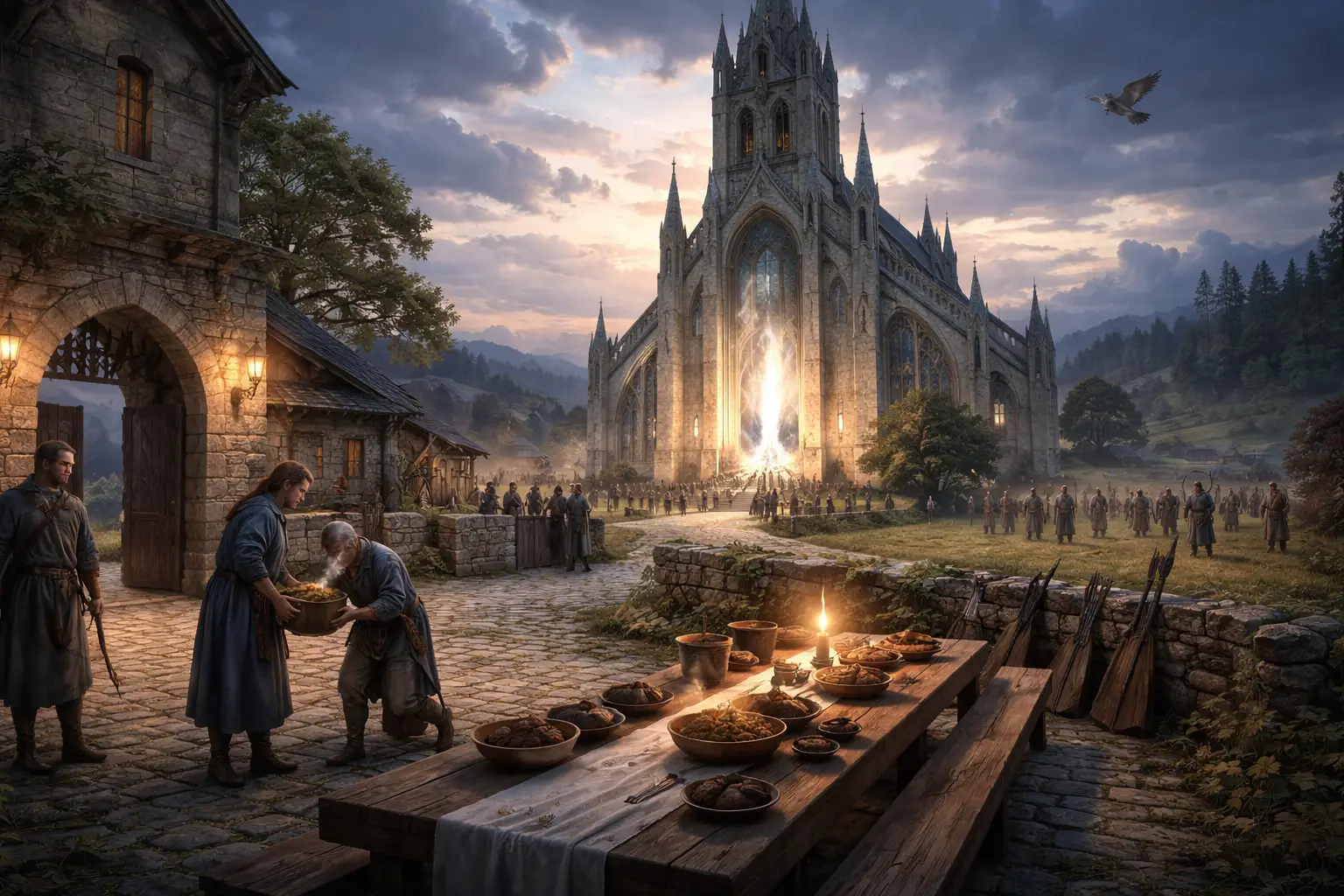
A visitor will see the militia at work on any feast day — farmers drawing bows in coordinated volleys, a priest calling corrections, a deacon keeping score. It looks like a festival event. It is also a functioning military drill, and the people who participate know it. A nation where every village practices archery as a religious obligation is a nation that can field trained bowmen from every settlement at short notice — a capability that no other nation in Khorvaire can match without formal conscription.
"The Thranes do not have an army in the way we have an army. They have a church that happens to own every bow in the country." — Karrnathi military assessor, in a briefing for the Vulyar command
The Argentum
The Argentum began as an order dedicated to recovering dangerous magic items — cursed weapons, fiendish relics, artifacts of the Dragon Below — and securing them in vaults where they could not harm the innocent. During the Last War, it was repurposed as the church's intelligence agency, operating across Khorvaire as the covert counterpart to the templars' overt enforcement.
Argentum agents are spies, investigators, and retrieval specialists — the kind of people who can identify a disguised rakshasa in a crowded market, track a stolen relic across three national borders, and conduct the kind of quiet diplomacy that a silver tabard makes impossible. Their original mandate — artifact recovery — continues alongside their intelligence role, and the vaults of recovered objects they maintain are the subject of constant political maneuvering among cardinals who would very much like to know what is in them and Argentum commanders who believe that some things are better left locked away.
The Argentum monitors the Emerald Claw's activities in Karrnath, Pure Flame movements in Thaliost, and fiendish operations across the continent. It is the church's most professional intelligence service and, because it reports directly to the Diet rather than to the Grand Master, operates outside the templar chain of command — a structural independence that makes it valuable and that the Grand Master tolerates because the Argentum handles the work that templars cannot do quietly.
The Inquisition
The Inquisition — known across its history as the Ardent Seekers of the Illuminated World, the Knights Inquisitive, and the office of the Hallowed Confessors — occupies the space between the Argentum's external operations and the templars' overt enforcement. Its purpose is internal: to root out enemies of the Flame within the Purified, within the clergy, within the church's own institutions — and to do so "by all appropriate means."
The Inquisition answers to the Grand Confessor — a cardinal on the Diet whose identity is known only to the Keeper and a handful of elder cardinals. Even other inquisitors rarely see their leader; they receive directives through intermediaries. In those rare personal appearances, the Grand Confessor is masked and cloaked in magical protection. The secrecy is intended to keep the Grand Confessor free from outside influence. It also keeps the Grand Confessor free from accountability, and the difference between those two things is a question the church has not examined as carefully as it should.
Most inquisitors serve honorably. Some believe the ends justify the means. A few have resorted to torture, or to burning innocents to cleanse a community of a single evil. The actions of these few have defined the Inquisition's reputation for outsiders — a reputation that is unfair to the majority and that the minority has earned. Civil law enforcement across Thrane falls entirely to the templars; there are no separate constabularies, and ecclesiastical courts adjudicate all cases. The Inquisition is not law enforcement. It is something older and less constrained.
Wartime Legacy
Thrane prosecuted the Last War as a holy enterprise — and its military record reflects both the capabilities and the costs of fighting a century-long war in the sincere belief that you are doing the Flame's work.
The conflict with Karrnath was the sharpest and most personal. Thrane and Karrnath began the war as allies — a fact that surprises anyone who knows only the hatred between them today. The alliance lasted two years. When Karrnath embraced the Blood of Vol and began fielding undead in 896 YK, Thrane broke the pact immediately and spent the next century trying to destroy the nation it had been allied with two years earlier. Thranish wyvern assaults devastated Korth and Rekkenmark. Karrnathi forces destroyed Shadukar — once the Jewel of the Sound, now a ruin haunted by Thrane ghosts and Karrnathi undead left behind after the retreat. Pitched naval battles in Scions Sound lasted decades. Neither side fought clean.
The Aundairian front produced the Crying Fields — a stretch of farmland between the two nations permanently scarred by Aundairian war magic, haunted by restless spirits, and agriculturally dead. The seizure of Thaliost — an ancient Aundairian city, ceded to Thrane under the Treaty of Thronehold — remains the most politically combustible territorial outcome of the war.
Under cover of troop movements, the church launched independent operations against Dark Six temples and Dragon Below cults in enemy territory — sorties that would have been acts of war if war were not already ongoing. The more extreme factions wiped out communities of Sovereign Host worshipers who stood in the path of Purified expansion. The church punished those who were discovered. The chaos of war ensured that many were not discovered, and the legacy of these operations — the sincere conviction that religious warfare against evil justifies collateral damage — persists in the more zealous corners of the templar order.
The Silver Crusade (832–882 YK) — the fifty-year campaign against lycanthropy that preceded the Last War by a generation — left a separate and older scar. The Crusade killed thousands of innocent shifters alongside the genuinely cursed, and the bitterness it produced among shifter communities across Khorvaire has never healed. Thrane's military is capable and motivated. It is also the military of an institution with a documented history of letting doctrine justify atrocity — and the awareness of that history shapes how every other nation on the continent assesses the risk of provoking it.
Active Threats
Three concerns dominate postwar strategic planning.
Thaliost consumes templar resources without resolution. Archbishop Dariznu's Pure Flame governance has inflamed Aundairian resistance rather than suppressing it, and the ongoing violence — between Pure Flame zealots and Aundairian loyalists, between occupation forces and a resentful population — drains the military of soldiers and the treasury of coin that both would rather spend elsewhere. The movement within the Pure Flame to "liberate the Keeper" by marching on Flamekeep is a fantasy, but it is a fantasy with armed followers and a charismatic leader, and the Argentum monitors it with acute attention.
Karrnath remains a standing threat. The undead legions stored in Atur's catacombs are a permanent concern for eastern planning, and the Emerald Claw — formally disbanded, now operating as an underground terrorist organization — is tracked by the Argentum across Khorvaire. The Crying Fields and the ruins of Shadukar on the eastern border are physical reminders that the next war with Karrnath would be fought across devastated ground.
Supernatural threats are the Flame's original and most important mission. Templar patrols monitor fiendish activity and respond to cult emergence across the nation. The Whispering Flame — a Bel Shalor cult embedded within the church itself — is the most sensitive concern: corruption at the source, monitored by the Inquisition but not necessarily contained by it. The Shadow in the Flame whispers to anyone who draws on the Flame's power, and the templars who fight it are the people most exposed to its influence.
House Deneith holds a limited presence in Thrane. Contracted forces handle diplomatic protection and convoy security, but the Blademarks Guild does not enjoy the broad mercenary market it maintains elsewhere — foreign soldiers are not permitted within templar command structures, and the church views outside military contractors with the same wariness it directs at all powerful worldly institutions.
"I've served the Flame since I was sixteen. I've fought aberrations in Droaam, cultists in the Demon Wastes, and undead in Shadukar. But the thing that keeps me up at night? Paperwork. The Diet wants a report every time a templar draws steel." — overheard outside a templar garrison, Daskara