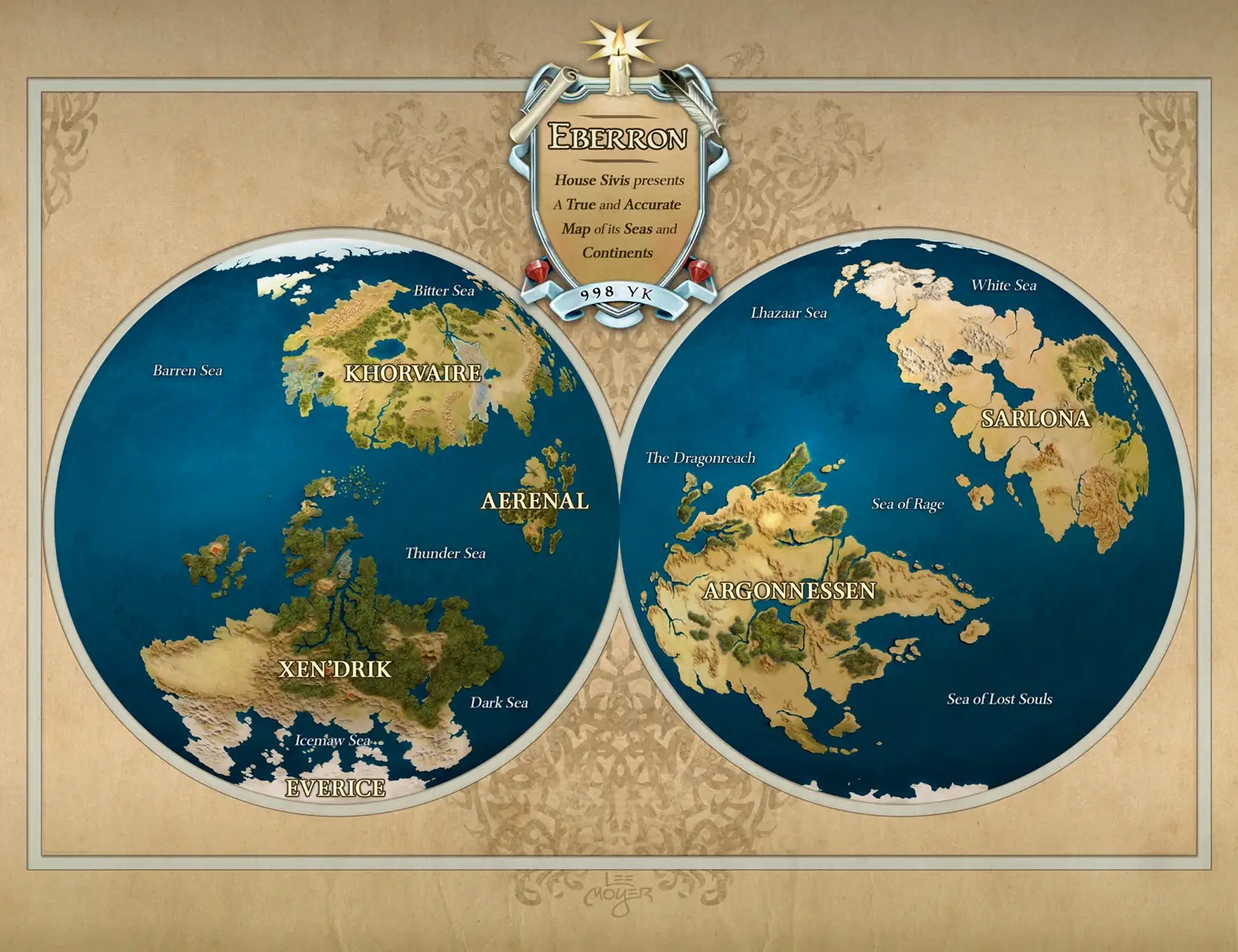
Eberron
The extraordinary isn't something you need to go looking for in Eberron. It's under your feet. It's in the stones of the road you're walking on, which were laid by a goblinoid empire that collapsed millennia before humans ever set foot on Khorvaire. It's in the manifest zone that makes your city's towers possible, in the dragonshard fragments embedded in the arcane lock on your front door, in the sealed, haunted tunnels beneath the old quarter that the city council has quietly decided not to talk about.
Empires have risen to continental scale on this world—and fallen so completely that their ruins warp the geography they left behind. The modern nations of Khorvaire, the Dragonmarked Houses, the trade routes and courts and universities—all of it represents a genuine, functional civilization. But that civilization is built on older foundations, and the foundations go down further than anyone has finished mapping.
The "civilized world" isn't monolithic, either. Khorvaire's postwar political drama is one story among many. Beyond its shores lie continents where giants built sky-cities that now rot in cursed jungles, where elves treat death as a civic institution rather than an ending, where entire nations are governed by psychic discipline and centralized thought, and where dragons operate a civilization so old and so defended that the concept of "visiting" is functionally meaningless. Eberron's peoples are connected by commerce, travel, and shared mythology. They are divided by distance, secrecy, incompatible philosophies, and fundamentally different answers to the question of what the world is for.
The Structure of the World
Most cultures explain Eberron's cosmology through the Progenitor myth: three primordial dragons whose conflict shaped existence. Siberys, the Dragon Above, whose shattered body became the ring of golden dragonshards visible in the night sky. Eberron, the Dragon Between, whose body became the natural world—soil, sea, sky, and everything living on it. Khyber, the Dragon Below, bound and buried, whose body became the vast, terrible underworld beneath the surface. Whether you take this as theology or metaphor, the model holds up remarkably well against observable reality.
The surface world is laced with manifest zones—regions where one of Eberron's thirteen planes presses close enough to bleed through, warping local conditions in ways that range from useful to catastrophic. A zone tied to Fernia, the Sea of Fire, might keep a forge district burning hotter than any mundane fuel allows. A zone tied to Dolurrh, the Realm of the Dead, might leave travelers listless and struggling to hold onto recent memories. These zones are mapped, studied, and in many cases exploited—but they are never fully tame.
Khyber is not a cave system. Beneath the surface lies a network of vaults, demiplanes, sealed prisons, and spaces that don't obey consistent geometry. The daelkyr—alien conquerors from the Realm of Madness—are bound here. Fiendish overlords from the Age of Demons are chained in prisons that predate every civilization currently standing. Things leak out. Aberrations crawl up from fissures. Cults find cracks. Most of what lives down there would prefer the surface world forgot it existed—at least until the seals weaken enough to make forgetting irrelevant.
The Ring of Siberys hangs in the sky like a shattered golden belt—visible on clear nights, beautiful, and the source of the rarest and most powerful dragonshards in existence. The Ring is tied, in ways scholars argue about constantly, to both the Draconic Prophecy and the fundamental nature of arcane magic. The fact that no one can fully explain it is itself significant: the Ring is either a divine remnant, a cosmic wonder, or a message nobody has managed to translate, and civilizations have staked their futures on which interpretation is correct.
The Continents
Khorvaire
Home—or at least, the closest thing to it for this campaign. Khorvaire is the most interconnected landmass on Eberron, stitched together by lightning rail lines, trade roads, airship routes, and the sprawling commercial networks of the dragonmarked Houses. It is also a continent trying to hold itself together after a century of war that ended not with victory but with exhaustion and an inexplicable apocalypse. The Five Nations eye each other across borders drawn in blood and ratified in haste. New states—Valenar, Darguun, the Mror Holds, the Eldeen Reaches—assert sovereignty that older powers have barely begun to accept. Beneath the veneer of postwar reconstruction, Khorvaire is a pressure cooker of unresolved grudges, competing ambitions, and the persistent question of what destroyed Cyre and whether it could happen again.
Xen'drik
South of Khorvaire, across the Thunder Sea, lies the shattered continent. Xen'drik was once home to a giant civilization of staggering scale—sky-cities, arcane infrastructure, empires that enslaved entire populations, including the ancestors of modern elves. That civilization collapsed in a war with the dragons of Argonnessen, and the magical fallout scarred the continent permanently. Xen'drik does not behave like normal geography: distance is unreliable, maps contradict each other, and the Traveler's Curse makes sustained colonization effectively impossible. Stormreach, the only significant port city, clings to the coast and doesn't pretend to control anything beyond its walls. Expeditions go to Xen'drik for relics, lost magic, and discovery. Those that succeed and return profit immensely; most don't come back at all.
Sarlona
The cradle of human civilization, and a continent most Khorvairians know almost nothing about. Sarlona is dominated by the Inspired—human rulers guided (or, depending on your perspective, inhabited) by the quori, psychic entities from the plane of Dal Quor. The resulting nation, Riedra, covers most of the continent and presents an outward face of order, prosperity, and philosophical calm. Look closer and the picture curdles: thought, loyalty, and emotional expression are managed as deliberately as agriculture. Dissent isn't punished so much as pre-empted. The kalashtar—descendants of humans who bonded with rebel quori—fled Sarlona generations ago and now live primarily in Khorvaire, carrying a quiet, intergenerational war against the Inspired that most of their neighbors don't know is happening.
Argonnessen
The draconic continent. Vast, ancient, ferociously defended. Dragons in Eberron are not scattered monsters hoarding gold in mountain caves. In Argonnessen, they are a civilization—one that has existed for tens of thousands of years, with internal politics, philosophical factions, and a relationship to the Draconic Prophecy that dwarfs anything mortal scholars have achieved. Outsiders who approach Argonnessen's shores are warned away. Those who press further are destroyed. The rare few who claim to have set foot on the continent and returned tell stories so fragmentary and contradictory that they raise more questions than answers.
Aerenal
An island nation southeast of Khorvaire, home to an elven civilization that broke away from Xen'drik's giant empires in an age so distant it makes human history look like a footnote. Aerenal is defined by its relationship with death—or more precisely, its refusal to accept death as final. The Undying Court, the nation's highest authority, is a council of deathless elves sustained not by necromancy but by the collective devotion of the living population. These are ancestors preserved in luminous undeath, carrying memories that stretch back thousands of years. The culture is deeply conservative, patient to the point of seeming inert, and profoundly cautious in its dealings with outsiders.
The Thunder Sea
The oceans between continents are not empty. The Thunder Sea—the body of water separating Khorvaire, Xen'drik, and Aerenal—is home to civilizations as old as anything on the surface. The sahuagin Eternal Dominion maintains borders, enforces territorial sovereignty, and stations ambassadors in port cities like Sharn and Stormreach. Merfolk nations cultivate the deep. Most surface-dwellers know almost nothing about these cultures beyond the practical reality that Lyrandar shipping crews employ "sea speakers" to negotiate safe passage. A league below the surface, lit by bioluminescence and cold fire, there is another world entirely—and it has its own politics, its own history, and its own problems.
The Frostfell and Everice
The polar extremes of Eberron—regions of killing cold and conditions hostile enough that even well-funded expeditions treat survival as the primary objective. Expeditionary sources offer little detail on these regions, which is itself an invitation. Strange things endure in places this remote, preserved by cold and isolation, undisturbed because no one has been desperate or foolish enough to go looking; they don't even know what they'd be looking for.
The Deep Past
The Grand History of Eberron isn't safely buried. It's still making moves.
Every significant civilization that has risen on this world has left behind ruins, magic, and consequences that the present has to live with. The giant empires of Xen'drik produced artifacts that modern artificers can catalog but not perfectly reproduce, and set wards that still function after millennia. The Empire of Dhakaan—a goblinoid civilization that ruled Khorvaire for thousands of years before humanity arrived—left its foundations beneath every major modern city. Dragons have operated on Khorvaire and beyond for longer than any younger race has kept records, manipulating events through the lens of the Prophecy in ways that are almost never visible to the people being manipulated.