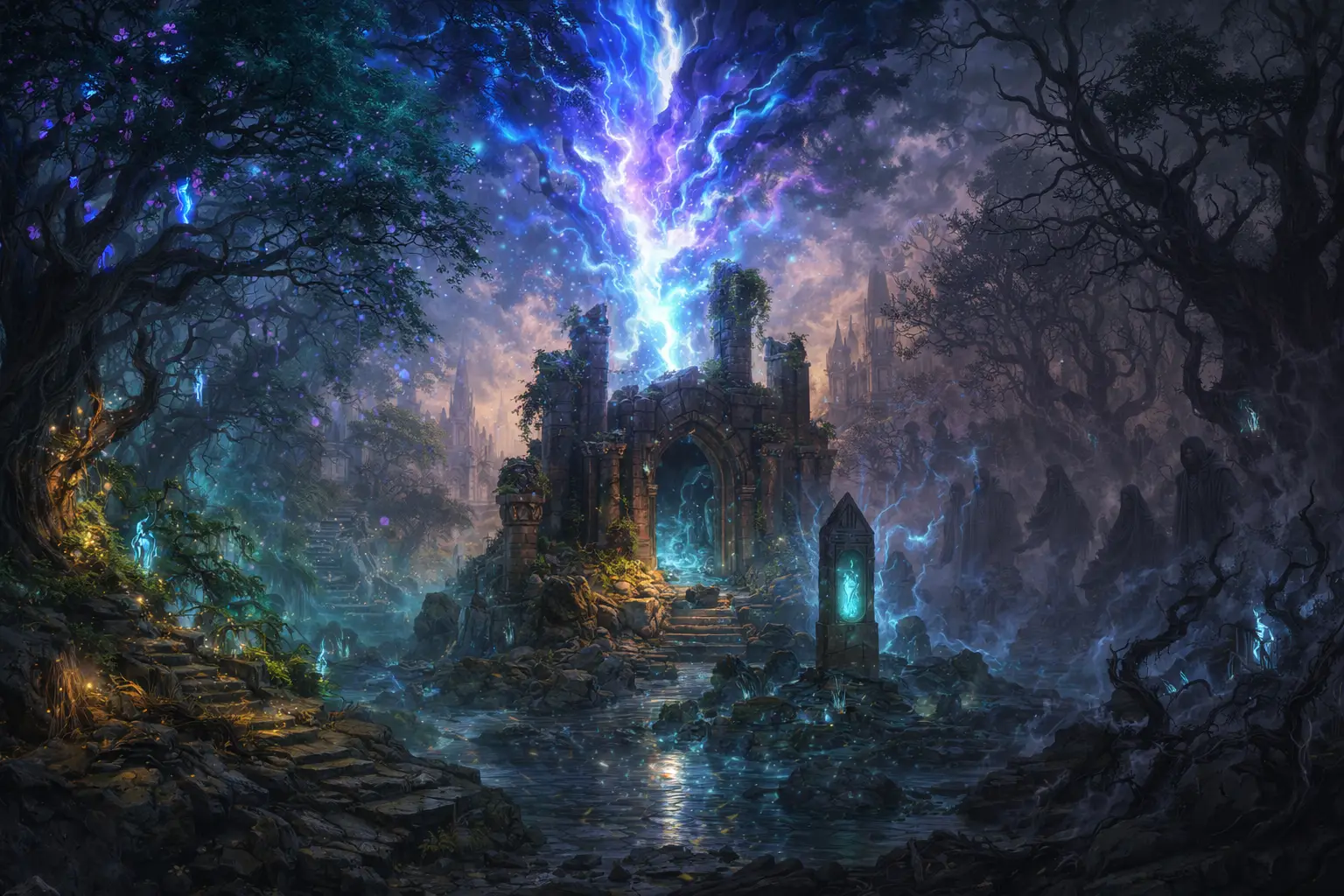
Manifest Zones
Where the planes bleed through
SURVEY REPORT — ARCANE CONGRESS, FIELD DIVISION, 997 YK
Zone MZ-471 (Lamannian, Twilight Forest subtype), southeastern Eldeen Reaches. Diameter approximately 1.2 miles. Flora within the zone exceeds baseline size by a factor of three to five. Fauna displays extreme vitality; a breed of giant rabbits unknown elsewhere in Khorvaire has established a stable population. A tribe of shifters inhabits the canopy of three massive trees at the zone's centre.
Classification: beneficial, low-risk, developed. House Vadalis has expressed interest in acquiring survey rights. Recommend approval with standard monitoring conditions.
Note: the shifters have not been consulted regarding the Vadalis interest. Recommend someone do that before this becomes a problem.
Sharn should not exist. A city built upward to that degree — towers stacked on towers, districts suspended over nothing, entire neighbourhoods held aloft by architecture that ignores what gravity normally requires — should not be structurally possible. It is possible because Sharn sits on a manifest zone linked to Syrania, the Azure Sky, and within that zone the rules governing flight, levitation, and vertical construction are not the same rules that apply in Wroat or Flamekeep or anywhere else. The zone does not grant flight on its own — what it does is make flight easier, enhancing the magic that keeps skycoaches aloft and buttresses bearing loads no mundane stonework could support. The engineers who built Sharn did not defy physics. They relocated to a place where the physics were more cooperative.
This is what a manifest zone is: a region where the boundary between Eberron and one of the thirteen planes is thin enough that planar influence expresses itself in persistent, repeatable ways. Not a temporary conjunction, not a summoning side effect, but a fixed geographic feature — stable for centuries, sometimes millennia, and treated by civilised nations the way they treat rivers, mountains, or soil quality. You do not remove a manifest zone. You build around it, build on top of it, or stay away from it, depending on what it does.
"The greatest farms and vineyards in Khorvaire are in Lamannian manifest zones. The finest forges in Fernian ones. The most secure prisons in zones where the stone itself is preternaturally durable. The tallest cities where the sky cooperates. Every civilisation on this continent was built on planar geography, whether its founders knew it or not." — Professor Dorial Amanath, Arcanix, survey methodology seminar
Distribution and Geography
Manifest zones are found across Khorvaire and beyond, though they are not evenly distributed. Some are ancient — older than any civilisation that has settled near them. Others appear to have formed or intensified due to arcane catastrophe, prolonged planar stress, or sustained ritual use. The Thunder Sea is particularly dense with manifest zones, mostly Lamannian: the endless fury of the First Storm lashes ships with lightning, great maelstroms pull vessels into the Endless Ocean, and masses of vegetation tied to the Twilight Forest rise from the water to entangle ships. Experienced navigators chart courses that avoid the worst zones, but when the connected plane is coterminous, storms extend beyond their usual radius and become far more powerful.
Scale varies enormously. Some zones are confined to a single building, cavern, or ruin — small enough that a traveller could pass through one without noticing if the effects were subtle. Others span entire forests, valleys, or city districts. Sharn's Syranian zone covers the entire city plateau. The Shadow Marches contain numerous zones tied to Xoriat and Kythri, which twist mundane beasts and plants into strange shapes and make time move oddly in the deep swamps.
Every manifest zone is tied to a particular location on both sides — the Material Plane and the connected plane. A zone linked to Thelanis does not connect to Thelanis in general; it connects to a specific region of a specific layer, such as a particular dominion of the Endless Weald. This is why two zones linked to the same plane can behave quite differently.
Most manifest zones have reliable, persistent effects. Some have only weak connections and express their properties only when the associated plane is coterminous. The planes cycle between coterminous and remote periods on timescales that vary: some follow patterns scholars can chart decades in advance; others, like Kythri's, are completely unpredictable, which is appropriate given the nature of the plane. Mortals born in or near manifest zones are far more likely to be planetouched — displaying traits associated with the connected plane — than those born elsewhere.
One special case: Dal Quor has no manifest zones. The giants of Xen'drik severed the connection tens of thousands of years ago by destroying the moon Crya, making Dal Quor permanently remote. The locations where manifest zones once existed are sometimes described as "a bit wrong" — regions called Dreamblights, where reality feels subtly off in ways that resist easy description.
The Thirteen Planes and Their Zones
Each of Eberron's planes is associated with one of the moons in the sky, and each produces manifest zones with a distinct character. What follows is a summary of each plane, along with the range of effects their manifest zones have been documented to produce. Not every zone displays every effect — most express only one or two properties, shaped by local conditions that the Arcane Congress has been cataloguing for decades without reaching fully satisfying conclusions.
Daanvi, the Perfect Order
Moon: Nymm, the Crown
Daanvi embodies absolute order — law, discipline, and their impact on civilisation. Its perfectly ordered districts are home to legalistic tribunals, immaculate fields maintained to exact specification, and hordes of modrons compiling archives of every rule or regulation ever created. Some districts are governed by a justice system rooted in goodness, where laws help maintain harmony. In more oppressive precincts, tyrannical devils impose harsh laws on the suffering populace. The Inescapable Prison, maintained by devils, is designed to hold celestials, elementals, and other beings with vast power — and a few legendary historical figures, long thought dead, who may instead have been held in suspended animation for millennia.
Daanvi zones with the Plane of Truth property — where creatures cannot tell deliberate lies — are used as courtrooms by local communities across the Five Nations, and several of the largest courthouses in Khorvaire are built in such zones. Intelligence agencies are always searching for zones with detection properties. Daanvi's coterminous and remote cycles are exceptionally long — traditionally, when it becomes coterminous, it remains so for an entire century.
d4 | Feature |
|---|---|
1 | People who live in the zone are inclined to follow duly enacted regulations without question, regardless of moral implications. |
2 | Creatures cannot tell deliberate lies while in the area. |
3 | Flora and fauna are preternaturally orderly. Trees grow in neat rows without tending, rocks settle into geometric patterns, and identical cattle graze in unison. |
4 | A contingent of modrons is methodically deconstructing and reorganising the zone, heedless of their effect on other inhabitants. |
Dal Quor, the Region of Dreams
Moon: Crya (believed destroyed — not visible in Eberron's sky)
Mortal creatures contact Dal Quor when they dream. The outer fringes of the plane are shaped by dreamers' memories; the dark core is shaped by the nightmare force known as the Dreaming Dark. Tens of thousands of years ago, the giants of Xen'drik ended a war with the quori by severing the connection between Dal Quor and Eberron. As a result, Dal Quor is always remote, no manifest zones are tied to it, and the only way to reach it from the Material Plane is through the psychic projection of dreaming. Locations where zones once existed — Dreamblights — are subtly unsettling in ways that defy easy classification. Not even plane shift or astral travel can allow direct contact with the Region of Dreams.
Dolurrh, the Realm of the Dead
Moon: Aryth, the Gateway
When mortal souls die, they are drawn to Dolurrh — a place of despair and apathy where memories are slowly leached away until only husks remain. Most religions maintain this is not the end but a gateway: the soul joining the Sovereigns, merging with the Silver Flame, or returning to the cycle of life. Dolurrh's manifest zones are grim places where death does not stay quiet. Some zones make raising the dead easier, halving the cost of material components — but the same zones may call back unwanted spirits alongside the intended soul.
Dolurrh traditionally becomes coterminous once a century for a full year, fifty years after which it is remote for a year. The coterminous period, known as Long Shadows, makes it easier for ghosts to slip from the Realm of the Dead into the Material Plane.
d4 | Feature |
|---|---|
1 | Bodies buried here reanimate within days, possessed by restless spirits that may be malevolent or benign. |
2 | Necromantic magic is empowered — the dead answer more readily, and the spells that call them draw on deeper reserves of power. |
3 | Attempts to raise the dead carry risk: angry spirits are drawn through alongside the intended soul — banshees, ghosts, shadows, specters, wraiths — and they do not come peacefully. |
4 | The zone smothers living magic. Spellcasters find their efforts drained, their concentration sapped by the plane's pervasive lethargy. |
Fernia, the Sea of Fire
Moon: Eyre, the Anvil
Fernia encompasses both the raw elemental power of fire and its symbolic versatility — flame as weapon, as industry, as a force for change. Efreeti pashas and fiendish satraps rule city-islands of obsidian drifting atop seas of magma, producing metalcraft of surpassing beauty and quality.
Fernian manifest zones are prized by smiths and artificers. Fire-based manufacturing processes that would consume prohibitive quantities of dragonshards elsewhere become economically viable when the local reality is already inclined toward combustion. Some of the greatest forges in Khorvaire are built in Fernian zones. The dark, robust Karrnathi beers brewed near Fernian zones in the Karrn region owe their complicated flavour to Mabaran influence, but several famous breweries also use Fernian heat in their processes.
d4 | Feature |
|---|---|
1 | Fire burns hotter and more fiercely. Fire-based magic is empowered as though drawing on deeper reserves of flame. |
2 | Weapons and armour forged here can develop unusual properties, though the enchantments are not always stable. |
3 | The area is dotted with pools of molten earth and fissures of scalding water, from which mephits and elementals emerge with regularity. |
4 | Motes of continual flame spontaneously generate, attaching to vegetation or minerals. These flames persist even when removed from the zone. |
Irian, the Eternal Dawn
Moon: Barrakas, the Lantern
Irian is the plane of light and hope — the wellspring of positive energy. Its regions reflect the idea of beginnings: fertile lands untouched by any tool, glittering crystal forests, and thriving communities where the sun never sets.
Irian manifest zones are among the most valuable natural resources in Khorvaire. Wounds close faster. Diseases lose their grip. Those who work to heal others find their hands surer and their efforts more effective — advantage on Medicine checks is common in Irian zones, and healing magic may restore the maximum possible amount. For these reasons, Irian zones often become the foundations of villages, towns, and Jorasco healing houses. The City of the Dead in Aerenal is built on a powerful Irian zone, which sustains the deathless councillors of the Undying Court. Many of Aerenal's exotic lumbers — notably livewood — grow only in Irian zones. Plants grown in these zones often have remarkable alchemical properties.
Irian is traditionally coterminous for ten days in the month of Eyre and remote for ten days in Sypheros, occurring once every three years. When coterminous, health and fertility are enhanced across the world, and creatures gain resistance to disease, poison, and fear. When remote, colours fade, a psychic numbness pervades, and healing magic restores only half its usual amount.
d4 | Feature |
|---|---|
1 | Natural water sources within the zone develop curative properties — curing disease, healing wounds, even restoring lost senses over time. |
2 | Radiant crystals sprout from the earth. Healing magic and spells of radiant light cast near them draw on deeper reserves of power. |
3 | Aging slows dramatically for creatures that live within the zone. Crops grow without blight, livestock bear healthy young, and even the seasons seem kinder. |
4 | Undead weaken in the zone — their movements sluggish, their malice diminished, their grip on the world loosened. |
Kythri, the Churning Chaos
Moon: Zarantyr, the Storm
Kythri is the plane of chaos and change — a realm in constant flux where elements collide, gravity shifts, and githzerai monks exert their will to carve islands of stability from the turmoil.
Kythrian zones are unpredictable: weather deviates from surrounding regions and changes without warning. Kythri's coterminous and remote cycles are completely unpredictable — it might be coterminous for days or centuries — and appropriately, its proximity has no discernible systematic effects on the Material Plane.
d4 | Feature |
|---|---|
1 | The terrain is highly changeable. A druid or geomancer can reshape it with effort — failure produces random, uncontrolled results. |
2 | Physical structures and natural formations are unstable. Rock piles collapse at random, waterways reverse direction, and cleared ground sprouts new growth overnight. |
3 | Slaadi periodically cross the planar boundary, emerging without warning to terrorise the surrounding area. |
4 | Elemental magic goes haywire — a spell meant to produce fire might produce lightning, cold, or thunder instead. |
Lamannia, the Twilight Forest
Moon: Olarune, the Sentinel
Though called a forest, Lamannia contains every possible natural environment — the Endless Ocean, the First Storm, the Rot. Animals born here are paragons of their species.
Lamannian manifest zones are relatively common and among the most commercially significant. Plants and beasts near them grow significantly larger and healthier, and many House Vadalis enclaves are built in these zones for exactly this reason. Zones with the Primordial Matter property produce purified food and water and exceptionally durable materials — the prison of Dreadhold is built in such a zone. Zilargo has a number of valuable zones with the Elemental Power property, and House Cannith and the Twelve are eager to find more — though elementals sometimes spontaneously manifest in such places. Bound elementals can break free from their bonds in some Lamannian zones — especially unfortunate if that elemental is keeping an airship aloft.
Some Lamannian zones actively resist civilisation, tearing down structures with weather, aggressive vegetation, and rapid decay. Lamannia traditionally becomes coterminous for a week around the summer solstice and is remote for a week during the winter solstice.
d4 | Feature |
|---|---|
1 | Magic that summons or commands elementals is empowered, drawing on deeper reserves of primal energy. |
2 | The forces of nature work to tear down anything built here. Weather, vegetation, and accelerated decay combine to destroy structures and overgrow the ruins. |
3 | Flora and fauna within the zone grow to extraordinary size and vitality. Animals migrate toward the area from the surrounding region. |
4 | Earth elementals and nature spirits cross the planar boundary during coterminous periods and remain afterward, dormant until disturbed. |
Mabar, the Endless Night
Moon: Sypheros, the Shadow
Mabar is the darkness that promises to swallow even the brightest day — the plane of entropy, hunger, and loss. It is the source of negative energy in Eberron.
Mabaran manifest zones are blighted places, almost universally shunned. Vegetation is sour and stunted, animals are stillborn or deformed, and a pervasive malaise hangs in the air. The Karrnathi city of Atur is built on a Mabaran zone — the Odakyr Rites that create Karrnathi undead require Mabaran energy, and when that energy is regularly channelled into rituals, it prevents it from spreading disease or killing vegetation, creating a curious synergy between necromantic industry and civic health.
Mabar is traditionally coterminous on the nights of the new moon closest to the winter solstice — a time known as Long Shadows, when friends and family gather together and keep lights burning through the night.
d4 | Feature |
|---|---|
1 | Undead raised here are stronger and more resilient, their connection to Mabar feeding them power. |
2 | Vegetation is sour and stunted. Animals are stillborn or deformed. During Sypheros, horrific monsters stalk the area, prompting residents to leave offerings outside their doors. |
3 | Light sources dim to half their normal reach. Necromantic magic finds less resistance here. |
4 | The negative energy intensifies with depth. The deeper one digs, the stronger the pull. Locals know not to dig. |
Risia, the Plain of Ice
Moon: Dravago, the Herder
The counterpoint to Fernia. Risia embodies winter's chill and the stoic constancy of the glacier. Unprotected visitors perish quickly. Risian manifest zones are used for preservation — the town of Vulyar in Karrnath sits on a Risian zone that powers its grain silos, keeping supplies fresh year-round.
d4 | Feature |
|---|---|
1 | Cold-based magic is empowered, drawing on the plane's endless reserves of frost. |
2 | Veins of cobalt-blue ice run through a glacier in the area. This ice never melts and can be carved into a focus for water and ice magic. |
3 | Frost creatures — yetis, ice mephits, cold-adapted predators — are drawn to the zone or emerge from the planar boundary. |
4 | Fire weakens here — flames burn low, and fire-based magic produces only a fraction of its normal effect. |
Shavarath, the Battleground
Moon: Vult, the Warder
Shavarath is the plane of war. Since the dawn of time, armies of fiends and celestials have fought here, each layer containing a different aspect of war — a bitter siege, a bloody melee, a lingering guerrilla conflict.
d4 | Feature |
|---|---|
1 | Blades crafted here are exceptionally sharp. Wounds dealt by piercing or slashing weapons cut deeper than they should. |
2 | Blood spilled here never washes away. Attempts to calm hostilities fail. Attempts to incite violence succeed without effort. |
3 | Storms of whirling blades scour the sky during times of combat, cutting the unprepared to ribbons. |
4 | Extraplanar combatants — devils, demons, and angels locked in their eternal war — periodically cross the boundary, dragging their conflict into the Material Plane. |
Syrania, the Azure Sky
Moon: Therendor, the Healer
Crystal spires floating in a perfect blue sky. Syrania is the plane of peace and all that flourishes in times of peace — including commerce. The Immeasurable Market draws merchants from across reality. Angels devote their immortal lives to mastering one pure concept each.
Syranian manifest zones are among the most coveted in Khorvaire. Zones that enhance flight and levitation enable architecture otherwise impossible — Sharn being the pre-eminent example, with the ancient cloud giant city known as the Unveiling in Xen'drik serving as another. Zones that suppress aggression attract temples. Zones that grant universal comprehension of language attract universities and House Sivis operations. Hidden portals to the Immeasurable Market exist in various forms — a back door, a large chest, a shallow pool.
d4 | Feature |
|---|---|
1 | The zone suppresses aggressive thought. Those who wish to commit violence must struggle against an overwhelming reluctance. |
2 | A silence fills this space, allowing intense clarity of thought and focus, but reducing verbal communication. |
3 | Levitation and flight come more easily. Spells and items that grant flight are empowered, and even mundane creatures occasionally find themselves buoyed. |
4 | Wind within the zone behaves with purpose — carrying objects, cushioning falls, and driving mechanisms that would otherwise require manual labour. |
Thelanis, the Faerie Court
Moon: Rhaan, the Book
Thelanis is the home of the fey, a realm where narrative and metaphor shape reality. Time and space are both malleable — a mortal who wanders in might leave after a few days to discover that months or years have passed back home.
Gateways to Thelanis form at naturally occurring thresholds — rings of mushrooms, gaps between ancient trees, still pools at twilight — and typically open only when specific conditions or offerings are met. Critically, you generally must break some superstition or taboo to be pulled through: if you stay on the path in the forest, you will not stumble into the Endless Weald, but if you follow the ghostly music or chase the silvery deer, that is on you. The Grove of Promises is a well-known Thelanian zone containing a fountain where vows are magically binding — local villagers perform marriages there, merchants seal deals, and those who prove false sicken and die.
Thelanis traditionally becomes coterminous for seven years every 225 years, and is remote for seven years halfway between these cycles. When coterminous, new gateways spring up across the world.
d4 | Feature |
|---|---|
1 | Flora develops magical properties — wood holds enchantment more readily, flowers produce supernatural effects, and trees may be awakened or sentient. |
2 | Portals form at natural thresholds and open when proper conditions are met. |
3 | Time flows strangely. Hours inside may correspond to days or weeks outside — or the reverse. |
4 | Enchantment and illusion are harder to resist — the mind bends more easily toward what it wants to believe. |
Xoriat, the Realm of Madness
Moon: Lharvion, the Eye
Xoriat's bizarre geometry and unspeakable inhabitants seem like the product of nightmare. The Gatekeeper seals that were forged fifteen thousand years ago keep the daelkyr bound in Khyber but also keep Xoriat from becoming coterminous — the last time it did, the daelkyr brought their armies through the walls of reality and laid waste to the Empire of Dhakaan. Xoriat manifest zones are common in the Shadow Marches and rare elsewhere.
d4 | Feature |
|---|---|
1 | Reality is frayed. Any act of magic risks unpredictable side effects — wild surges that answer to no one's intent. |
2 | Those who linger find their thoughts unravelling. The longer they stay, the harder it is to distinguish their own mind from whatever is pressing in. |
3 | Prolonged exposure produces physical and psychological changes — bizarre mutations, alien compulsions, behavioural shifts that worsen over time. |
4 | Aberrations seep through the weakened boundary with increasing frequency. The zone's influence spreads outward, slowly expanding. |
Civilisation and Manifest Zones
Civilisation does not avoid manifest zones. It builds around them, on top of them, and — when the opportunity is right — because of them. Irian zones become healing houses and holy sites. Fernian zones support forges. Lamannian zones feed Vadalis breeding programmes and provide the durable materials that built Dreadhold. Syranian zones hold up Sharn. Daanvi zones where lying is impossible reshape legal proceedings. Risian zones preserve grain stores. Even Mabaran zones find use — the Karrnathi undead that served as soldiers during the Last War were created through rites that require Mabaran energy.
Not all zones are developed. Many remain restricted, abandoned, undiscovered, or deliberately avoided. A Kythrian zone where the terrain reshapes itself and elemental magic fires at random is fascinating to study. It is not somewhere you put a school.
NOTICE — HOUSE VADALIS ENCLAVE, EASTERN BRELAND
Experimental magebreeding programme V-17 has been relocated to the Kythrian zone at [location redacted]. Preliminary results are exceptionally promising — transmutation efficiency has improved by a factor of three. All personnel are reminded that the zone's ambient instability affects more than livestock. Report any unusual physical or cognitive symptoms to the enclave physician immediately.
Coterminous and Remote
The planes cycle between periods of strong influence (coterminous) and weak influence (remote). These cycles are not uniform — some planes follow predictable calendars, others do not.
When Irian is coterminous, healing flows more freely across the world, disease loosens its grip, and people find it easier to resist fear. When it is remote, colours fade and a psychic numbness pervades. When Lamannia is coterminous around the summer solstice, fertility is enhanced and beasts born in the period are often exceptionally strong. When Mabar draws close during Long Shadows, undead grow more powerful and the nights feel hungrier. When Thelanis becomes coterminous — for seven years at a stretch — new fey gateways spring up across the world, and mischievous or dangerous fey may cross over.
These cycles matter for performing epic rituals, creating eldritch machines, and interacting with extraplanar entities. A manifest zone with a weak planar connection may only function during coterminous periods — and the difference between a zone that works and one that does not can mean the difference between a ritual that reshapes reality and one that fizzles.
Risks
Manifest zones are not fully understood, and the institutions that depend on them are more aware of this than they prefer to advertise.
Zones linked to hostile planes present direct dangers. A Dolurrh zone where the buried dead reanimate within days is a known hazard. A Shavarath zone where blood never washes away and blade-storms cut through anyone fool enough to fight there is worse. Xoriat zones warp minds and spawn aberrations — the Shadow Marches contain many such zones, and the Gatekeeper druids have spent millennia maintaining the seals that contain their influence. If enough of those seals are disrupted — whether by Tharashk mining, daelkyr machination, or simple neglect — the consequences for the world would be severe.
Lamannian zones that resist civilisation are a subtler danger. And bound elementals can break free in some zones — a risk that every airship pilot and lightning rail engineer is trained to watch for.
And the Mourning is the example no one can ignore. Whether manifest zones were involved in the destruction of Cyre remains theory rather than evidence — but the possibility that sustained arcane exploitation of planar resonance contributed to the annihilation of an entire nation has made every institution that operates near a manifest zone slightly more cautious, and every report of anomalous zone behaviour slightly more urgent.