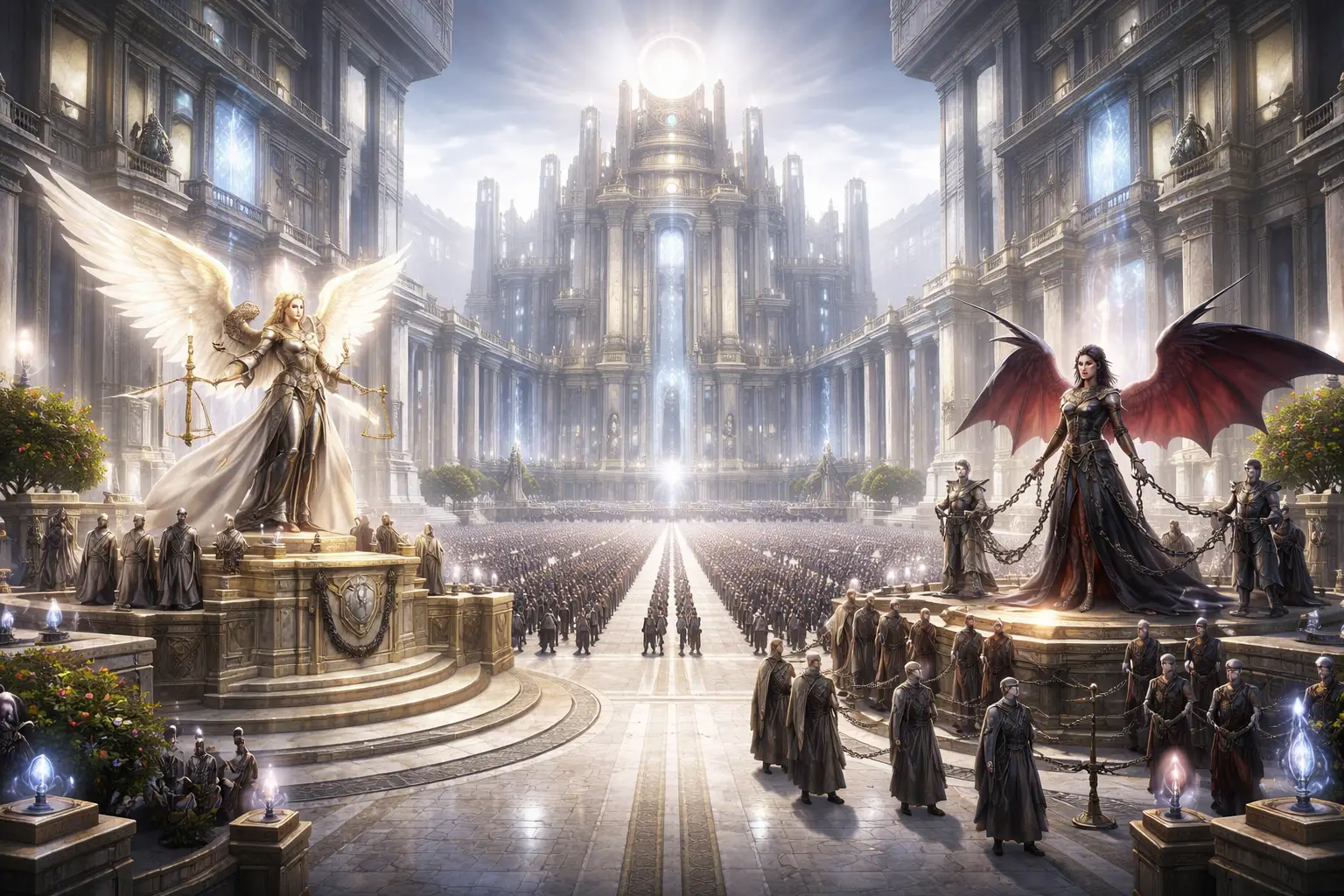
Daanvi, the Perfect Order
Plane — Law, Order, Justice & Tyranny — Moon: Nymm, the Crown
There is a rhythm to Daanvi, a subtle metronome keeping perfect time. If you act without thinking, you unconsciously move to the beat — the streets may be crowded, but everyone walks at the same pace, every foot striking the ground at the same moment. It takes a conscious effort to break this rhythm, to change the pattern, to stand out from the crowd. Your instincts push you to fall in line, match the tempo, become part of the great machine.
This is the Perfect Order. It represents the triumph of law over lawlessness, of discipline over chaos, of structure over entropy. From the precisely organized insect hives of the formians to the inevitable tribunals that weigh every mortal action against an impossibly complex code of justice, Daanvi is a monument to order in every form it can take — benevolent, oppressive, and everything in between. On one hand, it shows how structure and discipline can create enduring systems, how laws are the backbone of prosperous civilization. On the other hand, it demonstrates how those same laws can crush individuality and innovation, how order can become an instrument of tyranny, and how the machinery of justice can grind the innocent as readily as the guilty. Daanvi encompasses all of these truths without apology. It shows the benefits of law and order — and the catastrophic risks of taking them too far.
Daanvi's counterpart in the planar orrery is Kythri, the Churning Chaos — the plane where nothing is permanent and everything is in flux. Where Kythri embodies change, disruption, and creative destruction, Daanvi embodies permanence, regularity, and the systems that hold civilization together. The tension between the two planes is one of the fundamental dynamics of reality: without order, nothing endures; without chaos, nothing changes.
Daanvi embodies all aspects of law and order, not just the dispassionate neutrality. The plane incorporates utopian governance alongside mob justice, benevolent administration alongside crushing bureaucracy, fair tribunals alongside star chambers. Order is powerful, but it is not innately good. The Perfect Order displays law as a force for justice and as the crushing weight of an oppressive system — and it does so with the serene confidence of a plane that has never doubted its own purpose.
NOTICE — POSTED AT THE PRIME GATE, DAANVI, IN FORTY-SEVEN LANGUAGES AND MODRON BINARY
ATTENTION ALL VISITORS. Arrival in Daanvi via any means other than the Prime Gate constitutes a Class IV Unauthorized Entry violation under Article 9, Section 12 of the Daanvian Code of Extraplanar Ingress. Penalties range from a fine of not less than 500 galifars (or equivalent value) to permanent judgment tattoo, dependent on jurisdictional authority at the time of sentencing.
Travel passes must be obtained from the Passage Authority prior to departure from the Gate complex. Passes are non-transferable. Visitors are responsible for compliance with all local ordinances in any layer they enter. Ignorance of the law is not a defense. Ignorance of the existence of a law is not a defense. Being from a plane where the relevant law does not exist is not a defense.
The Passage Authority reserves the right to deny, revoke, or modify travel authorization without notice or explanation.
Have an orderly visit.
Universal Properties
The impulse toward order affects all creatures in Daanvi, constraining deception, dampening randomness, and sharpening the tools of surveillance. The following properties apply across all of the plane's layers.
Plane of Truth. A creature in Daanvi cannot tell a deliberate lie. It can avoid answering questions, or be evasive in its answers, as long as it remains within the boundaries of the truth — but outright falsehood is impossible. Words intended as lies simply will not form. This property makes Daanvi's courtrooms terrifying places for the guilty and invaluable ones for the just.
Impeded Illusion. When a creature casts an illusion spell with a duration of one minute or longer, the duration is halved. Daanvi has no patience for things that are not what they appear to be.
The Eyes of the Law. When a creature casts a divination spell, its range is doubled; if the spell has a duration of at least one minute but less than twenty-four hours, the duration is also doubled. Daanvi watches, and it ensures that those who serve the law can watch effectively.
Restricted Randomness. When rolling with advantage or disadvantage, a creature rolls only one die and treats the other as a 10. Fortune and misfortune alike are muted; in Daanvi, outcomes are reliable, and remarkable luck — good or bad — is vanishingly rare.
Flowing Time. For every ten minutes that pass in Daanvi, only one minute passes on the Material Plane. This means that a creature who spends ten days arguing a case before a Daanvian court loses less than a single day on Eberron — a property that makes the plane's notoriously protracted legal proceedings somewhat more bearable for mortal visitors, and somewhat less bearable for their allies waiting at home.
Standard Time (Internal). Time is consistent across all of Daanvi's layers, though some layers enforce strict regulations about what activities are permitted at what hours.
Layers
Daanvi is home to hundreds of layers, and each is a metaphor for a particular aspect of order or civilization — a precisely maintained farm, a legalistic tribunal, an oppressive prison, a utopian commune, a hive of industrious insects. Every layer has its own distinct laws, and while some rules are universal (the system of gateways and travel passes, the Plane of Truth), every layer supplements these with local ordinances that may range from the reasonable to the absurd. The critical question for any layer is the nature of its authority: is it generally just (administered by angels), even-handed but impersonal (managed by modrons), or oppressive (ruled by devils)? The answer determines whether a visitor's experience is enlightening, tedious, or actively dangerous.
Travel between layers is accomplished through clearly labeled portals, with angelic guides available at the Prime Gate to provide assistance. Lesser portals are guarded by modrons, while major portals may be maintained by a horned devil or a planetar. Travel passes can be obtained at the Prime Gate, though violating local ordinances in any layer can result in a revoked pass.
Travelers arriving in Daanvi via plane shift or similar abilities are deposited at the Prime Gate. Entering by any other means is a violation of Daanvian law — never a good start.
The Prime Gate
Imagine Terminus Station in Sharn, but instead of skycoaches and rail tickets, portals lead to different layers of reality. Hundreds of subjects and modrons mill about in orderly queues, waiting to pass through their designated portals. The Prime Gate is bustling, but the bustle is not chaotic — it is meticulously organized, every creature moving in its assigned lane at its assigned pace.
Extraplanar visitors must acquire travel passes from the Passage Authority, and the difficulty of this process depends entirely on which faction is running the Authority when you arrive — a rotation that shifts daily. If the Authority is operating under just administration (angels), the process is smooth and efficient; as long as you have a genuine reason for your visit, you should pass through quickly. If it is under even-handed administration (modrons), expect immense queues and mountains of redundant paperwork — your reason for travel must be precisely stated, and the modrons may restrict access to specific layers or impose conditions on your equipment. And if the Authority is under oppressive administration (devils), the experience becomes a small hell of extortion, arbitrary demands, and bureaucratic torment. Do they want a bribe? Do you need to perform a service? Will they simply enjoy watching you fill out the same form seventeen times? This is an archetypal abuse of power, and it is entirely legal.
The Panopticon
In the grand tower of the Panopticon, a host of immortals monitor events occurring across all of Eberron's planes. Countless modrons observe crystal balls. Angels and devils stand around wide scrying pools, replaying recent events and debating their significance. And in the highest chamber of the Panopticon, twelve solars — with one seat conspicuously empty — contemplate the events occurring in the planes they are bound to, waiting to be summoned by the legitimate authorities of those planes.
The Panopticon is larger than the entire city of Sharn. Different sections are devoted to each of the thirteen planes, and some immortals have spent thousands of years monitoring a single location or creature. It holds the most powerful and sophisticated scrying network in existence, dwarfing the capabilities of even the dragons of Argonnessen.
There are thirteen solars, each assigned to monitor and administer justice within one of Eberron's planes — though no solar holds dominion over the Material Plane. A solar can only act when invoked by a legitimate authority within its assigned plane, and there are extensive restrictions on how and when they may intervene. Hazariel, the Solar of Syrania, is the most active, typically called upon to cast down radiant idols. Azazar, the Solar of Xoriat, has never been summoned — though Azazar has been watching that plane since the beginning of creation, processing its alien reality in ways that would shatter a mortal mind. Tyrala, the Solar of Dal Quor, went to investigate the actions that led to the shift of the Quor Tarai; she has not been seen since.
The Panopticon is not intended to benefit mortals. Travelers must present an exceptional justification to obtain a travel pass granting admittance, and the immortals who work there are not inclined to answer casual questions.
The Hall of Justice
The Hall of Justice is an immense complex containing an impossible number of courts and chambers of inquiry. In smaller chambers, immortals debate the actions of the beings observed from the Panopticon — angels discussing the Treaty of Thronehold, inevitables dissecting the latest arcane legislation from Aundair. The weightier matters are resolved before an inevitable tribunal led by a Kolyarut — a representative of the great arbiter of impartial justice whose spirit permeates the hall itself. The tribunal is typically filled out with a planetar and an amnizu, each working to sway the Kolyarut's deciding vote to their side: the angel arguing for mercy and justice, the devil arguing for the harshest possible interpretation of the law.
Travlers who violate the laws of Daanvi are brought before an inevitable tribunal. The accused is granted an Advocate and opposed by a Voice of Justice — typically one is an angel and the other a devil. Both may conjure images from the accused's life, drawing on records gathered from the Panopticon. Such a case could be resolved quickly, but depending on protocols invoked or evidence sought, a case can take a very long time. Mercifully, the Flowing Time property ensures that even a protracted trial costs relatively little time on Eberron.
Rulings are final and cannot be questioned or appealed.
RECOVERED COURT TRANSCRIPT — HALL OF JUSTICE, DAANVI, CASE № 4,917,338,022,741
VOICE OF JUSTICE (Erinyes): The accused entered the Iron Ward in possession of an unregistered magical implement — to wit, a wand of secrets — in direct violation of Ordinance 77-C, which prohibits the carrying of divination-adjacent devices within municipal boundaries without prior authorization from the Councilor's office.
ADVOCATE (Deva): With respect, Ordinance 77-C was enacted three minutes before my client entered the Ward. She could not reasonably have known—
VOICE OF JUSTICE: Ignorance of the law is not a defense.
ADVOCATE: —and further, the ordinance was posted in Modron Binary, which my client does not read.
VOICE OF JUSTICE: Ignorance of the language of the law is not a defense.
KOLYARUT: The tribunal finds the accused guilty. The penalty is a fine of sixty-three gold pieces, payable immediately in standardized Daanvian coinage. The accused may convert foreign currency at the Bureau of Weights and Measures, third corridor, second door, during posted hours. The Bureau is currently closed for renovations.
The Infinite Archive
Where Dolurrh's Library merely contains records of every mortal soul that has passed through it, Daanvi's Infinite Archive contains records on every being that has ever existed. Here, the data gathered by the Panopticon and the rulings of the Hall of Justice are recorded and preserved with mechanical precision. Records focus on each individual's deeds — whether they have adhered to or violated countless codes of legal and moral standards. Daanvi does not generally do anything with this data; the plane has no jurisdiction to act on it. But through your entire life, the immortals of Daanvi have watched you and judged your every action. You are not rewarded or punished for your deeds, but they know what you have done, and it is forever preserved on your permanent record.
Mortals must present an excellent reason — or bribe a devil — to gain access to the Archive, but it is not as restricted as the Panopticon. The Archive is unknowably vast. If adventurers have a legitimate inquiry, a deva sage can be extraordinarily helpful. Working through modrons is a long and tedious process, while working through devils makes it actively unpleasant.
The Iron Ward
A city of gray stone, the Iron Ward embodies the worst aspects of oppressive law. Councilor Alashta, a cruel amnizu, wields absolute power and cannot be questioned or challenged. Most of the ward's subjects are indentured servants, trapped in inescapable contracts; visitors must be extremely careful not to accept any offers of work or service in the Iron Ward, lest they be similarly bound.
Regular displays of brutal "justice" take place in the grand plaza. Imps scurry in the shadows, watching outsiders and carrying news of their actions to the chain devils and erinyes that serve as the ward's police force. They cannot punish visitors unjustly — even in the Iron Ward, order must be maintained — but they can and will tempt visitors into violating one of the ward's countless obscure ordinances, then punish them to the fullest extent of the law. Fiendish merchants and patrons dangle appealing offers before planar travelers, almost all of which lead to inadvertently breaking a law the visitor did not know existed.
The Iron Ward is driven by order, not chaos, and this is the one advantage visitors have. The police and councilors twist and weaponize the law, but they must ultimately obey it themselves.
The Inescapable Prison
Maintained by devils, the Inescapable Prison is the embodiment of incarceration — the inevitable consequence of challenging the law. With the full power of Daanvi behind it, the Inescapable Prison makes Dreadhold look like a cell in a local sheriff's office. It is designed to hold celestials, elementals, and other beings of vast power; there are convicts here from half a dozen planes. Mortals can be imprisoned here as well — their biological processes are suspended, so they need neither food nor water, and they do not age. It is rare for mortals to end up in the Inescapable Prison, but there may be legendary historical figures, long thought dead, who have instead been held here for centuries.
Other Layers
The Perfect Grange is a vast, precisely maintained farm that displays the virtues of agricultural discipline — every row planted at the exact same interval, every harvest occurring at the scheduled moment. Hive 43 is a formian settlement where immortal ant-like spirits tend their queen with mechanical devotion; if that doesn't strike your fancy, there are forty-two other hives to choose from. There are layers that model utopian governance and layers that model mob justice, layers where the trains run on time because the authorities will execute anyone who disrupts the schedule, and layers where every citizen lives in peaceful contentment because the laws are genuinely wise and fairly enforced.
Denizens
All denizens of Daanvi either embody the concept of law and order or exist to be bound by it. Most modrons, angels, and devils perform administrative tasks, serving as cogs in the grand machinery of the plane. Nearly all follow an unvarying daily cycle, and each denizen is limited by its jurisdiction — a deva cannot take action in the Iron Ward, even if it witnesses an adventurer suffering injustice, because that ward falls under the jurisdiction of the local devils.
The angels and devils of Daanvi use normal statistics, but their appearance echoes the plane's aesthetic: metallic skin, mechanical wings, limbs that move with the precision of clockwork. They look like living constructs as much as celestials or fiends. All of them possess an Axiomatic Mind — they cannot be compelled to act in a manner contrary to their nature or instructions, no matter what magic is brought to bear.
Daanvi does not have a significant population of mortals, though there are indistinct humanoid figures called subjects — manifestations that serve as the population of the plane's model societies. They provide the impression of a person, someone completely normal and unremarkable (often appearing to be the same species as the viewer), but no matter how hard you try, it is impossible to actually focus on a subject's features. Conversations with them are surface-level at best. They pose no threat in combat and dissipate if they suffer any damage, reforming within minutes. Every tyrant needs people to oppress, and every utopian society needs citizens to enjoy its laws; the subjects serve this purpose.
Modrons and Inevitables
Modrons are Daanvi's most common inhabitants — embodiments of pure law, with no bias toward justice or oppression. They do their assigned tasks and obey every law; nothing more, nothing less. Monodrones can be found in many layers performing the most basic clerical and maintenance tasks. More sophisticated modrons manage the endless administrative work of the plane and enforce basic regulations.
Inevitables are powerful constructs dedicated to enforcing the law in all its aspects. The most formidable are the maruts, which can be assigned to enforce specific contracts — though these maruts have nothing to do with their counterparts in Dolurrh, just as the devils of Daanvi are unrelated to those of Shavarath. Beneath the Hall of Justice resides an entity known as the Kolyarut — a singular force of absolute legal authority that acts through a legion of host bodies. One such body serves on every inevitable tribunal; these representatives are also called Kolyarut, though they are merely extensions of the greater spirit.
Angels
The angels of Daanvi represent law in the service of justice and the greater good. They enforce the law, but they also do their best to act fairly and to ensure that justice is truly served. While they have duties to attend to and rarely have time for idle conversation, they are typically kind and helpful when they can spare a moment, and they believe with every fiber of their being that law and civilization are the most vital virtues of all.
Devas serve as local authorities — ministers, magistrates, and sages. A deva might be appointed to serve as counsel for a mortal called before an inevitable tribunal. Those stationed at the Infinite Archive serve as sages, studying the data that the modrons file and record. Planetars serve as high ministers and guardians of important gates and sites. And in the highest chamber of the Panopticon, the solars watch and wait.
Devils
The devils of Daanvi represent law in the service of tyranny and personal gain — the danger of laws weaponized, the way order can become oppressive force. While the angels and devils of Daanvi despise one another, the strict jurisdictional laws that govern the plane mean they rarely come into contact and almost never engage in combat. It is far more common to find a devil and an angel in opposing positions, arguing a case before an inevitable tribunal in the Hall of Justice — a debate that could last centuries.
Devils are most often found in layers like the Iron Ward, where they serve as cruel enforcers and petty tyrants. They can be encountered as guardians and sentinels, invariably too harsh in their duties. Other devils specialize in exploiting loopholes and using the law as a weapon, extorting adventurers or trapping them in contracts. Orthons and erinyes apprehend lawbreakers. Pit fiends serve as executioners in the Hall of Justice.
Daanvian Judgment
When a visitor breaks the laws of Daanvi, the punishment is determined by an incredibly complex Code of Justice administered by the Kolyarut. In practice, the severity depends on the district: an angel seeks to ensure the punishment is truly fair; a devil uses the threat of disproportionate sentencing to drive extortion.
Possible punishments include physical penalties (beating, maiming, execution — most common in oppressive layers), imprisonment (rare but possible, either in a local cell or the Inescapable Prison — a hundred years in Daanvi is only ten on Eberron), and fines (common, easily adjusted to the individual — gold seized immediately, or future earnings garnished until the debt is cleared).
The most distinctive punishment is the judgment tattoo — a complex marking placed across the victim's face that cannot be removed by any power short of a wish spell. Any creature that speaks a language can magically understand its meaning, which is conveyed as a simple concept: MURDERER, THIEF, LIAR. Other magical punishments include the effects of bestow curse for a year or a lifetime, the inability to tell lies, disadvantage on a specific skill check, or being stripped of fame — no one will credit the victim for positive actions, though they can still be blamed for misdeeds. There are few limits on what an inevitable tribunal can impose, and their rulings are final.
Planar Manifestations on Eberron
Manifest Zones
Manifest zones tied to Daanvi are relatively uncommon, but those that exist often share one or more of the plane's universal properties and can be extremely valuable. Zones with the Plane of Truth property are frequently used as makeshift courtrooms by local communities, and a number of the largest courthouses in the Five Nations are built within them. Intelligence agencies are always searching for zones with the Eyes of the Law property. Other zones reflect the unnatural order of the plane in more subtle ways — crops grow in perfect rows without tending, or residents find themselves more naturally inclined to follow instructions.
Unsubstantiated legends tell of modrons appearing in Daanvian manifest zones, methodically "repairing" local buildings and redesigning them to match the architecture of the Perfect Order, heedless of their effect on the current inhabitants.
Coterminous and Remote
Daanvi has coterminous and remote periods, but unlike those of other planes, these have no obvious dramatic effects. Some sages believe the cycles may impact the performance of certain rituals or the creation of eldritch machines, and others attempt to link the rise of major civilizations to coterminous periods, but supporting evidence is thin. What makes Daanvi's cycle remarkable is its length: traditionally, when Daanvi becomes coterminous, it remains so for an entire century; one hundred years later, it becomes remote for another century.
When Daanvi is coterminous, oaths sworn at Daanvian manifest zones may carry the actual enforcement power of the plane — and that those who break such vows may face genuine consequences from the inevitables. Ancient oathstones in the Shadow Marches and the Eldeen Reaches are whispered to carry this property, and local traditions warn that when Daanvi is coterminous, one must tread very carefully with promises.
Daanvian Artifacts
Daanvi does two things remarkably well: watch people and punish them. The plane's artifacts reflect this specialization. Adventurers might come into possession of an exceptional crystal ball stolen from the Panopticon, or a set of dimensional shackles lost by an orthon bounty hunter. The most notable Daanvian artifacts are not items of war or wonder but instruments of law.
The most significant way people on the Material Plane interact with Daanvi is through an unbreakable contract. In the Hall of Justice, any two creatures can negotiate a contract before a Kolyarut. The terms are inscribed on an enchanted sheet of gold worth 5,000 galifars, and the contract is bound to a marut, which acts to enforce its terms. On Eberron, a sufficiently powerful conjurer could use planar ally or a similar spell to summon a Kolyarut to establish such a contract — though they must provide the gold. These contracts are rare, expensive, and terrifyingly effective. A marut bound to an unbreakable contract will pursue violators across planes and centuries, and its judgment, when it comes, is final.