Sharn
Excerpted from a promotional handbill distributed to passengers aboard the Orien lightning rail, Wroat–Sharn express:
WELCOME TO THE CITY OF TOWERS! Whether you seek FORTUNE, KNOWLEDGE, or ADVENTURE, Sharn offers it all — and in quantities no other city on Khorvaire can match! Affordable skycoach tours depart hourly from Terminus Station. Licensed guides available through House Ghallanda. The Sharn Office of Tourism reminds all visitors that balcony railings are NOT load-bearing. Please secure all loose items. Feather tokens available for purchase at any Sivis message station. The City of Sharn assumes no liability for injury, death, property loss, or dimensional displacement incurred during your visit.
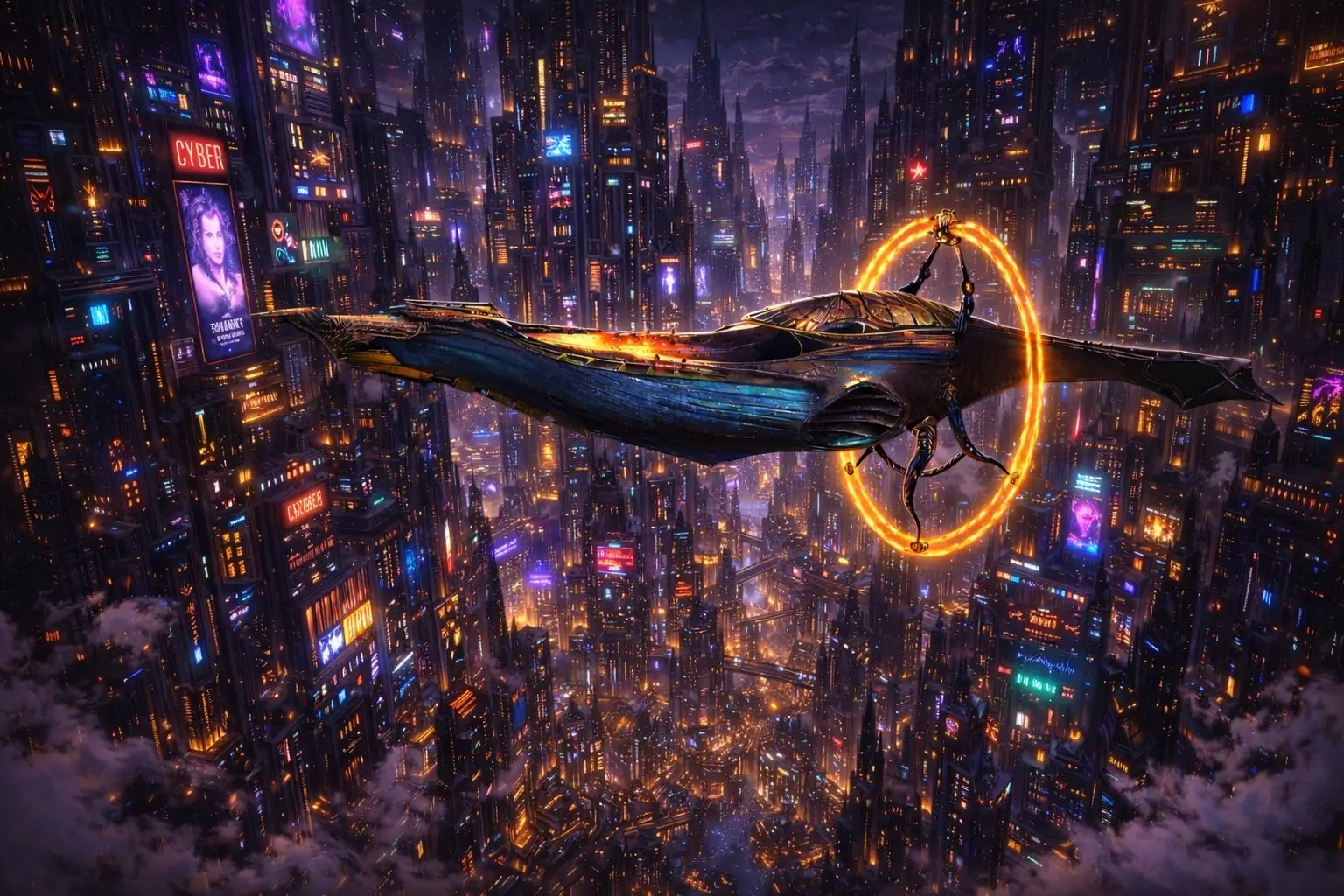
No city in Khorvaire announces itself quite like Sharn. The towers appear long before you arrive — a bristling wall of spires rising from the cliffs above the Dagger River, so tall and so densely packed that from a distance they look less like architecture than like a geological formation, something the earth pushed up rather than anything people built. Get closer and the scale becomes staggering. The great core towers are so massive that their walls contain entire neighborhoods; smaller turrets and platforms sprout from their flanks like barnacles on the hull of a ship. Bridges, platforms, balconies, and catwalks web the gaps between spires at every altitude, and the traffic — skycoaches, soarsleds, glidewings, mule-drawn wagons, and a churning river of pedestrians — moves in three dimensions, flowing not just through the streets but above and below them. The noise is extraordinary. So is the smell.
The city owes its impossible skyline to a manifest zone linked to Syrania, the Azure Sky. The zone doesn't grant flight outright, but it enhances all magic related to levitation and flying, allowing the enchantments that hold up Sharn's towers, bridges, and floating platforms to function at a scale that would be impossible anywhere else. Without the manifest zone, the core towers would collapse under their own weight; the skycoaches would fall; the vast magical disks suspending the district of Skyway would wink out, dropping some of the richest real estate in Khorvaire into the wards below. Geography reinforces the vertical logic — mountains and cliff faces crowd the banks of the Dagger River, leaving the city no room to spread outward. So for centuries, Sharn has only grown up.
Sharn's population hovers around a million permanent residents, with tens of thousands more passing through on any given day — tourists, spies, dragonmarked heirs, refugees, merchants, mercenaries, and those who've come hoping to find their fortune in the grandest city in Eberron. Roughly a third of the population is human, with dwarves forming the next largest group, followed by halflings, goblinoids, gnomes, elves, khoravar, shifters, and changelings in diminishing numbers. Kalashtar maintain a small but tight-knit community in Upper Dura, and the warforged — free citizens since the Treaty of Thronehold, though many still labor in conditions barely distinguishable from slavery — are concentrated in the deep industrial warrens of the Cogs. Orcs and orc-kin cluster around House Tharashk operations, while a scattered population of monstrous residents — ogres, medusas, minotaurs, and others, many brought from Droaam under Tharashk labor contracts — fills out the lower wards and the undercity. Every race on Khorvaire has a foothold somewhere in the City of Towers.
Social class in Sharn is measured in altitude. The upper wards are clean, well-lit, and aggressively patrolled; the lower wards are dim, neglected, and governed by whoever has the muscle to hold a street corner. The middle wards are where most of the city actually lives and works, balanced precariously between aspiration and decline. Corruption isn't a scandal in Sharn — it's a civic mechanism, a lubricant without which the gears of the city would seize. The Sharn Watch exists, and some of its officers are even honest, but the institution answers to a city council that answers to money. The King's Citadel operates above the Watch in theory, but even the Citadel picks its battles. Below it all, the Boromar Clan has run organized crime in Sharn for generations, though the monstrous newcomers of Daask have been steadily carving into Boromar territory from the lower wards upward.
The Last War may be over, but its consequences saturate the city. Sharn never fell under siege during the war — it was too far from the front lines, too economically vital — but its people fought and bled, and its districts absorbed wave after wave of refugees. The overcrowded ghetto of High Walls in Lower Tavick's Landing holds thousands of Cyran survivors packed into a space designed for a fraction of that number. Veterans haunt every ward, some celebrated, some broken, some nursing grudges that the Treaty of Thronehold did nothing to resolve. Shortages of imported goods persist as trade routes between the post-war nations slowly normalize. Sharn is a city shaped by the war even though the war never reached its gates, and the anger, grief, and unfinished business of a century of conflict are as present in its streets as the rain.
Structure of the City
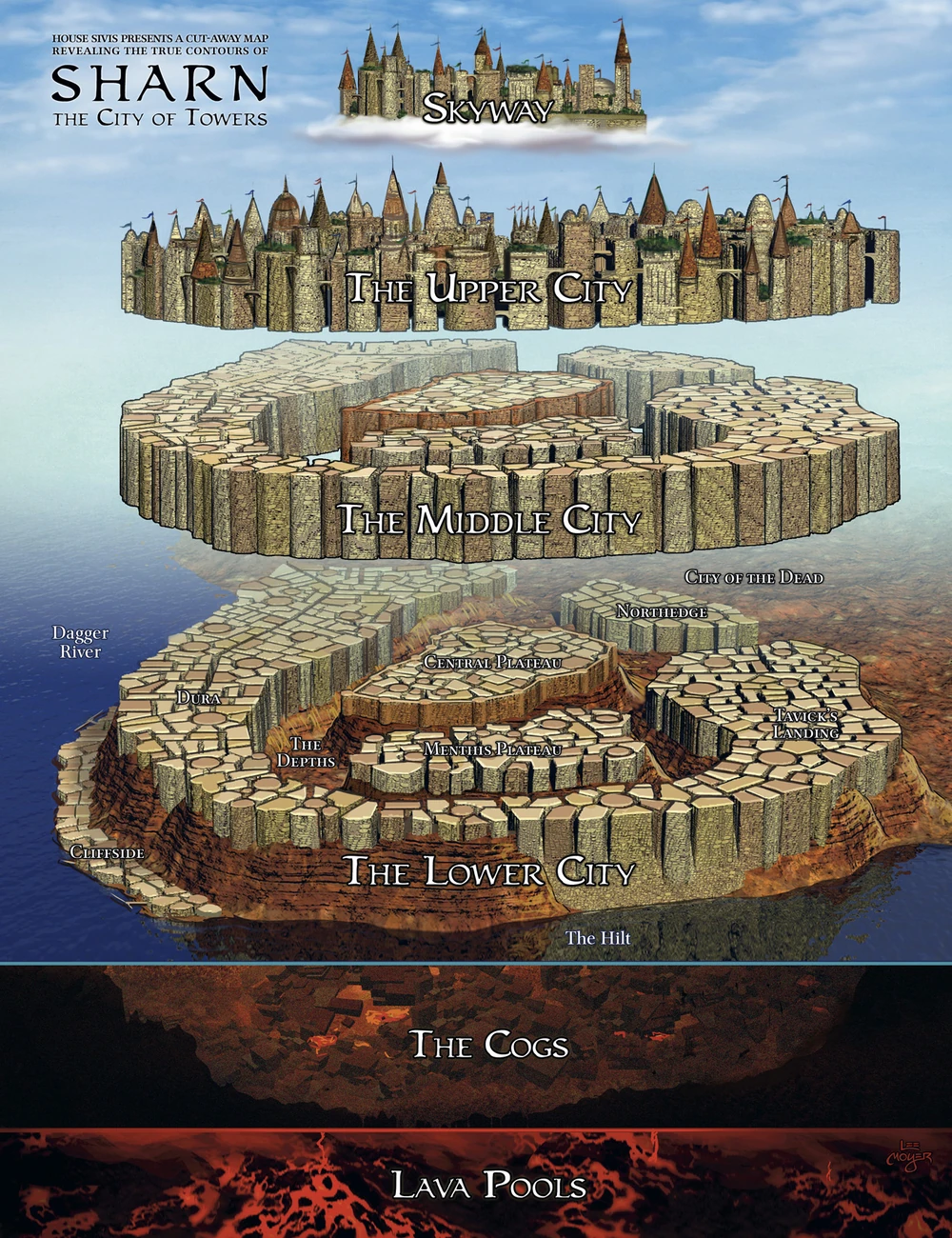
Sharn is organized into five major quarters — Central Plateau, Dura, Menthis Plateau, Northedge, and Tavick's Landing — each built on one of the natural plateaus that define the city's geography. At the center of each quarter rise the enormous core towers, structures so vast that entire neighborhoods exist inside their walls. A web of bridges and platforms connects these great spires, and smaller turrets and districts are built along the bridges, on the tower walls, and in the hollow interiors of the towers themselves. Someone standing in Callestan, deep in the well of a core tower in Lower Dura, looks up and sees not sky but a mile of bridges, platforms, and twinkling lights — the districts stacked above, stretching all the way up to the open air of the upper wards.
Each quarter is divided into an upper, middle, and lower ward, and each ward into individual districts — neighborhoods defined by economic role, cultural identity, or both. A location in Sharn is typically given as a combination of ward and district: "Platinum Heights, Upper Central" or "Callestan, Lower Dura." The ward tells you roughly what to expect — the wealth, the level of Watch presence, the quality of light and air — while the district tells you what happens there.
Beyond the five quarters, two exceptional zones define the city's extremes.
Skyway floats above the highest towers, suspended on vast magical disks of force — an extension of the city itself, not a cloud palace but actual real estate, where the wealthiest citizens of Khorvaire maintain mansions and the finest establishments in Sharn compete for clientele. No bridges or lifts connect Skyway to the city below; the only way up is by skycoach or flying mount, which suits its residents perfectly.
At the opposite extreme, the Cogs stretch far below the surface, a sweltering industrial underworld of forges and foundries powered by streams of Fernian lava, geysers, and bound fire elementals. When Halas Tarkanan shattered old Sharn during the War of the Mark, he opened channels to the lake of fire deep beneath the city, and House Cannith has spent centuries since building an industrial complex around that heat. The Cogs are home to much of Sharn's warforged population, laboring in the districts of Ashblack and Blackbones, as well as goblins, Droaamite immigrants, and everyone else who has fallen — or been pushed — to the very bottom of the city's vertical hierarchy. Between Skyway and the Cogs lie the Depths — the largely forgotten undercity of collapsed sewers, sealed ruins, and the remnants of the older cities that Sharn was built upon. King Galifar I ordered the passages to Old Sharn sealed with gates of metal and magic when the modern city was constructed, and it remains illegal to tamper with those seals. Most citizens know nothing of what lies below. Treasure hunters and cultists are less inclined to leave it alone.
Getting Around
"Sharn Resident Crushed by Falling Drunk — Third Incident This Season! We propose a new law: no traveling the middle or upper wards without a feather token." — Letter to the Sharn Inquisitive
Sharn is an enormous city, and crossing it on foot is a slow affair — at least thirty minutes to traverse a single ward, with additional time for each ward you pass through. Dura and Tavick's Landing are especially sprawling, doubling the transit time. Not all quarters are connected to one another by bridges; getting from Dura to Central Plateau, for instance, requires routing through Menthis or Tavick's Landing.
The most iconic form of transportation is the skycoach, a small enchanted vessel resembling something between a rowboat and a gondola, which darts through the open air between towers. Skycoaches charge a standard rate of one silver per mile and cut travel time to roughly a sixth of walking pace. House Orien also manages a system of hired carriages that halve foot-travel time for a more modest fee. Soarsleds — crystalline disks of force about five feet in diameter, controlled by thought — offer speed and maneuverability to those with the coin (or the nerve), while Talenta halflings in the Little Plains district of Middle Menthis offer rides on glidewings, the domesticated pteranodons of the plains. Griffons, hippogriffs, and giant owls can also be hired, though stabling them outside of Skyway is difficult.
For vertical travel, magic lifts — great floating disks that ascend and descend along threads of mystical energy — carry passengers and cargo between the wards. The lifts are primarily designed for freight and can be thirty feet in diameter; they have rails but are not enclosed, making them effective but occasionally harrowing. And of course, the simplest transit option is your own feet, carried along the suspended streets, stairs, and ramps that wind through the towers, though the walk from Lower Tavick's to Upper Central is not for the impatient.
Falling is a genuine hazard. Bridges and balconies are everywhere, many of them narrow, and not all of them have adequate railings. The affluent carry feather tokens as insurance. The less affluent rely on the fact that a fall from the upper wards will almost certainly be interrupted by a lower bridge before it becomes fatal — and that major bridges in the upper and middle wards are enchanted with feather fall effects that trigger automatically to prevent precisely this kind of death. Those enchantments don't extend to the lower wards. The Sharn Watch does not consider it a priority.
The Upper Wards
The upper wards are where Sharn presents itself as a triumph of civilization. Wealth, political power, and institutional legitimacy concentrate here, buffered from the city's worst excesses by altitude, access control, and money. The streets are broad, well-lit by everbright lanterns, and actively patrolled by Sharn Watch officers who are — if not always honest — at least well-organized and responsive to the interests of their wealthy patrons. Violence is rare, not because people in the upper wards are more virtuous but because the consequences of violence here are swift and expensive. Upper Central is the crown of the city — the seat of the city council in Highest Towers, the financial heart of Korranath where the great Kundarak Bank anchors a district of moneylenders and vaults, the fine shops of Platinum Heights, and the park district of Skysedge. The Lyrandar Tower airship docking spires rise here, and the Aurora Gallery in Platinum Heights hosts auctions of exotic magical items and relics from Xen'drik. Only those maintaining a wealthy or aristocratic lifestyle move comfortably through these districts; adventurers in muddy boots will draw stares and pointed questions from the Watch.
The other upper wards are less ostentatious but no less comfortable. Upper Dura, the best district in the city's roughest quarter, contains the adventurer-friendly neighborhood of Clifftop, the Daggerwatch garrison, and the kalashtar community of Overlook. Upper Menthis houses Morgrave University and the finest theaters in Breland — the Art Temple, the Grand Stage, the Khavish Theater, and the open-air Stargazer. Upper Northedge is quiet and residential, home to the elven neighborhood of Shae Lias and the well-appointed estates of Crystal Bridge and Oak Towers. Upper Tavick's Landing is more austere, containing the garrison district of Sword Point and the upscale residential areas of Sunrise and Ocean View.
This is where Sharn's future is planned — and where its past is most aggressively ignored.
The Middle Wards
The middle wards are the functional heart of Sharn. Most citizens live, work, drink, argue, and survive here. The goods and services are priced for modest to comfortable lifestyles, the Watch maintains a visible if imperfect presence, and the mix of people on any given street reflects the full diversity of the city. These are the wards where middle-class families raise children, where artisans keep shops, where students from Morgrave nurse cheap drinks in tavern districts, and where small-time criminals shade into ordinary commerce without anyone drawing a hard line between the two.
Middle Central is the administrative and diplomatic spine of the city — Ambassador Towers houses the foreign embassies and the headquarters of the King's Citadel in Andith Tower (which also serves as the city's high-security jail), while Dragon Towers is home to the dragonmarked house enclaves. Sovereign Towers holds the Pavilion of the Host, the grandest temple complex to the Sovereign Host in Sharn, and the Cathedral of the Cleansing Flame, which serves the Silver Flame. Middle Dura is dominated by the Bazaar, the largest commercial district in the entire city — a heaving, chaotic expanse of permanent shops, temporary stalls, and open-air markets where it's said you can find anything for sale if you're not too particular about its provenance. Middle Menthis is the entertainment capital of Sharn, home to the diverse ethnic neighborhoods of Little Plains and Den'iyas (Little Zilargo), the magic district of Everbright, and the theaters and taverns that draw crowds from across the city. Middle Northedge is the quietest of the middle wards, a residential district centered on the dwarven neighborhood of Holdfast and the sincere temple district of High Hope. Middle Tavick's Landing is the working gateway to the city, with the caravan districts of Terminus and Wroann's Gate channeling the flow of goods and travelers upward.
The Lower Wards
"There was a time when Lower Dura was the heart of Sharn, and remnants of that glory remain. The Silvermist Theater in Callestan was built to entertain nobles. The ward boasted manors, temples, and a garrison for the Watch. All of these edifices were abandoned long ago, and now most are home to nothing but squatters and vermin." — From a report to the Sharn City Council, filed and ignored
The lower wards are where Sharn's promises have failed. Poverty, neglect, and danger concentrate here, and the institutions that govern the upper city grow distant or disappear entirely. Everbright lanterns give way to everburning torches — where those haven't been smashed or stolen — and the light is thin and intermittent. The architecture shows its age: cracked streets, walls covered with mildew and graffiti, the skeletal outlines of once-grand buildings now given over to squatters and rats. The Sharn Watch rarely patrols these wards in force, and when officers do appear, they tend to be either corrupt or afraid.
Lower Dura is the worst of it — a ward that was once the heart of the city and has been left to rot as Sharn grew upward. Callestan, the old commercial center, is now a nexus for criminal activity where the Boromar Clan, Daask, the Tyrants, and House Tarkanan all compete for influence. Malleon's Gate is the goblinoid district, home to Sharn's oldest goblin families alongside newer and more dangerous immigrants from Darguun and Droaam. The district of Fallen — once the proud temple ward of Godsgate — was crushed during the Last War when Aundairian saboteurs brought down a floating tower and the falling spire obliterated the district below. It has never been rebuilt.
Lower Tavick's Landing is the gateway that most overland travelers use to enter the city, and its character reflects that role — rough, transient, and functionally necessary. The caravan districts feed goods upward through the system of lifts and skycoaches, while High Walls, the converted ghetto that once held foreign nationals during the war, now bursts with Cyran refugees and displaced survivors with nowhere else to go. The gates that sealed the district are generally open now, but the guard posts remain, and the city council has not yet decided whether High Walls is a neighborhood or a cage.
The lower wards are not lawless — but the peace is kept by less-legal institutions. Criminal organizations provide protection, settle disputes, and enforce boundaries that the city government will not. For the people who live here, that's not corruption. It's infrastructure.