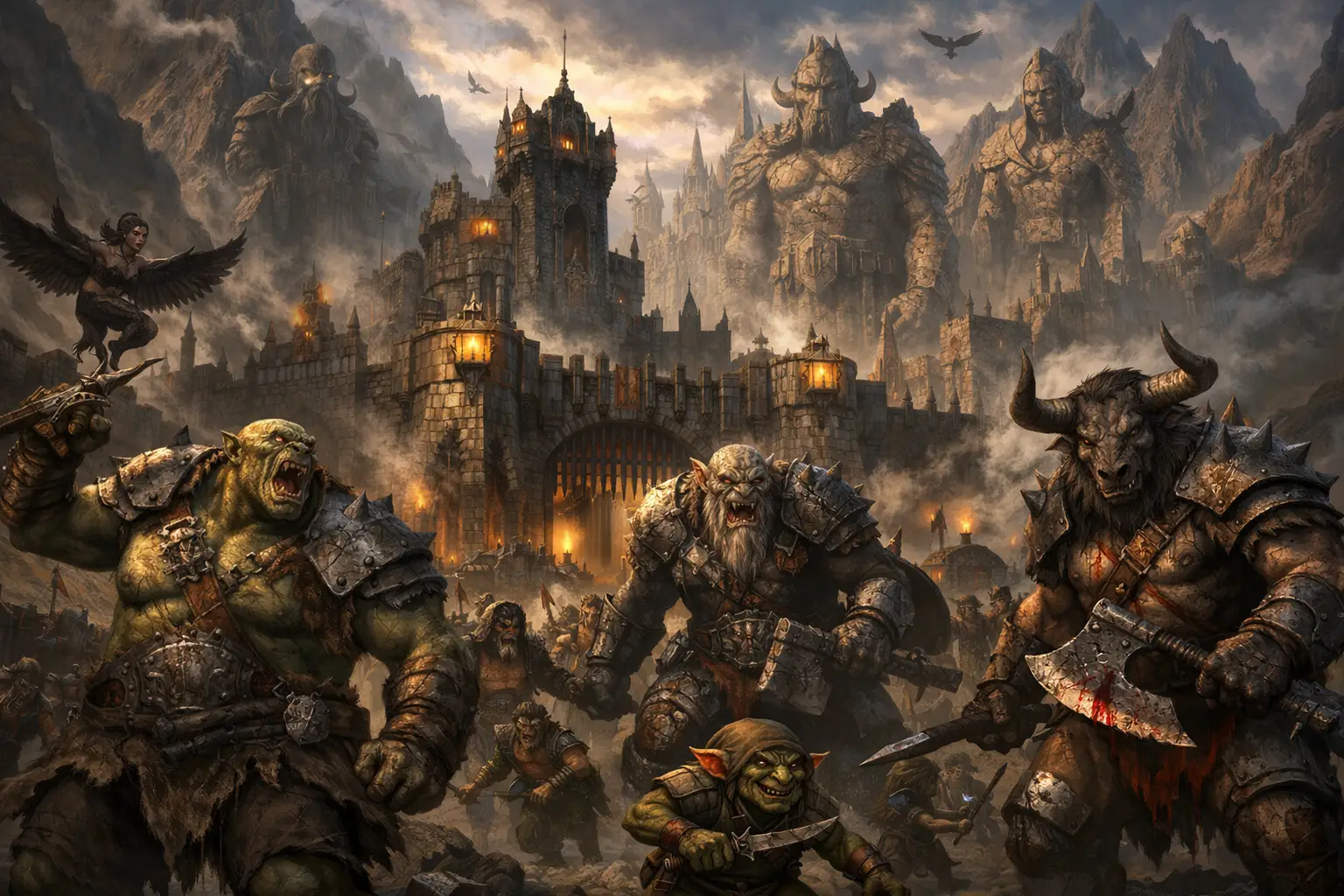
Droaam
"Tell your rulers there's a new power in the west. What you've called the Barrens, we now name Droaam. The land beyond the Graywall and below the Byeshk belongs to our people. Withdraw yours quickly and respect our claim; next time, there will be no survivors." — Sora Katra, 986 YK
Droaam is a nation of creatures the Five Nations have spent a millennium calling monsters — founded by villains who stepped out of storybook tales, governing a land Galifar never bothered to tame, and denied recognition by the very treaty that ended the war it emerged from. The youngest nation in Khorvaire is also, in the eyes of most eastern diplomats, the least real. They are still waiting for it to fall apart.
It hasn't.
Origins
For the last millennium, children of the Five Nations knew the fate awaiting the naughty: they'd be sent to the Barrens, where ogres would use them for footstools until the trolls ate them for dinner. The name was accurate enough. When Galifar was established, the province of Breland was formally granted dominion over all lands south of the Byeshk Mountains and west of the Seawall — a bold claim that extended Wroat's territory considerably, and meant nothing at all in practice. The Brelish had no need of the Barrens and no desire for them. Explorers confirmed the tales: gnolls on the plains, harpies in the mountains, trolls sleeping on piles of bones in deep chasms. Nothing the Brelish believed worth fighting for.
Over centuries Breland expanded westward anyway — Castle Arakhain became a favored royal residence in the eighth century, settlers staked claims along the Graywall, and the fortress-town of Stubborn was founded in the foothills. The Westwind Riders patrolled the border. The region remained violent and ungovernable, its population a shifting landscape of feuding chibs — local bosses, typically the largest and most dangerous creature in a given band — who rose and fell across generations without building anything that lasted. A minotaur warlord might unite the plains for a decade; an oni with ambitions might establish a dynasty that survived two generations before the relentless tide overwhelmed it. The Venomous Demesne and the hidden village of Lost were isolated exceptions, fortified or concealed from the world rather than engaged with it.
When the Last War began, Breland reduced the Westwind Riders to a skeleton force. Aundair's Royal Eyes seized the opportunity, supplying equipment and training to Barrens chibs in hopes of opening a second front against Breland from the west. The raids intensified. Settlers fled. The commanders of Orcbone and Stubborn held, but barely, and without reinforcement.
Then in 986 YK, the soldiers of Stubborn found themselves facing something they had no framework for: phalanxes of armored trolls fighting with deadly coordination, squads of ogres acting with discipline, walls shattered by hurled stones, defenders leaping from the battlements in pursuit of harpies' songs. The fortress fell. Survivors were herded into the plains to face three enigmatic figures — the Daughters of Sora Kell, assembled in one place for the first recorded time. Sora Katra delivered the message. The Westwind Riders who rode west in response left no survivors. Neither did the retaliatory strike on Orcbone itself.
King Boranel formally ordered all Brelish citizens to withdraw from the lands west of Graywall in 987 YK, while refusing to acknowledge Droaamite sovereignty. That same year, Sora Katra summoned the region's most powerful leaders to the ruins that would become the Great Crag and presented the blueprint for a nation: warlords appointed, territories assigned, responsibilities specified. Work began on Graywall, the Great Crag, and the port city of Vralkek. The fortress of Stubborn was repurposed and renamed Stonejaw. Thousands of goblins and kobolds were freed from their oppressive chibs and given a place in the new cities. Those chibs who refused the Daughters' terms met Maenya's Fist.
The Daughters' position was strengthened immediately by an alliance with House Tharashk, which gained access to Droaam's rich mineral resources and a new market for monstrous mercenaries; in exchange, Tharashk agents convinced the Twelve to open trade to Graywall, helped organize laborers and build the cities, and gave Droaam a legitimate voice in the east. Through Tharashk, Droaamites began appearing across the Five Nations — gargoyle and harpy couriers in Sharn, ogre laborers in Fairhaven and Wroat, gnoll soldiers brokered to any warlord who could pay the fee.
Government & Rule
Droaam is not a democracy, a constitutional monarchy, or a meritocracy. It is a hierarchy maintained by demonstrated power, sustained by something closer to faith, and codified through contracts rather than law.
The Daughters of Sora Kell hold supreme authority. Each controls her own domain — Sora Katra governs through voice and intrigue from the Great Crag, Sora Maenya commands the armies, and Sora Teraza advises in cryptic prophetic fragments from a position of near-total information. Below them, the nation is divided into territories governed by warlords appointed in the Daughters' name, ranging from the medusa Queen Sheshka of Cazhaak Draal to the oni Tzaryan Rrac and the minotaur Rhesh Turakbar on the eastern border. Each warlord is responsible for their territory's contribution to Droaam — soldiers when called, resources as specified, order maintained below them by chibs governing local communities.
The gnolls of the Znir Pact serve as Droaam's peacekeepers, neutral to all warlords and loyal to the Daughters. Their word is considered unbreakable, their contracts inviolable, their neutrality trusted even by enemies. When the Znir proves insufficient — when a chib defies the Daughters or a warlord overreaches — Maenya's Fist descends, and the message is delivered again: find your place, or choose obliteration.
Within this structure, Droaam is still a frontier. The cities are still being built. Citizens who contribute to the work of building are largely left to their own affairs; those who appear indolent or cause trouble are swept up by press gangs. In exchange for loyalty and service, citizens receive sustenance, shelter, and — more than anything — a sense of purpose. A goblin laboring in the mines knows they are building a great city, not serving the crude whims of a crass ogre chief. Most citizens are sincerely committed to what they are building, held together by a careful balance between practical fear of Sora Maenya and the genuine inspiration of Sora Katra's vision.
Cities & Sites
The land west of the Graywall is ancient. The Byeshk and Graywall Mountains bear Dhakaani ruins, and in the Graywall peaks stand thousand-foot statues commemorating the six kings who formed the Empire of Dhakaan. That empire was devastated in its war against the daelkyr, and what remained was centuries of anarchy. The Daughters are building on top of a very old wreckage.
The Great Crag, the capital, is built atop ancient goblin ruins in the heart of Droaam. It is the seat of the Daughters of Sora Kell — a thriving city of monsters that few outsiders have ever seen. Only House Tharashk maintains a presence here among the dragonmarked houses.
Graywall, the Gateway to Droaam, sits on the border with Breland and is Droaam's most cosmopolitan city. It is ruled by Xor'chylic, a mind flayer the Daughters reportedly freed from Khyber in exchange for loyalty. The dragonmarked houses maintain outposts here; House Tharashk governs the Calabas, the foreign quarter, which has become a haven for deserters, fugitives, and anyone who needs to exist outside the laws of the Five Nations.
Vralkek is a port city on the Thunder Sea coast, the nation's primary maritime outlet.
Cazhaak Draal is the ancient citadel of the medusas, held by their kind for centuries. Queen Sheshka rules here; medusa priests of the Dark Six serve as spiritual leaders in many Droaamish communities, and the stonewood artisanship of Cazhaak Draal is recognizable across the region.
The Venomous Demesne is hidden in the marshes south of Blackwater Lake, shrouded by powerful magic — a city of tiefling warlocks who produce the finest magecrafted goods in Droaam, operating at a level of arcane sophistication that compensates for their lack of industrial scale.
Stonejaw is the repurposed former fortress of Stubborn, renamed and remade as a symbol of the old order's end.
Religion
Droaam is a tapestry of diverse beliefs that resists any simple summary. The minotaurs revere a being known as the Horned Prince — different clans hold different names for their patron, some of which intersect with the fiendish overlord Rak Tulkhesh. The harpies say they sing with the Fury's voice, but hold the Fury to be Eberron's cry of pain at the moment of the world's creation. The changelings of Lost consider themselves the chosen people of the Traveler. The Znir Pact gnolls refuse to bow to any god or fiend. The warlock lords of the Venomous Demesne hold that there is no meaningful distinction between gods and fiends — only powers that can be bound or bargained with.
Despite this diversity, the Cazhaak Creed — an interpretation of the Sovereigns and Six codified by the medusas of Cazhaak Draal — provides broad shared reference across the nation. The Creed acknowledges that the Sovereigns exist while portraying them as tyrants who demand worship and give nothing. By contrast, the Dark Six are cast as patrons of fair exchange who gave their children real gifts: the medusa's gaze, the troll's regeneration, the ogre's strength. The Shadow is the deity most generally invoked across Droaam, framed as the patron of all those the east calls monsters.
Every multicultural city in Droaam holds shrines to many paths, but the true temple in any city is a temple of the Shadow, most likely tended by a medusa priest.
Postwar Tensions
The Treaty of Thronehold denied Droaam recognition. Legally, the land remains part of Breland; Droaamites are not Brelish citizens and are not entitled to the protections of the Code of Galifar. Their standing outside the law makes the nation a haven for war criminals, dissidents, and anyone who can find no place in the Five Nations — a population Droaamites have no particular love for, but tolerate.
Tensions on the Brelish border are constant. Skirmishes and raids are an ongoing feature of the frontier; Orcbone remains a fortified watch-post against a nation Breland officially claims but does not govern. Breland maintains no formal policy on Droaam beyond non-recognition, but the Daughters' alliance with House Tharashk has spread Droaamite laborers and mercenaries throughout Brelish cities — a presence still uncomfortable to many citizens, and increasingly unremarkable regardless.
The leaders of the Five Nations largely remain convinced that Droaam cannot last — that the Daughters cannot hold so disparate an alliance together, that the monsters will turn on each other. They have been holding this conviction for eleven years. After eleven years, Droaam is stronger than it has ever been. The Great Crag and Graywall expand continuously. Dragonmarked houses assess their opportunities. The remaining unanswered question — what do the Daughters of Sora Kell actually want? — continues to focus every foreign minister in Khorvaire, and provides no answer.