Art & Culture of Droaam
"For centuries the people of Droaam have hidden in the shadows; now they stand in the light, and they are proud."
Three Impossible Things Before Breakfast
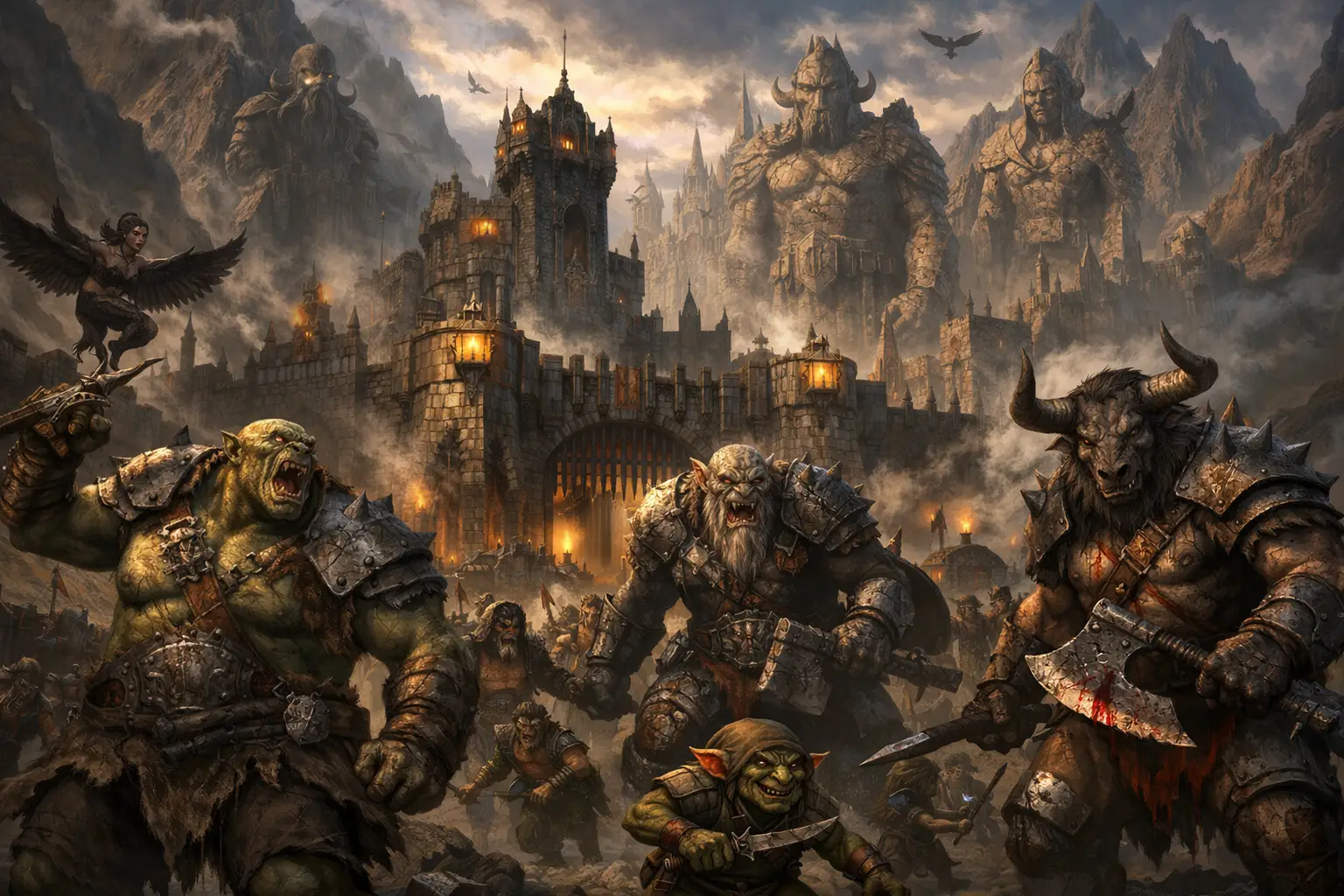
Walk through Graywall at dawn and the culture hits you before you've finished blinking. A harpy on a tower ledge opens her mouth and the shift-change call rolls across the district — not the murderous lure that Five Nations children are warned about, but a complex harmonic that somehow makes your tired legs want to carry you to work. Below her, a pair of gnoll soldiers in Znir Pact leathers patrol the market square with a professional calm that would earn a nod from a Deneith Blademark. A medusa architect in a silk veil directs a crew of ogres hauling basalt blocks into position on a half-finished wall, her serpent mane gesturing instructions in Serpentine — a sign language that only other medusas can speak but that everyone in the city has learned to read. At a food stall, a goblin cook serves steamed chuul legs and something involving a tiny living ooze that the cook insists aids digestion. A changeling street performer — skin rippling through a dozen faces and forms in time with a gnoll drum — draws a mixed crowd of goblins, minotaurs, and a single bewildered Brelish merchant who has stopped pretending he isn't staring.
This is Droaam's culture: a dozen incompatible peoples building something together in real time, with no shared past, no common aesthetic, no mutual understanding of what "art" means, and no particular agreement about whether the tiny ooze is food, medicine, or poison. What they have instead is shared investment — if the roads hold, the markets run, and the cities feed themselves, the experiment continues. The Daughters of Sora Kell use spectacle, ritual, and commerce as binding agents, and Sora Katra's persistent message is that the citizens of Droaam are family — that the troll and the goblin and the gnoll are building something together, and that the measure of a Droaamite is not who they can defeat but what they can contribute. The cultural shift this represents is slow, genuine, and the Daughters' most underestimated achievement.
Goblin is the shared tongue — the old Dhakaani trade language that threads through every city and lets a gnoll from the Byeshk Mountains and a medusa from Cazhaak Draal do business without an interpreter. The Dhakaani past is present not as living tradition but as physical substrate — ruins beneath the cities, statuary in the mountain passes, artifacts surfacing in excavations. Among the goblins and kobolds of the blended cities, that heritage is becoming something more: a tentative revival of the duur'kala tradition — Dhakaani dirge-singer bards who blended magic with music — is emerging from the rubble, and goblin artisans look to the empire's relics with genuine pride.
OVERHEARD — Graywall market, midmorning
"What do you mean, 'what is it?' It's breakfast. The legs are chuul. The sauce is proprietary. The ooze is optional but recommended. You want Aundairian pastries, go back East. You want to eat like a Droaamite, sit down and stop asking questions."
Voices, Bodies, Drums
Music in Droaam creates shared timing, shared emotion, and shared story across a population that speaks dozens of languages and hears the world through radically different sensory apparatus. It is also, by any standard, genuinely extraordinary.
Harpies bring the most remarkable musical capabilities in the nation. A gifted songbird can produce harmonics that inspire hope, despair, joy, or tears — a range far beyond the simple predatory lure their Five Nations reputation suggests. In Graywall and the Great Crag, harpy performances have begun to formalize into dedicated venues, but the songbird's most important role is civic: calling shift changes in every major city, soothing workers at the end of their day in the grist mills, relaying news across an entire district simultaneously with voices amplified to supernatural volume. Singing for a harpy is not merely a tool. It is a joyful act, a communion with the Fury, a craft. Those who have embraced Katra's vision are among the most enthusiastic participants in Droaam's civic project. Those who haven't — and there are harpies who hate the Daughters and everything they represent — sing with equal passion in a different key.
Changeling skindancing is unlike anything else in Khorvaire — physical motion blended with controlled shapeshifting, the dancer's body flowing through a dozen forms in time with the rhythm, simultaneously dance and visual spectacle. In the blended cities, skindancing draws mixed-species audiences and represents one of the few art forms that is genuinely new rather than inherited from an older tradition. The changelings of Lost wear their true faces in Droaam — a rarity across Khorvaire — and use their shapeshifting aesthetically, creating exotic patterns across their skin that shift and flow like living tattoos.
Gnoll chant-culture forms the backbone of Droaam's working music: call-and-response, work rhythms, war songs that coordinate labor, preserve history, and bond the pack simultaneously. The duum — the large goblin drum with its deep voice — anchors public gatherings. Minotaur horn ensembles and ogre drumlines serve as civic music for processions, border musters, and announcements. The combined effect in a blended city at shift change — harpy voice, gnoll chant, goblin drum, the rumble of ogre feet on stone — is an experience that visiting Five Nations citizens describe as either magnificent or terrifying, and that Droaamites describe as Tuesday.
What the Hands Make
Art in Droaam is craft-as-identity, and every species brings something different to the market.
Medusa artisans produce the most coveted fine work — stone sculpture, inlay, and architectural features that blur the line between art and power statement. The Cazhaak Draal tradition favors smooth curves and engraved patterns, often incorporating stonewood from the Stonelands alongside conventional metalwork. Commissioning medusa stonework is a declaration of status; owning it announces your place in the hierarchy before you open your mouth.
Gnoll artisans of the Znir Pact produce work that eastern eyes find ugly and Droaamites find reliable — functional, durable, excellent woodwork and leathercraft, built for endurance rather than impression. A Znir gnoll's equipment is patchwork by design: a Dhakaani axe head on a gnoll-crafted haft, armor assembled from three different salvaged suits, the whole thing ugly as sin and good for another twenty years. Ogres and minotaurs favor bold, readable displays — painted shields, massive banners, trophy installations meant to be understood at fifty paces.
The Venomous Demesne produces work at the sophisticated end of the spectrum: fine metals, ceramics, enamelwork, and magecrafted objects that exceed the Five Nations in individual craft if not in industrial scale. Most magic items in Droaam come from the Demesne, and tiefling artisans from its workshops are the nation's closest equivalent to House Cannith — a comparison neither party would appreciate.
And everywhere, the Dhakaani ruins yield treasure. Ancient adamantine weapons, ceramics that have survived millennia, forge-works in styles no living smith can replicate — all of it surfaces in the markets of Graywall and the Great Crag, sold alongside gnoll leatherwork and goblin pottery and the occasional crate of goods that fell off an eastern caravan under circumstances nobody wants to describe.
"You never know what you'll find in a goblin market." — common Droaamite expression
The Arena and the Mark
Public life in Droaam runs on two principles: controlled violence and visible status.
The arena is a central civic institution. Most large cities maintain one, used for trial by combat — a formal sanction under a chib's justice — and for voluntary gladiatorial competition. Combat sports draw genuine crowds and produce genuine champions, some of whom accumulate enough status to negotiate terms with the local chib on their own authority. Strength competitions — tug-of-war, boulder-lifting, endurance contests — are common wherever ogres and giants gather and bridge species divides effortlessly. Festivals in Droaam revolve around trade milestones (the opening of a mountain pass, the first caravan of the season, Tharashk treaty anniversaries) rather than religious holidays, and serve as controlled release valves — sanctioned contexts for rivalry, score-settling, and the competitive instincts of a nation of predators.
The most important public ritual is recognition: who stands where, speaks when, and wears what marks. In a society where bodies are weapons, etiquette is safety protocol. Larger creatures have the right of way — goblins clear the path of a troll, and everyone clears a path for a medusa. Status marks — trophies worn openly, contract tokens as identification, clan insignia on equipment — form a visual vocabulary every Droaamite reads fluently. Dress is engineered to signal: clan, city, contract, rank, and legal status, with heavy belts, layered wraps, and standardized tokens serving the role that papers serve travelers in the Five Nations. Symbolism favors triads — the Daughters' ever-present shadow — alongside chains and keys (order and access), teeth and horns and claws (power made visible), and road-marker glyphs (civic stability, trade). What Droaam does not have is a unified fashion identity. Each species and city dresses according to its own conventions, and those conventions are still forming.
At the Grist Mill and Beyond
Droaamish cuisine reflects the biology of its population without apology.
The baseline is grist — free, filling, produced through the Daughters' proprietary application of troll regeneration and processed through a secret herbal formula into something stable and edible. Every city has a grist mill; every citizen can eat. The grist is sustaining. It is not, by any reasonable standard, delicious. For those with slivers or bounty-marked teeth to spare, the markets offer what a nation of hunters and predators can catch: steamed chuul on the coastlines, spicy displacer beast inland, dried carrion crawler tentacles (a numbing gnoll and troll snack), and dishes served with a tiny living ooze that Droaamites insist aids digestion. Meat is the staple, preferred nearly raw by the nation's larger inhabitants — many lesser giants favor live prey entirely.
The markets also receive goods that cannot be found anywhere else in Khorvaire: organs and hides from exotic creatures, components for magic items (if you need the eyes of a leucrotta, the Graywall marketplace is your best chance), and the spoils from bandits, deserters, and renegades who drifted in from the Five Nations carrying whatever they could grab. From Barrens-primitive stone and bone to Venomous Demesne magecrafted enamelwork — and in any given market stall, you might find three of these traditions sitting side by side. You never know what you'll find in a goblin market. That is the entire point of going.
MARKET STALL — Graywall, prices in Droaamite teeth or eastern galifars
Grist bowl (free, courtesy of the Daughters). Steamed chuul legs (3 teeth). Spicy displacer beast skewer (5 teeth). Carrion crawler tentacle jerky (1 tooth — numbing sensation is normal, do not be alarmed). Mystery stew (2 teeth — contents rotate daily; vendor reserves the right to decline identification requests).
Live prey available on request. Bring your own container.