History of Droaam
"We're all going to die. That thought echoed through my mind as the wagon carried us toward the Great Crag. The diplomats around me intended to speak with the Daughters of Sora Kell. All I could think about was the stories my grandmother used to tell me." — Anonymous Brelish envoy, c. 998 YK
An Ancient Land
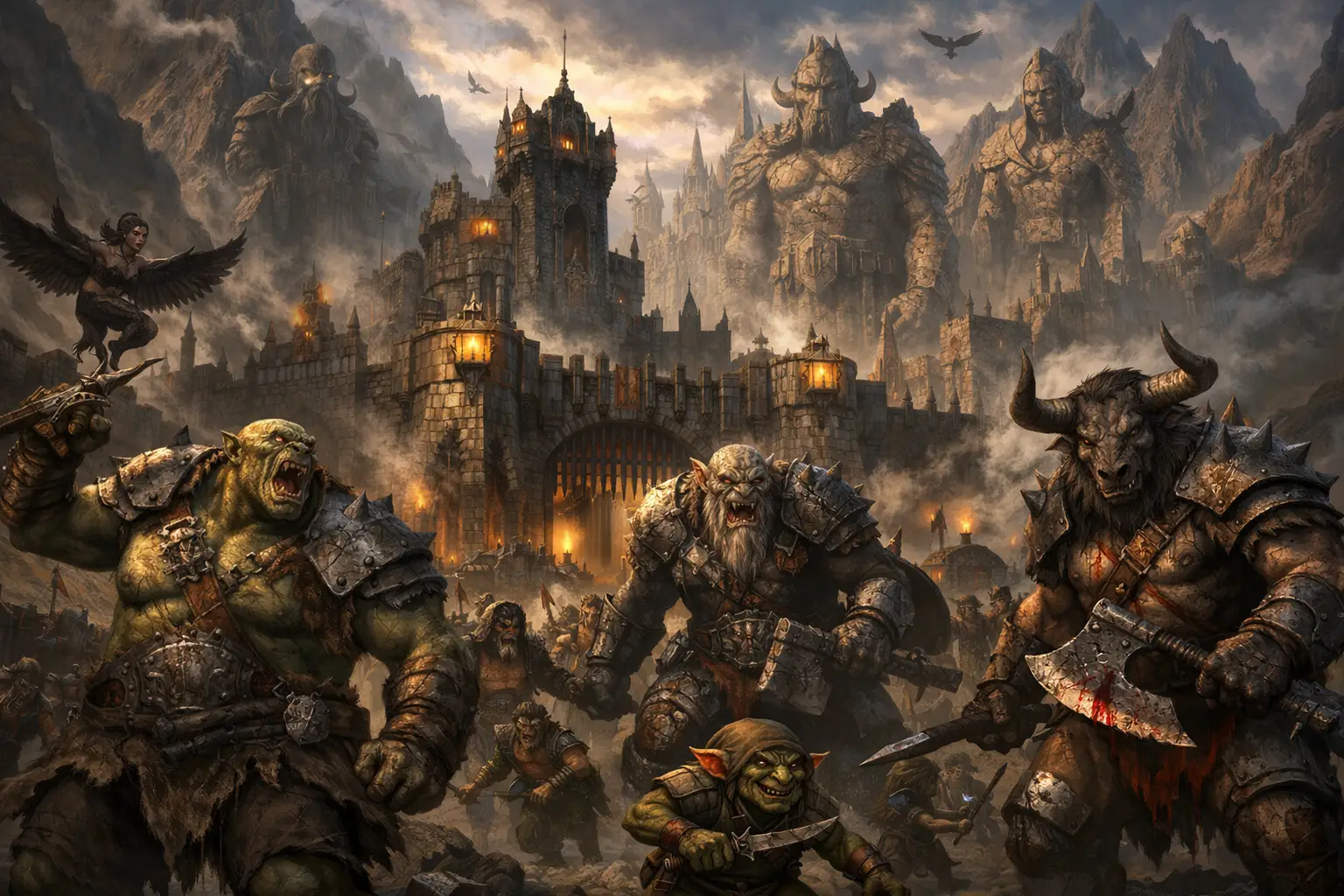
The territory that became Droaam is far older than Galifar or the nation of Wroat. The region holds rich mineral deposits — including the lustrous purple metal byeshk, mined from the Byeshk and Graywall Mountains — and some scholars believe it was the original homeland of the goblinoid peoples, a theory supported by the significant concentration of Dhakaani ruins along the mountain ranges and beneath the site of the Great Crag itself. In the Graywall Mountains, a set of thousand-foot statues commemorates the six kings who came together to forge the Empire of Dhakaan.
The empire's relationship with the western lands ended badly. When the daelkyr invaded Khorvaire, the region was utterly devastated. The dar who remained were infected with daelkyr curses — including what the Kech Dhakaan call the Kapaa'vola, Dyrrn the Corruptor's psychic contagion — and instead of standing together against the invaders, they turned on each other. Vicious gnolls swarmed south from the Towering Wood. Orcs emerged from the western swamps. Trolls and ogres came down from the mountains. When the collapse was complete, hobgoblins and bugbears had been eradicated in the region, and goblins were scattered and divided among themselves. What Dhakaan had built was rubble.
The region was dominated by anarchy from then on. The only bastions of organized civilization — the Venomous Demesne, the hidden village of Lost — survived by fortifying themselves or concealing their existence, with no interest in expanding their culture. Everywhere else, history was marked by the endless rise and fall of chibs: a Goblin term literally meaning "boss" or "big person," denoting whoever was powerful enough to assert control over the creatures around them. An ogre or troll strong enough to dominate goblins and kobolds might hold territory for a generation; a clever minotaur warlord or charismatic oni might build something that lasted two. None of it lasted. The relentless, brutal tide always prevailed.
Under Galifar's Shadow (1–894 YK)
When Galifar was established, the province of Breland was formally granted dominion over all lands south of the Byeshk Mountains and west of the Seawall, extending to the waters of the Thunder Sea. The grant was bold, thorough, and almost entirely fictional. The Brelish had no need of the Barrens — their name for everything west of the Graywall Mountains — and no desire for them. Explorers confirmed the stories: goblins and hungry gnolls on the plains, harpies whose songs led travelers into chasms, trolls sleeping on piles of bones. The Barrens had nothing the Brelish believed worth fighting for, and so it was left alone. Questing knights or templars occasionally crossed the Graywall to slay ogres and battle giants, but these were individual ventures, not campaigns of governance.
Over centuries, Breland expanded westward regardless. Castle Arakhain became a favored royal residence in the eighth century, bringing prosperity to Ardev and Shavalant and drawing a wave of settlers toward the Graywall. Those settlers were met by fierce raiders crossing the gap between the mountains and Silver Lake. The resulting attack on Castle Arakhain led to the brief Westward War — Galifar driving the raiders back across the Graywall and obliterating many of the marauding bands. In response, the crown established the fortress of Orcbone as the gate between Brelish lands and the Barrens, and founded the Westwind Riders to patrol the border.
The Riders held through the ninth century. Brelish settlers staked claims along the Graywall, and this period of relative stability peaked with the founding of the fortress-town of Stubborn in the foothills. In the Barrens itself, the underlying pattern continued unchanged: the harpies held the Byeshk Mountains in endless feuding flights; the medusas kept Cazhaak Draal; the plains were dominated by whatever chib was strongest that season. Galifar could claim the territory on maps. It could not collect taxes from harpy aeries or compel ogre bands to obey a distant crown.
The Last War and the Opening of the West (894–986 YK)
The Last War did not create Droaam, but it made Droaam possible. When the Five Nations turned on each other, Breland's western garrisons thinned. Wroann ir'Wynarn, newly crowned queen, needed every soldier for the eastern front and reduced the Westwind Riders to a skeleton force — enough to patrol between Orcbone and Stubborn, but little more. Many of the Riders had been Aundairian, and those soldiers went home.
Aundair saw the opening. Spy Master ir'Galanatyr of the Royal Eyes worked with Rhesh Toraa — the dominant minotaur warlord of the Barrens plains — and other chibs, providing equipment and training to support raids against Graywall settlers and sustained attacks across the border gap. Karrnath pursued similar arrangements. The plan failed in its primary purpose: the chibs were undisciplined and impossible to unify, never coalescing into the dire threat Breland's enemies had intended. But the raids intensified, settlements were overrun, and the border became effectively ungovernable. Stubborn held. Lesser claims did not.
The Daughters Arrive (986–987 YK)
In 986 YK, the soldiers of Stubborn faced something they had no framework for. A typical Barrens raiding band might include a single troll or a handful of ogres. What appeared at Stubborn's walls was an army: phalanxes of armored trolls fighting with deadly coordination, squads of skullcrusher ogres acting with discipline, walls shattered by hurled stones, defenders leaping from the battlements in pursuit of harpies' songs. The fortress fell. Survivors were herded into the plains to face the leaders of the army — the assembled Daughters of Sora Kell, three hags whose names children across the Five Nations had been told since birth.
Sora Katra delivered the terms: "Tell your rulers there's a new power in the west. What you've called the Barrens, we now name Droaam. The land beyond the Graywall and below the Byeshk belongs to our people. Withdraw yours quickly and respect our claim; next time, there will be no survivors."
She was true to her word. The Westwind Riders rode west from Orcbone in full force. They left no survivors. A retaliatory Droaamite strike — a fraction of the forces that had taken Stubborn — inflicted severe damage on Orcbone itself. King Boranel deployed every soldier he could spare to reinforce the fortress.
In 987 YK, Boranel formally ordered all Brelish citizens to withdraw from the lands west of Graywall, while explicitly refusing to acknowledge the sovereignty of the Daughters. That refusal did not change the outcome. The same year, Sora Katra summoned the most powerful leaders of the Barrens to the ruins that would become the Great Crag and presented the blueprint for a nation: warlords appointed, territories assigned, responsibilities specified. Work began on the three founding cities — Graywall, the Great Crag, and the port of Vralkek. Stubborn was repurposed and renamed Stonejaw. Thousands of goblins and kobolds were freed from oppressive chibs and given a place in the new cities. Those chibs who refused the Daughters' terms met Maenya's Fist.
The preparation, scholars would later conclude, could not have been recent. Sora Teraza had approached the Queen of Stone and the lords of the Venomous Demesne as early as 985 YK, and the Daughters brokered half the forces of the Znir Pact in this period. The theory of the scholar Melian Mit Davandi of the Library of Korranberg — that demiplanes may have been involved, and that Maenya's Khyber lair could exist outside the normal flow of time — remains unconfirmed. What is certain is that by 986 YK, the Daughters had an army of trained war trolls and disciplined skullcrusher ogres whose sophistication implied preparation measured in decades, not years.
Building a Nation (987–996 YK)
The founding of Droaam was not simply conquest; it was the construction of a governing framework imposed on a region that had never known one. Warlords kept their territories and their autonomy in exchange for paying tribute, suppressing uncontrolled raiding that invited eastern retaliation, and acknowledging the Daughters' authority as final. Order within the new nation was maintained by gnoll peacekeepers of the Znir Pact — neutral to all warlords, loyal to the Daughters, and trusted by virtue of a centuries-old reputation for keeping contracts inviolably. When the Znir proved insufficient, Maenya's Fist resolved the problem.
The alliance with House Tharashk was secured early and proved transformative. For Tharashk, Droaam offered access to the region's rich mineral resources — especially byeshk — and a new market for monstrous mercenaries that opened an entirely new revenue stream for the house. For the Daughters, Tharashk provided a legitimate voice in the east: Tharashk agents convinced the Twelve to open trade to Graywall, organized laborers to build the new cities, and began brokering Droaamite soldiers and workers into the Five Nations. Gargoyle and harpy couriers found a niche in Sharn. Ogre laborers appeared in Fairhaven and Wroat. Through Tharashk, Droaam made itself economically useful to nations that refused to acknowledge it existed.
Thronehold and Non-Recognition (996 YK)
The Treaty of Thronehold ended the Last War among the recognized nations and formalized the borders war had produced. Droaam sent representatives to the negotiations demanding recognition as a sovereign nation. The petition was denied. Breland, which had never relinquished its legal claim to the Barrens, led the opposition.
The practical consequences of non-recognition are complicated. In law, the land remains part of Breland; Droaamites are neither Brelish citizens nor entitled to the protections of the Code of Galifar. Their standing outside the law makes the nation a haven for war criminals, deserters, and dissidents who can find no place in the Five Nations — a population Droaamites have no particular love for but tolerate. Most maps produced since 996 YK include Droaam's name and mark its territory. Recognition and cartography are, it turns out, different things.
Modern Droaam (996 YK–Present)
After eleven years, Droaam is stronger than it has ever been. The Great Crag and Graywall expand continuously; goblins and ogres work through the night on construction that is visibly, measurably changing the landscape. Warlords drill their forces. The dragonmarked houses assess their opportunities with increasing interest, and Tharashk's network of mercenary brokering and resource extraction grows more sophisticated every year.
The leaders of the Five Nations have believed since 987 YK that Droaam cannot last — that the Daughters cannot hold so disparate an alliance together, that the monsters will turn on each other. The Daughters have had to crush a number of rebellious warlords and lesser chibs. The prediction has not otherwise come true.
What remains unanswered — and what every foreign ministry in Khorvaire would pay considerable sums to know — is what the Daughters of Sora Kell actually want. The practical work of governance, the economic development, the military discipline: all of it points toward a nation building toward something. Whether that something is permanent recognition, open war with Breland, or something tied to the prophetic visions of Sora Teraza that no eastern intelligence service has managed to decipher, remains the defining open question of Droaamite history. The story has not yet found its end.