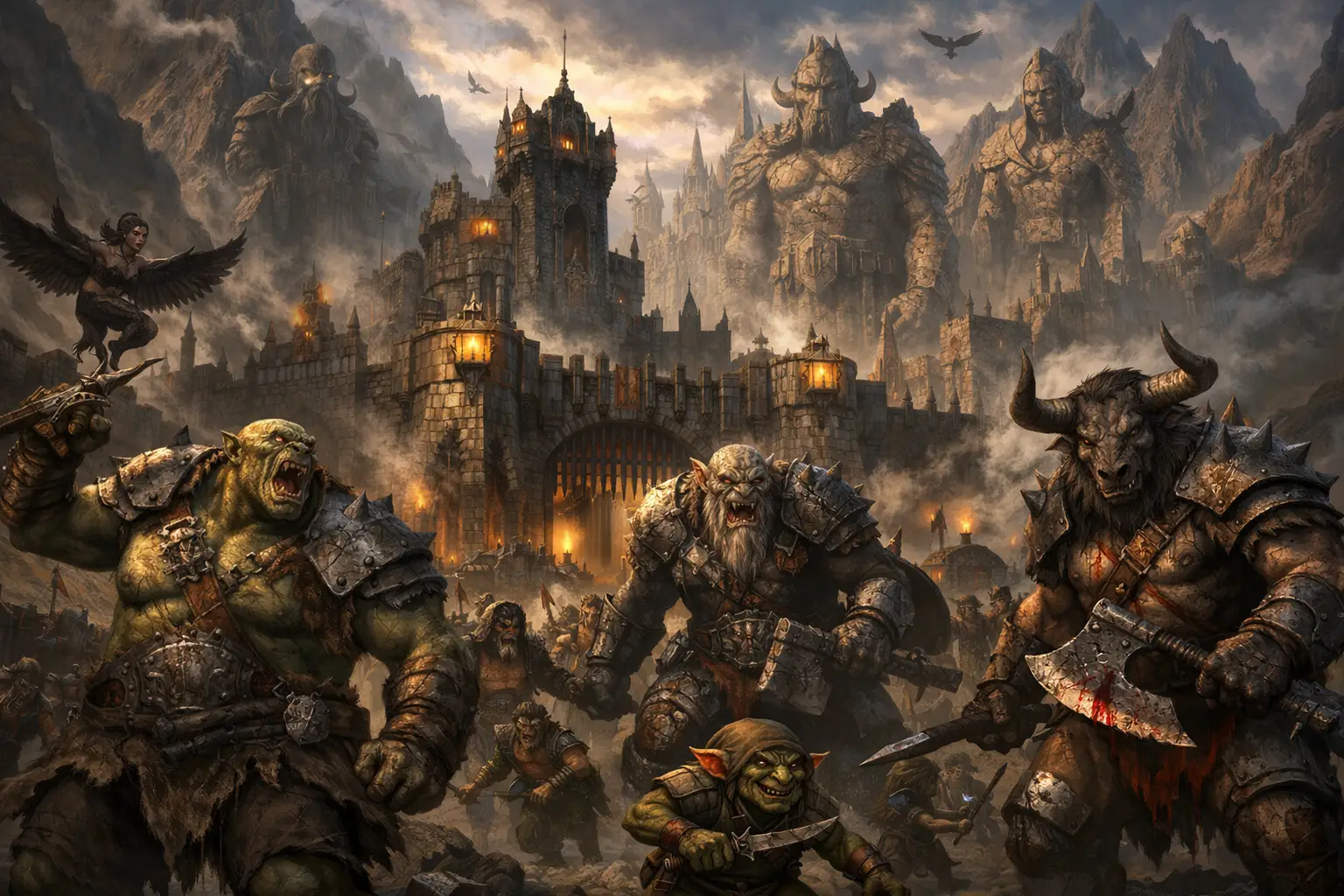
Politics of Droaam
"It's sort of like Karrnath, except each of the warlords of Droaam is a horrifying monster." — Anonymous Brelish envoy, c. 998 YK
Droaam is a state built on obedience, demonstrated power, and myth. It is not a bureaucracy, not a constitutional arrangement, and not a stable feudal realm in the Galifaran sense. It is a frontier nation barely eleven years old, expanding outward in every direction simultaneously, holding together because the center remains stronger than the parts — and because the parts profit from not collapsing.
The Daughters of Sora Kell
All authority in Droaam flows from the Daughters. There is no constitution, no parliament, no council that interposes itself between the Daughters' will and its execution. This is governance by singular force of personality, mythic reputation, and demonstrated willingness to destroy anyone who tests it.
In practice, the Daughters rule through distinct faces of power. Sora Katra is the Voice of Droaam — public architect of loyalty, master of illusion and enchantment, and the political intelligence behind the nation's design. She speaks for Droaam to the outside world and manages internal morale through her network of agents. It is Katra's vision that all creatures of Droaam work together as parts of a greater whole, that laborers be respected for their efforts rather than beaten on a foreman's whim — an aspiration imperfectly realized, but genuinely held. She also has a knack for knowing what people want, and for finding someone to take the fall for things that cannot be avoided. Combined with Teraza's guidance, she invariably foresees problems before they become crises.
Sora Maenya is the military fist. She commands Maenya's Fist — the elite armored trolls and skullcrusher ogres who serve as Droaam's instrument of final enforcement — and is the reason rebellious warlords do not stay rebellious for long. Her reputation alone does half the work. Stories of her strength and hunger are among the most widely known in Khorvaire; the practical fear she inspires is one of the two poles around which Droaamite civic loyalty organizes itself.
Sora Teraza is the oracle. Blind, possessed of vast powers of divination, she is the most gifted seer of the age — and the least predictable instrument of power in Droaam's arsenal. Her advice shapes long-term direction even when she withholds it or delivers it too late for conventional use. Some believe the entire nation of Droaam was constructed to serve some end visible only to her. Whether that is true, the prophetic authority she is understood to hold is itself a source of cohesion: Droaamites who trust that Teraza sees the future are unlikely to bet against the nation she helped found.
The Lheshat: Warlords and Chibs
Droaam is centralized in loyalty but decentralized in administration. The nation has been divided into lheshat — a Goblin term meaning "domain of a warlord." Each lheshat is governed by a warlord who answers directly to the Daughters and is charged with maintaining a military force available for their call. Below the warlord, local communities are governed by chibs — the most powerful local authority in any given settlement, who may no longer be the largest or most physically menacing creature in the room, but who retain real day-to-day power over the populace beneath them.
Each warlord organizes their own domain and army as they see fit. There is no standardized system of bureaucracy or military rank. In cities where multiple species live and work together, the common populace divides into soldiers, skilled laborers, and a general labor force, all organized under the local chib's authority. Citizens are expected to serve when called and to do whatever is demanded; in exchange, every city maintains a grist mill and a series of barracks, providing food and shared shelter for all workers. The arrangement is openly coercive and is not presented otherwise — anyone who challenges the Daughters or their warlord will be crushed without mercy. The cities are still expanding to meet capacity, and in many places, that shelter is a bedroll in a tent. It is, nonetheless, more than most of these peoples had before.
Most citizens are sincerely committed to what they are building. The alternative — the Barrens as it was, dominated by capricious chibs, endless raiding, and the law of whoever was largest — is not an abstraction. A goblin who spends their days in the mines knows they are building a great city, not serving the crude whims of a crass ogre chief. The commitment to Droaam among its citizens is genuine and should not be underestimated.
The Three Branches of Daughters' Authority
Three forces operate outside the lheshat system, working directly for the Daughters and wielding authority throughout the land regardless of which warlord holds the territory.
Katra's Voice — Envoys, entertainers, diplomats, and magistrates. Their task is to maintain morale and lines of communication and to resolve disputes before they escalate. Most agents of Katra's Voice are changelings, though medusas, tieflings, and even harpies serve in this capacity. Many operate primarily as entertainers, sharing stories and painting pictures of the bright future ahead; others serve as administrators of justice, particularly when there is unrest between a chib and their laborers. Katra's Voice includes magistrates with the authority to override local chibs in matters of justice. Magistrates travel between smaller communities; larger ones like Graywall have a resident magistrate. The current fashion is that magistrates are medusas — a choice with practical implications for anyone who brings a frivolous complaint. A few elite soldiers of Maenya's Fist typically accompany an emissary of Katra's Voice; if the Voice cannot soothe the trouble, the Fist ends it.
Teraza's Eye — Sages versed in the region's history and diverse customs. They survey ancient ruins, identify manifest zones and planar conjunctions, and offer unsolicited advice to local warlords. Though the smallest of the three branches, some believe that the Eyes who are visible are merely the tip of the ankheg — that Teraza is served by changeling and hidden agents who carry news of all developments back to the Daughters regardless of what the local chib believes they are keeping private.
Maenya's Fist — The Daughters' elite military instrument, composed of armored war trolls and skullcrusher ogres whose capabilities exceed what is common for their kinds. They are devoted to the Daughters and serve as the response to problems that the other two branches cannot resolve. A single war troll can crush a band of insubordinate minotaurs. The Fist does not patrol; it descends.
Law and Order
Droaam is not bound by the Code of Galifar, and there is no uniform code of justice. Justice is in the hands of the local chib unless Katra's Voice overrides them. Every chib maintains their own guard force — a handful of Gaa'aram orcs in a small village, a versatile combined force of orcs, minotaurs, ogres, harpies, and gargoyles in a city like Graywall. Every major community also has a garrison of Znir gnolls who serve as peacekeepers on direct retainer to the Daughters, not the chib — partly to protect the region from external threats, and partly to ensure that if a chib turns against the Daughters, the Znir will act against them.
In practice, the law is simple: do not harm the chib or anything that belongs to the Daughters. The guards do not care about street brawls or stolen purses. They do not care what laws a fugitive broke in some other land. What they do care about is significant damage to buildings, or anything that threatens to kill multiple laborers — losses that cost the nation. A Sentinel Marshal who enters Graywall to arrest a war criminal will not be interfered with; neither will the three trolls the criminal hired to kill the Marshal in return.
For serious crimes, a chib punishes with immediate execution. For lesser crimes, the convicted are branded and beaten, maimed, or given trial by combat — most large cities maintain an arena for this purpose, though people may also enter the arena by choice. Those who survive their punishment are freed. The one recourse for those seeking formal justice beyond the chib's discretion is a magistrate of Katra's Voice: if the magistrate finds the case has merit, she orders the chib to act. If she finds the complaint frivolous, she petrifies the plaintiff. Very few people take the risk of seeking formal justice — but for laborers who know they could, the option is a meaningful comfort.
One notable exception: the foreign quarter of Graywall, the Calabas, has been granted to House Tharashk's Kundran Torrn to administer. Within the Calabas, much of the Code of Galifar holds sway. This arrangement contains the implicit acknowledgment that Droaam cannot attract eastern trade without offering eastern merchants something they recognize as law.
External Legitimacy and Treaty Politics
Droaam sent representatives to Thronehold and demanded recognition as a sovereign nation. The petition was denied, led in opposition by Breland, which has never formally relinquished its legal claim to the Barrens. Under the Treaty of Thronehold, the territory remains legally part of Breland; Droaamites are not recognized citizens and are not entitled to the protections of the Code of Galifar. It is debatable whether Droaamites are legally invaders or rebels defying the Brelish crown. Either way, they are outside the law — which makes Droaam both dangerous and strategically useful as a haven for war criminals, deserters, dissidents, and anyone who needs to exist outside the structures the Five Nations maintain.
Most recent maps include Droaam's name and mark its territory. Recognition and cartography are different things.
Breland's position on the western frontier remains non-recognition without meaningful policy beyond it. Some in the Brelish parliament see opportunity in trade and engagement; House Tharashk's brokering arrangements have already drawn Droaamite laborers and mercenaries into Brelish cities in numbers that are becoming difficult to ignore. Others call for containment or confrontation. The legal fiction that the territory is still part of Breland satisfies no one and shapes no practical policy.
Political Tensions
Droaam's internal tensions organize around a single structural question: it is holding together — so what happens next? The Five Nations have been waiting for the inevitable collapse since 987 YK. After eleven years, the Great Crag and Graywall are larger than ever, the warlord structure has proven more stable than anticipated, and Droaamite soldiers and laborers have become a feature of life across Khorvaire. The prediction of collapse has not come true.
That leaves the question every foreign ministry in Khorvaire would pay to answer: what do the Daughters of Sora Kell actually want? Whether the goal is formal recognition, open war with Breland, economic leverage sufficient to force accommodation, or something tied to the prophetic visions of Sora Teraza that no eastern intelligence service has managed to interpret, the answer would resolve the central open question of Droaamite foreign relations — and possibly of the postwar order itself.
Internally, the standing threat is rebellious warlords. The Daughters have already had to crush a number of them and lesser chibs. The lheshat system functions because centralized enforcement is credible; Maenya's Fist has demonstrated what happens to those who test it. Whether that credibility remains intact as Droaam grows larger and the Daughters' attention is divided across more territory is an open question — one that Droaamite warlords with ambitions are quietly monitoring.