Military and Security of Droaam
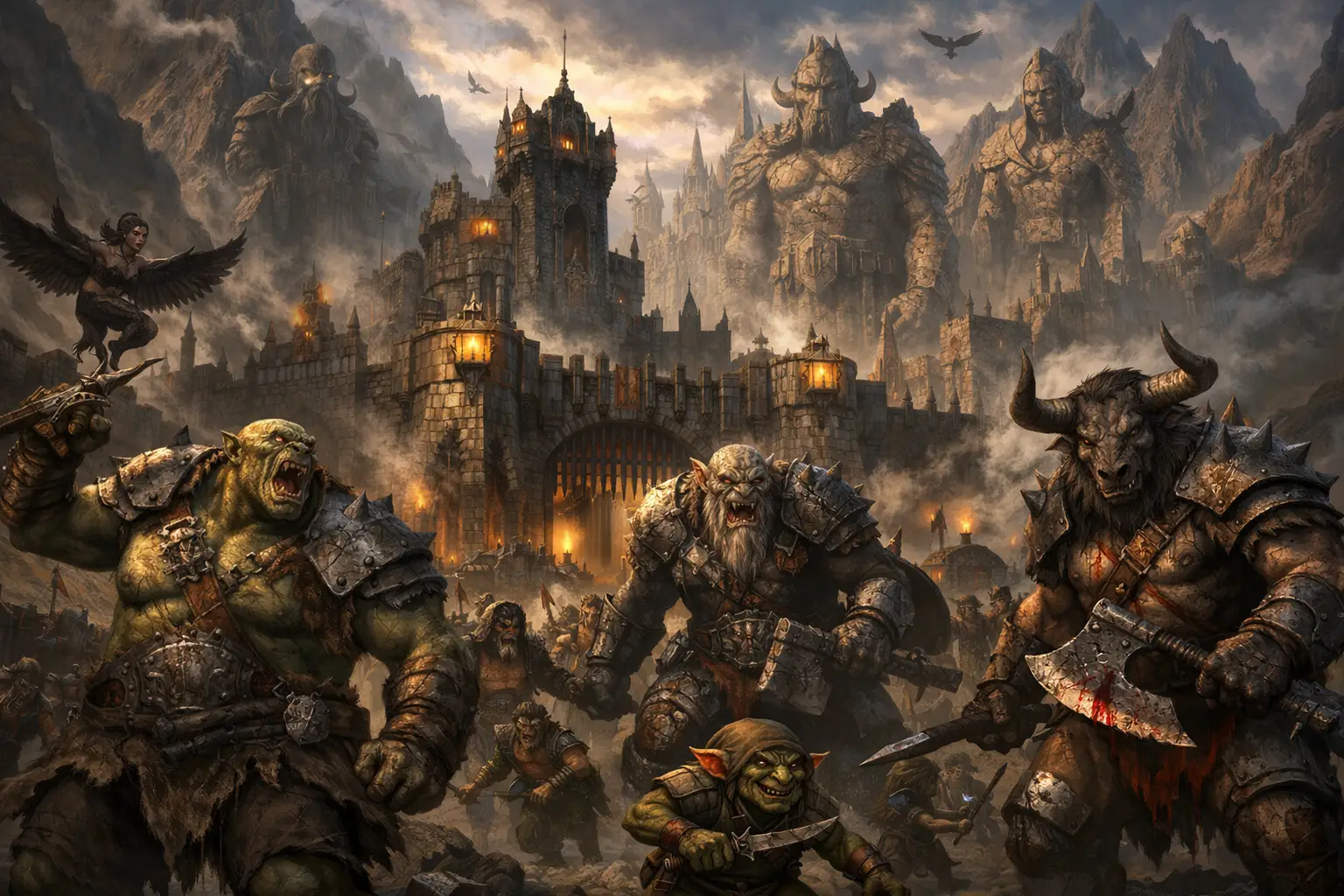
"Warlords drill their troops, forcing all manner of monsters to work together. A predatory aspect permeates life in Droaam — but also a sense of excitement, the belief that the Daughters will lead Droaam to greatness."
Droaam does not field a standardized national army in the Galifaran sense. It fields warlords — each with their own force, their own doctrine, and their own understanding of what they owe the Daughters — backed by a small number of elite centralized assets that can end any internal crisis decisively, and a mercenary peacekeeper corps whose neutrality is the closest thing Droaam has to institutional law enforcement. The nation's military posture is organized around two goals that the Daughters have never had to articulate explicitly: no warlord should ever believe rebellion is worth the cost, and no eastern nation should ever believe invasion is cheap.
Maenya's Fist
The core of Droaam's centralized military power is Maenya's Fist — an elite corps of war trolls and skullcrusher ogres fanatically devoted to Sora Maenya and to Droaam. Everything about the Fist is shrouded in uncertainty. Some say Maenya assembled and trained them in a forgotten Dhakaani fortress buried deep below the Byeshk Mountains, that she personally oversaw the forging of the imposing plate armor they wear, and that the war trolls and skullcrushers are smarter and more capable than their common cousins because Maenya bred them to be — that she calls them her children, and may mean it literally. The scholar Melian Mit Davandi of the Library of Korranberg has speculated that demiplanes may have been involved, allowing preparation measured in generations rather than years. Whatever the truth, the result is a force of a quality that eastern military analysts have not stopped studying since the fall of Stubborn.
The Fist does not patrol cities or garrison borders. It descends. When a warlord refuses a Daughters' order, when a chib declares independence, when a threat exceeds what local forces and Znir peacekeepers can contain, Maenya's Fist arrives and the problem ends. A single war troll can crush a band of insubordinate minotaurs. The Fist has demonstrated this enough times that its reputation does most of the work before it ever arrives. Sora Maenya has shown herself, through the engagements of the past decade, to be a brilliant and unorthodox strategist — one that foreign military planners have consistently underestimated, to their cost.
The Znir Pact
Every major community in Droaam has a garrison of Znir gnolls, and their role in Droaam's security architecture is distinct from every other military force in the nation. The Znir do not serve chibs or warlords. They serve the Daughters directly, on retainer, and their presence in a community is both a peacekeeping function and a standing deterrent against that community's leadership turning against the Daughters. If the local chib or warlord moves against Droaam's rulers, the Znir garrison acts against them. Every warlord knows this. Every chib knows this. The Znir do not need to say it.
The Znir's value as a security institution rests entirely on a reputation centuries in the making: their word is as unbreakable as stone, their contracts are inviolable, and they have never been subjugated by any force that has tried. Within Droaam, this reputation is known and respected, and the Pact can unite its full strength against anyone who defies it. The Daughters have placed roughly half the Pact's total forces on extended retainer; the remainder serve warlords and chibs who can pay the fee, providing bodyguards, enforcers, and hunters on contract. House Tharashk has begun brokering Znir services into the Five Nations, though the Pact's leadership is cautious — the Znir's strength is rooted in the unity they can bring to bear when defied, and that unity is harder to exercise when their people are scattered across foreign nations.
Warlord Forces and Local Enforcement
Below the level of Maenya's Fist and the Znir garrisons, Droaam's security is the responsibility of warlords and chibs. Each warlord maintains their own armed force, organized however they see fit and answerable first to themselves and then to the Daughters. Each chib maintains a guard contingent sized to their community — a handful of Gaa'aram orcs in a small village, a substantial combined force of orcs, minotaurs, ogres, harpies, and gargoyles in a city like Graywall. These forces protect the town and the chib's authority. They do not protect personal property, pursue individual crimes, or care about what laws a fugitive broke in some other land. The law in any Droaamish community is simple: do not harm the chib or anything that belongs to the Daughters. Everything else is managed locally or not at all.
The warlords drill their troops continuously. The nation is eleven years old and has not stopped building its military capacity since the founding of the Great Crag. Warlords are required to maintain forces capable of serving the Daughters when called; those forces represent the levy pool from which a combined Droaamish army could theoretically be assembled, though Droaam has yet to field the full combined force of its warlords as a single coordinated host.
Monster Capabilities as Military Assets
Droaam's strategic advantage mirrors its economic one: monstrous abilities applied as practical instruments of war. Harpies provide reconnaissance and battlefield communication at ranges and speeds no conventional courier network can match, and their song is a weapon that has broken formations and cleared walls in every engagement where it has been used. Gargoyle units serve in overwatch, night security, and rapid response — their elemental nature means they neither eat nor sleep, and they can remain motionless for months between deployments, making them ideal for long-duration surveillance. Ogres and hill giants anchor shock formations with a mass and durability that heavy infantry cannot replicate. Medusas function as area-denial assets and terror weapons of a distinctive kind — deployed sparingly, because the political consequences of petrifying enemy soldiers are non-trivial, but kept close, because nothing ends a fight like the possibility of turning to stone.
The gargoyle warlord Cairngorm of Grimstone Keep commands the largest host of gargoyles in Droaam. Rhesh Turakbar's minotaur forces on the eastern border raid regularly into Breland in the name of his fiendish patron Rak Tulkhesh, making him one of the most active sources of Droaam-attributed border violence. The Dark Pack — an alliance of lycanthropes, worgs, and other bestial predators under the elf werewolf Zaeurl — operates in southern Droaam and carries a deep hatred of the Church of the Silver Flame that shapes its threat calculus in ways that do not always align with the Daughters' strategic interests.
The Eastern Frontier
Droaam's most politically sensitive military front is its eastern border with Breland. The fortress of Orcbone, established by Galifar as the gate between Breland and the western Barrens, marks the contested line. Tensions have remained high since 987 YK, with constant skirmishes and raids crossing the frontier in both directions. Breland has reinforced Orcbone substantially since the Last War; Droaam has not attempted a sustained offensive against it. The Daughters' approach on the eastern frontier is not conquest — it is deterrence through demonstrated cost. Border posts are pressured. Incursions are met with retaliatory strikes disproportionate enough to make the next incursion feel expensive. The goal is to keep Breland's parliament from unifying around a war footing, while ensuring that any Brelish commander who considers a major western offensive has to account for what Maenya's Fist, Znir mercenaries, and an entire nation of monstrous warlords would mean for that operation.
Droaam's operations are not limited to the frontier. Daask — the criminal network operating in major Khorvaire cities under Sora Katra's ultimate authority — represents a strategic forward presence in the east. The Daask operatives in Sharn are not merely criminals; they are elite Droaamite soldiers running an operation that is building Katra a foothold in the heart of Khorvaire's largest city. Their ongoing campaign against the Boromar Clan is only the visible part of an agenda whose full scope is unknown even to Sharn's own intelligence community.
Mercenaries, Tharashk, and External Force Projection
House Tharashk's role in Droaam's military economy is significant. The mercenary brokering arrangements that send gnolls, ogres, minotaurs, and other Droaamite soldiers into service across Khorvaire accomplish several things simultaneously: they generate revenue flowing back to the Daughters' coffers, they keep idle warbands productively occupied rather than restless at home, and they give Droaam intelligence assets and influence in cities and courts that would never grant a Droaamite diplomat an audience. A gnoll garrison hired through Tharashk to protect a merchant caravan in Aundair is, by definition, a gnoll garrison that knows Aundair's roads, its guard rotations, and its trade patterns. The Daughters appear willing to accept the risks that come with battle-hardened assets returning home with foreign contacts and new ambitions, because the strategic benefits of that outward-facing presence outweigh the management problem.
Active Threats
Droaam's threat picture is not abstract, and the Daughters do not treat it as such. The Brelish frontier is the primary external pressure point — containment operations, covert destabilization attempts by the King's Dark Lanterns, and the constant risk that a border incident escalates into something that requires a full military response. Thrane represents a different threat: the Church of the Silver Flame's historical conduct toward lycanthropes and other monstrous peoples is remembered across Droaam, and "cleansing" rhetoric emanating from Thranish crusader circles is monitored carefully. The Dark Pack under Zaeurl is the internal faction most likely to respond to Thranish provocation independently of the Daughters' wishes.
Internal fracture remains the existential threat the Daughters' entire security architecture is designed to prevent. Rebellious warlords have been crushed before; the Fist's track record of doing so quickly and publicly is the primary reason the frequency of such attempts has declined. The structural risk — that a warlord calculates the Daughters' attention is divided, that a species rivalry becomes an armed conflict, that a chib decides the isolation of their lheshat is worth testing — never fully goes away. Droaam holds together because the center is stronger than the parts and because the parts profit from not collapsing. The Daughters' military apparatus exists to make sure that calculation stays accurate.