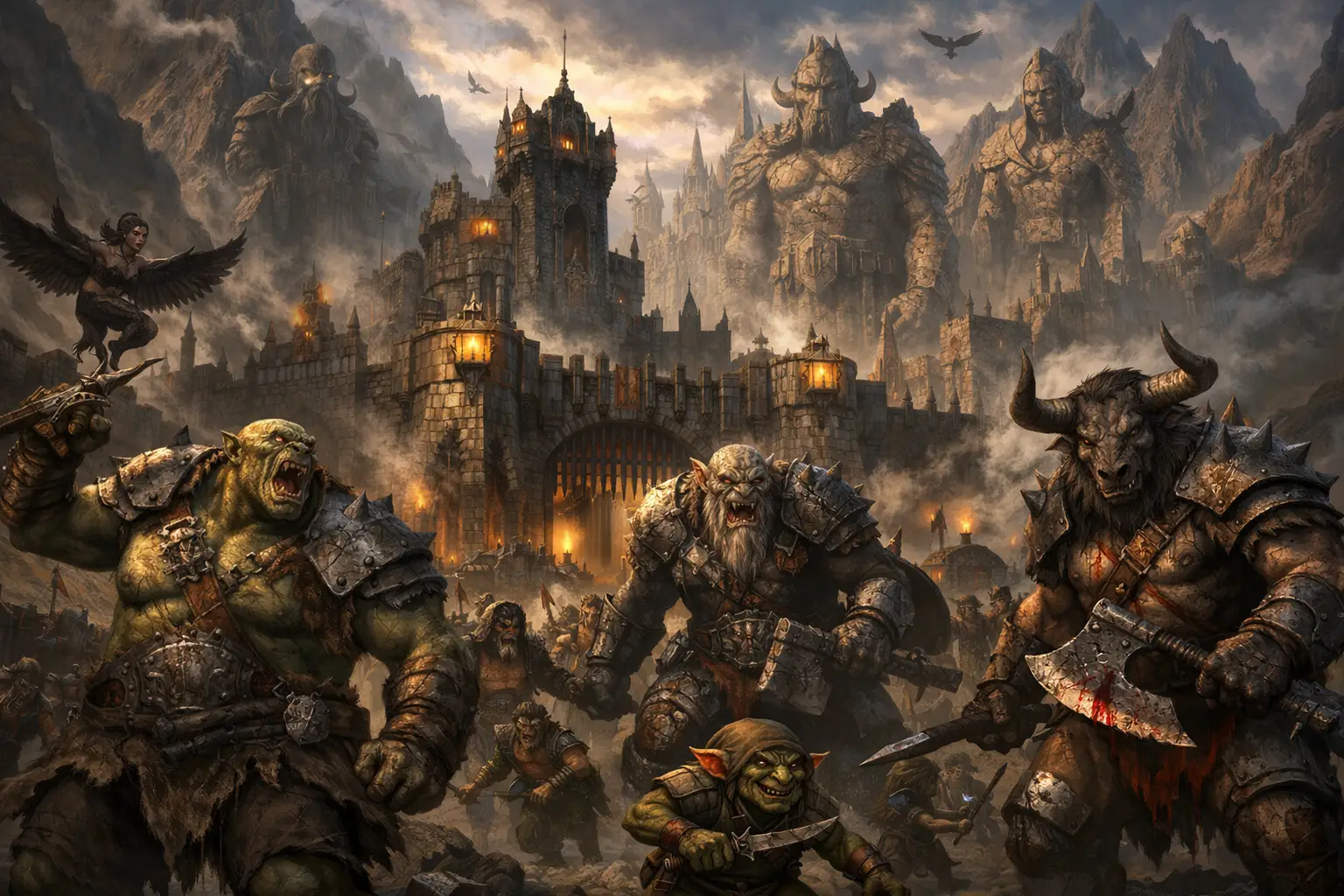
Economy and Culture of Droaam
"Today may be difficult, and tomorrow maybe harder still. But look what we've done in one decade, and imagine what we'll achieve in the next!" — Sora Katra
Droaam is not an economy in the Galifaran sense. There is no central bank, no lightning rail moving goods between cities, no network of dragonmarked house enclaves sustaining commerce at a continental scale. What Droaam has is a labor compact and a food supply, and from those two foundations it is building everything else. The Daughters did not promise prosperity — they promised sustenance, shelter, and a purpose larger than any single chib's fiefdom. For peoples who spent centuries as prey to whoever was largest that week, that promise was enough.
The Grist Mills
The single most important piece of economic infrastructure in Droaam is food, because reliable calories are what makes cities possible. The Barrens could not previously sustain large urban populations — many of Droaam's inhabitants are carnivorous, and those who are not lacked the agricultural discipline that feeding a city requires. The Daughters solved this problem with grist.
Grist is a ground meat served as stew, pie, or sausage, tough and sour but filling. Every major settlement in Droaam has a grist mill — a public cafeteria where it is dispensed without charge to anyone who serves the nation. The mills are staffed by trolls on rotating service — a position of recognized civic honor, compensated with status, preferred rations, and the respect owed to those whose bodies literally feed the city. Flesh is cut away in measured portions, always leaving full time for the creature to safely regenerate before the next harvest. Trolls cycle in and out of mill duty and return to other roles; the contribution is understood across Droaam as something like military service elsewhere — a sacrifice made for the nation, openly acknowledged as such. In communities where Katra's vision has taken deepest root, the trolls who have served longest are among the most celebrated members of their neighborhoods.
On its own, troll meat is highly toxic and carcinogenic. The Daughters of Sora Kell hold the only known process for rendering it safe: a magical mixture of herbs and spices blended with the ground meat, the formula for which is kept tightly controlled. Grist is not eaten anywhere else in Khorvaire. Most easterners find it sour and unpleasant. Most Droaamites eat it without complaint, because it is free and the alternative is hunger. Every grist mill also employs a harpy songbird whose magically amplified voice soothes weary workers at the end of a shift — a detail that captures something essential about how Droaam solves problems.
Wide Monster
It is commonly said that Eberron is "wide magic, not high magic" — the civilization of the Five Nations rests on the broad application of low-level arcane magic to solve the problems of daily life. Droaam is building something different: a civilization based not on wide magic, but wide monster. Where eastern cities use message stations and speaking stones, Droaam uses harpy songbirds to call the hour and relay news. Where the Five Nations use enchanted lanterns to light their cities, Droaam's residents are naturally keen-eyed in the dark. Where House Jorasco provides healing, Droaam's chirurgeons employ broodworms — a form of maggot whose secretions anesthetize patients and cleanse infected wounds — alongside tiny gelatinous cubes used as unusual anesthetics. The Daughters have also been experimenting with troll's blood, a salve with remarkable healing properties; if it can be perfected and produced at scale, it could change Droaamish public health considerably.
The medusa's petrifying gaze, which eastern stories frame exclusively as a weapon, is used in Droaam to preserve the critically injured or dying until proper care can be reached. The Medusa's Kiss — a ritual mastered by medusa magewrights that reverses petrification — turns a feared power into a medical tool. Medusa architects direct construction in the blended cities; their intelligence and organizational capacity make them indispensable to a nation that is building faster than it can train administrators. Ogres and hill giants provide the raw physical labor that would require specialized equipment elsewhere; many tasks that demand beasts of burden in Breland are simply performed by a large and powerful humanoid.
This is the logic the Daughters have embedded into Droaamish civic identity: your nature is not a problem to be managed, it is a resource to be deployed. The question is always how.
Currency and Internal Trade
Droaam has no established currency. The standard return for daily labor is sustenance and shelter — the grist and the barracks bed. Beyond that, most exchange is barter. In the major cities, eastern coins are accepted by most merchants, but two secondary systems operate alongside them.
Miners and skilled workers often trade in slivers — small chunks of precious metal or gemstone shards, valued by weight and material rather than by any official denomination. Bounty-marked teeth serve as a second quasi-currency, particularly for gambling and market transactions. The Daughters, through the chibs, offer bounties on dangerous animals paid in teeth bearing a carved Goblin symbol identifying the creature. Most merchants will not accept a tooth unless they personally recognize it — the system depends on direct knowledge rather than standardization. The bounty is a tool for encouraging the elimination of threats; if a creature doesn't threaten Droaam's people, there will be no bounty on its teeth.
Barter is slower than coin-based trade and creates openings for unusual exchange. A goblin merchant who can't make change for a platinum piece might offer a scrap of vellum that looks like a piece of a map, and say it came from below the city. Dhakaani relics, daelkyr remnants, items pawned by Brelish deserters — the goblin markets of Droaam turn up things that cannot be found anywhere else in Khorvaire, because things flow into Droaam from people who cannot bring them anywhere else.
Exports and the Tharashk Bridge
Droaam's main exports are brokered through House Tharashk: byeshk ore and other minerals from the Byeshk and Graywall Mountains, Eberron shards from the plains, and the mercenary services of its people. These three categories represent the nation's formal economic relationship with the outside world, and it is a substantial one. Byeshk is prized across Khorvaire for its effectiveness against aberrations; monstrous mercenaries brokered through Tharashk serve in cities from Sharn to Fairhaven; gargoyle couriers and harpy messengers have become features of urban life in the Five Nations in ways that would have seemed impossible a decade ago.
Droaam is also the source of goods that are illegal or unavailable through conventional channels. Dragon's blood is a drug distributed by Daask — Sora Katra's monstrous criminal network operating in major Khorvaire cities — that produces a long-lasting state of euphoria but causes paranoia and catatonic terror with extended use; its true nature and purpose remain unknown even to the dragonmarked houses and the Boromar Clan that Daask has been systematically dismantling in Sharn. Blood gin is a necrotic narcotic distilled from berries of a Mabaran manifest zone fermented in the blood of someone who died by violence; it induces euphoria while replaying the victim's final moments, and frequent users suffer severe nightmares. Beyond narcotics, Droaam is a source of exotic creature components — organs, hides, and materials that may be critical to arcane crafting and available nowhere else in Khorvaire.
The markets of Droaam also absorb the spoils of banditry and the possessions of the deserters, war criminals, and renegades who pass through Graywall. In any goblin market, you do not know what you will find.
Artisanship
Droaamish craftsmanship spans an unusual range, because Droaam's population spans an unusual range. The Barrens raiders of a decade ago had no smiths and fought with weapons of wood and stone or with equipment salvaged from eastern supply lines. The Daughters have been working to change this, and gnoll and medusa artisans now operate in many of the blended cities. At the sophisticated end, the Venomous Demesne produces magecrafted goods that surpass the Five Nations in arcane refinement, even if they lack the industrial scale of House Cannith; most magic items circulating through Droaam originate there.
Znir gnoll work is ugly to eastern eyes but functional and reliable — excellent use of wood and leather, limited metalwork, the product of a culture that values endurance. Cazhaak Draal medusa artisans work with smooth curves and engraved patterns, using stonewood — an exceptionally hard wood from the Stonelands — alongside conventional metalwork. Maenya's Fist gear is brutalist in form and intended to intimidate: heavy armor and metal weapons of excellent construction, built to project power as much as to provide it. And woven through all of this is a culture of patchwork pragmatism — a Dhakaani axe head on a Znir haft, a suit of armor assembled from three different suits — that reflects a people who have spent generations making use of what they could find.
Cultural Character
The cultural character of Droaam is shaped by a fundamental reality: for centuries, its peoples lived in a world without reliable protection, reliable food, or reliable law. Mercy and compassion are not baseline assumptions. Strangers are not owed care. The world is split into predators and prey, and it is always better to be the predator. Surviving the day is a victory; having shelter and food should be celebrated, not taken for granted.
Inside the in-group, however, Droaamites are steadfast. The people of Droaam fight to protect what they love, and they are as reliable to those they count as friends as they are indifferent to strangers. The Daughters — Katra especially — push a deliberate reframing of these instincts: comrades as family, citizens as brothers and sisters building something together. This is not empty rhetoric for most who have accepted it. A troll living in a blended city knows the little goblins are annoying; she also knows they are supposed to be her little brothers. She will give a little brother a smack if he pushes her — he needs to know better — but she will not go out of her way to kill him. That is a genuine behavioral shift from the Barrens as it was, and its slow normalization across Droaam's cities is perhaps the Daughters' most underestimated political achievement.
Goblin — the common language of the old Dhakaani trade networks — functions as Droaam's lingua franca. Almost every Droaamite speaks or at least understands it. The diverse religious traditions of Droaam's peoples coexist with tolerance born of exhaustion; no one wastes energy policing other species' theology. The consistent exception is the Church of the Silver Flame, remembered across many Droaamish communities for purges and raids, and treated as an existential threat rather than a foreign religious institution.
Droaam is harsh, functional, and increasingly coherent — not civilized in the Brelish sense, but civilized on its own terms, built by monsters learning to act like stakeholders in something that might outlast them.