House Tharashk
"I grew up tracking prey through the swamps. I use mine to find fugitives in the slums of Sharn. I'm still a hunter. I always find my mark." — Hondar'Aashta, Tharashk bounty hunter
Mark: Finding | Race: Orc-kin | Symbol: The Dragonne Leaders: The Triumvirate (Maagrim Torrn d'Tharashk, Khandar'aashta, Daric d'Velderan) | Headquarters: Zarash'ak, Shadow Marches | Guild: Finders Guild
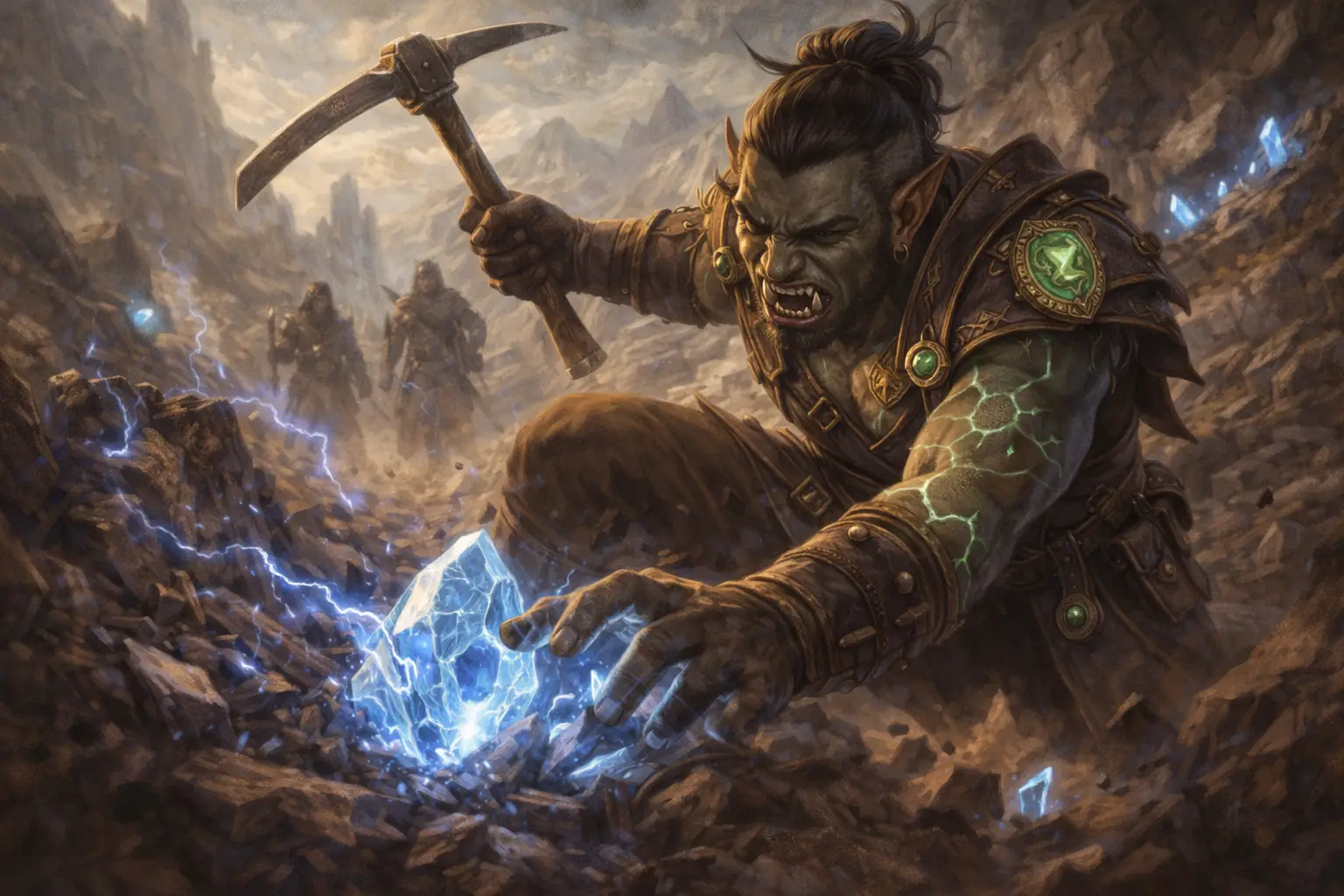
Somewhere in a Q'barra jungle, a half-orc holds a forked wand at arm's length and closes her eyes. She breathes out, and the wand twitches — pointing down and to the left, unerring, toward a vein of Eberron dragonshards three hundred feet below the mud. She marks the spot, signals the extraction team, and moves on. Tomorrow she'll be in Sharn, pointing that same wand down a different trail — this one leading to a fugitive who jumped Kundarak bail and fled into the Cogs. The house she works for does one thing. It does it better than anyone else in the world.
House Tharashk bears the Mark of Finding — the dragonmark of tracking, detection, and resource discovery. Alone among the dragonmarks, the Mark of Finding is carried by two races: humans and half-orcs. It first appeared among the clans of the Shadow Marches, where hunters used it to run down prey in the deep swamps, and the house that grew from those clans has never entirely shed its frontier character. Its crest — the dragonne, a lion-dragon hybrid — appears above guild-halls, mining outposts, and mercenary lodges that have spread across Khorvaire with remarkable speed over the last few centuries.
Tharashk is the youngest of the dragonmarked houses, and it has never fully embraced the customs of the others. Where most houses expect heirs to adopt the "d'" prefix and set aside clan identity, Tharashk heirs commonly retain their family names — Aashta, Torrn, Velderan — and their clans remain the true organizing units of house life. The house was not forged from noble bloodlines or urban merchants but from an alliance of Marcher clans who saw the economic potential of their mark and chose to exploit it together. The very name Tharashk is an old Orcish word meaning united — an aspiration the house has pursued with more enthusiasm than consistency ever since.
That alliance has paid handsomely. As dragonshards have become the lifeblood of the magical economy, Tharashk's unrivaled talent for locating them has given the house new wealth at a staggering pace. The house began as a house of hunters, not prospectors; prospecting is a relatively new path that arose with the increased demand for dragonshards and, crucially, with the invention of the prospector's wand. As the speaking stone is to House Sivis, the prospector's wand is to Tharashk: it is this tool that expanded the powers of the mark beyond the simple scope of locate object and allowed prospecting on an industrial scale. And the house's alliance with Droaam has opened an entirely different revenue stream — brokering monstrous laborers and mercenaries under the banner of the Dragonne's Roar — that has brought it into direct rivalry with House Deneith while forcing the continent to reckon with orcs, half-orcs, and Droaamite peoples in new and uncomfortable ways.
Overheard in the Dragon Towers enclave, 998 YK: "Deneith's had the mercenary trade sewn up for centuries. We walked in ten years ago with ogres, gnolls, and a contract the Daughters of Sora Kell couldn't refuse, and now Breven d'Deneith won't take Khandar's messages. I love this house." — Anonymous Aashta field agent
Origins & Lineage
The Shadow Marches are a desolate land of swamps and moors on Khorvaire's western edge — the ancient homeland of the orcs, scarred beyond reckoning in the war against the daelkyr thousands of years ago. The fiends left twisted creatures and aberrations in the bogs, and sowed seeds of madness that linger to this day. There are moonlit rituals in the Marches: some to honor the daelkyr, others to maintain the seals that keep them imprisoned in Khyber. Humans came as refugees from Sarlona, and over generations the two cultures merged, forming clans that blended human pragmatism with orcish tradition and the mystical legacy of the Gatekeepers.
The Marches had little contact with the east until a House Sivis expedition made two discoveries: the region contained rich Eberron dragonshard deposits, and a number of clans had manifested an unknown dragonmark. The clans that bore the mark recognized the opportunity. Rather than allow themselves to be exploited one by one, three great clans — the Aashta, the Torrn, and the Velderan — joined together in the model of the eastern houses, pooling their strength under a single banner. This structure is sometimes described as one, three, and many: one house, three great clans, and many lesser families tied to each.
The Marches had two distinct cultures long before the house arose. The clans blended human and orc traditions, building towns and working with steel, their communities anchored in the great stilt-cities along the rivers and coasts. The tribes maintained far older ways — nomadic hunter-gatherers who made their tools from stone, hide, and bone, and who still keep traditions predating humanity's arrival by thousands of years. House Tharashk drew its strength from the clans, but not every bearer of the Mark of Finding chose to join. Independent marked hunters still roam the deep swamps, proud of their freedom and suspicious of the house that shares their blood.
From "A Sivis Surveyor's Account of the Shadow Marches," 498 YK (excerpted):
"The fishing-punt came around the bend at dusk, and the woman at the prow held up her forearm. The mark was unmistakable — I have catalogued nine dragonmarks in my career, and this was not one of them. Her companion, a full-blooded orc of considerable stature, regarded our delegation with open contempt. 'They want to see the mark,' the woman told him in Goblin. 'Let them look,' he said. 'Then tell them the price.'"
The Mark of Finding
The Mark of Finding sharpens the senses and guides the hunter to prey — an unerring ability to follow a trail, pinpoint a location, or identify what others have overlooked. A Tharashk tracker can feel the direction of their quarry the way a compass feels north: not a thought, exactly, but a pull behind the eyes that intensifies as the gap narrows. More developed expressions of the mark extend to minerals and buried resources, enabling the bearer to specify a material type and minimum concentration within range and locate deposits with a precision no other form of divination can match.
The critical distinction between Tharashk and Medani inquisitives is one of specialization. A Medani inquisitive with the Mark of Detection reads a crime scene — interprets the evidence, identifies the threat, pieces together the puzzle. A Tharashk inquisitive with the Mark of Finding tracks the fugitive who fled it. Medani gets more information about the mystery. Tharashk finds the person. If you need to know why something happened, hire Medani. If you need to know where someone went, hire Tharashk.
The Three Clans
The Triumvirate structure makes the internal architecture of House Tharashk explicit: heirs identify first with their clan, second with the house. Each of the three great clans has a representative on the governing Triumvirate, and each maintains distinct territory, traditions, and temperament. The fault lines between them are real, and understanding them is essential to understanding the house.
The naming conventions alone reveal how deep these divisions run. Khandar'aashta does not bother with the d' prefix or the house name — he is Aashta, full stop. Daric d'Velderan uses his clan name but appends the d' as a nod to eastern custom. Maagrim Torrn d'Tharashk applies the prefix to the house name rather than her clan, a deliberate statement of her devotion to the alliance. No one uses d'Torrn. As an heir, you could follow any of these conventions, and change them over the course of a career as your loyalties shift.
Clan Torrn is the oldest of the three, closest to the earth and the most traditionally minded. Their capital of Valshar'ak has endured since the days of Dhakaan, and holds a stone platform known as Vvaraak's Throne. The Torrn carry the strongest traditions of primal magic within the Marches — Torrn druids raised the mighty murk oaks that serve as the primary supports of Zarash'ak — and they blend this heritage with arcane science in their work as prospectors. They are the finest mining overseers in the house, known for patience and stoicism; a calm person might be described as being as patient as a Torrn. Most Torrn follow the broad traditions of the Gatekeepers, opposing the cults of the Dragon Below and maintaining respect for the natural world, though some Torrn overseers born outside the Marches care only about results and place less weight on their druidic roots. Maagrim Torrn d'Tharashk, the eldest Triumvir, embodies this blend of caution and pragmatism — slow to act, but unshakable once a course is set.
Clan Velderan has always been the most outward-looking. Based in the coastal town of Urthhold, the Velderan were renowned fisherfolk and river-runners long before the house existed — the only clan with regular contact outside the Marches, the guides who led Sivis explorers into the swamps in the first place. That spirit of exploration remains alive today. The Velderan are the diplomats, administrators, and innovators of the house, the ones who dream of the future while the Aashta fight and the Torrn dig. They are most devoted to the inquisitive services of the Finders Guild, preferring the unraveling of mysteries to the more brutal work of bounty hunting. Velderan heirs tend to have the most human appearance of the three clans, leading outsiders to assume the clan is largely human — a misconception, since the Jhorgun'taal (those of blended orc-human heritage) are the majority in Velderan; it's simply that most Velderan Jhorgun'taal look more human than the stereotype common in the Five Nations. Daric d'Velderan, the current Triumvir, is known for his disarming humor and genuine altruism, and he plays a critical role in balancing the stronger tempers of his colleagues.
Clan Aashta is the fiercest. Based at Patrahk'n on the eastern edge of the Shadow Marches, the Aashta have centuries of conflict behind them — fought against worg packs from the Watching Wood, ogres, trolls, and even their own Gaa'aram orc cousins. They thrive on conflict, live for the hunt, and have always been the most enthusiastic bounty hunters in the house. It was the Aashta who devised the Dragonne's Roar — the program brokering monstrous mercenaries from Droaam across Khorvaire — and who pushed for it despite the obvious tension it would create with House Deneith. The Aashta have also forged alliances with some of the more unusual peoples of the Marches, including the sizable Mrrga Pod of grungs, whose amphibious commandos served with distinction in the last days of the Last War. But the Aashta also carry the house's most controversial tradition: they are devoted to what they call the "Old Ways" — what scholars identify as Cults of the Dragon Below. The two primary traditions within the Aashta are the Inner Sun, whose followers seek to buy passage to a promised paradise with the blood of worthy enemies, and the Whisperers, who are tied to the daelkyr Kyrzin. Khandar'aashta, the Aashta Triumvir, is extremely ambitious, constantly pushing to expand Tharashk's power even if it strains relations with the rest of the Twelve. He believes in the union and wants all three clans to prosper — but he is Aashta first, Aashta always.
The defining tension within the house runs between the Torrn's Gatekeeper-inflected traditionalism and the commercial ambitions of the Velderan, with the Aashta pushing for aggressive expansion regardless. Mining operations in the Marches have caused genuine friction with Marcher tribes, and some within the Torrn believe the house is straying dangerously far from the obligations that the Marches' history demands — obligations that are, quite literally, keeping ancient horrors sealed beneath the earth.
Tharashk field agent's toast, common in Zarash'ak taprooms:
"Torrn digs the hole. Velderan sells it. Aashta throws someone into it. That's unity."
Guild Operations
The Finders Guild is the commercial arm of House Tharashk's services, and across Khorvaire it has a reputation for discretion and cunning. The guild operates as a loose network of independent inquisitive agencies: dragonmarked heirs own and run their own shops, employing unmarked inquisitives for most casework and reserving marked heirs for the most difficult contracts. A connection with the Finders Guild is viewed as a guarantee of quality — a mark of professional excellence that prospective clients recognize on sight.
In Sharn alone, four agencies hold guild affiliation: Kurt Karr'Aashta's Investigations in Deathsgate, Information Acquisition in Underlook, Thuranne Velderan's Investigative Services in Warden Towers, and the Globe Information Agency in Dragon Towers. Better rates and more experienced guides for expeditions are found at the Clifftop enclave in Upper Dura rather than the grand hall in Dragon Towers — a distinction the house does not advertise but which seasoned clients know well.
Dragonshard Prospecting has become the economic backbone of the house. Tharashk is the primary buyer of Eberron dragonshards in Khorvaire and runs large-scale mining operations in Q'barra, the Shadow Marches, and increasingly in Xen'drik. The dragonshard fields of the Shadow Marches are not as rich as those of Q'barra, but there is gold to be made for those willing to hunt shards in dangerous swamps. The house coordinates refinement with House Cannith and claim security with House Kundarak, forming a supply chain that feeds the entire magical economy of the continent.
The Dragonne's Roar is Tharashk's monstrous mercenary and labor brokerage, born from the Aashta's long-standing ties to the peoples of what is now Droaam. Through this program, the house brokers ogre laborers, gargoyle couriers, gnoll soldiers, grung commandos, centaur cavalry, and other Droaamite workers across Khorvaire. "Mercenary" is a somewhat loaded term here — the majority of Tharashk-brokered workers in a city like Sharn are performing nonviolent services. Ogre laborers put their strength to practical use in construction and portage. Gargoyle couriers are in high demand for cross-city delivery. The house takes considerable pride in having used this leverage to normalize orcs and half-orcs in Five Nations society, and now advocates for the Droaamite peoples it represents. All Tharashk-brokered workers are under contract to the house, not to the client, and anti-petrification protocols are standard for any contract involving medusa-adjacent personnel.
Notice posted on the Clifftop Guild board, 998 YK:
SEEKING: Experienced guide for three-week Xen'drik expedition. Tempest Bay approach via Zantashk. Party of six. Standard rates plus hazard bonus. Must be comfortable working alongside non-humanoid personnel. Finders Guild affiliation REQUIRED.
Contact: Delan Torshaa, Dragon Towers Enclave. "If you can't find it, we'll find someone who can."
Political Relations
Tharashk sits unusually among the Twelve. It has no historic ties to Galifar's nobility. It governs a homeland that is not recognized as a sovereign nation. It rose through raw economic leverage rather than centuries of institutional tradition, and it maintains an alliance with a monstrous nation that most of the Five Nations refuse to formally acknowledge. This gives the house both vulnerability and extraordinary freedom — nobody's rules quite apply to it, and nobody quite knows what to do about that.
The house's alliance with the Daughters of Sora Kell is among the most consequential relationships in postwar Khorvaire. Tharashk agents convinced the Twelve to open trade to Droaam through Graywall, and the house helped organize laborers and build the new cities. Through Tharashk, the peoples of Droaam began to appear across the Five Nations — gargoyles replacing bats in Sharn's Race of Eight Winds, ogre work crews in Fairhaven and Wroat. For the Daughters, the alliance ties them to a force with legitimate voice and influence in the East. For Tharashk, it provides access to Droaam's rich mineral resources and an entirely new revenue stream. Both sides benefit, and neither fully trusts the other.
The house is in escalating rivalry with House Deneith — monstrous mercenaries versus Blademarks, bounty hunters versus Sentinel Marshals. Neither house admits to open conflict, but sabotage and covert operations are common. Tharashk also overlaps with House Medani in the inquisitive trade, though the two houses have carved out reasonably distinct niches: Medani handles subtle threats, counterintelligence, and predictive defense; Tharashk handles direct tracking and retrieval. The critical factor moderating both rivalries is that Tharashk controls the dragonshard supply. Nobody wants to get into an all-out feud with the house that provides the single most valuable resource in the magical economy.
The Gatekeepers remain friendly. Guild agents help the druids locate stray aberrations and open portals between planes, and the Gatekeepers offer their primal magic in return. But this relationship is not without strain. The house's urban expansion and mining operations in the Marches always risk disrupting Gatekeeper seals and unleashing ancient evils bound beneath the swamps — a risk the Torrn take seriously and the Aashta, by and large, do not.
Notable Holdings
Zarash'ak (Shadow Marches) — The City of Stilts. Built above the swamps, accessible primarily by sea due to the dangers of overland travel through Droaam or the Eldeen Reaches. Known across the Marches for its cuisine and music, Zarash'ak is the center of commerce in the region and the house's official seat of power. The city has expanded dramatically over the last decade as the house has grown in wealth and influence. Marcher clans and tribes come here to sell crafts, celebrate religious rituals, and do business with the wider world.
Q'barra Operations — The richest Eberron dragonshard deposits in Khorvaire, and the site of Tharashk's most lucrative mining operations. Prospectors here regularly test the limits of King Sebastes's treaty with the Cold Sun Federation of lizardfolk, and conflicts between settlers and scales have escalated sharply in recent years. Bandits prey on Tharashk convoys and independent settlers alike, and the deeper jungles hold ruins tied to the Age of Demons that even the house's bravest prospectors avoid.
Zantashk (Xen'drik) — A prospecting town on Tempest Bay, administered by Reeve Duluth Velderan d'Tharashk. Smaller than Stormreach and more intimate, Zantashk serves as a base for dragonshard prospecting — particularly Siberys and Khyber shards — and House-funded exploration. The population is primarily drawn from Sharn, Stormreach, and the Shadow Marches, with a scattering of Droaamite peoples and a frontier culture that blends Marcher gruffness with the anything-goes energy of a boomtown. The town's main saloon, the Rock Locker, hangs over the choppy ocean of Tempest Bay and serves gaeth'ad brewed by an aged orc known only as Aunty, whose liqueurs command eye-watering prices from Sharn's elite.
Dragon Towers Enclave (Sharn) — The house's primary enclave in the City of Towers, housing guild operations and the Globe Information Agency. The Clifftop enclave in Upper Dura, while less grand, is where the serious expedition work gets done.
Graywall (Droaam) — The Gateway to Droaam, where Tharashk governs the Calabas — the foreign quarter inhabited by humans and other people from elsewhere in Khorvaire. This is the primary recruitment base for the Dragonne's Roar and the hub through which monstrous labor contracts flow east. Of the dragonmarked houses, only Tharashk has a presence in the Great Crag itself.