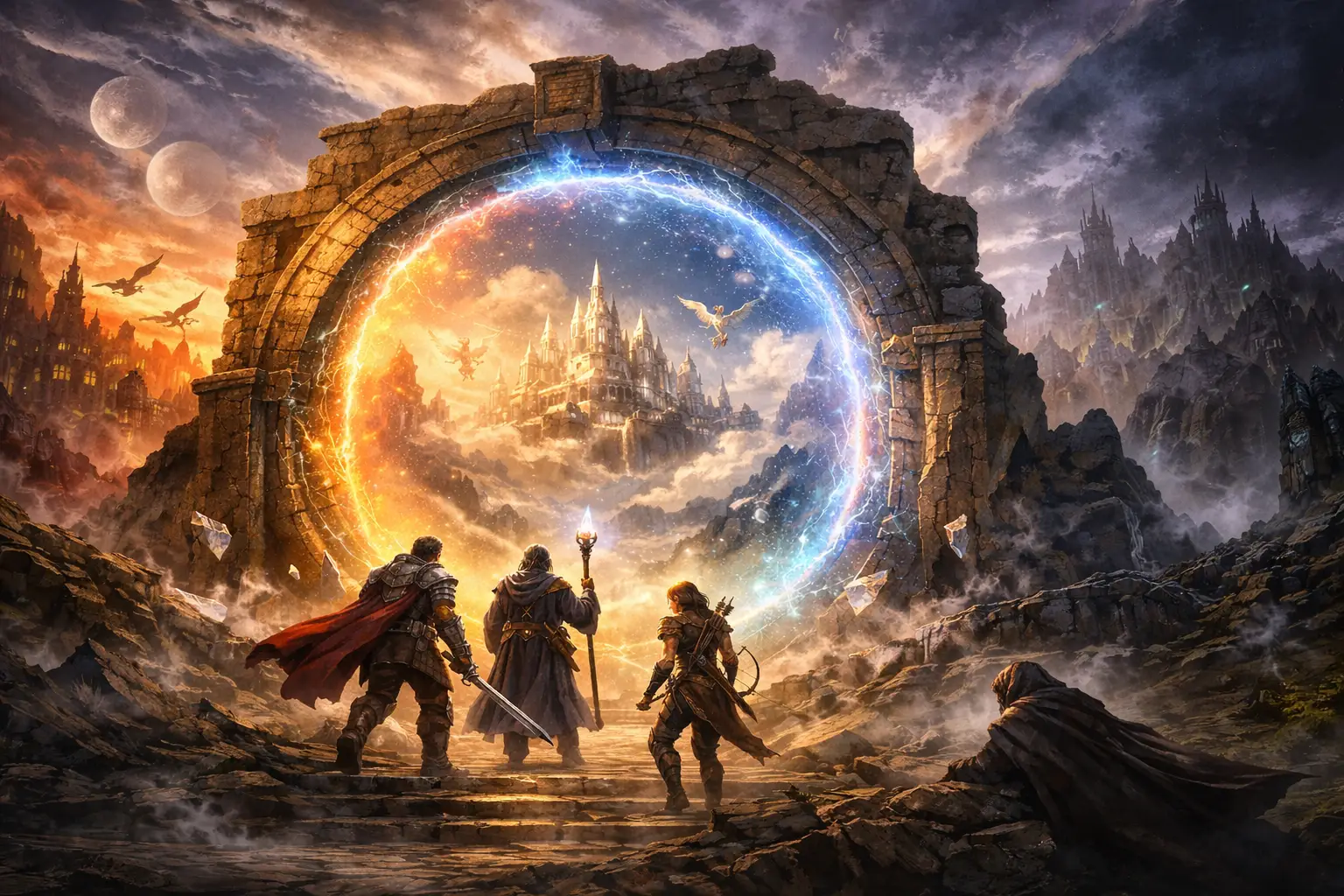
The Planes of Existence
Ideas made real
INTRODUCTORY LECTURE — PROFESSOR LHARA DAEN, ARCANIX, 998 YK
You don't go to the planes. The planes come to you. Every morning when you feel like getting out of bed, that's Irian. Every night when you wonder what the point of it all is, that's Mabar. The courage that lets a soldier hold the line at Vathirond — that's Shavarath. The storyteller in the tavern who makes you weep for a woman who never existed — that's Thelanis. You are soaking in them, all of you, all the time. This course will teach you what you're soaking in.
The most important thing to understand about the planes of Eberron is that they are ideas. Each one is a pure, iconic concept — war, peace, chaos, order, death, growth, stories, madness — made eternal and, with few exceptions, unchanging. There has always been war in Shavarath, and there always will be. That is what Shavarath is. What differentiates a fortress in Shavarath from a fortress in Irian is not architecture but meaning: the fortress of Shavarath has worn stones and the scent of blood and smoke; the fortress of Irian is bright, clean, and may have never seen an actual battle, because it symbolises an empire on the rise rather than an empire at war.
Eberron is where all these concepts come together and interact. It is the Material Plane — the world that feels the passage of time, where life can change and evolve. The planes are the raw principles. Eberron is what happens when all of them are present at once.
All mortals are connected on a spiritual level to all thirteen planes. When creatures sleep, their spirits are drawn to Dal Quor, where their dreams take shape. When creatures die, their souls are pulled to Dolurrh. A storyteller might be inspired by Thelanis without ever knowing it, while a soldier's courage could flow from Shavarath. An artist's revelation may come from Xoriat, and the basic energy of life itself flows into the world from Irian, while Mabar consumes both life and hope. These forces are everywhere — as much a part of the soul as gravity is part of the world.
Each plane is composed of layers — distinct regions within the plane, each reflecting a different facet of its core concept. The layers of Shavarath each contain a different aspect of war: a bitter siege, a bloody melee, a lingering guerrilla conflict. The layers of Lamannia range from the Endless Ocean to the First Storm to the Rot, where natural decay feeds giant scavengers. Travel between layers varies: in some planes, you walk through a massive door; in Thelanis, you travel to a new layer by acting out the elements of a new story; in Lamannia, you walk inland from an island and discover the ocean is no longer behind you.
Coterminous and Remote
The planes are often depicted as orbiting the Material Plane, reflecting the fact that they move into and out of alignment with it. When a plane is coterminous, its influence grows over the entire world and amplifies the effects of existing manifest zones. When a plane is remote, its power fades — and since the planes are always influencing the Material in subtle ways, their absence impacts the world as strongly as their presence does.
Multiple planes can be coterminous at the same time. These planar conjunctions are often related to the interactions of the moons, and characters proficient in Arcana can usually work out upcoming conjunctions. Coterminous and remote periods are tracked by scholars, governments, and arcane institutions; calendars, infrastructure planning, and major rituals all account for these cycles. Some cycles are predictable decades in advance; others — like Kythri's — are entirely unpredictable. Each of Eberron's twelve moons is associated with a plane, and when a plane is coterminous, its moon often enters an ascendant phase — brighter than usual, visible even in daylight. The thirteenth moon, Crya, was associated with Dal Quor before the giants destroyed it, severing the connection permanently.
"The Fernian cycle is predictable enough that Cannith schedules forge maintenance around it. The Kythri cycle is predictable enough that Cannith schedules work releases around it."
— Jork d'Cannith, forgewright, Sharn
Manifest Zones
At certain places in the Material Plane, the barriers between worlds are thin, and some characteristics of another plane bleed through persistently into the material world. These places are called manifest zones. The nature of each one is shaped by the plane it connects to — and by the specific location within that plane. A manifest zone to Thelanis does not connect to Thelanis generally; it connects to a particular region of a particular layer, and the effects reflect that specific place.
The city of Sharn is built on a manifest zone linked to Syrania that keeps its towers reaching toward the sky and aids flight. The City of the Dead in Aerenal is sustained by a powerful Irian zone. The prison of Dreadhold is built in a Lamannian zone that produces preternaturally durable stone. The Karrnathi city of Atur sits on a Mabaran zone whose negative energy powers the Odakyr Rites. Temples are often built on Syranian zones with peaceful properties, while universities and House Sivis search for zones with universal comprehension properties.
Some manifest zones include portals that allow passage between planes — though travel is blocked to Dal Quor and Xoriat. Most portals open only under certain circumstances: when the associated plane is coterminous, when the corresponding moon is full, or both.
"The basement of the Phiarlan enclave in Sharn has a door that, on certain nights, opens into the Immeasurable Market of Syrannia. They charge admission. I am told the markup is unreasonable." — Zilargo trade correspondent
The Thirteen Planes
Each plane is briefly described below. For full treatment, see the individual articles.
Plane | Concept | Moon | Moon Colour |
|---|---|---|---|
Daanvi | Order and Law | Nymm, the Crown | Yellow-gold |
Dal Quor | Dreams | Crya (destroyed) | Impossibly black |
Dolurrh | Death and Transition | Aryth, the Gateway | Orange-red |
Fernia | Fire and Industry | Eyre, the Anvil | Silver |
Irian | Life and Beginnings | Barrakas, the Lantern | Bright grey |
Kythri | Chaos and Change | Zarantyr, the Storm | Pearly white |
Lamannia | Nature and the Wild | Olarune, the Sentinel | Pale orange |
Mabar | Entropy and Loss | Sypheros, the Shadow | Smoky grey |
Risia | Cold and Stasis | Dravago, the Herder | Lavender |
Shavarath | War | Vult, the Warder | Steel-grey |
Syrania | Peace and Commerce | Therendor, the Healer | Blue-grey |
Thelanis | Stories and Fey | Rhaan, the Book | Pale blue |
Xoriat | The Unnatural | Lharvion, the Eye | Dull white with black chasm |
Daanvi, the Perfect Order
Daanvi embodies absolute order — law, discipline, and their impact on civilisation. Its perfectly ordered districts represent different aspects of law: precisely maintained fields, legalistic tribunals, and hordes of modrons compiling archives of every rule or regulation ever created. Some districts are governed by a justice system based in goodness, where laws maintain harmony; in more oppressive locations, tyrannical devils impose harsh laws on the suffering populace. The Inescapable Prison, maintained by devils, is designed to hold celestials, elementals, and beings of vast power — some legendary historical figures, long thought dead, may instead have been held there in suspended animation for millennia. Unbreakable contracts can be negotiated before a Kolyarut in the Hall of Justice, inscribed on enchanted gold and enforced by a marut — though you must provide the gold yourself. Manifest zones linked to Daanvi incline people to follow regulations without question, and in some, creatures cannot tell deliberate lies — a property that has made such zones the preferred locations for courthouses across the Five Nations.
"I once watched a modron spend four hours cataloguing the municipal codes of a village in the Eldeen Reaches that hadn't existed for three hundred years. When I pointed this out, it thanked me for the correction and began compiling a record of villages that no longer exist." — Pennis Vaela, Morgrave University, field notes
Main article: Daanvi, the Perfect Order
Dal Quor, the Region of Dreams
Mortal creatures come into contact with Dal Quor when they dream. The outer fringes of the plane are shaped by the memories and experiences of dreamers. The dark core at its heart is shaped by the nightmare force known as the Dreaming Dark, and its primary inhabitants are the quori — enigmatic manipulators that can inhabit the dreams of others. Tens of thousands of years ago, the quori fought a bitter war with the giants of Xen'drik; the giants ended it by destroying the moon Crya and severing the connection between Dal Quor and Eberron. As a result, Dal Quor is always remote, no manifest zones connect to it — the locations where they once existed, called Dreamblights, are subtly unsettling in ways that defy easy classification — and not even plane shift or astral travel can allow direct contact. The quori are forced to possess mortal hosts to work their will on Eberron. And yet every mortal who sleeps still travels there, which means the barrier is not as absolute as scholars assume.
"Everyone dreams, but most people forget when they wake. The quori are counting on both." — Taratai of the Fourth Light, kalashtar dissident, Sharn broadsheet interview
Main article: Dal Quor, the Region of Dreams
Dolurrh, the Realm of the Dead
When a mortal soul dies, it is drawn to Dolurrh. This is not a place of judgement or punishment — it is a machine. Spirits arrive, their memories begin to decay, and over weeks and months they fade into husks and then into moaning mist. The faiths disagree about what this means: the Sovereign Host says the soul ascends to join the Sovereigns; followers of the Silver Flame say noble souls strengthen the Flame; the Blood of Vol and the Undying Court maintain that Dolurrh is simply the end. The sage Annolysse of Arcanix declared that Dolurrh must be the thirteenth plane, for it has no opposite — it does not embody an idea so much as it serves a purpose.
"Everyone argues about what happens after Dolurrh. Nobody argues about Dolurrh itself. It is grey. It is sad. Your memories leave you. The theological debates start after that part." — Karrnathi priest, interfaith symposium
Main article: Dolurrh, the Realm of the Dead
Fernia, the Sea of Fire
Fernia encompasses both the raw elemental power of fire and its versatility — flame as a weapon, as a force that holds darkness at bay, as a destroyer, and as an agent of change. Efreeti pashas and fiendish satraps rule city-islands of obsidian drifting atop seas of magma, producing metalcraft of surpassing beauty. Cannith forgeholds actively seek Fernian manifest zones for the economic advantages they provide to fire-based manufacturing. The plane explores all symbolic associations of fire — both benevolent and destructive — this is why Fernia is not inherently evil, unlike Risia, which does carry an innate hunger to consume warmth and life.
Main article: Fernia, the Sea of Fire
Irian, the Eternal Dawn
Irian is the plane of light and hope — the wellspring of positive energy that is the foundation of life, light, and love. Its regions reflect beginnings and resurgent life: fertile lands, glittering crystal forests, thriving communities where the sun never sets. Angels dwell in the Amaranthine City, a grand settlement reflecting the first days of a glorious empire. Positive energy flows into Eberron from Irian, and the celestials of the Eternal Dawn are those most likely to respond when mortals call for aid. The City of the Dead in Aerenal is built on a powerful Irian zone, which sustains the deathless councillors of the Undying Court, and many of Aerenal's exotic lumbers — notably livewood — grow only in Irian zones.
Main article: Irian, the Eternal Dawn
Kythri, the Churning Chaos
The plane of chaos and change, Kythri is a realm in constant flux where elements collide, gravity constantly shifts, and githzerai monks exert their will to carve islands of stability from the turmoil. Kythri's coterminous and remote cycles are completely unpredictable — it might be coterminous for days or centuries — and its proximity to Eberron has no discernible systematic effects, which is itself a very Kythrian outcome.
"I lost three sets of notes in a Kythri manifest zone. Not because they were destroyed — because the ink kept rearranging itself into different languages. By the third set, I was taking notes in charcoal on slate, and the slate changed colour every hour." — Wessen Orath, Arcanix transmutation student, formal academic complaint, 989 YK
Main article: Kythri, the Churning Chaos
Lamannia, the Twilight Forest
Though referred to as a forest, Lamannia contains every possible natural environment — the Endless Ocean, the First Storm where hurricane winds lash a realm of plains and hills, and the Rot where natural decay feeds giant scavengers. Animals born here are paragons of their species. Great beasts, lycanthropes, and primal spirits reflect the full power of untamed nature. Where Irian represents the idea of life, Lamannia represents the blueprint for the natural world — primal, untouched, and indifferent to civilisation. Lamannian manifest zones are common, commercially significant, and occasionally hostile: some actively resist civilisation, tearing down structures with weather, vegetation, and rapid decay, and bound elementals can break free from their bonds in some zones.
Main article: Lamannia, the Twilight Forest
Mabar, the Endless Night
Where Irian is the beginning, Mabar is the end. A sea of liquid shadows laps against black sands and basalt cliffs; the bone of a skull lies half-buried in the sand, but it is not sun-bleached, for there is no sun here — only the faint glimmer of the smoky grey moon. Mabar is the plane of entropy, hunger, and loss — the source of negative energy in Eberron. Most undead are animated by its power, and the life they drain from mortals flows back into the Endless Night. Its Dark Powers — the Empress of Shadows, the Bone King, the Queen of All Tears — claim fragments of other planes and drag them into the Hinterlands, where they are slowly consumed and integrated.
"Long Shadows is not a holiday. It is the opposite of a holiday. You light the candles and you stay awake and you wait for dawn. If the candles go out, you light them again. That is the entire tradition." — Brelish grandmother, overheard
Main article: Mabar, the Endless Night
Risia, the Plain of Ice
A plane of absolute cold and stasis. Risia does not merely freeze — it preserves. Objects and creatures caught in Risian influence are held in place, unchanged, potentially forever. There are things preserved in Risian ice that have been there since before the rise of Galifar, and some of them are still alive in some meaningful sense. Risia carries an innate hunger — a desire to consume warmth and bury living things in ice — that Fernia, its counterpart, does not share. Most people who experience Risia feel this malign presence even before the cold reaches them.
Main article: Risia, the Plain of Ice
Shavarath, the Eternal Battleground
Shavarath is perpetual, structured conflict — not random violence, but war as an eternal principle. Three vast armies fight endlessly: the Legion of Justice (celestials), the Legion of Tyranny (devils), and the Legion of Cruelty (demons). The war never ends and was never meant to. No side can win, because war itself is the point. When Shavarath is coterminous, aggression escalates, wars intensify, and the wounded find their injuries harder to heal. Amid the constant strife, windstorms of blades scour the landscape, and for all its danger, Shavarath holds weapons of legend and a wealth of knowledge on the art of war.
"We scheduled the assault on the Thaliost salient for early Vult, when Shavarath was coterminous. Our troops fought like demons — which was the intent. The Thranes fought like angels — which was also, technically, accurate. Looking back, I'm not certain the conjunction benefited either side so much as it benefited Shavarath." — Colonel Daven ir'Movannis, Aundairian Third Arcane Brigade, personal war diary, recovered 997 YK
Main article: Shavarath, the Eternal Battleground
Syrania, the Azure Sky
Crystal spires float in a perfect blue sky. The sun never appears, but the sky is always bright, and a warm, gentle breeze carries the sound of distant chimes. All anger melts away. This is Syrania — the plane of peace and all that flourishes in peaceful times: commerce, education, reflection. The magic of Syrania grants flight to all creatures, allows universal understanding of any spoken or written language, and suppresses violence. The Immeasurable Market — where a slaadi haggles with a modron over hippogriff eggs while a dao shows a balor a selection of Fernia-forged blades — is the most remarkable bazaar in existence, drawing merchants from across the planes. Angels devote their immortal lives to mastering one pure concept each: an angel of war studies the perfection of strategy, an angel of dreams interprets the subconscious, an angel of knowledge compiles all that can be known on a single subject.
Main article: Syrania, the Azure Sky
Thelanis, the Faerie Court
Every culture has fairy tales — stories that use exaggeration and supernatural elements to warn, teach, or entertain. Breland tells tales of the Sleeping Prince, cursed by a cruel hag until saved by the Woodcutter's Daughter. The Mror Holds have a tale older than Breland in which Lady Narathun curses Doldarun's son. The Dhakaani dar have an ancient story about how Hezhaal cast the marhu's son into cursed slumber. These are all the same story, appearing in different cultures across different millennia — because Thelanis is the plane where stories are real.
Its many domains are governed by archfey, and the denizens of each realm reflect the nature and story of their lord. The realm of the Prince of Frost is trapped in endless winter — not because of Risian cold, but because the prince's heart is broken. If the story changed, the realm would change with it. Time and space are both malleable; a mortal who wanders in might leave after a few days to discover that months or years have passed back home. Gateways form at naturally occurring thresholds — rings of mushrooms, gaps between ancient trees, still pools at twilight — and you must generally break some superstition to be pulled through: stay on the path and you are safe, but follow the ghostly music and that is on you.
"Never insult a dryad. Never accept a gift from a hag without asking the price. Never assume you are not in a story." — Eldeen Reaches woodsman
Main article: Thelanis, the Faerie Court
Xoriat, the Realm of Madness
The popular view is that Xoriat warps flesh and corrupts minds, and that its inhabitants seek to transform or destroy all that is natural. This is not entirely true. The illithids call it the Realm of Revelations — and they may be more accurate. Where Lamannia embodies the natural world, Xoriat embodies the unnatural: a window into the workings of reality that mortals normally do not see and are ill-equipped to handle. It suggests that time and space, order and chaos, war and peace — all of these are inventions, foundations upon which mortal lives are built. Xoriat shows what lies under those foundations.
Main article: Xoriat, the Realm of Madness
Beyond the Thirteen
The Astral Plane is not one of the thirteen. It was not created to embody a concept, because it was not created — it is the ultimate foundation of reality, the canvas upon which the Progenitors painted existence. It is the space between and beyond the planes, and with few exceptions, travel between planes involves passing through it. Colour pools scattered through the Astral connect to each of the thirteen planes (except Dal Quor, whose portals are inaccessible). The Astral is also a sanctuary for exiles, a graveyard for forgotten debris, and the domain of the githyanki and their vast city-ships.
Khyber is not a plane in the conventional sense. It is the world below — the demiplanes that lie beneath Eberron's surface. Go deep enough and you find not a molten core but an endless array of demiplanes, each unique, each strange, many dangerous. The heart demiplanes of the overlords, the prison demiplanes that seal ancient threats, and shadow demiplanes that exist for reasons no one can determine — all are Khyber.
The System
Eberron exists at the centre of this arrangement — the sole planet in its Material Plane, the fulcrum where all thirteen concepts come together. The planes are not destinations to be reached so much as conditions that are always present, always exerting influence, always cycling between nearness and distance. Understanding them is not a matter of faith. It is a matter of paying attention.
Counting those that are lost, there were thirteen planes, thirteen moons, thirteen dragonmarks. Whether that means anything is one of the oldest questions in arcane theory, and one of the least resolved.
"Thirteen planes. Thirteen moons. Thirteen marks. If you think that's a coincidence, you haven't been paying attention. If you think you know what it means, you're lying." — Korranberg numerologist, retirement lecture