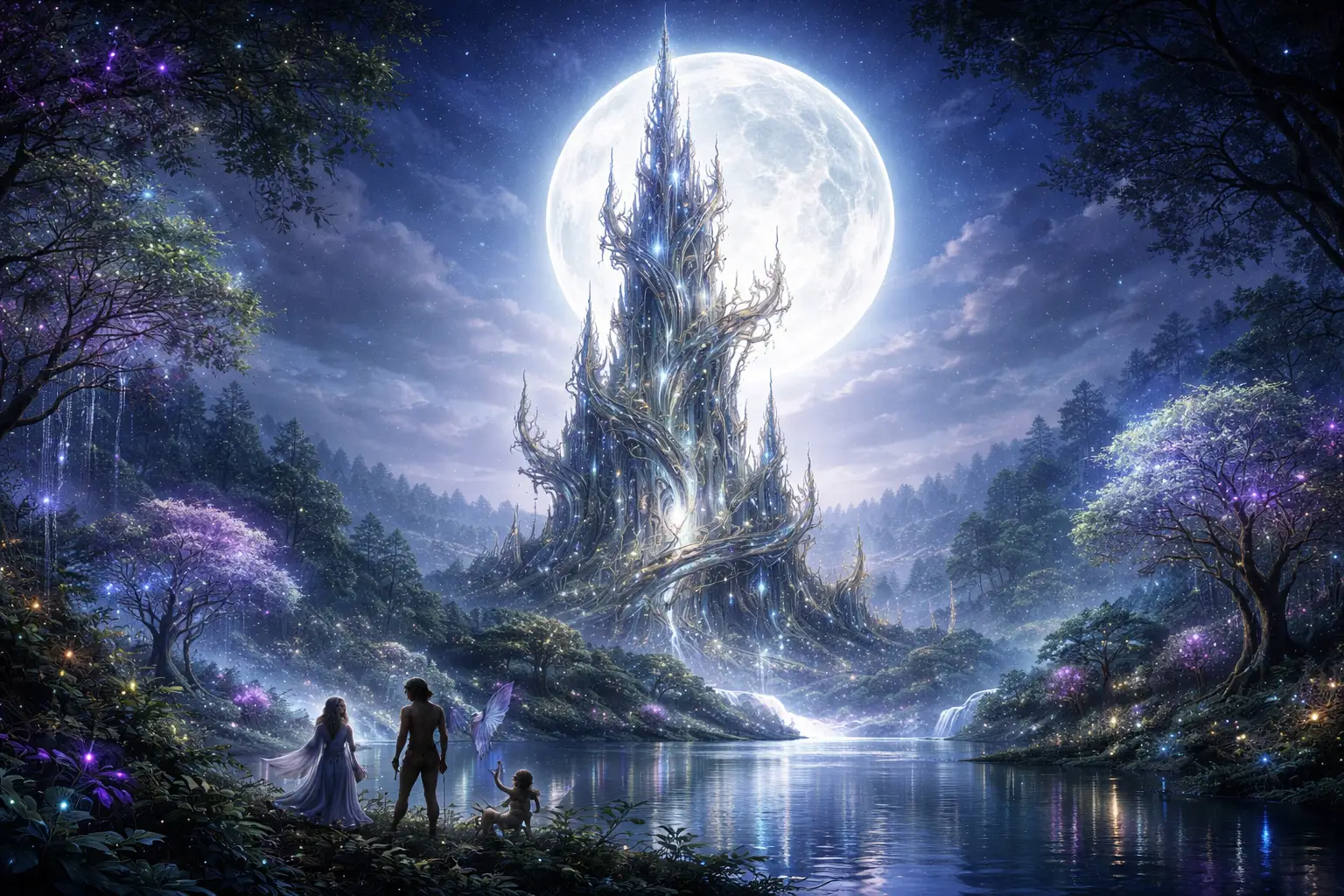
Thelanis, the Faerie Court
Plane — Stories, Narrative, the Fey & the Power of Myth — Moon: Rhaan, the Book
Every culture has faerie tales — stories that use exaggeration and the supernatural to warn children of consequences, demonstrate virtues, or simply explain why the world works the way it does. Breland tells of the Sleeping Prince, cursed to slumber by a cruel hag until he is saved by the courage of the Woodcutter's Daughter. In the Mror Holds, there is a tale older than Breland itself in which Lady Narathun curses Doldarun's son with eternal sleep until he is saved by humble Toldorath. The Dhakaani dar have an ancient story about how Hezhaal — a dirge singer who studied sinister magic — cast the marhu's son into a cursed slumber, until he was saved by a simple golin'dar.
The details shift. The sleeper is a prince, or a marhu's son, or Doldarun's heir. The villain is a hag, or a dirge singer, or a lady of the mountain court. But the thrust of the tale and the lessons it teaches persist, because long before any of these cultures arose, the story existed somewhere else.
In a layer of Thelanis, the Lady in Shadow curses a prince with eternal sleep. She tends a garden full of wonders and keeps her own daughter hidden in the heart of a labyrinth of thorns. This is the original — the archetype from which all versions descend. And at the deepest level, that is what the fey are: stories. The dryad is not a natural spirit; it is the magic we want in the world when we see a slender willow tree move in the wind and imagine it as a beautiful person. Thelanis is built on iconic stories, but it is also the Faerie Court — at its heart, satyrs and nymphs dance in the shadows of the Palace of the Moon while the archfey engage in immortal intrigues. It is a fantastic realm essentially built around the idea of adventures, but it is a deadly place for those who refuse to understand its rules.
Thelanis is one of the easiest planes for mortals to reach. Just walk through a mushroom ring when Rhaan is full in the sky, or follow the sound of distant music in the forest. It is not always this easy, but it can be. One wrong step and you could find yourself in the Faerie Court, retracing the steps of storybook heroes and making dangerous bargains with the rulers of a realm where words have the weight of iron and promises are unbreakable chains.
A BRELISH NURSERY RHYME, COLLECTED BY PROFESSOR ALINA LORRIDAN LYRRIS, UNIVERSITY OF WYNARN, 991 YK
Don't follow the music into the wood, don't chase the silver deer. Stay on the path like a good child should, or you'll not come home for a year.
Don't drink the wine in the hollow hill, don't dance when the fiddles play. Don't make a promise you can't fulfill, or they'll take your name away.
Don't steal the fruit from the witch's tree, don't open the thirteenth door. Don't ask the price till you've paid the fee — that's what the stories are for.
Universal Properties
Thelanis is unpredictable, and its cardinal rule is that every layer follows its own story. The following properties apply broadly, but any of them can be overridden by the particular tale a layer is telling.
Enchanted Realm. Magic that charms or deceives is amplified in Thelanis. Saving throws against enchantment spells are made at disadvantage, and when a creature casts an illusion or enchantment spell with a duration of one minute or longer, the duration is doubled. Spells with a duration of twenty-four hours or more are unaffected.
Storybook Logic. No two layers of Thelanis are exactly alike, because each is driven by its own story, and any rule can be overridden by the demands of a particular tale. Damage types might be swapped or rendered meaningless; a potion of healing might function as a poison, or vice versa. While these effects vary from layer to layer, they are entirely reliable within a given layer and should feel logical based on the nature of the local narrative.
Words Have Power. In Thelanis, words — and particularly promises — carry real weight. Creatures should be extremely careful about making formal agreements of any sort, especially with archfey. The more powerful the fey, the graver the consequences of breaking a promise. A slightly broken promise to a greater fey might result in a run of bad luck; a promise to an archfey could inherently carry the power of a geas. The fey themselves are bound by this same restriction, but they are exceedingly aware of it and choose their words with surgical precision.
Chaotic Time. Time is entirely flexible in Thelanis, moving at different rates from layer to layer. Adventurers might spend a night in Thelanis and discover that a year has passed on Eberron — or they might save a kingdom, reign as kings and queens for decades, and stumble through a gate to find that only an hour has passed at home. When mortals return to Eberron, time often catches up with them: those for whom more time has passed on the Material Plane may swiftly age, while those who spent decades in Thelanis may find their youth restored and the years erased.
Layers
Much like Kythri and Dal Quor, Thelanis has a core layer surrounded by lesser layers. The heart of the plane is the Moonlit Vale, where all archfey gather for their revels. Surrounding it are endless baronies, each embodying the stories of a particular archfey. While eladrin and fey can shift freely between layers, it is more challenging for mortals to travel to a barony — this often requires a token from that realm, or for the mortals to act out some aspect of its story.
Regardless of the specific identity of a layer, Thelanis always feels magical and otherworldly. Its environments are typically vibrant and beautiful, but when they are harsh and ugly, they are exceptionally so. Everything feels like a story — exaggerated, saturated, and slightly unreal.
The Moonlit Vale
The Moonlit Vale is the largest layer of Thelanis and the heart of the plane — essentially a country, with the feyspires spread across it as cities, and days of travel between them. While largely arboreal, the Vale contains beautiful valleys, glittering lakes, and a vast mountain. It is always night here, and the moon Rhaan radiates bright light, always seeming to hang just above the viewer's head. The moon does not move or change, but the seasons do: in winter the court is covered in snow, in spring it is in brilliant flower. This has nothing to do with the passage of time and everything to do with the intrigues of the Palace of the Moon — the current season indicates which seasonal court is dominant.
This is a crucial aspect of the Moonlit Vale: things change. The baronies are fixed in their stories, but the intrigues of the four seasons are the story that Thelanis tells itself.
The Vale embodies the general idea of the fey — otherworldly beauty and magic. Streams of glowing mist wind through ancient forests. Ethereal music drifts from no identifiable source. Motes of light drift slowly between the trees. The beasts are sleek and graceful, with unusual colors and patterns. The land is fertile, game is easy to hunt, and foraging is simple — though hunting without permission may incur the wrath of the local fey.
The Palace of the Moon is the grandest structure in the Vale. Its towers are built into the trunks of four vast trees, each reflecting a particular season: the Summer Tree is in full bloom, the Winter Tree is withered and bare. The four seasons are factions among the fey of the Moon Court, and those who dwell within the palace live in the tree of their season. The palace is full of endless intrigues, and envoys negotiate alliances with the feyspires and the anchor barons. At the apex of each season — a strangely arbitrary declaration in a realm with such a casual relationship to time — the ruling season's fey host a grand revel that draws archfey from across the plane. These revels are moments when intrigues bloom and stories are shaped, a time for duels and grand declarations.
The Feyspires are the cities of the Moonlit Vale, each home to a single archfey whose personal story is reflected by the spire, along with a few greater fey and a host of eladrin and other mortals. Many feyspires serve as planar beachheads — they are tied to specific manifest zones on Eberron and can slip into the Material Plane for short periods when the conditions are right. Usually the spires are hidden by powerful illusions during these transitions, but there are stories of people stumbling into magical cities that are gone the next day.
Notable feyspires include: Pylas Pyrial, the Gate of Joy, celebrated for its bards and revels, tied to Zilargo and home to a significant gnome population. Shae Joridal, the City of Emerald Lights, whose illusionists are legendary, appearing in what is now Darguun. Shae Loralyndar, the City of Rose and Thorn, an arboreal spire frequently found in the Twilight Demesne of the Eldeen Reaches. Shaelas Tiraleth, the Court of the Silver Tree, largest of the feyspires, whose ruler Shan Tira is a master diviner and gifted oracle, tied to Cyre. Taer Syraen, the Winter Citadel, seat of the Prince of Frost, appearing in a barren region of Karrnath. And Shae Tirias Tolai, the City of Silver and Bone, tied to Xen'drik and sacked by the giants of the Cul'sir Dominion who captured eladrin and magebred them into modern day elves — today it is a haunted ruin, shunned by the fey.
The Baronies
Each barony is a collection of layers embodying the stories of a particular anchor baron. Only one archfey is found in each barony, and it is a serious transgression for another archfey to enter uninvited, as their presence disrupts the story. Each barony is unique, but its layers are often quite small, reflecting the events of a familiar tale — though not all of Thelanis's stories are known to every culture in Khorvaire.
The Assembly is the barony of the Forge Maiden, where innovation is celebrated and artifice is amplified. Wondrous and impossible artifacts can be found here — but so can many dangers: the construct dragon that claimed the workshop and gathered a hoard, the labyrinth so well-designed that its creator became lost in it, the time stop spell that cannot be undone.
The Shadow is the barony of the Lady in Shadow, with branches reflecting the many tales of this sinister figure — the secret garden walled and guarded by dangerous plant creatures, the tiny kingdom that serves as the stage for the Sleeping Prince, the tower hidden in a maze of thorns.
Folly is the barony of Fortune's Fool, where great misfortunes regularly occur but invariably lead to unlikely success. Here, d20 rolls of 5 or below are always treated as a 1, and rolls of 16 or above always count as a 20. Wits are far more important than brawn, and skill checks can achieve things that would be impossible anywhere else.
Denizens
Thelanis is home to fey in all their forms — from the nameless sprite who serves as scenery to the archfey whose stories have echoed through mortal cultures for millennia.
The Supporting Cast
The most common fey of Thelanis are manifestations — immortal spirits that serve as the background characters of the plane's stories. Sprites dance in the forest. Satyrs carouse at the revels. A dryad tends her tree. These are not individuals; they are roles, and they are replaced if destroyed. They live entirely in the moment — there is no tomorrow, no past, no fear of consequence, only the pure experience of love, joy, or rage. When a dryad curses a traveler who steals fruit from her tree, it is because in that moment this is the worst thing that could ever happen and he deserves it.
A supporting cast member can evolve. If a nameless sprite helps the adventurers defeat the giant at the well, it is no longer a nameless sprite — it is Clever Jack, or whatever name the adventurers gave it. If a manifestation becomes mortal through this evolution, it can go anywhere it likes, even following the adventurers back to Eberron — but if it dies, it is gone forever.
Greater Fey
Greater fey are tied to a barony or have a role in the Moonlit Vale, but they possess their own names, identities, and distinct personalities. They have their own agendas and schemes within the grander story of the archfey — seeking love or revenge or other ambitions. Despite their individuality, they remain attached to their layers and do not experience the passage of time as mortals do. When greater fey leave Thelanis — to establish a domain in a manifest zone, or to sell strange trinkets in Syrania's Immeasurable Market — they seek to create their own stories, because narrative is the only framework that makes sense to them.
A greater fey's abilities can grow as its story grows, but power is often balanced by a weakness rooted in storybook logic: a greater dryad might be immune to fire unless someone knows her true name, or immune to piercing damage but vulnerable to slashing — arrows refuse to strike her, but axes hunger to cut her down.
Archfey and Anchor Barons
The archfey are the foundation of Thelanis — the force that sets a story in motion. Where greater fey may be tied to a single tale, most archfey have inspired countless tales across cultures and generations, often serving as the antagonist, though they can also be benevolent. The Lady in Shadow is the archetype of the mighty witch who lives apart from society, whose anger can bring terrible curses. She is the villain of the Sleeping Prince, but she also curses those who steal from her garden, and may have advice for those who approach her carefully and with gifts. In Eberron, the villain of the story might be called Sora Katra or Hezhaal or Lady Narathun — the Lady in Shadow does not care. She does not need mortals to know her name.
Archfey possess great power within Thelanis and its manifest zones, but to act in the wider world, they need agents — Greensingers, warlocks, or other emissaries. An archfey cannot be permanently killed; as long as its stories are told, it will reform. However, the reformed archfey may not be exactly the same as the one that came before — the story persists, but the exact telling shifts.
Notable archfey include: The Forest Queen, a force of nature and primal vengeance. The Forgotten Prince, who steals secrets and unloved things. The Forge Maiden, patron of invention and dangerous innovation. The Lady in Shadow, the sinister witch of a thousand tales. Fortune's Fool, who stumbles into disaster and emerges unscathed, to the misfortune of everyone around her. The Prince of Frost, once the Prince of Summer, whose heart froze when his beloved fled with a mortal hero — he waits in his castle of frozen tears for their return and his revenge, tormenting virtuous heroes in the meantime.
Eladrin and Other Mortals
The eladrin are the primary mortal population of Thelanis, dwelling in the feyspires of the Moonlit Vale. Each spire is ruled by an archfey, and each has a distinct story that shapes the personality of the local eladrin. The eladrin are not as bound by narrative as other fey, but the magic of the plane encourages deep devotion to their spire and their ruler. They hunt, they hold revels, they serve in the intrigues of the Moon Court — and it rarely occurs to them that there could be more to life. But they are indeed mortal: they fall in love, have children, are born, and die. An eladrin who leaves their spire and lives among mortals in the mundane world often gains a greater appreciation of the passage of time — though compared to the wonders of the Faerie Court, the streets of Sharn can feel terribly gray.
Beyond the eladrin, there are gnomes of Pylas Pyrial, wandering Greensingers, mortals personally chosen by an archfey, and the occasional creature who wandered through a manifest zone and is trying desperately to find their way home.
Planar Manifestations on Eberron
Manifest Zones
More than with any other plane, Thelanian manifest zones often allow travel between the planes. Fey creatures dwell in such zones, and a greater fey may claim one as a personal domain. Gateway zones always share the general environment of the layer they connect to, though it is rarely obvious when the crossing occurs — it may take time for travelers to realize they have left Eberron. There are always signs: circles of mushrooms, strange patterns of vegetation, eerie lights, or faint unearthly music. Gateways typically activate only at certain times — often when the moon Rhaan is full — and usually require the traveler to do something that violates a known superstition. If you stay on the path in the forest, you will not stumble into the Endless Weald. But if you follow the ghostly music, or chase the silvery deer? That is on you.
Other manifest zones reflect the properties and influence of Thelanis without allowing passage. Zones with the Enchanted Realm property are sought after by House Phiarlan and House Thuranni. Zones with Storybook Logic break the rules of reality in specific, reliable ways — the Grove of Promises, for instance, is a clearing with an old stone fountain where promises sworn and sealed with a shared drink are magically binding, and those who break their word sicken and die.
A final form of manifest zone is the beachhead — a phenomenon that periodically draws a piece of Thelanis into Eberron. The feyspires are the most prominent example, but beachheads can be any unusual location: the Tomb of the Forgotten King in the Mror Holds, found only when a traveler seeks shelter in a cave and discovers deeper passages, where jewels are embedded in the walls and coins are heaped on tables — and treasures taken from the tomb always bring misfortune until returned.
Coterminous and Remote
When Thelanis is coterminous, new gateway zones spring up, mischievous or cruel fey may cross over, and it becomes far easier for careless travelers to stumble into the Faerie Court. There are always warning signs, and you must generally break some superstition or taboo to be pulled through — so when people know the planes are coterminous, they are careful to remember the stories and avoid foolish behavior.
When Thelanis is remote, the effects of Thelanian manifest zones are suppressed. Fey creatures may be temporarily drawn back to Thelanis, even those that normally dwell on Eberron. The world feels less magical.
Traditionally, Thelanis becomes coterminous for a period of seven years every 225 years, and is remote for seven years halfway between these cycles. However, there is evidence that this cycle has been disrupted — beachheads remaining in place longer than usual, manifest zones behaving erratically. This may be a result of the Mourning, or the Mourning may simply be a convenient excuse, and the true cause lies in the schemes of an archfey or a mortal mastermind.
Thelanian Artifacts
Thelanis can be a source of wondrous magical items, and the simplest deal with illusion or enchantment: eyes of charming, a hat of disguise. But any sort of magic item can come from Thelanis — the catch is that Thelanian items invariably have a story attached to them. The berserker axe that cannot be released until it kills someone you love. The dragon slayer that calls out to dragons, summoning wyverns and drawing the attention of the Chamber. The crystal ball that occasionally shows glimpses of things you would rather not know.
Thelanian items can also hold curses with no accompanying benefit. The mithral falcon is a statue that amplifies existing greed — generous people are unaffected, but greedy folk feel a growing compulsion to claim the falcon from its current owner. It can start a gang war between criminal organizations or turn Aurum concordians into bitter enemies. The falcon has no beneficial powers. Its curse drives a story, and that is enough.
LETTER — SHAE LORALYNDAR EMBASSY, TWILIGHT DEMESNE, ELDEEN REACHES. RECIPIENT AND DATE UNKNOWN. FOUND PRESSED BETWEEN THE PAGES OF A BESTIARY IN THE LIBRARY OF KORRANBERG.
Dearest,
You asked me what the Faerie Court is like. I will try, but you must understand that describing Thelanis in Common is like describing color to someone who sees only in shades of gray. The words are all wrong. They are too heavy, too literal. In the Court, a word is the thing it describes. A promise is a chain. A name is a weapon. A story is a cage, and also a palace, and also the only kind of freedom that matters.
The moon is always full. The trees glow. The music never stops. I have been here for what feels like a season, but I cannot tell you how long that is. I danced with a satyr who told me a joke so funny I laughed for three days. I met a dryad who wept because a traveler stole an apple from her tree four hundred years ago and she has not yet forgiven him. I was invited to dinner by a woman with silver eyes who served roast pheasant and asked me, very politely, what I would give her in exchange for the meal. I said "a story." She said "which one?" I told her about the time my brother fell into the Dagger River. She seemed satisfied. I think I got the better end of that bargain, but with fey, you can never be entirely sure.
Do not come here. I mean that sincerely and with great love. This place is not for people who need things to make sense.
Yours, always, Mirren