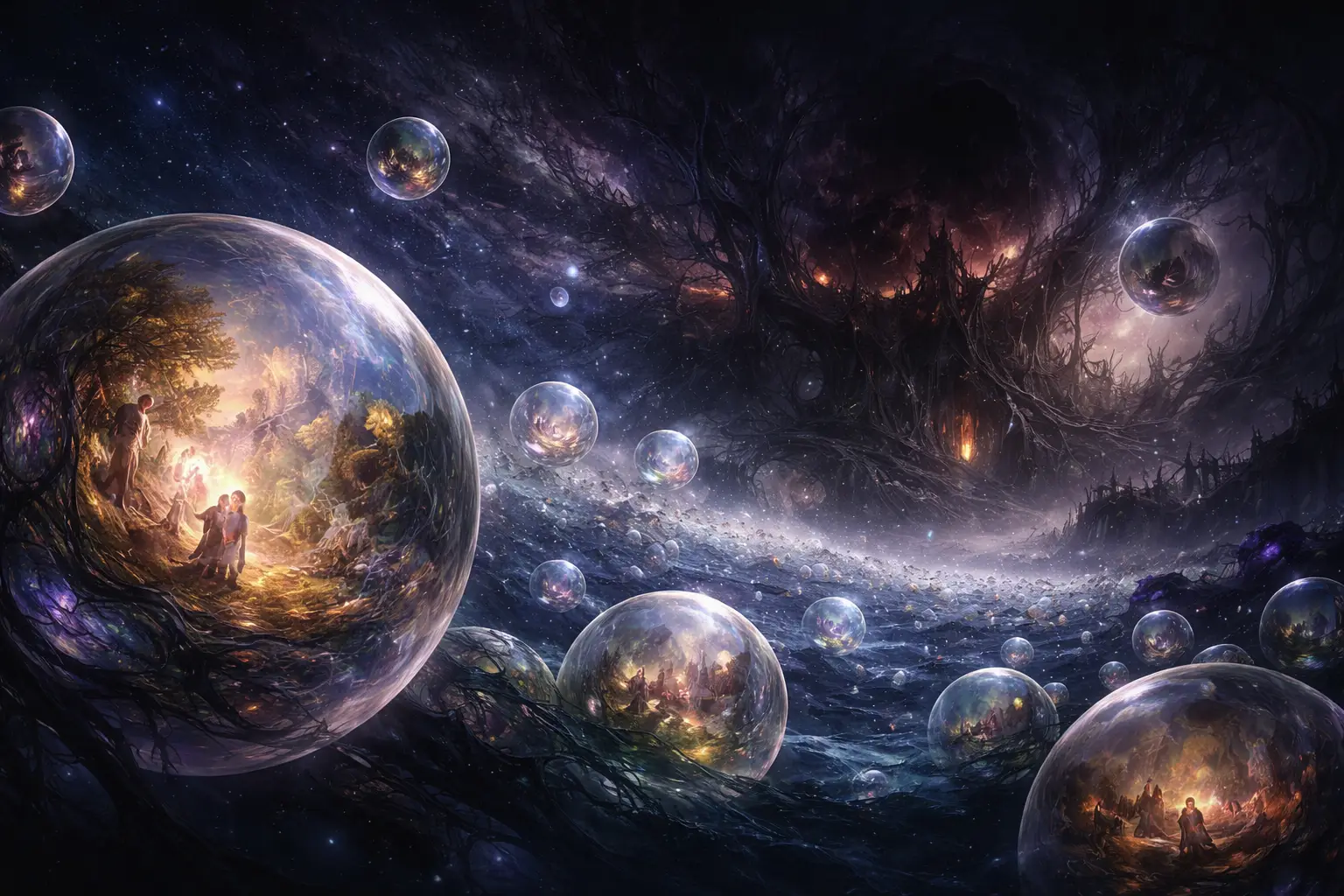
Dal Quor, the Region of Dreams
Plane — Dreams, Nightmares, Memory & the Subconscious — Moon: Crya (destroyed)
Dal Quor is the realm of dreams — a place of imagination where memory and emotion shape reality, where the impossible is commonplace and the surroundings can change in the blink of an eye. It is impossibly distant and remarkably close. Tens of thousands of years ago, the giants of Xen'drik shattered the ties between the Material Plane and the Region of Dreams, and that severance has never been repaired. Dal Quor is permanently remote; no naturally occurring manifest zone connects to it, and neither plane shift nor astral travel can pierce the barrier. It is the only plane in Eberron's cosmology that cannot be physically reached by conventional means.
And yet it is also the closest of the planes. To visit, just close your eyes.
Dreaming is a form of spiritual travel. When a mortal sleeps, their consciousness is drawn to Dal Quor, creating a small pocket of dream-reality shaped by their memories and desires. These pockets — dream islands — are unique, individual, and fleeting. Unlike the shared stories of Thelanis, the dreams of Dal Quor are personal: defined by our experiences and emotions, and rarely remembered when they end. Dreams allow us to sift through our subconscious, and they are ours alone — or at least, they should be, if they are not manipulated by an outside force.
The denizens of Dal Quor reflect the plane's secondary theme, and for now — for this age — that theme is nightmares. The quori prey on mortal dreams, twisting them to produce the emotions they crave. This does not mean all dreams are nightmares; most people dream without interference. But when a quori takes an interest in your dream, it will usually become one.
What differentiates Dal Quor from the surreal landscapes of Kythri and Xoriat is that its changes are drawn from minds: from the mortal subconscious, and from the ancient, malevolent dreaming of the force that lies at the plane's dark heart. Even when you are exploring someone else's dream, your own desires and memories can infect the landscape. A door that was not there a moment ago leads to a room from your childhood. A face in the crowd belongs to someone you have not thought about in years. The plane responds to thought, and thought in Dal Quor is as solid as stone.
EXCERPT — THE PLANAR CODEX, BY PROVOST HAMMOND FAURIOUS, THIRD EDITION, MORGRAVE UNIVERSITY PRESS, 992 YK
The paradox of Dal Quor is this: it is simultaneously the most remote and the most intimate of the thirteen planes. No manifest zone connects to it. No spell of plane shift can reach it. The giants of Xen'drik shattered its ties to the Material Plane forty thousand years ago, and that severance has never been repaired. And yet — every night, every sleeping mind in Eberron opens a window into the Region of Dreams. You cannot walk there. You cannot fly there. You cannot teleport there. But you can close your eyes, and there you are.
Universal Properties
Dal Quor is a place where impossible things are possible and the surroundings can shift without warning.
Extremely Morphic. The environment of Dal Quor can change at any moment. These changes are generally drawn from the mind of the current dreamer, but the thoughts of anyone present — including adventurers exploring someone else's dream — might reshape the landscape without warning or intention.
Extended Illusion. When a creature casts an illusion spell with a duration of one minute or longer, the duration is doubled. Spells with a duration of twenty-four hours or more are unaffected. In a plane defined by imagination, illusion is the closest thing to natural law.
Flowing Time. For every ten minutes that pass in Dal Quor, only one minute passes on the Material Plane. A creature sleeping for eight hours could spend three full days in the Region of Dreams. The Dreaming Dark exploits this ruthlessly — an hour in Dal Quor coordinating operations costs only a few minutes on Eberron.
The Structure of Dreams
Dal Quor does not have layers in the way most planes do. Instead, it can be understood as a vast ocean of psychic space — the Ocean of Dreams — surrounding a stable core: the dark heart of the Quor Tarai. When a mortal dreams, their consciousness falls into this ocean and creates a small island, a dream pocket shaped by their memories and desires. When they wake, the island vanishes. At any given moment, Dal Quor contains millions of such islands, but none last for long. A passive dreamer cannot leave their own island, but a lucid dreamer — one who has achieved awareness through training or magic — can travel between them, moving through psychic portals, flying on dream-ships, or simply breaking through the shimmering border of one island and drifting to the next.
These flickering islands orbit the stable core. In addition to the transient dreams of mortals, there are a few permanent islands sustained by extraordinary power, and these are among the most remarkable features of the plane.
The Ocean of Dreams
The Ocean of Dreams is a vast expanse of psychic space, home to millions of mortal dreamscapes. From the outside, each dream appears as a glittering bubble, with an image of its dreamer visible within. The islands are loosely arranged by the physical location of the dreamer on Eberron — there is a stretch of the ocean that contains dreamers near Breland, another for Thrane, and so on, including regions for any dreamers currently on other planes.
The Ocean contains creatures that prey on dreams or drift between them. Drifters — figments that have developed free will — wander from dream to dream, some serving as guides, others as predators. Night hags freely come and go, collecting nightmares for their own inscrutable purposes.
The Uul Dhakaan
When the dar dream, they do not create their own islands in the Ocean. Instead, they are drawn to the Uul Dhakaan — a vast, ongoing dream created by an act of epic bardic magic performed by Jhazaal Dhakaan millennia ago. The Uul Dhakaan is a vision of what the Dhakaani Empire could and should be: it encompasses many cities and fortresses, populated by the spirits of dreaming dar alongside countless figments — background soldiers, artisans, and facsimiles of legendary champions whose memories have been preserved. Most dar are not lucid dreamers and do not fully remember the time they spend in the Uul Dhakaan, but it reinforces Dhakaani values and traditions. For adventurers who wish to experience what the Dhakaani Empire was at its height — and what it could be again — this is where to find it. The magic woven into the dream ensures that the throne in the imperial palace remains empty, for now. But when a new emperor is chosen and has the support of the majority of the dar, they will hold the throne in the Uul Dhakaan as well as in the material world.
Il-Lashtavar
The dark heart of Dal Quor, il-Lashtavar — the Great Darkness that Dreams — is the current incarnation of the Quor Tarai. This vast dreamscape, orbited by the Ocean of Dreams, is the source and home of the quori. It is a menagerie of nightmares, a showcase of terrors that haunt the dreams of mortals. On its edges, corpses dangle from the trees of a haunted orchard. Blood drips from the leaves of a terrifying topiary maze. While the basic form of these nightmares is stable, they feed on the psyches of nearby mortals — adventurers walking through the orchard see the hanging corpses as the people they care about most, or as themselves, or as whatever is most disturbing to each individual intruder.
Those who press through this outer ring of nightmares find the great fortress-city of the Devourer of Dreams, the kalaraq quori who coordinates the actions of the Dreaming Dark on Eberron. The fortress is ever-shifting; its walls might be formed from black twisted roots one moment and blood-soaked spiderwebs the next. At the very center is a pool of shadows where newborn quori emerge when they are reincarnated, and where the Devourer descends to commune with the Great Darkness itself.
Il-Lashtavar is the most dangerous place in Dal Quor. At any given time, there are hundreds or even thousands of quori present. The Great Darkness does not act directly, but its presence can be felt in the way the environment shifts to showcase the specific nightmares of intruders. Only the most powerful and prepared adventurers should enter il-Lashtavar — and even they may not leave.
In those regions of il-Lashtavar that appear to be outdoors, adventurers may notice a dark, nearly invisible moon in the sky. A scholar with considerable knowledge of history or arcana may recognize this as the moon Crya — thought to have been destroyed in the Age of Giants when the Moonbreaker weapon severed Dal Quor from the Material Plane. Perhaps Crya was thrown into Dal Quor and could somehow be returned, restoring the plane to its proper orbit. Or perhaps this is only il-Lashtavar dreaming of the lost moon.
The Turning of the Age
The quori believe that the heart of Dal Quor is itself the dream of an immense, ancient spirit, and that they — the quori — are simply part of its dream. They call this the Quor Tarai, the Dream of the Age. But there is a catch: every dream ends when the dreamer wakes up.
Forty thousand years ago, the giants of Xen'drik fought a war with Dal Quor — but none of the current quori remember this war or anything that preceded it. They believe this is because the Quor Tarai came to an end. Dal Quor woke from its dream, then immediately returned to slumber and began to dream again — but it was a new dream, with entirely new quori. The quori call this transition the Turning of the Age. They do not know how many times it has happened before, and they know nothing about the quori of the previous age. But they believe each incarnation of the Quor Tarai has its own distinct flavor.
The present Quor Tarai is il-Lashtavar, the Great Darkness that Dreams. It is malevolent and cruel, and its nature is reflected by the quori it has created. But a handful of quori did not fit in this dream — spirits touched by il-Yannah, the incarnation of light that the kalashtar believe will one day replace the Dreaming Dark. The kalaraq Taratai was the first to rally these dissident quori, teaching them to push back the darkness and embrace the coming light. These rebels are the spirits now bound to the kalashtar. They are still quori — tsucora, hashalaq, du'ulora, kalaraq — and they remain tied to the emotion associated with their type. But they are driven by their vision of the light that is to come, rather than the darkness of the present.
This drives the central conflict of Dal Quor. The kalashtar believe that their devotions and meditations slowly turn the wheel toward a dream of light — il-Yannah. The agents of the Dreaming Dark believe they can permanently anchor the Quor Tarai in the current age, preventing the Turning forever. If they succeed, il-Lashtavar will endure eternally, and the quori will never be destroyed and reborn. If the Turning occurs, all existing quori will be annihilated and replaced — and no one knows what that would mean for the kalashtar, or for Eberron.
Denizens
Dreamers
At any given moment, millions of dreaming minds create islands in Dal Quor. Humans, orcs, giants, dragons — any creature that dreams can be found here. The vast majority of dreamers are not lucid; they are driven by their subconscious and react based on instinct and deep desire. A rare few — through training, innate talent, or magic — achieve lucidity and full control of their actions, and these are capable of leaving their own dreams and traveling through the Ocean.
Elves, kalashtar, and warforged do not dream in the traditional sense. Elves enter a meditative trance in which they reflect on their memories rather than generating dream-islands. Kalashtar are cut off from Dal Quor entirely — the door is barred against them because the quori remember what Taratai's rebels did. Warforged simply do not sleep.
Figments
The dreams of mortals are populated by figments — manifestations generated by the dreamer's subconscious. Some resemble people the dreamer knows; others are stranger, symbolic entities. Figments are not real in any meaningful sense — a figment human might have the statistics of an ogre if the dream demands it — but occasionally a remarkable figment develops the ability to persist beyond the dream that created it, becoming a truly sentient spirit called a drifter. Some drifters serve as guides or allies for mortal dreamers; others become predators, traveling from dream to dream and feasting on mortal fears.
The Quori
The quori themselves are figments of il-Lashtavar — but they are immortal figments, and they do not disappear when a mortal's dream ends. If destroyed, they are reborn within il-Lashtavar. Like other figments, they came into existence knowing the role they were supposed to play: they are shapers of nightmares. Each type of quori feeds on a particular emotion — tsucora quori craft terrifying nightmares to feast on fear, du'ulora quori cultivate rage, and hashalaq quori savor despair and doubt.
When a quori enters a dream, it can create new figments, alter the story's script, or change its own appearance (though its statistics remain the same). If the invading quori is killed within the dream, the story reverts to the original script, so most prefer to remain in the background while shaping events — though some are arrogant and cannot resist playing a starring role. The quori do not create every nightmare; there are millions of dreamers and only thousands of quori. But the nightmares they personally craft are works of art.
The quori are classified as aberrations in current sources, reflecting their fundamentally alien nature. They are not biological creatures but immortal spirits, fragments of nightmare spawned by il-Lashtavar. They do not sleep, and they dine only on the emotions of mortals.
Interlopers
Some creatures in Dal Quor are neither figments nor mortal dreamers. Night hags freely come and go, collecting nightmares for purposes they do not share. The Fey of the Fading Dream — eladrin of the cursed feyspire Taer Lian Doresh, which was cast into Dal Quor by the tyrant Cul'sir — have become embodiments of classic nightmares, easing their pain by spreading fear among mortals. Taer Lian Doresh now exists between Dal Quor and the Material Plane; its eladrin can freely pass to both realms, but other creatures can only enter the Fading Dream and return to their own plane of origin — it cannot be used as a portal between planes.
The Draconic Eidolon holds the dreaming spirits of dead dragons. And somewhere in the deepest reaches of il-Lashtavar, the remnants of ancient Cul'sir giants linger as discorporated minds, viewing intruders as thieves to be crushed.
Planar Manifestations on Eberron
Dreams
The primary way Dal Quor manifests in the world is through dreams themselves. Every sleeping mortal whose consciousness drifts to Dal Quor is, in a very real sense, creating a small piece of the plane — and anything that takes an interest in that piece can reach into the dreamer's mind. For most people, this is harmless. For those who draw the attention of the quori, it is considerably less so.
Manifest Zones
The metaphysical damage inflicted during the war between Dal Quor and the giants of Xen'drik shattered all ties between the plane and the Material Plane. There are no naturally occurring manifest zones to Dal Quor, and even plane shift cannot bridge the gap. However, anything is possible with an eldritch machine — and the Inspired of Riedra have been building them for centuries.
The regions where manifest zones to Dal Quor once existed are sometimes subtly wrong — places where dreams bleed into waking reality in minor, unsettling ways. These locations are known as Dreamblights.
The Hanbalani Altas
The monoliths that dot the Riedran landscape are tools of Inspired control, psychic anchors that allow the quori to manipulate the dreams of millions simultaneously. To the faithful population, they are sacred monuments that hold the spirits of the dead until they move on to a new existence. In truth, they serve a far darker purpose: they are anchors for Dal Quor itself, slowly drawing Eberron into closer alignment with the Region of Dreams. If the process is completed, the convergence could be irreversible — but it is also possible that the quori's meddling could produce consequences even they cannot foresee.
Quori Artifacts
It is rare to encounter objects from Dal Quor on Eberron, but the Inspired of Sarlona create items using quori techniques. The primary substance used in quori objects is sentira, a form of solidified emotion. It has an opalescent, organic texture similar to polished horn; the color depends on the emotion used in its creation, and the wearer can feel that emotion as a constant background presence in their mind — the faint warmth of joy, the chill of sorrow, the sharp edge of anger. As a material, sentira is light and extremely strong, comparable to mithral. An agent of the Dreaming Dark might wear armor that functions as mithral but is actually crafted from solidified fear.
Quori items generally enhance telepathy or other psychic effects. A ring of mind shielding or a crystal ball of mind reading would be logical creations of the quori. Such items occasionally surface in Khorvaire through trade, theft, or the slow infiltration of Inspired agents — and their origins are rarely understood by those who carry them.
RECOVERED JOURNAL — ADARAN MONASTERY OF KASSHTA KEEP, SARLONA. ATTRIBUTED TO AN UNNAMED KALASHTAR MONK, DATE UNCERTAIN.
I do not dream. My siblings do not dream. This is what it means to be kalashtar — that the door which opens for every sleeping mortal in the world is closed to us. Locked, barred, and warded, because the things on the other side of that door remember what we did, and they have not forgiven us.
But I remember. Not my memories — hers. Taratai's memories, passed through blood and spirit across sixty-seven lines. I remember the dark heart of il-Lashtavar. I remember the ocean of dreaming minds, glittering like stars seen through black water. I remember the moment she understood that the Age would turn, that the darkness was not permanent, that light was coming — and I remember the fury of the Devourer when it realized she intended to prove it.
The humans of Khorvaire close their eyes each night and visit a plane they do not understand. They think their dreams are their own. Most of the time, they are right. But sometimes — more often than anyone would like to believe — something in that ocean of dreams notices them. And when it does, the dream stops being theirs.