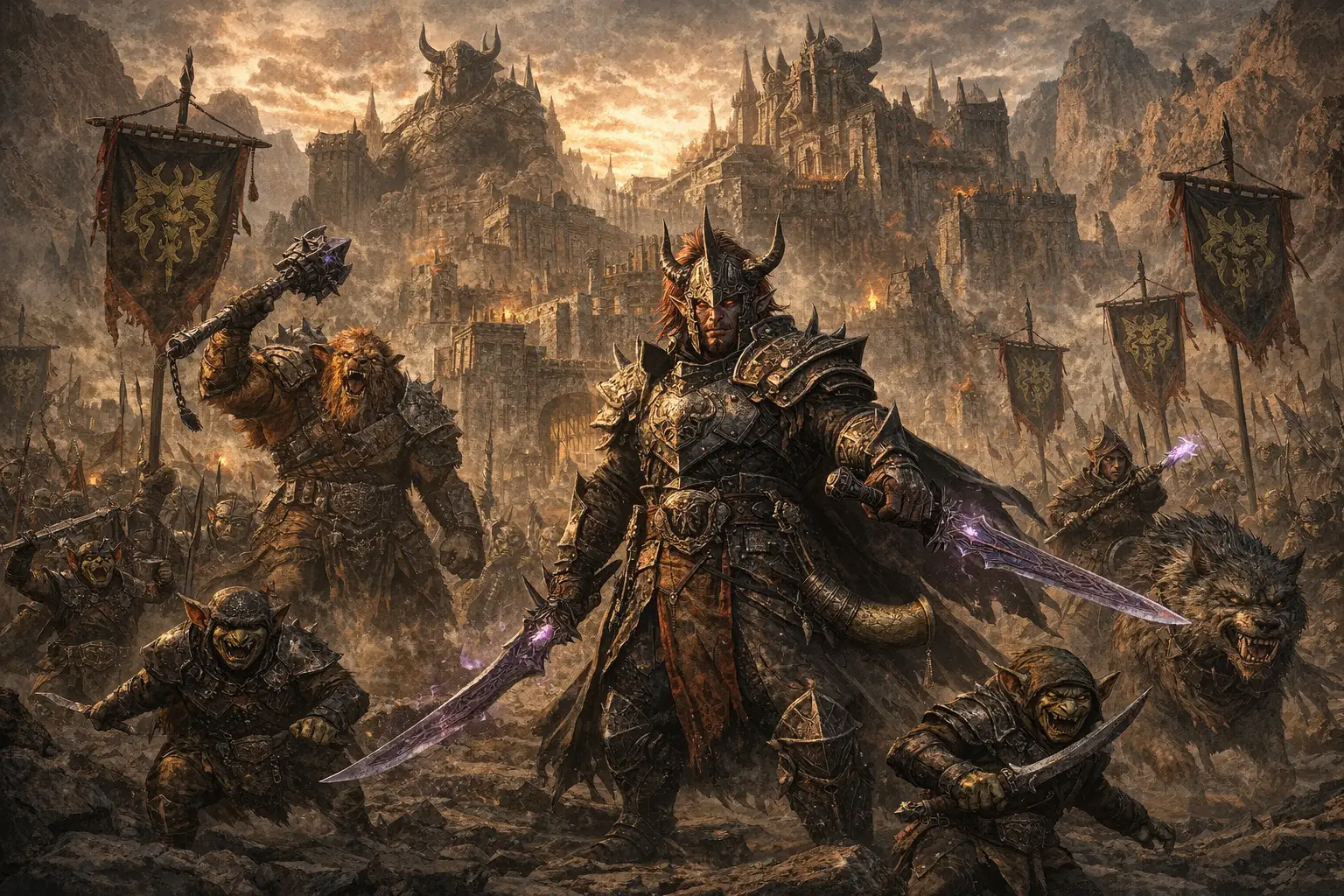
The Empire of Dhakaan
Raat shi anaa: the story continues.
"Our empire was so grand that even the spirits grew jealous." — Dhakaani oral tradition, as preserved by the duur'kala
The Empire of Dhakaan was the dominant civilization of Khorvaire for over five thousand years, a goblinoid superpower whose territory spanned the continent long before the first humans set foot on its shores. Founded by the legendary dirge singer Jhazaal Dhakaan roughly sixteen thousand years ago, the empire united the three goblinoid subspecies — the ghaal'dar (hobgoblins), the golin'dar (goblins), and the guul'dar (bugbears) — under a shared culture, a shared dream, and a single imperial throne. At its height, Dhakaan pushed the dwarves into the depths of Khyber, drove the dragonborn into the eastern jungles, repelled fearsome Tairnadal colonists, and consigned orcs, gnolls, and other cultures to the wild frontiers. The empire's ruins still form the foundations of many of the greatest cities of the Five Nations, and its descendants — both the surface-dwelling Ghaal'dar tribes and the hidden Kech Dhakaan — remain a force whose full power the modern world has yet to reckon with.
Origins of the Dar
Little is known with certainty about the origins of the goblinoid species. Aereni records describe warring goblinoids on Khorvaire approximately forty thousand years ago, around the time elves settled Aerenal, but modern scholarship suggests the goblinoids appeared quite suddenly around that period. The commonly held theory is that they evolved in vast caverns beneath the surface. Competing academic theories exist: Kel Kador of the Library of Korranberg believes the goblinoid subspecies were magebred from a common ancestor, a goblin progenitor that might still be found underground. Hass Holan of Morgrave University has advanced a more exotic hypothesis — that the goblinoids may have emerged from a demiplane within Khyber, a warlike realm not yet discovered.
The goblins themselves have little interest in these questions. For the dar — a Goblin word meaning simply "the people" — the history of Dhakaan is the history of the dar. The two are synonymous. Whatever their ultimate origins, the culture that would become Dhakaan emerged approximately sixteen thousand years ago, and everything before that is considered prehistory unworthy of serious attention.
The dar recognize three branches of their people, each named for the quality they embody: the ghaal'dar ("mighty people," the hobgoblins), the golin'dar ("quick people," the goblins), and the guul'dar ("strong people," the bugbears). Though the subspecies cannot interbreed and possess different lifespans, a primal connection binds them together at an instinctual level — scent, body language, and subtle factors that make them feel more comfortable around one another than around any other humanoid.
The Founding: Jhazaal Dhakaan and the Six Kings
In the distant past, six mighty hobgoblin kings rose to power across Khorvaire. Each sought to do their duty to their people, to bring prosperity and security, to defeat all rivals. Time and again the six kings clashed on the field of battle, but they were matched in cunning and their warriors were equals in courage and skill. No victory could be won. No compromise could be found.
Jhazaal Dhakaan, the greatest duur'kala — dirge singer — of the age, called the six kings together, and none could resist her summons. She brought them to a field soaked with blood and strewn with blunted blades. There she sang the song of the dar, reminding the kings they were all one people. She sang the song of muut — of the Duty all dar share. She sang the song of atcha — of the Glory awaiting the people, of the heroes of the past and of those yet to come. With her words, she wove a dream, and she gave that dream to the six kings and to all who followed them.
This was not merely metaphor. Jhazaal Dhakaan bound the spirits of the dar together, creating a vast, permanent dreamscape within Dal Quor — a vision of the ideal empire. This Uul Dhakaan, the Dream of Dhakaan, gave the ancient goblinoids oneness of culture and purpose, uniting them under Jhazaal as the first marhu — emperor of Dhakaan.
In the Graywall Mountains, a set of thousand-foot statues still commemorates the six kings who came together to forge the empire. Their names are remembered by the duur'kala, and the phrase kron rhukaan — "Six Kings" — remains an oath of sincerity and a common expletive among the dar to this day.
The Golden Age
The Dhakaani empire spread across Khorvaire with devastating efficiency. The dar pushed the dwarves back into the depths of Khyber. They drove the dragonborn into the eastern jungles of Q'barra. They repelled Tairnadal colonists from Aerenal who attempted to establish beachheads on the continent's shores. Orcs, gnolls, and other tribal cultures were driven into the wild frontiers. The territory controlled by Dhakaan encompassed the lands that would later be claimed by Galifar — virtually the entirety of central and southern Khorvaire.
The golden age lasted over five millennia. Dhakaani engineering produced cities and fortifications of extraordinary sophistication, many of which still survive as the foundations beneath the great cities of the Five Nations. The ancient hobgoblin metropolis on the Dagger River — Ja'shaarat, the "Bright Blade" — eventually became the foundations of modern Sharn. Dhakaani ruins dot the Seawall Mountains, the Graywall range, and countless other locations across the continent, testament to the staggering scope of the empire's infrastructure.
During this era, the dar perfected their martial culture, their systems of governance, their traditions of artifice and song, and the great dream that bound them all together. The empire was not merely powerful — it was stable, prosperous, and unified to a degree that even the Kingdom of Galifar never achieved. Every goblinoid knew their role, their duty, and their place within the dream.
Society and Culture
Muut and Atcha
Dhakaani society revolves around two cardinal concepts: muut and atcha. Muut is typically translated as "duty," though it carries the deeper connotation of "the honor of the empire" — something everyone must work to maintain. Muut is what is expected of you, what you owe to your comrades and to the dream. The dar do not expect thanks for doing something that has to be done; they are disgusted by those who shirk their responsibilities. The closest Dhakaani equivalent to "thank you" is ta muut, which simply means "you do your duty."
Atcha, by contrast, refers to personal honor or glory — an opportunity to exceed what is required. No dar is content to simply meet expectations; the quest for atcha is a powerful driving force urging every dar to chase their full potential. In battle, the exhortation paatcha means "this is a chance to gain honor!"
For the true dar of the Kech Dhakaan, muut and atcha are not abstract ideals but the driving poles of daily life, reinforced by childhood training, daily practice, and the ever-present influence of the Uul Dhakaan. Muut should always come first. A dar must be ready to die for the empire — but when possible, it is always better to kill for it.
The Dhakaani conception of honor differs sharply from that of Dol Arrah and the people of the Five Nations. The dar prize victory and efficiency above all. There is honor in using cunning to defeat a superior foe. Guerrilla warfare, ambush, and assassination are all acceptable tactics when muut demands them. Muut requires the dar to honor their debts and keep their promises — but strictly speaking, muut only binds dar to dar. Some feel no shame in deceiving the chaat'oor, the non-goblins, who have stolen their lands and plundered their tombs.
The Three Subspecies
Under Dhakaan, the goblinoid subspecies worked in concert, each celebrated for its strengths, and this unity is reinforced both by the principle of muut and by the Uul Dhakaan. Hobgoblins — the ghaal'dar — serve as strategists, commanders, and leaders. They possess especially expressive ears, which function as an important channel of body language and silent communication; hobgoblin soldiers signal allies with quick flicks of the ear the way a human soldier would use hand gestures. Bugbears — the guul'dar — use their tremendous strength for the greater good, serving as the terrifying vanguard of Dhakaani armies. Their battle rage is not unthinking savagery but a cultivated surge of adrenaline and combat awareness. Goblins — the golin'dar — are primarily artisans and laborers, maintaining the hearth and the forges, though exceptional goblins join the elite Khesh'dar as scouts, spies, and assassins.
All roles are respected. The goblin who cleans the latrines serves the demands of muut as fully as a formidable hobgoblin warlord. The ghaal'dar lead because they are natural leaders. The guul'dar use their strength for the common good. These things are simply understood, and the ghaal'dar do not have to use force to enforce their rule.
Clan Before Family
Family lines are of minimal importance among the Dhakaani. Rank must be earned, not inherited from a parent, and family names are only used within a clan. In formal situations, the full clan name replaces a surname: "Dhaaka of Kech Volaar." Leaders often adopt the surname Dhakaan itself as a way of indicating that the empire is their family — thus, Tuura Dhakaan of Kech Volaar and Ruus Dhakaan of Kech Shaarat are not related by blood. It is a formal affectation of devotion.
A Martial Culture
The culture of the Kech Dhakaan is relentlessly martial. The Keepers are armies that have preserved the dream of the empire for thousands of years. There is no place for indolence or waste. Surviving countless generations in deep subterranean vaults required absolute discipline. The young are assigned roles based on their subspecies and aptitudes, and advancement is earned through performance.
The dar are inherently pragmatic and rational. Their minds have difficulty engaging with entirely abstract concepts or unproven claims. They prefer history to fiction. As a result, divine spellcasters are rare among the dar, who struggle with the transcendental faith required to channel divine magic. The Dhakaani are an agnostic society without clerics, paladins, or druids. Their spiritual leaders are the duur'kala bards, who inspire with tales of things that actually happened.
Fashion, Art, and Cuisine
Dhakaani uniforms and armor are durable and functional, designed for extended wear. Officers often sport hornlike protrusions on helmets or shoulder plates to indicate rank. Many dar wear an armored mask covering the lower face — for lower-ranking soldiers, the mask design is tied to the clan; for officers, it may evoke an honored ancestor or an imposing beast. Tattoos and scarification are common, with clan symbols being the most frequent marking. The Kech Volaar in particular maintain an ongoing series of tattoos reflecting the bearer's life and accomplishments.
Dar art is practical and functional. It is primarily instructional — depicting an ideal to strive toward — or commemorative — preserving the deeds of heroes. Abstraction is disfavored. Clothing and art are designed to be viewed in dark subterranean tunnels, where darkvision conveys color in shades of gray. As a result, color combinations can seem quite odd to human eyes, chosen not for their hue but for how they appear in darkness.
Dhakaani cuisine is simple, hearty, and portable. Food is thick and chewy, with sour and bitter flavors central to the dar palate and strong spices used to mask undesirable tastes. On the surface, a grain called noon is a primary staple, pressed into starchy balls. In the subterranean vaults, a fungus called suur fills this role. Protein sources include lizards, snakes, blind cave fish, and insects. Pickling is crucial for preservation, and dehydrated meats — especially chewy lizard and fish jerky — are common. Sweet foods are rare, though the golin'dar have a noted sweet tooth and often indulge when traveling among the gath'dar. Most dar are lactose intolerant.
The Uul Dhakaan: The Dream of the Empire
The Uul Dhakaan is not merely a metaphor for shared national purpose. It is a literal, permanent dreamscape within Dal Quor, created by Jhazaal Dhakaan when she united the six kings. When mortals sleep, their spirits touch Dal Quor and create temporary dreamscapes. Jhazaal bound the spirits of the dar together, creating a vast permanent dreamscape — a vision of the ideal empire.
With the spirit of every dar tied to this place, when one of them sleeps, they dream of the empire and their place within it. The Uul Dhakaan is not oppressive. Each dreaming dar has unique dreams within the Uul, a place to process recent events and experiences. But the dream provides a foundation that shapes and flavors those dreams, teaching and inspiring even while allowing personal experience. It also retains the memories of all those who have gone before. A warrior could experience a battle against the daelkyr that occurred thousands of years ago, fighting alongside one of the greatest heroes of that age. A smith could forge a blade alongside a legendary daashor. These experiences are dreams — not real — but they remain in the subconscious as sources of inspiration and instinct.
The dar know what the empire could and should be. They know the role they are supposed to play, the meaning of muut and atcha. And they feel the connection to the dar around them, understanding they all share that common vision. This reinforces the martial discipline of the Dhakaani and underlies their adherence to caste roles.
Several specialized orders interact with the Uul Dhakaan more directly. The chot'uul ("dream watchers") are an order of monks who monitor and protect the dream from corruption — quori manipulation, daelkyr influence, and other spiritual threats. They employ specialized tools called uul'kur to retain full consciousness and memories while dreaming. The uul'kala ("dream singers") are dirge singers who specialize in walking the dream, acting as ambassadors and emissaries who maintain communication between the isolated kech vaults spread across Khorvaire — a function analogous to the speaking stones of House Sivis. Ordinary duur'kala also train within the Uul Dhakaan, studying with memory-shades of past masters.
The Uul Dhakaan was formed in the current age of the Dreaming Dark. The Dhakaani know nothing of the quori belief in the Turning of the Age, and no one knows what will happen to the dream when that turning occurs.
Traditions and Equipment
The Daashor
Dhakaani daashor — artificers — are the finest weaponsmiths on Khorvaire. Their skill at metallurgy outstrips even House Cannith. Dhakaani traditions blend mundane craft with transmutation magic to create and manipulate remarkable alloys, including adamantine, mithral, and byeshk. Champions often wield weapons forged from these materials. Equipment is designed for durability and efficiency, rarely gaudy or bejeweled.
The daashor value function over fashion. Their tools and weapons are impeccably designed but typically austere: blackened adamantine or steel, with emblems of clan and empire woven unobtrusively into the design. While the Dhakaani use swords, bows, and spears, their champions often favor flails, maces, and mauls. Magic items are usually focused on battlefield use — magical banners, instruments that inspire allies or instill fear, enchanted armor, and weapons of extraordinary quality.
Elite units are often equipped with uncommon magic items: adamantine armor, cloaks of protection, gauntlets of ogre power, and other enchantments. Shaarat'khesh assassins may carry hats of disguise, bags of holding, daggers of venom, or more powerful weapons. Though the Dhakaani are relatively few in number compared to the people of the Five Nations, they are not only disciplined and highly skilled — they are exceptionally well equipped.
At the height of the empire, the daashor and duur'kala could create grand artifacts and eldritch machines. The creation of such artifacts was never trivial, relying on remarkable talents, knowledge lost during the daelkyr incursion, and the use of rare substances and planar conjunctions. Whether the present-day Dhakaani retain the ability to craft new artifacts or whether their greatest secrets were lost with the fall remains an open question.
Byeshk
Byeshk is a rare and heavy metal of lustrous purple, mined from the Byeshk and Graywall Mountains along Droaam's borders and found in the Ironlands, a Khyberian demiplane delved into by the Kech Shaarat. Aberrations tied to the daelkyr — including dolgaunts, dolgrims, and mind flayers — are susceptible to weapons made of byeshk alloys, making the metal highly prized by the Dhakaani. Many weapons forged during the Xoriat incursion were made of byeshk.
The Duur'kala
The duur'kala — dirge singers — are the spiritual and intellectual heart of Dhakaani civilization. They preserve the history and knowledge of past ages, and their music is the most common form of magic among the dar. As the magic manifests mostly in females, duur'kala are often called gaanu duur ("daughters of the dirge"), and elders are referred to as niianu duur ("mothers of the dirge"). The duur'kala serve as diplomats, civic leaders, healers, battlefield commanders, and the primary spellcasters of Dhakaani society — filling the role that priests serve in most other cultures, but through tales of the past and the dream of the future rather than through appeals to divine powers.
The Daelkyr War and the Fall
The Xoriat Incursion
The golden age of Dhakaan ended with the daelkyr incursion, when the lords of madness from Xoriat led armies of aberrations into Khorvaire. The daelkyr destroyed Dhakaani cities and transformed goblinoids into aberrations — dolgaunts and dolgrims among them. The war was long and bitter. Dhakaani champions blinded the Lord of Eyes and cut the roots of the Rotting Queen. They fought the great Corruptor, Dyrrn, and brought him down. The orc Gatekeeper druids bound the daelkyr in Khyber, but it was Dhakaani warriors who scattered their armies and hunted down the surviving beasts.
The Kapaa'vola
But the daelkyr achieved victory even in defeat. As Dyrrn fell, he unleashed the Kapaa'vola — the Treacherous Whisper — a psychic contagion that severed goblinoids from the Uul Dhakaan and encouraged chaotic behavior and irrational beliefs. Leaders among the duur'kala identified the threat but could find no way to stop it. Isolation was the only answer.
"The Kapaa'vola did not destroy the empire's walls. It destroyed the dream inside them. Everything that followed — the fragmentation, the displacement, the human conquest — was downstream. Dyrrn understood that you do not need to break an empire's fortresses. You only need to break its reason for existing." — Kech Volaar lorekeeper, oral history
The Long Collapse
On the surface, the remnants of the empire fragmented and collapsed. As far as the Kech Dhakaan are concerned, the history of the Empire of Dhakaan ended the moment Dyrrn unleashed the Kapaa'vola. But in truth, the empire lingered for centuries after the Keepers left. The wider world does not even know the term Kapaa'vola; their history books consider the fall of Dhakaan to be a long and ugly affair.
Dyrrn's curse caused paranoia and wild beliefs to flourish, further driving the survivors apart. The discipline and knowledge of Dhakaan were lost. The traditions of the daashor and the duur'kala were forgotten. New religions and cults emerged — some tribes embraced the Dark Six, while others revered a wider pantheon. Under Dhakaan, the goblinoid subspecies had been united; in the wake of the Kapaa'vola, the strong dominated the weak. Some tribes developed unusual and complex traditions, while others became cruel and feral.
When human explorers arrived and found these warring tribes living in the ruins of grand cities, many assumed that the goblinoids had claimed the remnants of an ancient human civilization they had destroyed. This false narrative was used to justify countless atrocities. Humanity slowly displaced the goblinoids, seizing the lands that once belonged to Dhakaan. Goblins were often enslaved, while bugbears and hobgoblins were driven into the wilds or the upper levels of Khyber. In time, scholars learned the truth — that the foundations they had built upon were goblin cities, not human. But few people cared. In their eyes, the goblinoids were merely savages, children of the Dark Six, dangerous and cruel. It was in this era that the terms "goblin," "bugbear," and "hobgoblin" took root, even among the former dar themselves.
The Legacy: Goblinoid Cultures of the Modern Age
City Goblins
Goblins dwell in most of the major cities of the Five Nations. When humans first came to Khorvaire, they enslaved many goblins and built their cities on the foundations of Dhakaani ruins. Galifar Wynarn ended the practice of slavery and promised freedom to any goblin who fought under his banner — goblin soldiers played a vital role in the war of unification. Despite this freedom, goblins were still treated with prejudice and denied education and other tools for success. Even today, goblins can be found in every major city, but an overwhelming number live in poverty. Gifted goblins can be found in all walks of life, and goblins served in the armies of the Five Nations during the Last War.
The Ghaal'dar
The Ghaal'dar tribes arose from the remnants of the Dhakaani Empire in the Seawall Mountains. Hobgoblins lead the Ghaal'dar, enforcing their will on their goblin and bugbear peers. Their history is filled with strife — when they were not fighting Galifar or Zilargo, the tribes usually turned on one another. This changed with the Last War, when House Deneith hired Ghaal'dar mercenaries, giving focus to the divided tribes.
A brilliant hobgoblin named Haruuc united the Ghaal'dar. In 969 YK, Haruuc led the uprising that claimed the lands of southern Cyre and founded the nation of Darguun, establishing himself as Lhesh Haruuc Shaarat'kor — adopting the ancient Dhakaani rank of lhesh (high warlord) as the title of his new nation's ruler.
The Ghaal'dar have adopted the concepts of muut and atcha, but merely as abstract ideals. They recovered scraps of their ancient history and honed their anger against the chaat'oor who had stolen their lands. They know of the duur'kala and the ancient empire, but they do not share the Uul Dhakaan. Their understanding of what it means to be dar is incomplete — a shadow of the original.
It is important to note the dual meaning of the term: ghaal'dar in lowercase refers to hobgoblins of the Kech Dhakaan; Ghaal'dar capitalized refers to the modern tribal federation that dominates Darguun. The Ghaal'dar tribes are not Dhakaani. They mimic some customs and are proud of their imperial history, but they were twisted by the Kapaa'vola and differ from the true dar in fundamental ways.
The Marguul
The Marguul bugbears threw off the yoke of the Ghaal'dar long ago, seizing territory in the Seawall Mountains in the south of Darguun. They are infamous raiders who worship the Mockery and believe in victory by any means necessary. While they have brokered a truce with the Ghaal'dar, anyone venturing into the Seawall Mountains had best travel with a Marguul guide.
Raat shan gath'kal dor: the story stops but never ends.
Military Ranks of the Empire
Rank | Goblin Term | Meaning |
|---|---|---|
Emperor | Marhu | Supreme leader |
General | Lhesh | High warlord |
Colonel | Lhevket | Elder warlord |
Captain | Lhevk'rhu | Skilled warlord |
Lieutenant | Lhevk | Warlord |
Sergeant | Lhurusk | War leader |
Private (shock trooper) | Thradaask | Shock trooper; most often guul'dar |
Private (line infantry) | Olhirot | Spear-bearer |
The suffix or prefix rhu indicates higher status, experience, or prestige than others of the same rank.
Common Knowledge
Anyone who has received a common education in the Five Nations knows that a goblin empire inhabited Khorvaire before humanity arrived, and that it fell long ago. Most people recognize Dhakaani ruins as goblin creations and know that many of Khorvaire's largest cities are built on goblin foundations. Detailed knowledge — the importance of muut and atcha, the names of specific rulers, the existence of the Kapaa'vola and the belief that some clans fled from this threat — requires considerable scholarly expertise.
Most people of the Five Nations, and even many denizens of Darguun, do not know the difference between the Kech Dhakaan and the more modern goblin civilizations. When someone from the Five Nations encounters dar of the Kech Dhakaan, they may notice unusual elements evoking Dhakaani history, but it is not commonly known that the Kech Dhakaan have maintained an unbroken link to the ancient past — nor does anyone in the modern world have any idea how powerful the goblinoids of Dhakaan truly are.