Galifar
Period: 1 YK – 894 YK
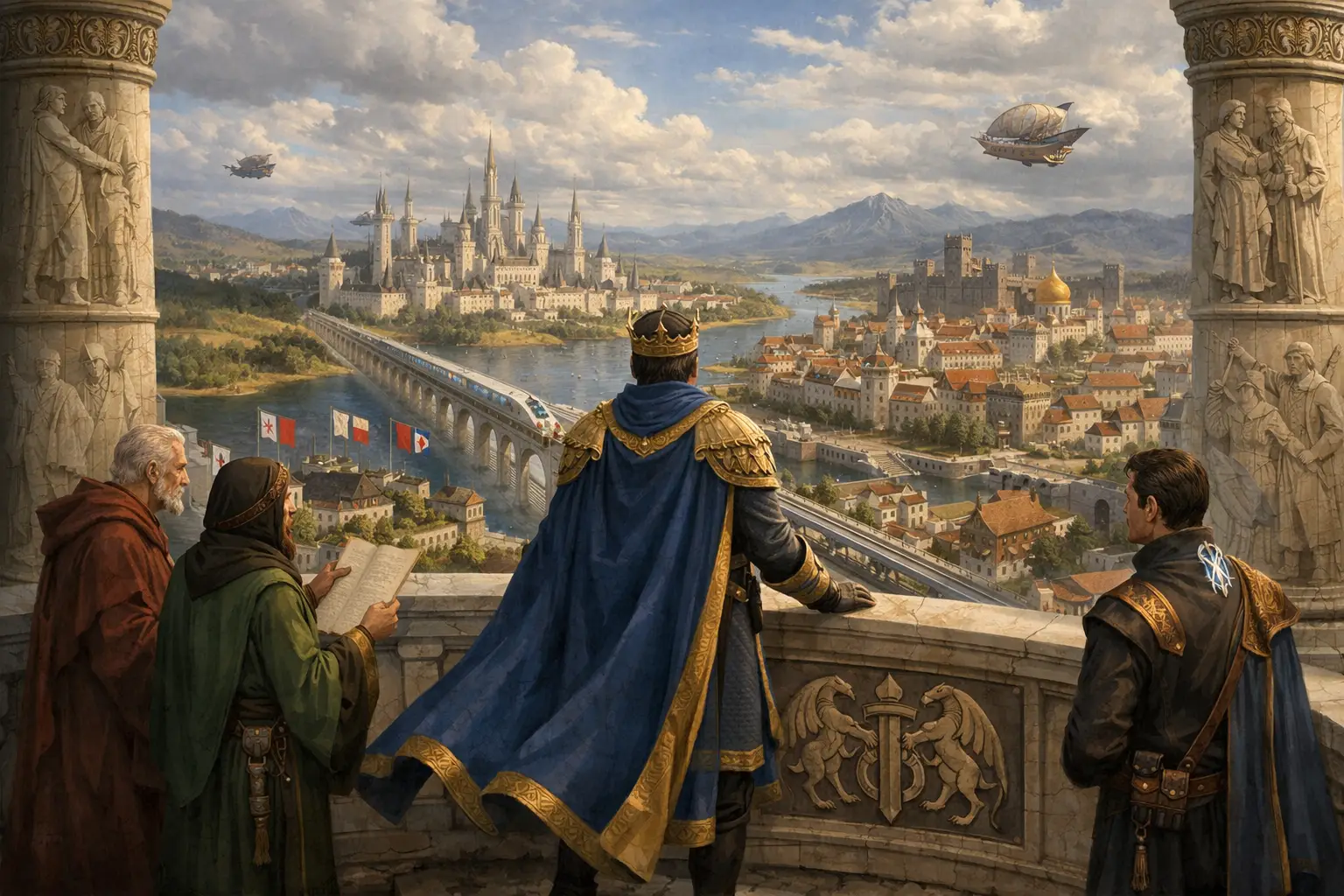
The Kingdom of Galifar was the greatest human political achievement in the history of Khorvaire — a unified realm spanning most of the continent, held together for nearly nine centuries by a combination of dynastic authority, legal infrastructure, institutional investment, and a bargain with the most powerful economic forces the world had ever produced. It was not a utopia. It was not even especially just. But for the people who lived within it, it was something rare: a framework stable enough that they could plan their lives around it.
When Galifar collapsed in 894 YK, it did not fall to an outside conqueror. It tore itself apart from within, as the heirs of the last king chose their own crowns over a shared inheritance. The war that followed lasted a century. Its final act was the annihilation of an entire nation. The kingdom has not been restored, and most people alive today have never known anything but its absence.
"Galifar succeeded where Karrn failed because he understood something Karrn did not: that you cannot hold a continent with soldiers. You hold it with systems — laws that people trust, services they depend on, institutions they believe in. The houses provided the services. The laws provided the framework. The soldiers came last, not first." — Arcanix lecturer, political history
Founding and the Wynarn Settlement
Galifar ir'Wynarn was born in –43 YK in the city of Karrlakton, of the bloodline of Karrn the Conqueror. He assumed rulership of Karrnath in –22 YK and spent the next decade consolidating authority over a fractious nation before turning his attention outward. In –12 YK, he began his campaign to unite the Five Nations.
He did not simply conquer. Galifar abolished slavery within his domain and promised freedom to the oppressed subjects of his enemies — a move that drew significant goblinoid support to his cause at a time when goblins lived as slaves or slum-dwellers throughout the other city-states. Whether this offer reflected genuine principle or political calculation is a question historians continue to argue. The answer is probably both. What is certain is that it worked: Galifar's armies were joined by goblinoid fighters who had every reason to prefer his rule over the existing order, and he coordinated with descendants of successful goblinoid uprisings that had occurred over the previous millennium.
In –5 YK he met with the dragonmarked houses and established the Korth Edicts: the dragonmarked houses would be forbidden from holding land or noble titles, and would remain a formally neutral force, but in exchange they would receive regulatory power and industrial preeminence throughout the kingdom. This bargain gave the houses economic dominance while keeping them politically subordinate — in theory. In practice it created a permanent tension that would define Khorvairian politics for nine hundred years and survive the kingdom's collapse entirely.
After a long campaign of conquest and diplomacy, Galifar I declared the United Kingdom of Galifar in 1 YK. The calendar that marks that year as the first Year of the Kingdom was established during the later reign of his grandson, Galifar the Dark, but the retroactive date has stuck. The modern age is measured from the moment Galifar's vision became law.
In 2 YK, he appointed each of his five eldest children as governors of the provinces and renamed them for those heirs: Daskara became Thrane, Metrol became Cyre, Thaliost became Aundair, Wroat became Breland after his daughter Brey. Karrnath, already bearing a conqueror's name, remained unchanged. Galifar I stepped down at eighty-five in 40 YK, passing rulership to his eldest daughter Cyre — establishing the pattern of primogeniture succession that would define the kingdom for generations. He died in 53 YK.
"The Five Nations were named for the eldest scions of Galifar I. Galifar envisioned a unified empire strong enough to outlast its founder, but the regional identities of his heirs and their descendants endured." — Five Nations, introduction
Structure and Governance
The Monarchy and Succession
Galifar was a feudal monarchy in structure, though its actual operation was considerably more complex than that description suggests. The monarch ruled from Thronehold on Scion's Sound, and the kingdom's governance rested on a layered system of crown authority, provincial princes, and local ducal administration.
The succession system Galifar designed was intended to bind the Five Nations to a single throne across generations. When a new monarch assumed the throne, their five eldest children would each be appointed to govern one of the Five Nations as a prince or princess. Those princes married into local ducal families, formally anchoring the Wynarn bloodline into the nobility of each province. When the monarchy changed again, the previous princes became dukes, and a new generation of Wynarns took the provincial thrones. The result was a continual dispersal of Wynarn blood throughout the noble families of every nation — a design that made the dynasty culturally omnipresent while ensuring no single branch could easily consolidate independent power.
In practice, this system was unstable. It required every monarch to produce at least five capable heirs. After a few centuries, it became common for kings to take multiple spouses — one from each of the Five Nations — to ensure the appropriate succession. The requirement was a constant source of political tension, and the dynasties of the provinces never fully surrendered their regional identities to the crown. The throne held. But it held imperfectly, through continuous negotiation rather than settled authority.
The Galifar Code of Justice
One of the kingdom's most enduring contributions was its legal system. The Galifar Code of Justice, established under the first king and expanded by the Arcane Congress, provided a unified framework of law across all Five Nations. It invoked the authority of Aureon — Galifar I believed himself guided by that Sovereign, and the belief that the Wynarn bloodline was blessed by the god of law and knowledge became a cornerstone of royal legitimacy — but it also contained entirely practical provisions: rules on the use of magic, restrictions on dangerous arcane items, procedures for citizenship and fealty, and guidelines for the use of letters of marque by adventurers and salvagers.
Citizens of the Five Nations were protected by the Code. Citizenship itself was obtained by swearing fealty to a local noble, who accepted responsibility for the citizen in exchange. This system worked well enough in the core provinces, but it created permanent grey zones at the margins — regions like the Demon Wastes and the lands west of the Graywall Mountains that Galifar claimed in name but never effectively administered.
The Code survived the kingdom. Its provisions still structure law in Breland, Aundair, and Karrnath today, even as those nations rewrite and reinterpret it to suit their own purposes.
The Korth Edicts and the Houses
The relationship between the crown and the dragonmarked houses was governed by the Korth Edicts for the entirety of the kingdom's existence. The houses provided the infrastructure of daily life — healing, transportation, communication, manufacturing, banking — and in exchange received regulatory monopolies that the crown was legally bound to respect. A noble wishing to marry a dragonmarked heir had to choose: the heir could sever all ties to their house, or the noble could renounce their title. There was no path that preserved both.
This arrangement created structural power without structural accountability. The houses grew wealthy on a scale that individual nobles could not match, and their services became so deeply integrated into Khorvairian life that even the crown could not afford to alienate them. Galifar I had negotiated a system that kept the houses nominally subordinate while making them practically indispensable. Whether this was wisdom or short-sightedness depended entirely on which century you were living in.
"The Korth Edicts prevent the houses from owning land, holding noble titles, or maintaining military forces. Today, many in the houses feel the edicts have become obsolete in the wake of the Last War."
Institutions
Galifar did not merely conquer territory. It built things meant to last. The kingdom's major institutions were its most deliberate legacy — and most of them did outlast it.
The Arcane Congress was established by Galifar I in 15 YK, housed in the floating towers of Arcanix above southern Aundair. Its mandate was to explore the limits of arcane arts for the good of all. During the golden age of Galifar it delved into magical mysteries that were made available across the kingdom — the everbright lantern that lit Metrol's streets, the standards for magic-item use codified in the Code of Justice. After the kingdom's collapse, the Congress became Aundair's alone. It remains the largest institute of wizardry and artifice outside House Cannith.
Rekkenmark Academy in Karrnath trained Galifar's officers for centuries. Nobles from every nation sent their children to Rekkenmark for at least part of their education. The practice ended with the Last War. The academy hopes to welcome outside students again; few have come.
The Wynarn Institute of Art in Metrol was one of the kingdom's great cultural projects — both a museum and an academy of magical arts, dedicated to exploring the artistic rather than practical applications of the arcane. The Hall of Kings within it allowed visitors to converse with illusory replicas of past Galifar rulers. It was lost with Cyre in 994 YK.
The King's Citadel in Breland served as the kingdom's intelligence and internal security apparatus. Each province received one of the kingdom's pillars: the Arcane Congress in Aundair, Rekkenmark in Karrnath, the Grand Temple in Thrane. Cyre received no single institution — instead it became the nexus where all of them met, the seat of the royal treasury and the showcase of what Galifar could achieve when it chose to spend its wealth on people rather than war.
"Each nation was given one of the pillars of the united kingdom. Cyre was the exception. Rather than building on the existing culture of Metrol, Cyre drew experts and artisans from across Galifar. Instead of being the center of any one discipline, Cyre was the nexus where all of these things came together — the best of what Galifar could be."
Culture and Identity
The Five Nations Within the One Kingdom
Galifar was unified in law and dynasty, but it was never culturally homogenous. Each province retained and, in many ways, deepened the identity it had carried before the kingdom existed. Karrnath was martial and austere. Thrane was devout. Aundair was intellectual and refined. Breland was industrious and increasingly democratic in temperament. Cyre was the synthesis — a deliberate project in cosmopolitanism that drew talent from all four of its siblings and tried to show what they could become together.
This diversity was a strength and eventually a fatal weakness. The regional identities that gave the kingdom texture were the same identities that made the Five Nations willing to tear each other apart when the succession broke down.
The Sovereign Host
The faith of the Sovereign Host was the religious foundation of the kingdom. Galifar I believed himself guided by Aureon, the god of law, knowledge, and magic, and the Wynarn bloodline's divine mandate was a cornerstone of royal legitimacy for nine centuries. The Galifar Code of Justice invoked Aureon by name. Religious diversity existed — the Blood of Vol had deep roots in Karrnath, and the Church of the Silver Flame grew steadily in Thrane from the 3rd century onward — but the Sovereign Host was the faith of the kingdom as an institution, and it shaped the cultural assumptions of the educated classes across all Five Nations.
The Naming Conventions
Galifar unified the naming practices of its people as thoroughly as it unified their laws. Citizens of the Five Nations generally carried a given name and a surname drawn from Common — a family name, an occupational name, or a place of origin. Landed nobles added the prefix ir' to their surname. Members of a dragonmarked house who had manifested their mark used d'. The Wynarn bloodline itself — the royal family, dispersed through five centuries of provincial marriages into nearly every noble house on the continent — carried ir'Wynarn as the most recognized surname in Khorvaire.
"The Wynarns were the royal line of Galifar, and the current rulers of Aundair, Breland, and Karrnath are all heirs of the Wynarn bloodline."
The Long Peace — and Its Cracks
The nine centuries between Galifar's founding and the Last War were not a period of unbroken tranquility. The kingdom faced external threats, internal rebellions, religious upheaval, and the slow accumulation of pressures that its founding structures were not designed to resolve. But it held together, and that holding-together was itself remarkable.
The Year of Blood and Fire in 298 YK saw the fiend-lord Bel Shalor partially released from his bonds in Thrane, his armies of fiends terrorizing the province for a year before the paladin Tira Miron sacrificed herself to rebind him. The Church of the Silver Flame was established around the pillar of fire marking her sacrifice, and Flamekeep became the faith's cathedral. This event, more than any other, made Thrane what it would become.
The Silver Crusade of 832–882 YK saw the Keeper of the Flame dispatch templars across Khorvaire to eliminate lycanthropy. The crusade was brutal and often indiscriminate, and the religious violence it sanctioned left deep scars in western Aundair and the Towering Wood.
In 845 YK, King Jarot began the most ambitious public works project in Galifar's history, funding lightning rail connections between all of central Khorvaire. Within twenty years, lines connected the Five Nations, Zilargo, the Mror Holds, and the Talenta Plains. The lightning rail became the circulatory system of the kingdom's economy. Jarot also upgraded the trade city of Stormreach in Xen'drik in cooperation with the houses, extending Galifar's commercial reach beyond the continent. These achievements defined the kingdom's final peacetime generation — a kingdom that looked more powerful and more unified than it had ever been, and beneath the surface had never been more brittle.
Jarot feared war. He spent his reign preparing for it, building armadas and fortifying borders against threats he could not name precisely. The war he feared did not come from outside.
Collapse: The Last War
In 894 YK, King Jarot ir'Wynarn died. He was the last king of Galifar.
The succession system required his eldest child, Mishann of Cyre, to take the throne. Three of Jarot's other children — Thalin of Thrane, Kaius of Karrnath, and Wroann of Breland — rejected her claim. Only Wrogar of Aundair backed his sister. What followed was the Last War: a hundred-year civil conflict fought not against an external enemy but among the fragments of the kingdom itself.
The war lasted from 894 YK to 996 YK. Over a century of fighting, Galifar's provinces became nations, its institutions were weaponized or captured by the surviving powers, and the dragonmarked houses enriched themselves on all sides while the Korth Edicts — which no single nation could now enforce — became increasingly notional. New states emerged from the chaos: Darguun seized by goblinoid rebellion, Valenar carved out by Tairnadal mercenaries, the Eldeen Reaches breaking from Aundair, Droaam declared by the Daughters of Sora Kell.
The end came not at the negotiating table but with catastrophe. On 20 Olarune 994 YK — the Day of Mourning — Cyre was destroyed. The nation that had been the seat of the kingdom's treasury, the home of its finest institutions, the showcase of what Galifar could achieve, was annihilated. The cause remains unknown. Shock and terror brought the surviving nations to the table. The Treaty of Thronehold ended the war in 996 YK. No one won.
"Galifar lies shattered, the Five Nations irreparably divided. So many new realms claim sovereignty. Can it last, or will another war fracture us further? Should I dwell on such things when the Mourning might simply consume us all? Gods, how I fear the future." — Lyrian Das, Morgrave historian
Legacy
Galifar is remembered differently depending on who is doing the remembering.
In the Five Nations, it is remembered as a golden age — an era of peace, prosperity, and shared civilization that the Last War destroyed and that the Treaty of Thronehold has not restored. The nostalgia is genuine and selective in equal measure. The kingdom's legal framework still structures law in every surviving province. The institutions it built — the Arcane Congress, Rekkenmark, the King's Citadel — still function, now serving individual nations rather than the whole. The Korth Edicts are still nominally in force, though the houses increasingly treat them as renegotiable.
Among goblinoids, the legacy is more complicated. Galifar's founding promise of liberation was real but incomplete. The kingdom freed enslaved goblinoids and did little else to improve their material position. The result was a society in which the formal structures of slavery were abolished while economic and social marginalization were preserved. The goblinoid nations that exist today — Darguun, the Heirs of Dhakaan — exist in spite of Galifar's legacy as much as because of it.
The kingdom's deepest institutional legacy may be the one it least intended: the dragonmarked houses emerged from nine hundred years of protected monopoly stronger than any surviving nation. The Korth Edicts that were meant to keep the houses subordinate to the crown have outlasted the crown. There is no king of Galifar to enforce them. There is no shortage of houses that have noticed.
"The modern age did not begin with Galifar. Galifar inherited a continent that had already been shaped by migration, displacement, dragonmark monopolies, and one very efficient purge. What he did was give it a name and a calendar. Which, to be fair, is more than anyone else managed." — Sharn journalist, editorial column
Key Dates
Year | Event |
|---|---|
–43 YK | Galifar ir'Wynarn born in Karrlakton |
–22 YK | Galifar assumes rulership of Karrnath |
–12 YK | Campaign to unite the Five Nations begins; slavery abolished in Galifar's domain |
–5 YK | Korth Edicts established with the Twelve |
1 YK | Kingdom of Galifar declared |
2 YK | Five provinces named for Galifar's children |
5 YK | Reconstruction of Sharn begins |
15 YK | Arcane Congress established |
40 YK | Galifar I steps down; Cyre inherits the throne |
53 YK | Galifar I dies |
106 YK | House Kundarak joins the Twelve |
298–299 YK | Year of Blood and Fire; Silver Flame established in Thrane |
498 YK | House Tharashk founded; the Twelve reaches its canonical twelve |
811 YK | First lightning rail connects Flamekeep and Fairhaven |
845 YK | Jarot's continent-wide lightning rail project begins |
894 YK | King Jarot dies; Last War begins |
994 YK | Day of Mourning; Cyre destroyed |
996 YK | Treaty of Thronehold; Last War ends |