Cyre
Capital: Metrol | Last Ruler: Queen Dannel ir'Wynarn (presumed dead) | Government: Galifaran hereditary monarchy | Hallmarks: Art, artifice, diversity, jewelry, music, philosophy
From the pages of the Korranberg Chronicle, 21 Olarune 994 YK:
CATACLYSM IN CYRE! A magical catastrophe of unknown origin engulfed the nation of Cyre yesterday, bringing a century of war to an explosive climax. Surely when the children of King Jarot began their squabbles over succession a hundred years ago, they could not have foreseen the horror that would engulf the home of Queen Mishann. It is clear at this point that beautiful Cyre, the jewel of Galifar's vast holdings, has disappeared behind a churning cloud of dead-gray mist.
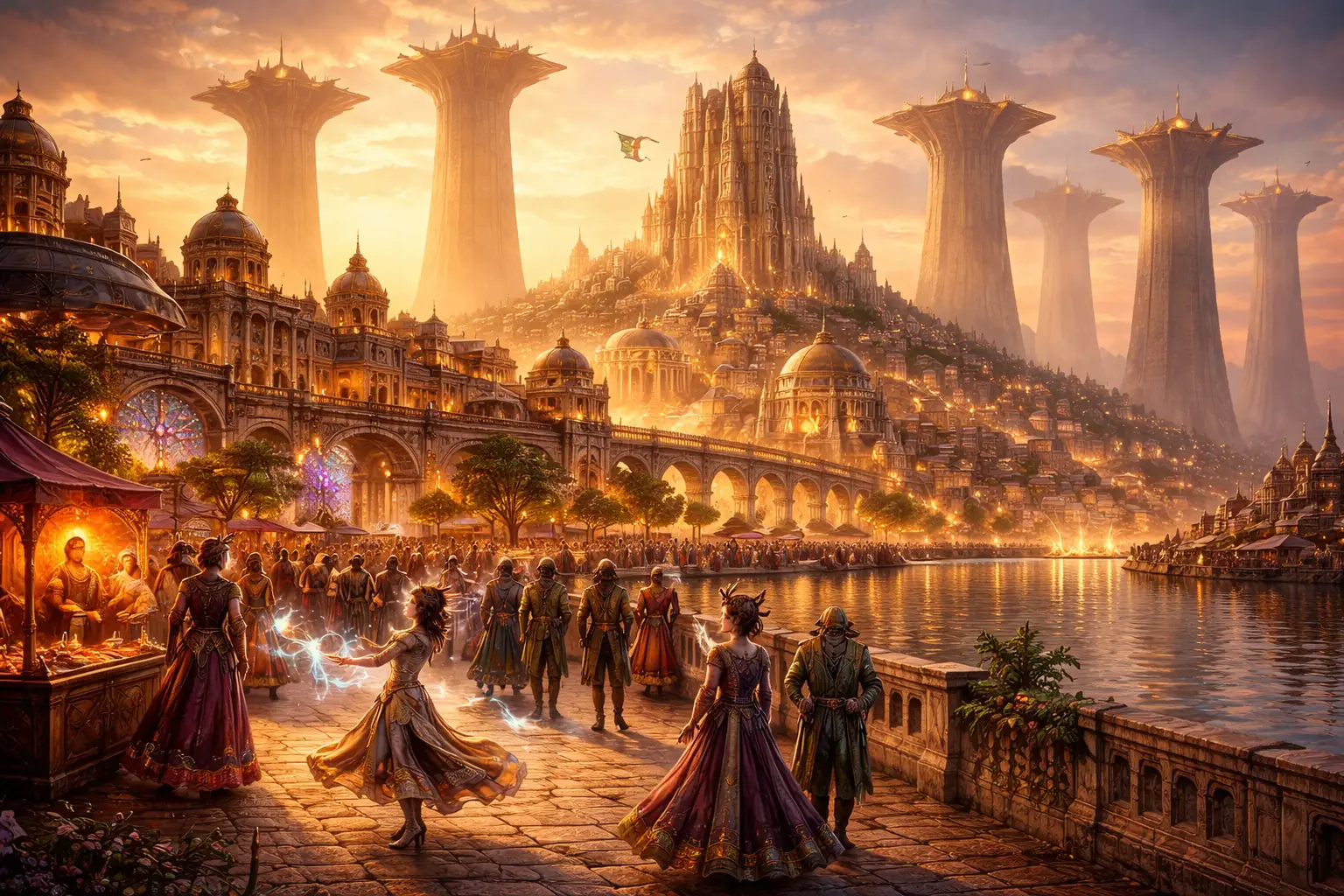
No nation won the Last War, but Cyre unquestionably lost it. Before the Mourning, it was the jewel of Galifar's crown — the place where Karrn discipline, Aundairian arcane innovation, Thranic scholarship, and Brelish craft came together and became something larger than any one tradition. If Aundair was the nation of wizards and Karrnath the nation of soldiers, Cyre was the nation of artists, dreamers, and people who believed they could take the best of everything and make it better. It occupied the heart of Khorvaire, bordered by Karrnath to the north, Breland to the west, Thrane to the northwest, and — after the secessions — Darguun and Valenar to the south and east. Its capital, Metrol, was the Rising City: a metropolis of nearly a million people built around seven soaring columns of natural rock, each capped with a palace, their glittering spires lit by illusory magic.
Cyre was governed as a hereditary monarchy through the fullest surviving expression of the old Galifaran court — archdukes, dukes, counts, viscounts, barons, ministers, and civic jurists, all layered beneath a queen who ruled through advisors and legal process rather than personal decree. Its culture drew from every corner of Khorvaire and was sustained by the industrial power of House Cannith and the artistic sophistication of House Phiarlan, both headquartered in Cyran cities. On 20 Olarune 994 YK, the nation ceased to exist. What was Cyre is now the Mournland.
The Cyran Spirit
The Cyran national character was defined by synthesis, creativity, and a quiet confidence that could shade into arrogance. Cyrans were encouraged to be creative and question received wisdom, to study widely rather than deeply, to treat the arcane arts as much as an aesthetic discipline as a practical one. They called their habit of borrowing from other cultures "Cyran appreciation" — engaging with other nations' art, music, food, and ideas, adapting them, improving them, and reincorporating them as something distinctly Cyran. Other nations called it appropriation, the work of carrion crawlers who stole from others while arrogantly believing they could do it better. Cyrans replied that it was rooted in love, not arrogance — in the genuine belief that diversity is a source of strength and that there is always room for improvement.
This character was also shaped by catastrophe. A century of war ground the Cyran people down. The early optimism of Mishann's claim gave way to siege mentality, secession, and a deep collective depression that settled over the nation in its final decades. Brooding melodies with heavy drum and strings dominated the soundscape. And then the mists came.
"As a Cyran, you stand on the moral high ground — but that may offer little comfort." — common observation about the Cyran condition
Crown and Court
Queen Dannel ir'Wynarn was elevated to the throne at seventeen and proved a capable consolidator — she secured the loyalty of Cyre's dukes and held the court together through a half-century of erosion. But decision-making was slow, shaped by precedent, and constitutionally incapable of the rapid adaptation that attrition warfare demanded. By the war's final decade, the aging queen was lampooned in the Cyran press as too prideful to acknowledge the trajectory of the conflict.
Cyre's most experienced military leader, General Shivaji — an elf approaching the end of his third century — had faithfully served the crown through Dannel's entire reign, having overseen the military buildup under King Jarot. He never forgave himself for failing to foresee the war before it began. Dannel was in Metrol on 20 Olarune 994 YK and is presumed dead. Her youngest son, Prince Oargev ir'Wynarn, was serving as ambassador to Breland when the Mourning struck and is the last known surviving descendant of Mishann ir'Wynarn.
"Cyre did not believe it could end. It truly believed itself the heir to Galifar and patiently believed the world would remember that, and return." — Professor Halden ir'Morgrave, Morgrave University, On the Collapse of the Imperial Core
Faith and Culture
The Sovereign Host was the dominant faith of central Cyre, woven into its architecture and civic culture. The Cathedral in Metrol, with its nine colossal statues and illusory displays, was the primary seat of Vassal devotion in Galifar. Eastern Cyre's nobles believed Aureon had given them a divine mandate; southern Cyre held to a quieter faith. The Silver Flame had devoted followers and temples but never rivaled the Host's dominance. Cyrans were always encouraged to question and search for new paths rather than accept received doctrine.
Cyran fashion blended practicality with endless diversity — a durable base layer over which Cyrans added flair through coats, gloves, masks, and jewelry of copper, leather, wood, or glass. Coats were integral: a heavy traveling coat, a short socializing coat, a long glamerweave-lined coat for an evening at the Grand Stage. Cyran soldiers were called "Greencoats" for their distinctive uniforms. Masks were worn at formal occasions not to conceal identity but to enhance it. Feathers and bells were common accessories. Traditionally, Cyran fashion was filled with color, often accentuated with glamerweave; since the Mourning, many survivors have adopted Mourning wear — the same cuts, entirely in black.
Cyran magical practice treated arcane casting as an art form. For a wizard trained at the Wynarn Institute, somatic components were almost a dance, verbal components had the cadence of song or poetry. Pre-war Cyran art was sweeping and optimistic — filigree designs, precious gems, dragonshards adding glimmering light. The war forced evolution: mithral and gemstones had been imported from what became the Mror Holds, and dragonshards were drafted to the war effort, leaving artists to work with humbler materials and darker subjects. Architecture featured dramatic, sweeping Galifaran-era buildings with Sovereign Host iconography woven into even secular structures. Cyran cuisine reflected the same principles: Karrn stews spiced with Thranic thrakel, Aundairian pastries sharpened with southern Brelish heat, desserts no one nation could claim.
The Shape of the Nation
Metrol, the Rising City, served as both the capital of Cyre and, in practice, the political center of pre-war Galifar. Its seven Royal Vermishards — towering natural columns of rock, each capped with a palace — held the Cyran crown, the nobility, the royal treasury, civic administration, the Vermishard Academy and House Phiarlan, House Cannith, and the military command. Houses Cannith and Phiarlan worked with Cyran magewrights to embed illusory lighting into the spires, making the Metrol skyline a wonder visible for miles. The city housed Orien's grandest lightning rail station, the Cathedral of the Sovereign Host with its nine colossal statues, and the Wynarn Institute of Art — both one of the foremost academies of magic in Khorvaire and one of its most spectacular museums. The Vault, the Royal Treasury of Galifar, included the mint, reserves of currencies and precious metals, and cultural artifacts deemed too valuable to display. The city sat on the River Melandor, with Starmantle Bay providing a deep freshwater basin for its docks and navy, including the flagship The Mishann. Metrol held close to a million residents at its height.
Eston, the ancestral seat of House Cannith, was a city where magic came to life. An iridescent dome protected it from storms and harsh winds. It housed the Clockwork Menagerie, three creation forges, and the Steel Gardens — a late-war breakthrough that grew trees with metal bark and leaves, creating renewable sources of base crafting materials. Making, the city for which House Cannith was named, was its industrial floor — plain, functional architecture on a grid, housing the Genesis Foundry and one of the continent's first airship docking towers. It sat at the edge of the Galifar Forest, a protected reserve with heavy fey presence from Thelanian manifest zones; legend says Galifar I made a deal with a hag who ruled the woods, promising that so long as the forest stood, so would the Kingdom. Dollen on the River, Cyre's largest northern port on Scion's Sound, was one of the richest trade ports on the continent before the war, converted into a naval fortress after a Karrnathi sacking, armed with arcane cannons and warforged sentries below the waterline. Castle Dollen was rebuilt several times after devastating raids. And Seaside, a popular coastal resort even during the war, was where the Kundarak bank did brisk business and the Court of the Silver Tree, a feyspire from Thelanis, often appeared just off the road.
The Cyran Character
Two qualities define the Cyran temperament in the postwar world, and neither existed in quite the same way before the Mourning. The first is loss — every Cyran has lost something, whether wealth, status, family, an ancestral home, or an entire way of life. Estates are gone. Armies are scattered. The institutions that granted standing no longer exist, and a former viscount and a former criminal carry equal weight in the refugee camps of New Cyre and High Walls. Cyran grief is sharp and accusatory; many see the fall of their homeland not as an isolated cataclysm but as the culmination of envy, betrayal, and the long refusal of the other nations to accept Cyran legitimacy.
The second quality is versatility — a trait the Cyrans possessed long before their nation fell, and one that has kept them alive since. Cyrans were raised to find the best in all things, to blend traditions, to improvise. Central Cyre's culture prized elegance across disciplines, and a well-bred Cyran was expected to hold their own in conversation with a Karrn soldier, an Aundairian arcanist, or a Zil diplomat. Nobles, entertainers, guild artisans, soldiers, sages, spies — Cyre produced all of them, often in the same family. That adaptability now serves a grimmer purpose: survival without a state.
Cyrans are recognizable across Khorvaire. Their clothing and design sensibilities were famous — elegant, poised, and enviably refined — and because Cyran craftsmanship emphasized durability, many refugees still wear the clothes they had on the Day of Mourning, garments that have outlasted the nation that made them. Heirloom weapons, family wands, and traditional masks remain common markers of identity among the displaced. Some Cyrans hold tight to their nationality with a ferocity that borders on defiance; others have quietly become expatriates, citizens of wherever they landed, too exhausted or too practical to mourn a kingdom that no longer exists.