History of Cyre
From a letter found in the personal effects of General Shivaji, recovered from a salvage expedition into Metrol, 998 YK:
Your Majesty — I write this knowing you may never read it, and knowing that if you do, it means we have already lost the eastern corridor. I have served the crown since before your mother was born. I have watched this nation spend a century being right and losing anyway. We had the treasury, the artificers, the tradition, and the moral claim. We had everything except the one thing that matters in war, which is the willingness to become worse than the enemy. Mishann would not become that. Dannel would not. And so we fought as we were — brilliant, versatile, stubborn, and insufficient — and the world punished us for it.
I remain, as always, your servant in all things.
Before Galifar
The territory at the heart of what would become Cyre has been inhabited across many civilizations. The earliest stratum belongs to the Empire of Dhakaan — ruins older than any human structure on the continent remain scattered beneath Cyre's central plains, their foundations still visible in the basements and lower wards of cities that built on top of them without knowing what they were building on. Human settlement coalesced around the city of Metrol, which by the pre-Galifar era had grown into a prosperous city-state at the geographic center of Khorvaire. The Kingdom of Metrol worked effectively with what it had — ample forests, fertile plains, and the appearance of the Mark of Making among its population, which created a meaningful divide between those with access to arcane fabrication and those without. The mark and the ingenuity it represented were old when Galifar was young, and the people of Metrol had been making things — beautiful things, useful things, things that had never existed before — for centuries before a Karrnathi warlord arrived and told them they were now part of something larger.
Cyre Under Galifar (1–894 YK)
When Galifar I unified the Five Nations in 1 YK, the Kingdom of Metrol was incorporated and renamed Cyre — after the king's eldest daughter, twin to Aundair and the most mystically gifted of the Wynarns. Cyre ir'Wynarn was devoted to divination, illusion, and transmutation, and it was her vision of all five nations working together as a single civilization that drove the founding of the united kingdom. The crest adopted for the nation — a crown and bell on a green field above a hammer and bellows — captured the mandate: Cyre would be the synthesis of everything Galifar could be.
Rather than deepening a single tradition as the other provinces did — Karrnath its martial culture, Thrane its faith, Aundair its arcane study, Breland its industry — Cyre was made into a nexus where all of them converged. House Cannith, ancestrally rooted in Cyran soil, provided the industrial foundation. House Orien's lightning rail network was established more thoroughly here than anywhere else. The Wynarn Institute of Art explored the artistic potential of the arcane at a level no other institution attempted — one of the foremost academies of magic in Khorvaire and one of its most extraordinary museums, with a Hall of Kings where visitors could converse with illusory replicas of Galifar's past rulers.
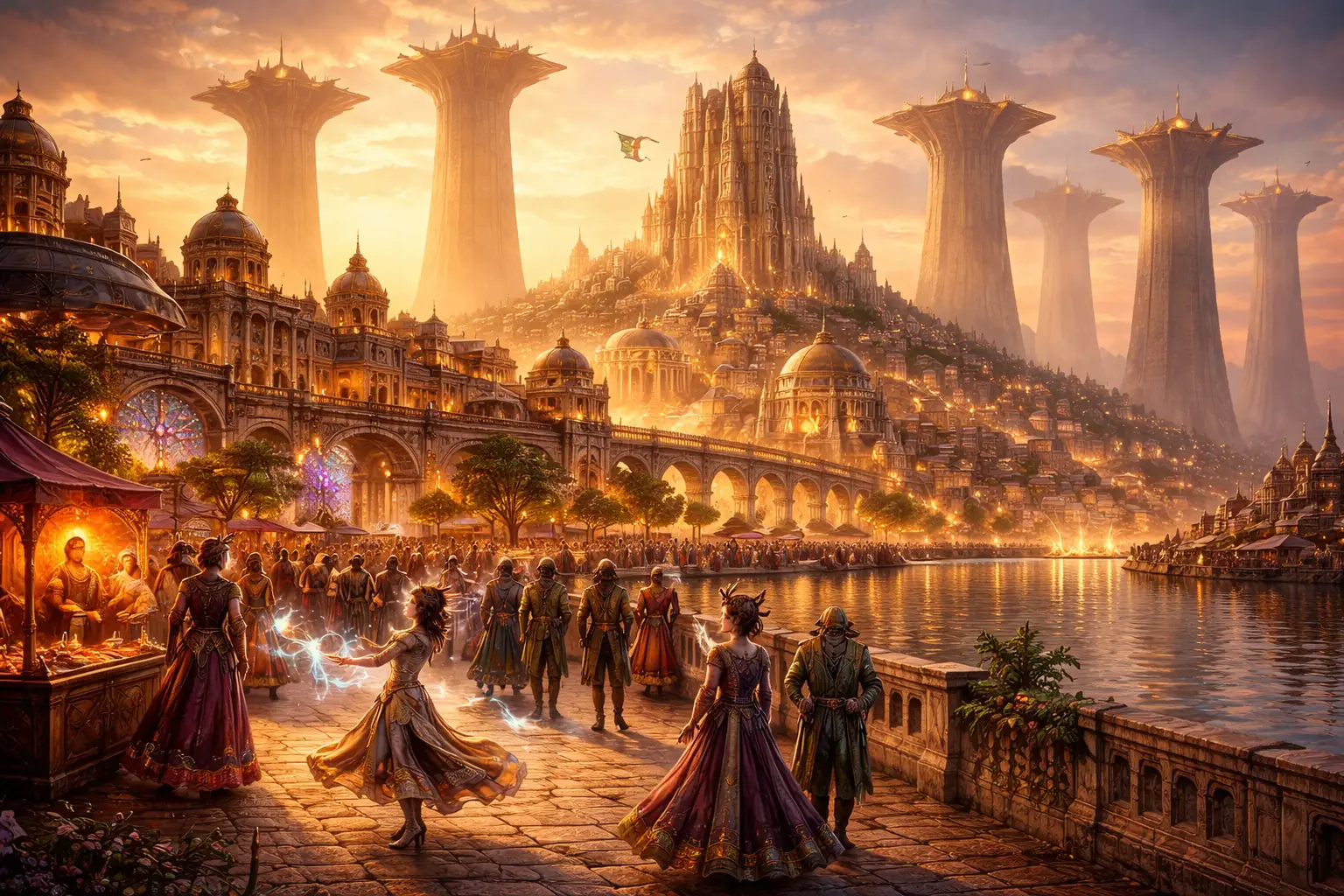
Metrol became a city of wonders. The Royal Vermishards — seven towering columns of rock jutting from the central plains, visible for miles — held palaces atop each spire: the Royal Vermishard (seat of the Cyran crown), the Vermishard of Blood (the old noble families), the Vermishard of Gold (the royal treasury), the Vermishard of Law (civic administration), the Vermishard of Lore (Vermishard Academy and House Phiarlan's enclave), the Vermishard of Steel (House Cannith's major enclave), and the Vermishard of War (the military command). Houses Cannith and Phiarlan worked together with Cyran magewrights to embed illusory lighting into the spires, their glittering columns becoming the most recognizable feature of the Metrol skyline. Floating gardens orbited the Royal Vermishard. Crystal theaters hosted performances that blended arcane illusion with traditional stagecraft. The Cathedral of the Sovereign Host served as the center of worship for the kingdom's dominant faith.
Cyrans said this reflected the generosity and selflessness of the Cyran spirit — a proof of concept for what Galifar could be. Critics from other nations called it parasitic, sustained by imperial taxes, a dream built on the hard work of others. "What our dreams imagine, our hands create" was the national motto, and bitter outsiders pointed out that while Cyran hands may have built, they used resources gathered by everyone else.
By the tradition Galifar established, the eldest child governed Cyre and upon the monarch's death would take the crown, with their own children assuming the five governorships. Cyre was always first — the heart of the kingdom, the province that would not change while all else shifted around it.
"Cyre was proof that the Five Nations could be one civilization. Cyre was also proof that one civilization costs more than four nations can afford." — Professor Marin Delvais, University of Wynarn, Fairhaven, in a lecture on pre-Mourning economics
The Three Cyres
The nation that outsiders called Cyre was, in practice, three nations with one name — and understanding what was lost requires understanding that each was lost differently.
Central Cyre — the territory roughly corresponding to the modern Mournland — was the Cyre of the Vermishards, the Wynarn Institute, the lightning rail, House Cannith's forges, and the cultural ambitions that made the nation both admired and resented. It was the Cyre that people mean when they say "Cyre."
Eastern Cyre — now Valenar — was, from the beginning, a structural failure of Galifar's design. The king wanted the lands of old Metrol, so he resettled Metrol's displaced noble families as feudal overlords of the Khunan settlers across the Blade Desert, then largely ignored the arrangement. Those nobles held to the old traditions of pre-Galifar Metrol rather than embracing the new Cyran culture. Many were petty and proud, dissatisfied with their exile, and took their frustrations out on their Khunan subjects — who called their rulers "thrones" and had no love for any of them. Eastern Cyre was effectively a separate nation with dramatically different values: isolated, feudal, and devoted to the Sovereign Host with a conviction that Aureon had chosen them to rule. It was arguably Galifar's greatest failing.
Southern Cyre — now Darguun — was a different kind of neglect. A backwater that mimicked central Cyre's customs but received little of its wealth, with ongoing goblinoid clashes that remained manageable until the Last War drew the Ghaal'dar out of the Seawall Mountains. The people of southern Cyre prospered modestly and took pride in their identity as Cyrans, but they had little of the wonders invested in the north. Counties in the south were often ruled by shields — minor nobles tasked with holding territory taken from the goblins in conflicts that had been going on for centuries.
The Last War (894–994 YK)
King Jarot ir'Wynarn died on 12 Therendor 894 YK. By long tradition, Cyre's Princess Mishann held the right of succession. Three of the five ruling children rejected her claim: Thalin of Thrane, Kaius of Karrnath, and Wroann of Breland. Wrogar of Aundair backed his sister. The Last War began.
Cyre entered the war sustained by the absolute belief that it was in the right. What it discovered was that moral conviction does not translate to battlefield dominance. Its finest wizards were artists and theorists, not war-trained like Aundair's Arcane Congress. Its expert artificers were largely employed by House Cannith, which maintained neutrality. The Vermishard Guard formed the core of a new military academy, but its graduates could not match the output of Rekkenmark. If the Five Nations can be likened to a party of adventurers — Thrane the paladin, Karrnath the fighter, Aundair the wizard, Breland the rogue — then Cyre was the bard: elegant, versatile, and poorly suited to standing alone against a powerful foe.
General Shivaji, an elf approaching the end of his third century, served as Cyre's most experienced commander throughout the entire conflict — the only senior officer who had overseen the military buildup under King Jarot and who would live to see the war's end. His tactical acuity saved Queen Mishann from capture at the war's outbreak. He never forgave himself for not foreseeing the war in the first place.
Cyre relied heavily on mercenaries from the outset — it had the gold to spare. House Deneith had been brokering goblinoid mercenaries from the Darguun region since 878 YK, and these forces served Cyre and Breland throughout the war's early decades. In 906 YK, Cyre hired the newly arrived Tairnadal elves as elite cavalry — warriors of extraordinary skill whose ancestor-driven battle fury made them the most devastating light cavalry force on the continent.
Mishann's assassination in 908 YK ended the earliest optimism. The queen who had the rightful claim, whose moral authority sustained the nation's conviction, was dead — and the succession passed to rulers who inherited the claim without inheriting the certainty.
Both major mercenary arrangements ended in betrayal at devastating cost. The Tairnadal annexation of Eastern Cyre in 956 YK transformed mercenaries into conquerors overnight. The Khunan majority offered little resistance — they had no love for their Cyran overlords — and the refugees who fled were mostly disconnected nobles painfully out of touch with central Cyre. The loss of the east was an insult. The Haruuc rebellion of 969 YK — when the brilliant hobgoblin mercenary leader Lhesh Haruuc Sharaat'kor united the Ghaal'dar and seized the territory he was supposed to protect — was a wound. Southern Cyre was close to home. The flood of refugees into a nation already unable to absorb them broke something in the national spirit that never fully healed.
By the war's final decades, the Cyran people had fallen into a deep collective depression. Brooding melodies with heavy drum and strings dominated the soundscape. The visual arts took bitter, demeaning turns in their depiction of the nation's former mercenaries. The aging Queen Dannel — elevated to the throne at seventeen, ruling for over half a century by the war's end — was lampooned in the press as too prideful to forsake her throne even as the evidence of failure accumulated. The ministries attempted to suppress critical art. The suppression failed, because the art was telling the truth.
"We were the bard. We knew all the songs. We could do a little of everything. And then the party disbanded and left us alone in the dungeon, and it turned out that a little of everything is not enough of anything." — anonymous Cyran veteran, New Cyre, 997 YK
The Day of Mourning (20 Olarune 994 YK)
Accounts contradict each other in almost every particular.
Some survivors describe a blinding light near the Saerun Road. Others say dead-gray mists rose in Metrol — from one of the Vermishards, or from the Cannith stronghold of Making. Some say the mists came slowly, spilling outward in rising confusion as people disappeared. Others say they spread too fast to outrun. House Medani later attempted to find answers by examining the bodies left behind, but found evidence as conflicting as the stories — many had fled in different directions, while others appeared to have died with no awareness at all.
Within a single day, the mists had engulfed the entire nation.
Over a million Cyrans died — along with tens of thousands of Karrnathi soldiers who had seized Cyran territory and were preparing a deeper push into Breland. Queen Dannel was in Metrol. General Shivaji died that day alongside his queen. The mist slowed as it spread, and some in the borderlands heard of the disaster in time to flee. The mist stopped mere feet from the camps of Cyran soldiers holding sections of the Brelish front. Thousands survived within the mists for reasons no one can explain, most with no clear memory of the event. In the Verdant Canyon — the lush agricultural valley in Cyre's north — the ground ruptured in terrible earthquakes, leveling towns and transforming survivors into aberrant versions of themselves, growing toxic indigo crystals from their flesh. The canyon is now the Glowing Chasm, a jagged scar across the Mournland emanating eerie purple light.
The fear of the Mourning — not the Treaty of Thronehold, signed two years later — is what ended the Last War. Every nation looked at the dead-grey mists and asked the same question: could this happen to us? No one has answered it. No one knows the cause. Cyrans were largely excluded from the treaty negotiations. And the Mournland does not explain itself.
Aftermath (996 YK–Present)
Prince Oargev ir'Wynarn, Dannel's youngest son, was serving as Cyre's ambassador to Breland on the Day of Mourning — the last known surviving descendant of Mishann. A trained diplomat and proper royal, Oargev holds court in New Cyre by the sufferance of King Boranel — a sprawling settlement that ranges from roughly hewn downtown buildings to outlying tent cities, populated by former prisoners of war released under the Treaty, soldiers who were fighting in enemy territory when the Mourning struck, and civilians who made it to the border in time. Oargev's priorities are split between safeguarding the future of those living in New Cyre and looking to the past to uncover the truth about the Day of Mourning. Beneath his polished diplomatic manner is a prince consumed by anger and the need for vengeance — a need that shifts from day to day between justice for the fallen and welfare for the survivors.
The Cyran diaspora fractures his political base. Refugees live in every major city across Khorvaire. Breland opened its borders; Thrane accepted refugees but worked to disperse and integrate them. Some survivors have settled in Hope, a region of Q'barra where Cyran refugees have built new communities alongside but culturally distant from the older New Galifaran settlers. Others have gone to Xen'drik, or to Sharn's lower wards, or to wherever the war deposited them. Many have begun putting down new roots and see the dream of restoration as a burden rather than an inheritance. Bitter avengers complicate Oargev's diplomacy with every nation he needs as an ally. Blood-Regent Diani ir'Wynarn of Thrane has earned particular attention from Oargev in the current court season — a relationship whose implications both nations are still calculating.
The Mournland itself remains both a warning and an unresolved mystery. Salvagers, expeditionary crews like Ikar's, and Oargev's agents send parties into its borders. The treasures they seek are real — Cannith vaults, the Wynarn Institute's collections, the Vault's cultural artifacts, the Vermishard palaces — and so are the dangers. Metrol is intact but rearranged, its Vermishards swapped and its districts shuffled without apparent pattern. The dead-grey mists do not recede. The cause remains unknown. And the fundamental questions — what happened, who is responsible, and whether it can happen again — remain unanswered.
"Every Cyran I have met believes two things: that Cyre was in the right, and that being in the right did not save them. The first belief sustains them. The second belief is making them dangerous." — Dark Lantern field assessment, New Cyre, 998 YK