Economy & Industry of Cyre
"Cyre didn't mine more than Karrnath or build more than Breland. What it did was turn everything into something worth more than the sum of its parts — and then sell it back to the people who provided the raw materials. That is either genius or parasitism, and the answer depends entirely on whether you are the one selling or the one buying." — Provost Halden ir'Morgrave, lecture notes, Morgrave University
The Economic Logic of Cyre
Before its destruction, Cyre was the wealthiest province in the history of Galifar — not because it extracted more resources than other nations, but because it transformed what it had into goods and experiences that commanded premium prices. Its hallmarks were art, artifice, jewelry, music, oratory, and philosophy, and those hallmarks were economic assets. Cyran fashions, performing arts, scholarship, and arcane craftsmanship drew foreign students, commissions, and investment that no other province could replicate. The standard of living was higher than any other nation. No one ever went hungry in Metrol, and no one felt the bite of winter — or so the stories say. Cyrans attributed this to the generosity of the Cyran spirit. Critics from other nations pointed out that these social projects were funded by taxes paid by the people of other provinces, and that the generosity was easy when the gold came from someone else's mines.
The economic logic was straightforward: cultural production was infrastructure, not luxury. A magewright who could make an everbright lantern was useful, but one who could make an everbright lantern that was also beautiful was worth three times the price. When the Arcane Congress perfected the everbright lantern, Metrol was the first city whose streets were lit with them. When soldiers trained at Rekkenmark, the finest served in the Vermishard Guard. When Cannith developed a new tool, Cyre was the first to benefit. The nation was the nexus where all of Galifar's strengths converged — not the best at any single thing, but the place where all the best things happened first.
This model required two conditions: Galifar's wealth flowing through Cyre, and the houses cooperating willingly. The Last War destroyed the first condition and strained the second to breaking.
The Wonders of Cyre
The nation's economic power was visible in its wonders — physical expressions of the principle that artistry and industry, combined, could produce something no other nation could match.
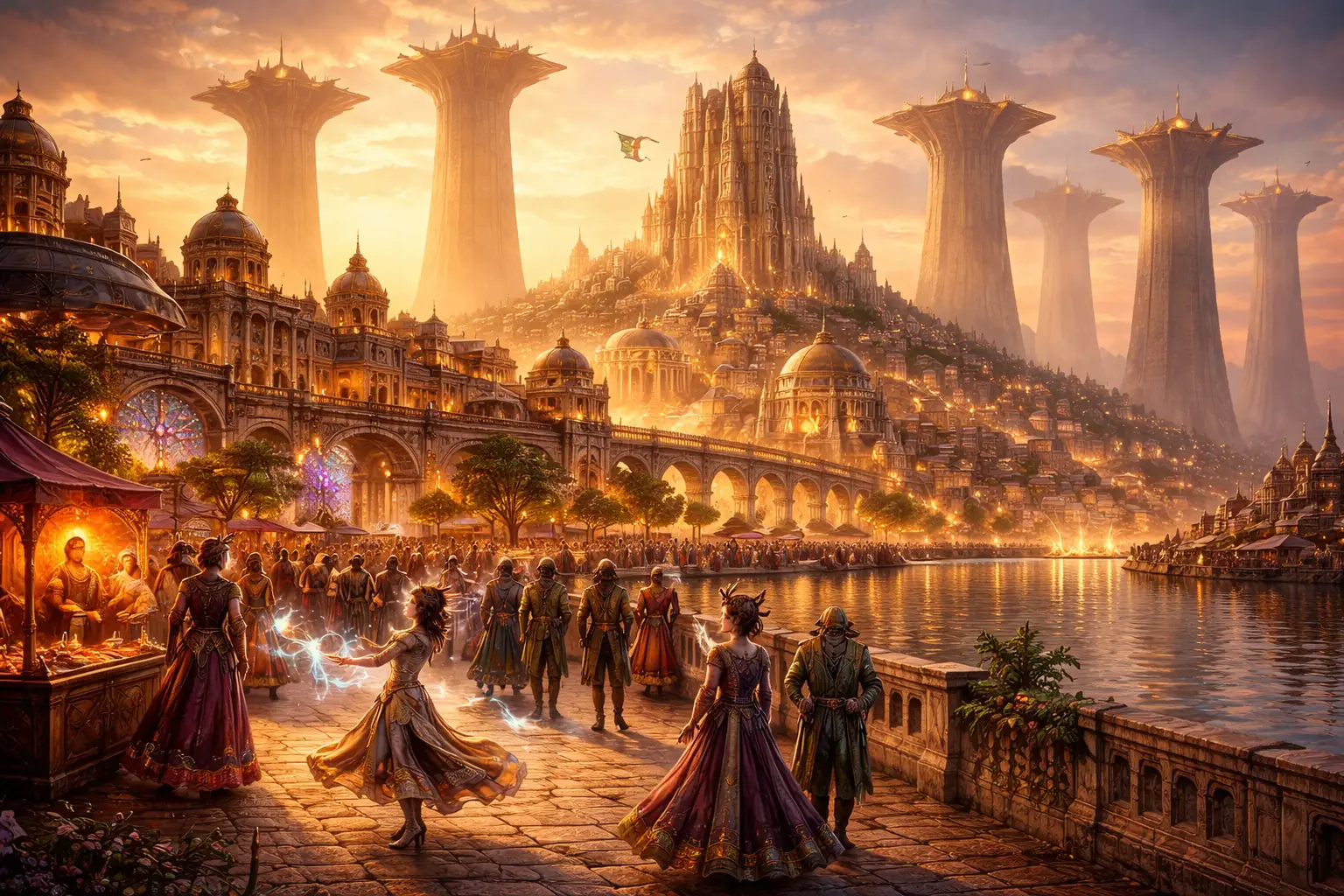
Metrol was the showcase. The Royal Vermishards — seven spires visible for miles — held the palaces and institutions of the state, their surfaces embedded with illusory lighting by the combined efforts of Houses Cannith and Phiarlan. Floating gardens orbited the Royal Vermishard, dropping flower petals on the wind to the city below. Crystal theaters in even small towns allowed audiences to scry on the great performances in the Demesne of Shape. Music was always in the air and lights in the sky. The Cathedral of the Sovereign Host was expanded by generation after generation of monarchs until, by King Jarot's time, nine colossal statues encircled the temple, illusory displays depicted scenes from the faith, and its relics collection was among the most valuable on the continent.
The Wynarn Institute of Art was both an academy and a museum — the foremost institution in Khorvaire exploring the artistic potential of the arcane. Treasures of the pre-Galifar kingdoms were displayed alongside modern works. The Hall of Kings allowed visitors to converse with illusory replicas of past rulers of Galifar — not the preserved dead, as in Aerenal, but artificial constructs designed as a tourist attraction. The Institute drew patronage and talent from across the continent, converting cultural prestige into economic gravity.
These wonders were not decorative. They were the economic engine — the proof of concept that attracted the investment, the students, the commissions, and the foreign currency that sustained Cyre's standard of living. When the war closed those channels, the engine began to starve.
House Cannith and the Dependency
No element of Cyre's economy was more significant than House Cannith, and no element of Cannith's economy was more significant than Cyre. The relationship was structurally symbiotic — Cannith's forgeholds were woven into Cyre's productive capacity, its leadership was headquartered there, and its most ambitious facilities were all Cyran installations.
Eston was Cannith's birthplace and its most extraordinary showcase. The city's Clockwork Menagerie displayed the golems and homunculi made by generations of artificers. Skycoaches carried smiths and magewrights from forge to forge. An iridescent dome protected the city from storms. Three creation forges — the arcane machines that produced warforged — operated on the city's proving grounds, where cadres of newborn warforged learned combat skills before deployment. Eston was the city where "magic comes to life," and it earned the description.
Making was Eston's practical counterpart — the mundane industrial center where Cannith's factories produced textiles, processed ores, and transformed raw materials into usable products. Where Eston dreamed, Making built. The city was laid out on a plain, functional grid — no floating gardens, no crystal theaters, just the output that sustained the nation's material economy. The Genesis Foundry within Making was an extraordinary application of the Mark of Making: proficient Cannith heirs could transform raw materials into finished goods using a fraction of the time and effort conventional production required. The city also housed one of the continent's first airship docking towers, and the Galifar Forest bordering its southern edge was a protected reserve — legend held that Galifar made a deal with a hag ruling the woods, promising that as long as the forest stood, so would the kingdom.
Making was also the site of a nascent labor movement — assembly line workers organizing against cottonlung, hazardous conditions, and the brutal hours that Cannith's production demands imposed. The union organizer Muhsina fought for protections that the Cyran court had no framework to provide. The labor movement was destroyed along with everything else on the Day of Mourning, but its existence documented a side of Cyran industry that the nostalgia of exile has largely erased: the wonders of Cyre were built on the backs of workers whose lives were considerably less wonderful.
The crown-Cannith relationship defined wartime Cyre. Taxes on Cannith profits in Making often flowed straight back into the house's coffers as the crown funded border defense. As war debts mounted, the crown sold Vermishard properties to Cannith and Phiarlan rather than outside investors. The Korth Edicts nominally prevented this kind of entanglement, but Cyre's interpretation had always been permissive — less flagrantly so than Lyrandar's effective governance of Stormhome, but the wartime necessities made the blurring unavoidable. By the war's end, the nation's creditors were also its primary institutions, and House Cannith's decisions about what to research, produce, and sell shaped the conflict as much as the crown's own commands.
"House Cannith built the warforged, and Cyre paid for them. Cannith then sold warforged to Cyre's enemies, because house neutrality required it. Cyre paid Cannith to build the weapon that would save it, and Cannith sold that same weapon to the nations trying to destroy it. That is the Korth Edicts in practice, and if you think it sounds like madness, you are beginning to understand Cyran economic policy." — anonymous Cyran trade minister, recorded at New Cyre
Transit and Trade
Cyre's position at the geographic center of Khorvaire made it the natural hub of continental trade. House Orien established its lightning rail network more thoroughly in Cyre than anywhere else — Cannith's manufacturing demands required efficient movement of raw materials and finished goods, and the crown invested accordingly. No lightning rail station in Khorvaire was grander than Metrol's Orien Station, a mammoth building of the finest construction that served as the hub through which lines from every direction converged.
River access was the second pillar. The Cyre River's long border with Karrnath demanded continuous military and commercial attention, and naval control of the waterway was a strategic necessity. Dollen on the River, once one of the richest ports on Scions Sound, was converted from a trade center into a naval fortress during the war — the market that had made it wealthy slowly emptied over a century of siege mentality. The Cyran Navy, based at Starmantle Bay in Metrol, innovated methods for rapid troop transport across the water, and those innovations — like so much else — were lost in the Mourning.
The lightning rail network that once passed through Cyre now routes around the Mournland at significant additional cost, and no successor state has inherited Cyre's role as continental trade hub. The economic geography of Khorvaire was designed with Cyre at its center. Without that center, the entire network operates at reduced efficiency — a cost borne by every nation and measured in every delayed shipment and rerouted caravan.
The Vault
Metrol held the mint and treasury of Galifar — the Vault — containing bullion, currencies, precious metals, and cultural artifacts deemed too valuable to display. It was this accumulated wealth that allowed Cyre to fund extensive mercenary campaigns in the early Last War. As the war extended and costs mounted, that reserve was drawn down, wartime borrowing increased, and royal properties were liquidated. By the end, the financial architecture that had sustained Cyran confidence had been spent on a war it could not win.
The Vault's contents remain in Metrol — or they did. Salvagers who entered the Mournland expecting to find the "Golden Palace" unguarded discovered that it had vanished entirely from the Vermishard of Gold. Not destroyed. Not looted. Gone. The Mourning had strange effects on Metrol, and the Vault may have been physically displaced — or it could have fallen into another plane entirely. Whoever finds it will find not only gold and platinum but priceless cultural artifacts accumulated over centuries of Galifaran rule.
Wartime Distortion and the Legacy of the Mourning
A century of war transformed Cyre's economy region by region. The loss of eastern Cyre to Valenar in 956 YK removed territory the central economy had long ignored. The loss of southern Cyre to Darguun in 969 YK was the sharper blow — it removed productive territory and flooded central Cyre with refugees the war-strained economy could not absorb. Manufacturing shifted toward military procurement and away from the quality-over-volume export model that had defined Cyran industry. Commercial nodes became military installations. Seaside, a coastal town in southern Cyre and a beloved vacation destination, lives now only in memory — an iconic image of peace for a people who have forgotten what peace felt like.
Despite these pressures, Cyre's economy was still operational on 20 Olarune 994 YK. Contracts were being negotiated. Workshops were producing. Trains were running. The Mourning did not finish an economy in the process of failing — it erased one still in motion.
The consequences ripple forward. The destruction of Eston and Making simultaneously eliminated Cannith's primary research and production infrastructure. Specific techniques — the Genesis Foundry's rapid material transformation, the docent network technology for the colossi, innovations in riverine military transport — were lost with no surviving documentation. Three Cannith factions now compete to recover what they can, sending expeditions into the Mournland for notes, prototypes, and creation forge components. The first to recover those secrets will hold an extraordinary advantage.
The broader Khorvaire economy has never fully replaced what Cyre produced. The Cyran artisans, magewrights, scholars, and performers who survived carry their skills into refugee camps and host nations' economies — a dispersed population of specialists without institutions, producing at a fraction of their former capacity, training no new generation in the Cyran tradition. That is the economic legacy of the Mourning: not just the loss of a nation's output, but the erasure of the institutional knowledge that made that output possible.
AUCTION NOTICE — House Kundarak, Korranberg Branch, Eyre 998 YK
Lot 14: One (1) glamerweave evening coat, Cyran cut, pre-war manufacture, provenance verified. Illusory lining depicts a night sky over the Vermishards. Minor fraying at hem. Starting bid: 400 galifars.
Note from the auctioneer: "We've had six of these this season. They keep getting more expensive."