Art & Culture of Cyre
PROGRAM NOTE — Grand Stage, Metrol, Rhaan 993 YK (recovered from a salvage expedition):
Tonight's performance of The Bell and the Hammer is dedicated to the soldiers of the 7th Greencoat Regiment, currently deployed along the Saerun Road. House Phiarlan reminds audiences that crystal theater relay to provincial stages will begin at the second bell. Glamerweave cloaks must be dimmed during the performance. Masks are welcome. Weapons are not.
Cyran Appreciation
Cyrans prized curiosity over orthodoxy — they were raised to explore broadly, to experiment freely, and to see magic as something you performed rather than merely deployed. Their signature cultural habit, which they called Cyran appreciation, involved absorbing the traditions of other nations — Karrn music, Aundairian technique, Thranic spice, Brelish practicality — and reworking them into something new, something that belonged to no single source but carried the fingerprints of all of them. A Cyran musician might play Karrnathi funeral dirges in the style of a Thrane devotional. A Cyran chef might blend thrakel spices with traditional Karrn stews and add the heat of southern Breland to the delicate pastries of Aundair. The culture was a puzzle where the pieces were known but constantly being arranged in new ways.
The people of other nations had a less generous name for this. They called it theft with good lighting — the behavior of scavengers who picked through everyone else's achievements and called the result superior. Cyrans shrugged this off. They believed, with a conviction that could look a great deal like arrogance, that blending traditions made all of them stronger, and that nothing was so good it couldn't be made better. The practice was rooted in love, they insisted, not arrogance — though the distinction was easier to maintain when you were the one doing the improving.
But a century of walls between nations meant that by the war's end, the appreciation had become partial — a chimera increasingly disconnected from the living traditions it once drew upon. Cyrans still knew the old add-a-verse songs beloved by Aundairians but had lost touch with the Epic of Valiant and Vigilant, a modern Aundairian classic. They knew nothing of the maxims of Beggar Dane that had become a cornerstone of Brelish culture. The synthesis that defined Cyre required contact with all five nations, and the war severed those contacts one by one. What remained was a culture that remembered being universal and could no longer demonstrate it.
Magic as Art
Cyrans viewed arcane magic as an art form as much as a practical tool — a perspective that lent itself to a wider study of illusion and enchantment than other nations pursued. Where Aundair focused on magic as a tool of war and Karrnath on necromancy as a military asset, Cyre explored the aesthetic potential of the arcane with an intensity that no other nation attempted.
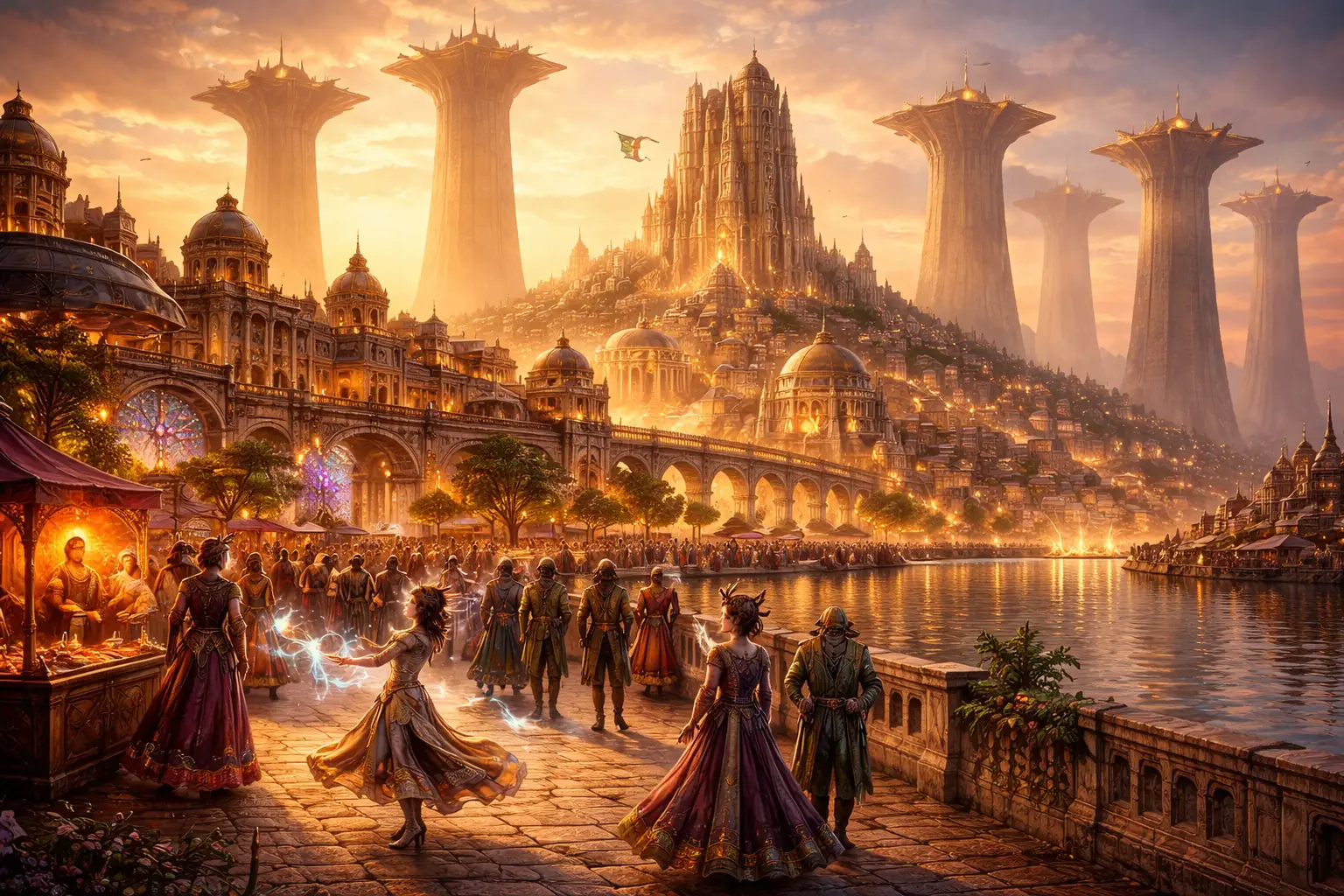
A wizard trained at the Wynarn Institute performed somatic components as near-dance, verbal components with the cadence of song or poetry. Magewrights, bards, and wizards alike put more show into the performance of magic than even the Aundairians. This was not mere showmanship — though it was certainly that too. The philosophy held that magic performed beautifully was magic performed well, and that the distinction between an elegant spell and a crude one was a distinction of quality, not merely of style. The flowing capes and cloaks that were ubiquitous in Cyran fashion echoed this theatrical quality — every gesture amplified, every movement designed to be watched.
The Wynarn Institute was the institutional heart of this tradition — both an academy and a museum, exploring the artistic potential of the arcane at a level no other institution attempted. Treasures of the pre-Galifar kingdoms were displayed alongside modern works. The Hall of Kings allowed visitors to converse with illusory replicas of past rulers of Galifar — not preserved dead, as in Aerenal, but artificial constructs designed as both education and entertainment. The Institute's collections, its research, and its faculty are now somewhere inside the Mournland.
Art Through the War
Pre-war Cyran art was ambitious, optimistic, and materially spectacular. Filigree designs pushed the limits of material engineering, incorporating mithral thread from eastern Karrnath, precious gems from the Mror Holds, and dragonshards in abundance. The Sovereign Host's popularity meant even secular buildings featured religious iconography — draconic depictions of the Host were fashionable in the late eighth century, shifting to more humanoid, multiracial representations by the time of Jarot's death. This shift in iconographic style is a reliable method for dating Cyran artwork and architecture.
The war transformed the art almost immediately. Mithral and gemstones vanished from the supply chain. Dragonshards were drafted to the war effort. What emerged was art made from wood, copper, leather, and glass — humbler materials that Cyran artists adapted to with characteristic experimentalism. The loss of luxury materials did not kill Cyran art. It forced it to become something more honest.
The wartime aesthetic shifted in four phases. First, optimism: literature imagining the utopian advances of a reunited postwar Galifar, artists persevering in the belief that the war would resolve quickly. The arrival of the Tairnadal mercenaries in 906 YK created a surge of interest in their foreign culture.
After Mishann's assassination in 908 YK, endurance: state-sponsored music urging sacrifice and solidarity, nobles commissioning nostalgic pieces celebrating glory days they could no longer afford, the optimism shifting to determination.
After the Valenar betrayal and the loss of Darguun, anger: brooding melodies dominated by heavy drum and strings, visual arts taking contemptuous and xenophobic slants against the elves and goblins who had betrayed the nation. The interest in Tairnadal culture curdled into bitterness.
And finally, depression — a deep collective darkening that settled over the culture in its final decades. The aging Queen Dannel was lampooned in the press as too prideful to forsake her throne. The ministries attempted to suppress the most critical art. The suppression failed, because the art was telling the truth, and everyone in Metrol knew it.
Performance and the Crystal Theater
Metrol's performing arts infrastructure was among the most developed in Khorvaire. The Grand Stage hosted classic and contemporary works. House Phiarlan, whose Demesne of Shape was headquartered in Cyre, trained the performers, managed the venues, and held the rights to the technology that made the system work.
Crystal theaters were Phiarlan's most significant innovation — large devices using a tiny scrying crystal to project a live performance from one of Phiarlan's central stages onto a screen in a provincial town, giving audiences across central Cyre access to the same productions Metrol enjoyed in real time. Even small towns had crystal theaters. These were not luxuries reserved for the capital — they were distributed infrastructure for cultural participation, and they made Cyre's performing arts accessible in a way no other nation could match. As the practice expanded, Phiarlan began licensing rights to dramatize the exploits of adventurers and notable figures — a business model that may yet survive the Mourning.
In the postwar world, the most significant theatrical engagement with Cyran themes is happening in Sharn. The Diamond Theater in Lower Menthis — once known only for bawdy comedy — has gained unexpected fame through its playwright in residence, the enigmatic Luca Syara, whose plays The Broken Sword, Fallen Angels, and Five Lives have forced audiences to confront the spiritual cost of the Last War. Syara shuns all interviews and is rumored to have been in Metrol on the Day of Mourning. A wilder rumor maintains she is an exile from the Faerie Court of Thelanis, an archfey bound to human form. Her works are debated in classrooms and taverns across the city.
"I challenge anyone to leave a performance of The Broken Sword with dry eyes. I believe that even a warforged would be moved to tears." — theater review, Sharn Inquisitive
Fashion
Cyran clothing started practical and got interesting from there. The foundation was always a well-made, durable base — whatever the wearer found most comfortable — and everything built on top of it was personal expression.
Coats were the centerpiece of any Cyran wardrobe: a heavy wool coat for the road, a short coat thrown over the shoulders for an afternoon in the city, a long evening coat with a glamerweave lining that shifted colors under lamplight — starfields, rippling water, slow-blooming flowers. Soldiers earned the nickname "Greencoats" from their uniform coats in the field.
Gloves ranged from sturdy work leather to long, decorative silk for formal occasions. Jewelry was made from copper, wood, glass, and leather rather than precious metals — the point was to say something about who you were, not how much you had. Feathers and bells turned up on everything; there is a traditional Cyran dance that requires belled anklets and bracelets to perform properly. Masks appeared at festivals and formal gatherings — not to hide the wearer but to project a mood, an aspect of identity chosen for the evening. Color was everywhere, amplified by glamerweave into shifting hues and illusory patterns.
Cosmetic transmutation was practiced in Cyre — magewright beauticians performing minor transformations such as changing hair or eye color. The practice was less extravagant than in Aundair or Zilargo, where metallic hair colors and adopted elf features were fashionable, but it was common enough that altering one's appearance for an evening was considered unremarkable rather than exotic. More complex transmutations — permanent changes, unusual effects — required skilled magewrights and commanded premium prices.
Since the Mourning, many survivors wear the same styles cut entirely in black — a mode now known as Mourningwear, a declaration of grief worn as national identity. Others keep the old colors burning as an act of defiance: refusing to let the Mourning define how Cyre is remembered. Because of the emphasis on durability, a Cyran survivor might still wear the specific outfit they had on when the mists came — the same coat, the same glamerweave cloak, now carrying a weight of memory that no enchantment can replicate.
At the Table
Cyran cuisine reflected the same principle of appreciation that defined every other aspect of the culture — working with the best of all traditions while continuing to innovate. Cyrans blended thrakel spices from Thrane with traditional Karrn stews, added the heat of southern Breland to the delicate pastries of Aundair, and treated cooking as a creative discipline rather than a domestic chore. The cuisine was fusion before the word existed — a kitchen philosophy that held that any dish could be improved by someone willing to experiment with it, and that borrowing from another nation's table was not theft but tribute.
In the postwar diaspora, the cuisine has both preserved and expanded the tradition. Many refugees cling to family recipes as a way to hold onto a nation that no longer has a physical location — a mother's Karrn-style stew with Thranic thrakel, a grandmother's Aundairian pastries given a Brelish kick, each recipe a map of the cultural geography that produced it. Others continue the Cyran appreciation, adopting new favorites from wherever they've landed and improving them. Cyran refugee chefs are rising stars in Sharn's culinary scene, and their fusion techniques are influencing the city's already cosmopolitan food culture. The cuisine survives where the country does not, and a meal cooked by a Cyran exile in a Sharn kitchen — thrakel and Karrn stew and Aundairian pastry and whatever the local market had that morning — is the most honest expression of what Cyre was: a place that took what everyone else made and tried to make it better.
Festivals and the Faith
The Day of Mourning (20 Olarune) is the single most significant civic observance for the surviving Cyran population. Wherever Cyrans gather — in New Cyre, in High Walls, in Gatherhold, in Dragonroost — the day is marked by stories of the dead, traditional songs, and debate over the Mourning's cause conducted with grief and anger in equal measure. The observance has been marked by violence in recent years as bitter avengers use the occasion to act against those they hold responsible.
Before the Mourning, central Cyre's festival calendar followed the Sovereign Host's liturgical year — the Festival of Ascension and Unity Day were among the named celebrations. These observances are now maintained in refugee communities as acts of cultural preservation rather than civic ceremony — whether or not a particular Cyran is still devout, participating has become a marker of national identity independent of religious conviction.
The Sovereign Host dominated pre-war Cyre; the Silver Flame had a devoted but secondary following. The Mourning fractured the faith landscape. Some survivors hold their beliefs more tightly, understanding their suffering as divine trial. Others lost belief entirely — turning toward the Blood of Vol, cults of the Dragon Below, or stranger things, refusing to respect gods who would allow a nation to be destroyed. A number of entirely new Cyran strains of the old faiths have emerged — theological adaptations of the Host and the Flame that try to make sense of a world in which an entire nation was erased. Cyrans have always been encouraged to question and search for new paths, and that tendency now works in every direction: toward resilient faith, toward radical doubt, and toward innovation that may not resemble the traditions it emerged from.
The Three Cyres carried different religious cultures, and the distinction matters in the diaspora. Eastern Cyrans were devout Vassals who believed Aureon had chosen them to rule. Southern Cyrans held a quieter, steadfast faith. Central Cyrans questioned everything, including the faith they inherited. The refugees who gather at New Cyre on the Day of Mourning bring three different relationships with the divine to the same observance, and the tensions between them are as sharp as any political disagreement.
"The hardest thing about being Cyran is that everyone remembers a different Cyre. The central Cyrans mourn Metrol. The eastern Cyrans mourn a kingdom the central Cyrans barely knew existed. The southern Cyrans mourn a home the other two forgot about. And they all mourn together, which would be beautiful if it weren't also impossible." — overheard at the Day of Mourning observance, New Cyre, 997 YK