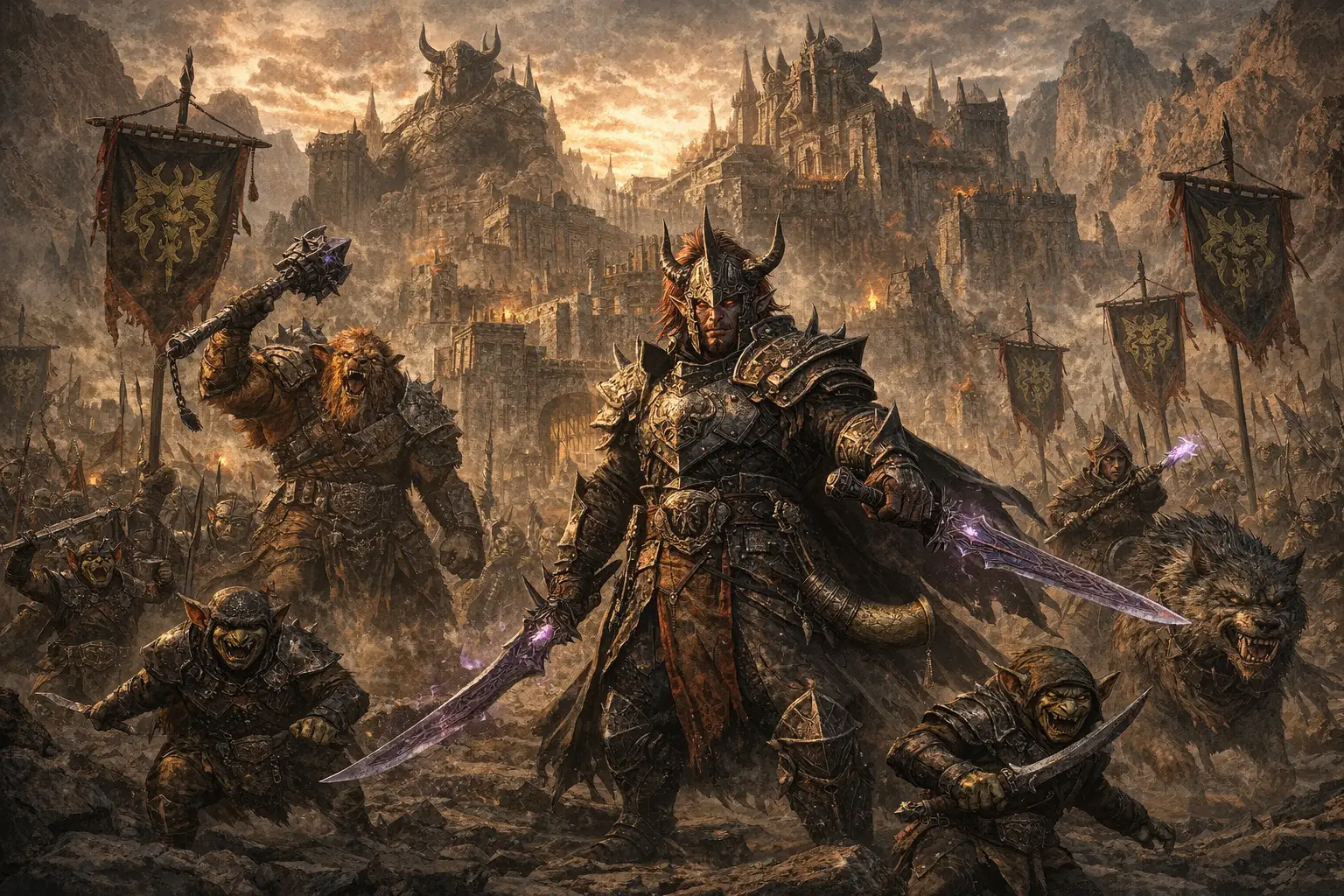
The Goblin Tongue: Language of the Empire of Dhakaan
Raat shi anaa: the story continues.
"Khaavolaar!" — The most common curse in the Goblin language, literally "blood of the word," uttered in frustration and amazement by dar and Darguul alike across Khorvaire
The language known simply as Goblin is one of the oldest living tongues on Khorvaire and arguably its most widely spoken non-Common language. It was the administrative, literary, and military language of the Empire of Dhakaan for over five thousand years, and its dominance was so absolute that it smothered nearly every other language on the continent during the Age of Monsters. Today, Goblin remains the primary language of Darguun, Droaam, and the Shadow Marches, and it is understood by almost every goblinoid, orc, ogre, gnoll, and other "monstrous" inhabitant of Khorvaire. It is the oldest trade language the continent has ever known, and its influence persists in place names, loan words, and the foundational script used by orcs and other cultures to this day.
Among the Kech Dhakaan — the Keepers of the Empire who preserved Dhakaani traditions in deep subterranean vaults for millennia — the language is spoken in its oldest and most formal register. The dar who emerge from these vaults speak a Goblin that a modern Darguul would mostly understand but find archaic and strangely cadenced, much as a modern English speaker might react to hearing Chaucer read aloud. For the Dhakaani, their language is not merely a tool of communication. It is a living artifact of the empire itself, preserved in song by the duur'kala, reinforced nightly in the shared dream of the Uul Dhakaan, and guarded with the same ferocity they bring to the defense of their adamantine blades and ancestral fortresses.
History and Spread
Goblin can be considered the Common of pre-human Khorvaire. It spread across the continent during the long reign of the Dhakaani Empire and smothered most existing languages in the process. The empire endured for significantly longer than humans have even been present on Khorvaire, and the linguistic consequences of that dominance are difficult to overstate. The Orc language, for instance, was largely eliminated from common use thousands of years ago and is nearly extinct in modern Khorvaire — replaced entirely by Goblin. The Orc script was itself adopted from the Goblin script used during the Dhakaani Empire, meaning that even orcish literacy was built on Dhakaani foundations.
When humans arrived on Khorvaire from Sarlona, they found a continent where Goblin was the lingua franca of every culture that had survived the Age of Monsters. Common gradually displaced Goblin as the trade language of the Five Nations following the establishment of the Kingdom of Galifar, but Goblin never disappeared. It retreated to the margins — to Darguun, to the Shadow Marches, to the monstrous cultures of Droaam, to the goblin warrens beneath every major city — but it endured. In Droaam, almost every citizen speaks or at least understands Goblin, regardless of species. Medusas, ogres, trolls, gnolls, harpies, and minotaurs all conduct business in the tongue of the ancient empire.
Within the Five Nations, Goblin is widely understood but rarely studied formally. City goblins — the descendants of those who were enslaved and later freed by Galifar — typically speak both Common and Goblin, and many neighborhoods in Sharn, Wroat, and Korth are effectively bilingual. Scholars at institutions like Morgrave University and the Library of Korranberg study Goblin as an academic language, essential for reading Dhakaani inscriptions and understanding the archaeological record of Khorvaire's oldest civilization.
Characteristics of the Language
Phonology
Goblin is a language of hard consonants and open vowels, built for clarity in echoing underground tunnels and on noisy battlefields alike. Doubled vowels are common and typically indicate lengthened sounds or emphasis — ghaal (mighty), duur (dirge), suur (a subterranean fungus). The glottal stop, represented in transliteration by an apostrophe, is one of the language's most distinctive features, used to join compound words and mark morphological boundaries: duur'kala (dirge singer), golin'dar (quick people), chaat'oor (defiler).
The language favors consonant clusters involving kh, sh, th, and gh, giving it a guttural, percussive quality that can sound harsh to human ears. But among the dar, Goblin is also the language of the duur'kala — of song, of history, of magic woven through voice. In the mouths of the dirge singers, the same harsh syllables become rhythmic and hypnotic, a language as suited to battlefield commands as to epic recitation.
Grammar and Structure
Goblin is an agglutinative language that builds meaning through the combination of root words and affixes. Several key structural features are attested in the canonical vocabulary:
The negative prefix gath- means "not" or "without" and attaches to the beginning of words to negate them: gath'kal means "without end" (i.e., eternal), gath'dar means "not people" (the neutral, or least-offensive, term for non-goblinoids), and gath'atcha means "without honor" — a phrase that can be spoken as an expression of contrition but is a grave insult when applied to someone else.
The prefix pa- indicates something given or bestowed: paatcha literally means "to offer honor" and is spoken as a compliment or a rallying cry to troops facing danger. Pamuut similarly indicates the offering or honoring of duty. The suffix -mo indicates intensity or emphasis.
Possession is expressed through the general term piir, while na indicates that something belongs to someone else and can be appended as a suffix for emphasis — kur'na means "not my key." The word piiroto means "my stuff" or "one's belongings."
Negation of verbs follows a postposed structure: dor means "never" as an eternal negation and follows the negated term. Gan dor means "never eat." This contrasts with the prefixed gath-, which negates nouns and adjectives.
Compound terms are the backbone of the vocabulary. Goblin builds complex concepts by joining simple roots: duur'kala (dirge + singer), khaar draguus (blood + dragon), lhesh shaarat (warlord + blade), uul'kala (dream + singer). This compounding system gives the language great precision while keeping its core vocabulary relatively compact. A speaker who knows the roots can often parse an unfamiliar compound on first hearing.
The Role of Body Language
Among the dar, Goblin is never spoken in isolation from the body. The pointed ears of goblinoids are more flexible than human ears and constitute a critical channel of nonverbal communication. Hobgoblins have especially expressive ears, and it is common for hobgoblin soldiers to signal allies with quick ear-flicks when silence is required — the same way a human soldier would use hand gestures. Two quick flicks of the ear is a common signal to be on guard. Posture, scent, and facial expression all carry grammatical weight in dar communication, conveying tone, status, and intent in ways that cannot be captured in written text. A phrase like ta muut ("you do your duty") can express genuine respect, dry acknowledgment, or cutting irony depending entirely on the speaker's ear position and the set of their shoulders.
The Counting System
The Dhakaani numeral system is base-ten, with a notable structural quirk: the number nine is expressed as gath'mokaas — literally "not ten" — suggesting that the original system may have been structured around groups of five (the hand, kaas) before being extended. The word kaas is itself a remarkable example of Goblin polysemy, serving triple duty as the number five, the word for "hand," and the first-person plural pronoun "we/us." This is not accidental. For the dar, the hand is the fundamental unit of collective action — five fingers working as one, just as five soldiers form a squad, just as the dar themselves are bound together in the dream.
Number | Goblin | Notes |
|---|---|---|
First | Ur | Also a prefix meaning "original" or "primary" |
One | Ga | Also means "primary" |
Two | Ka | Also means "a pair" |
Three | Kaga | Literally "two and one" |
Four | Aath | Also means "corner" or "wall" |
Five | Kaas | Also means "hand" and "we/us" |
Six | Kron | |
Seven | Hirot | |
Eight | Kaath | |
Nine | Gath'mokaas | Literally "not ten" |
Ten | Mokaas |
Pronouns
The Goblin pronoun system makes clear grammatical distinctions of gender and number, but lacks the elaborate honorific registers found in languages like Elven. Status among the dar is communicated through body language, tone, and choice of vocabulary rather than through pronoun selection.
Pronoun | Meaning |
|---|---|
Ya | I / me (first person singular) |
Kaas | We / us (first person plural) |
Ta | You (second person singular) |
Taan | You all (second person plural) |
Te | He / him (masculine) |
Nu | She / her (feminine) |
Mu | They / them (neutral) |
Mi | One (indefinite pronoun, generic "you") |
Vocabulary by Domain
The People
The dar define themselves and their world through language with great precision. The very word dar — "people" — is simultaneously the simplest and most loaded term in the language. Used broadly, it refers to all goblinoids. Used by the Kech Dhakaan, it specifically denotes those goblinoids who were unaffected by the Kapaa'vola and who maintain the traditions of the empire. The distinction between dar and gath'dar ("not people") is not quite as hostile as it sounds — it is the neutral term for non-goblinoid humanoids. The pejorative is chaat'oor — "defiler" — reserved specifically for the foreign species who stole Dhakaani lands, particularly humans. Droaamites, interestingly, do not use either chaat'oor or gath'dar to describe humans; they prefer aravaat, meaning "easterner."
Term | Meaning |
|---|---|
Dar | "People." The collective term for hobgoblins, bugbears, and goblins |
Ghaal'dar | "Mighty people." Hobgoblins |
Golin'dar | "Quick people." Goblins |
Guul'dar | "Strong people." Bugbears |
Gath'dar | "Not people." Neutral, less-offensive term for non-goblinoid humanoids |
Chaat'oor | "Defiler." Pejorative for non-native species, especially humans. |
Taarn | Elves |
Orces | Orcs |
Shiftaa | Shifters |
Gaa'ma | "Wax baby." Pejorative term for changelings |
Draguus | Dragon |
Roo | "Friendly stranger." Someone unknown but not obviously hostile |
The word "goblin" itself is a bastardization of golin'dar — the human tongue mangling the dar's own name for the smallest of their subspecies into an alien word that the conquered people eventually adopted for themselves.
War and Command
A civilization that has been at war for sixteen thousand years naturally develops an extraordinarily precise military vocabulary. Dhakaani battlefield commands are short, sharp, and unambiguous — designed to cut through the din of combat and echo clearly through underground tunnels.
Command | Meaning |
|---|---|
Itaa! | Attack! |
Aazat! | Hold position! |
Aisi itaa! | Forward ranks, attack! |
Kaasi itaa! | Rear ranks, close! |
Iroo! | Loose arrows! |
Irii! | Cover me! |
Irzat! | Cease fire! |
Romath! | Form up! |
Shaash! | Come together! |
Skiir! | Run! |
Toh! | Beware! |
Kaana! | Signal of urgency (emphasized by repetition: kaana kaana) |
Military Term | Meaning |
|---|---|
Marhu | Emperor. Supreme leader |
Lhesh | High warlord. Equivalent to general |
Lhevket | Elder warlord. Equivalent to colonel |
Lhevk'rhu | Skilled warlord. Equivalent to captain |
Lhevk | Warlord. Equivalent to lieutenant |
Lhurusk | War leader. Equivalent to sergeant |
Thradaask | Shock trooper. Private; most often guul'dar |
Olhirot | Spear-bearer. Private |
Daask | Soldier |
Shaarat | Blade |
Lhesh shaarat | "Warlord's blade." A Dhakaani weapon suitable only for the greatest warriors |
Skai Shaarat | "Great Blade." The hereditary weapon of the Kech Shaarat |
Shaarat'dor | "No weapons." The unarmed martial art of the Khesh'dar |
Paaldaask | Spellcaster. Literally "spell warrior" |
The suffix rhu (or prefix, depending on the construction) indicates higher status, experience, or prestige within a rank — a lhevk'rhu is not merely a warlord but a skilled warlord, recognized as exceptional among their peers.
Honor, Duty, and Society
Term | Meaning |
|---|---|
Muut | Duty. What is owed to the empire and one's comrades |
Atcha | Personal honor. Must be earned and carefully protected |
Paatcha! | "To offer honor!" A compliment or battle cry |
Gath'atcha | "Without honor." Contrition when said of oneself; grave insult when said of another |
Ta muut | "You do your duty." The most common form of thanks in Dhakaani culture |
Ya panozhii kita atcha | "I owe a debt to your honor." An expression of profound indebtedness; never said lightly |
Shava | "Sword brother." A solemn bond between dar warriors carrying deep responsibilities |
Kech | "Bearer" or "clan" |
Karda | Throne |
Marhuat | Empire. Literally "the reach of an emperor's power" |
Lheshat | Kingdom. Literally "the reach of a warlord's power" |
Ran | Sacrifice |
Nozhii | Debt |
Doovol | Truth |
The phrase chit guulen pamuut ran — "there is strength in honoring a sacrifice" — is a proverb that captures something essential about the Dhakaani worldview: that sacrifice in service of duty is not loss but a source of power.
The Dream and Magic
Term | Meaning |
|---|---|
Uul | Dream |
Uul Dhakaan | The shared dreamscape of the dar within Dal Quor |
Uul'kala | "Dream singer." A dirge singer specializing in walking in dreams |
Uul'kur | "Dream key." A token that allows its bearer to remember their dreams in the Uul Dhakaan |
Kra'uul | "Dream forged." Items that accompany their bearer into the Uul Dhakaan |
Chot'uul | "Dream watcher." The monastic order that protects the Uul Dhakaan |
Chot | Eye |
Paal | Spell |
Duur | Dirge, sorrow; also "song of the past" |
Duur'kala | "Dirge singer." Bards who preserve history and wield the most common form of dar magic |
Gaanu duur | "Daughter of the Dirge." Alternate title for duur'kala |
Niianu duur | "Mother of the Dirge." Title for a senior duur'kala |
Daashor | A dar artificer |
Kapaa'vola | "The Treacherous Word." The psychic curse of Dyrrn the Corruptor |
Kapaa | Betrayal, treachery |
Vola / Volaar | Word; more broadly, lore or recorded knowledge |
Place and Structure
Goblin place-names are transparently descriptive, their meanings readable to any speaker of the language. This is a feature, not a limitation — it reflects the dar preference for the concrete and the functional over the abstract and decorative.
Term | Meaning |
|---|---|
Draal | City |
Kraat | Smithy, forge |
Batuuvk | Marketplace |
Calabas | Kennel |
Rhukaan | Crown. Literally "high status head covering" |
Rhukaan Draal | "Crown City." Capital of Darguun |
Ja'shaarat | "Bright Blade." Ancient name of the metropolis that became Sharn |
Duur'shaarat | "Blade of Sorrows." The modern dar name for the ruins beneath Sharn |
Khaar draguus | "Blood of the dragon." Ancient term for the lava pools beneath Sharn |
Cazhaak Draal | "Stonelands City" |
Darguun | "Land of the people" |
The shift from Ja'shaarat — "Bright Blade," a name of pride and power — to Duur'shaarat — "Blade of Sorrows" — tells the entire story of the fall of Dhakaan in two words. The city that was once a beacon became a wound.
Daily Life
Term | Meaning |
|---|---|
Noon | A starchy grain pressed into compact balls; surface staple |
Suur | A fungus; underground staple of the deep vaults |
Shaat'aar | A small sweet bun filled with honey cream, loved by golin'dar |
Korluat | A highly alcoholic beverage. Literally "hero's blood" |
Gan | Eat |
Gantii | Hungry |
Tuuv | Buy, own |
Piiroto | "My stuff." One's belongings |
Mor | Life |
Morguur | Lifespan |
Kurar | Death |
Vanon | Dusk |
Vus | Fire |
Vusrii | Burn |
Ja | Bright |
Kor | Blood red, scarlet |
Nasaar | Night |
Khesh | Silent |
Skai | Great |
Sar | Little |
Ghaal | Mighty (with specific connotations of battle prowess) |
Guul | Strong |
Golin | Quick |
Tohiish | Dangerous |
Aram | Wrath, righteous anger |
Poltaa | Thought |
Raat | Story |
Kuur | Speak |
Mur | Horn |
Kaan | Helmet, or any head covering |
Khaar | Blood |
Animals and Culture
Term | Meaning |
|---|---|
Ruuska | Tiger. Often used as battle mounts by Dhakaani cavalry |
Taarka | Wolf. Also refers to hounds or worgs |
Haakar | Panther |
Duum | A large goblin drum with a deep voice |
Kiirin | A traditional Dhakaani stringed instrument |
Common Phrases and Expressions
The phrases of daily Dhakaani speech reveal a culture that values precision, efficiency, and the careful calibration of social obligation. There are multiple words for "yes" and each carries a different weight — from the casual acknowledgment of cho to the emphatic commitment of mazo, used when discussing plans or acknowledging orders. There is no real word for "please." The concept is foreign to a people who expect duty to be performed without coaxing.
Phrase | Meaning | Context |
|---|---|---|
Saa | Hello | Casual greeting |
Saa'atcha | "It's an honor to meet you" | Formal greeting |
Cho | Yes, okay | Acknowledgment, implied agreement |
Mazo | Absolutely, yes | Emphatic agreement; used with plans and orders |
Ban | Sure, your funeral | Noncommittal agreement |
Atta so? | What's that? | |
Taat | — | Derogatory term for someone of lesser status |
Gaa'taat | "Less than a child" | Extreme insult |
Skuurz'taat | "Pathetic drunkard" | |
Khaavolaar! | "Blood of the word!" | Curse of frustration or amazement |
Maabet! | — | Ancient curse whose meaning has never been translated into Common |
Marhu orr! | "Emperor's ears!" | Exclamation of surprise |
Kron rhukaan'kor! | "Blood of Six Kings!" | Oath of sincerity or expletive |
Ban'na | "I don't care" / "none of your business" | Literally "not mine, your funeral." A Lhazaar explorer once asked native goblins what their yellow fruit was called; the misunderstanding led to the word "banana" being adopted into Common |
Atchot | — | To look someone in the eye |
Gurrthau | Patience | |
Tsash ghaal'dar | "Strength to your arms" | A greeting or blessing |
Proverbs
The dar have a rich tradition of proverbial wisdom, almost always rooted in concrete imagery rather than abstraction:
Shii marhu polto huuntad ka ruuska atchot. — "Even an emperor must think twice when looking a tiger in the eye."
Chit guulen pamuut ran. — "There is strength in honoring a sacrifice."
Je'shaarat mi pa kotanaa. — "A sharp sword hurts less when you fall on it." A characteristically dark Dhakaani observation about the pragmatism of accepting inevitable outcomes rather than resisting them.
Storytelling Formulae
The duur'kala open and close their tales with ritual phrases that have been unchanged for millennia:
Raat shi anaa. — "The story continues." The traditional opening of Dhakaani legends. Literally "to begin again," reflecting the dar belief that every story is a continuation of one that came before.
Raat shan gath'kal dor. — "The story stops but never ends." The traditional closing. The history of the dar is a single unbroken narrative, and no telling is ever truly complete.
Terms of Endearment and Kinship
Even a culture as martial as the Dhakaani has its tenderness, though it tends to express affection through the language of strength rather than softness:
Term | Meaning |
|---|---|
Ruuska'te | "Tiger man." A term of endearment for a fierce man |
Ruuska'nu | "Tiger woman." Feminine equivalent |
Taarka'te | "Wolf man." Term of endearment for a fierce man |
Taarka'nu | "Wolf woman." Term of endearment for a fierce woman |
Niianu | Mother (nunu is a diminutive form) |
Gaanu | Daughter |
Gaate | Son |
Sora | Grandmother. A term of respect for any elder, even if unrelated |
Shava | "Sword brother." The deepest bond between warriors — accepting the status of shava commits two dar to trusting one another with their lives and resolving one another's affairs in death |
The Goblin Script
Goblin is written in its own script, which predates the arrival of humans on Khorvaire by millennia. It is a blocky, angular system — well suited to being carved into stone, scratched into metal, and read by darkvision in dim tunnels. The script was adopted by the orcs of the Shadow Marches, who had no native writing system of their own, and its influence can be detected in inscriptions across the continent from the Mror Holds to the Demon Wastes.
Among the Kech Dhakaan, literacy is universal and expected. The duur'kala are the primary keepers of written records, maintaining scrolls and tablets that record thousands of years of imperial history. The Kech Volaar in particular possess deep vaults filled with written lore — their very name, Volaar, means "word" or "recorded knowledge," and they consider the preservation of the written word to be as sacred a duty as the preservation of the dream itself.
In modern Droaam, literacy in Goblin script is common among medusas, tieflings, changelings, merchants, and envoys, though much of the general populace remains illiterate. In the Five Nations, Goblin script is an academic specialty, studied by archaeologists, historians, and the occasional Brelish intelligence officer trying to make sense of Dhakaani inscriptions in the ruins beneath their own capital.
Linguistic Legacy
The influence of Goblin on the languages and cultures of Khorvaire extends far beyond the populations that still speak it. The foundations of Sharn are covered in Goblin inscriptions. The basic unit of Droaamish political organization — the lheshat, meaning "the reach of a warlord's power" — is a Goblin term. The word "banana" entered Common because a Lhazaar explorer asked a goblin what the yellow fruit was called and received the dismissive reply ban'na — "I don't care, none of your business."
Goblin was once what Common is now: the language everyone spoke because the empire that ruled the continent demanded it. That empire fell, but the language endured. It endures in the warrens beneath Sharn and the courts of Rhukaan Draal, in the war-songs of the Kech Shaarat and the whispered reports of the Shaarat'khesh, in the dreams of every dar who sleeps and finds themselves walking through the halls of the eternal empire.
Raat shan gath'kal dor.
Clan Names Decoded
Every Keeper clan's name follows the formula Kech + their guarded ideal, and reading the clan names as Goblin compounds reveals their core identity at a glance:
Clan | Literal Meaning | Role |
|---|---|---|
Kech Dhakaan | "Keepers of Dhakaan" | Collective term for all Keeper clans |
Kech Shaarat | "Keepers of the Sword" | Military supremacy |
Kech Volaar | "Keepers of the Word" | History, lore, and arcane knowledge |
Kech Draal | "Keepers of the City" | Fortification and civic engineering |
Kech Uul | "Keepers of the Dream" | Guardians of the Uul Dhakaan |
Kech Nasaar | "Keepers of Night" | Covert operations and psychological warfare |
Kech Ruuska | "Keepers of the Tiger" | Beast-tending and cavalry |
Kech Hashraac | "Keepers of Thunder" | Siege warfare and combat engineering |
Kech Ghaalrac | "Clan of Heroes" | Daelkyr-slayers and champions |
Kech Nozhii | "Keepers of the Debt" | The imperial treasury (absorbed by the Kech Shaarat) |
Khesh'dar | "The Silent Folk" | Scouts, spies, and assassins |
Taarka'khesh | "Silent Wolves" | Wilderness reconnaissance within the Khesh'dar |
Shaarat'khesh | "Silent Blades" | Urban espionage and assassination within the Khesh'dar |