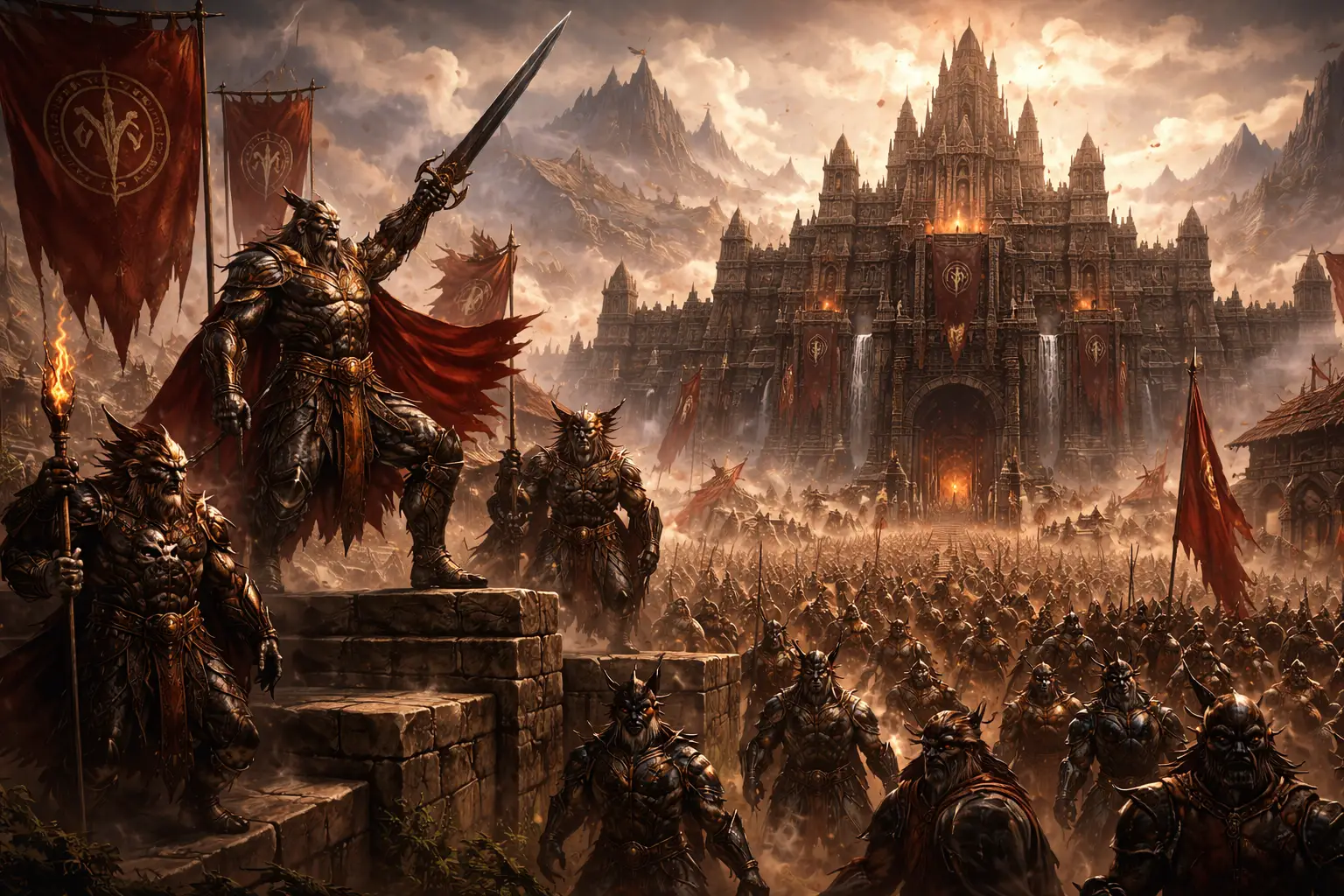
The Age of Monsters
Period: ~40,000–5,000 Years Ago
The name is misleading. "The Age of Monsters" was a label applied by human historians who categorized everything that preceded Galifar as primitive and everything non-human as monstrous. The goblinoid scholars of the Kech Dhakaan would find this characterization offensive, and they would be correct to do so.
What actually defined this era was not chaos but civilisation. After Xen'drik was shattered by the dragons, they returned to isolation in Argonnessen. Human civilization was slowly taking shape on Sarlona, but the most dynamic cultures of this period were forming on and around Khorvaire. The elves founded a new homeland on Aerenal. On Khorvaire itself, the goblinoids rose to prominence, founding the Empire of Dhakaan — a continent-spanning state that flourished for ten thousand years and whose ruins sit directly beneath the cities that replaced it.
The Age of Monsters also encompasses the daelkyr incursion from Xoriat, which shattered the Empire of Dhakaan and the dwarven Realm Below, and whose consequences — the Gatekeeper seals, the cults of the Dragon Below, the aberrations that lurk beneath every major city — are still active today.
"Anyone who has received the common education of the Five Nations knows there was a goblin empire before humanity arrived. Most people do not know its name, its scale, or how much of their current infrastructure was built on top of it. This is not an accident. It is the result of a two thousand year campaign to rewrite a false history of human exceptionalism." — Korranberg historian, goblinoid studies
The Founding of Aerenal
The elves who fled the devastation of Xen'drik settled on the island continent of Aerenal — "Aeren's rest" in Elvish — and there they established the cultures that would define elven civilization for the next forty thousand years.
The Undying Court was instituted: a council of ancient deathless elves who guide Aereni society with the weight of continuous, living memory. The Aereni became an introspective civilization devoted to tradition, arcane mastery, and the preservation of the past over millennia. The Tairnadal became a warrior culture defined by reverence for the patron ancestors who had fought and survived under giant rule — every Tairnadal warrior carries a sacred obligation to relive the deeds of a specific ancestor.
The founding of Aerenal is the event that gives the elves their identity. Everything that followed — the Undying Court's unbroken continuity, the Aereni's centuries-long studies, the Tairnadal's ancestor-driven martial tradition, House Phiarlan's eventual relocation to Khorvaire — traces back to the exodus from Xen'drik and the refusal to let the dead be forgotten.
Main Article: Aerenal
The Empire of Dhakaan
Origins
Little is known of the earliest origins of the goblinoid species. Aereni records describe warring goblinoids on Khorvaire around forty thousand years ago, when the elves first settled on Aerenal, but explored further. Recent studies suggest the goblinoids themselves appeared quite suddenly around this time. It is commonly believed they evolved in vast caverns below the surface, but scholars hold competing theories. Kel Kador of the Library of Korranberg believes the goblinoid subspecies were magebred from a common ancestor that might still be found underground. Hass Holan of Morgrave University has advanced a more exotic theory — that the goblinoids may have emerged from a demiplane within Khyber, from a warlike realm that has yet to be found.
The goblins themselves have little interest in the question. For them, the history of Dhakaan is the history of the dar — a Goblin word for their own kind that translates to "the people." The two are considered synonymous. Regardless of their origins, Dhakaani culture emerged approximately sixteen thousand years ago.
The Unification
In the age before the empire, six hobgoblin kings fought over ancient Khorvaire. Jhazaal Dhakaan, the greatest duur'kala — dirge singer — of the age, performed a feat of epic magic. She crafted the dream of an empire and bound the goblinoids of the time to it. This Uul Dhakaan — the Dream of Dhakaan — gave the ancient goblins oneness of culture and purpose, uniting them under Jhazaal Dhakaan as the first marhu, emperor of Dhakaan.
The Uul Dhakaan was not a metaphor. When mortals sleep, their spirits touch Dal Quor and create temporary dreamscapes. Jhazaal bound the spirits of the dar together, creating a vast, permanent dreamscape within Dal Quor — a vision of the ideal empire. Every dar who slept dreamed of the empire and their place within it. The Uul taught and inspired even while allowing each dar to process their own experiences. It retained the memories of all those who had gone before: a warrior could dream of a battle fought thousands of years ago, fighting alongside one of the greatest heroes of the age. A smith could forge a blade alongside a legendary daashor.
The Dhakaani empire spread across Khorvaire, pushing the dwarves back into the depths of Khyber and driving the dragonborn kingdoms into the eastern jungles. They repelled Tairnadal colonists from modern-day Valenar and drove orcs, gnolls, and other cultures into the wild frontiers.
The Golden Age
The golden age of Dhakaan lasted over five millennia, with goblins ruling over the lands that would later be claimed by Galifar. Dhakaani governance was organized around the principles of muut and atcha — duty and honour — which formed the ethical foundation of imperial life. The three goblinoid subspecies each had their role: the ghaal'dar (hobgoblins) served as soldiers and administrators, the golin'dar (goblins) as scouts and specialists, and the guul'dar (bugbears) as laborers and elite shock troops. The duur'kala — the dirge singers — provided counsel, preserved history through song, and maintained the spiritual health of the empire.
The daashor — the artificers of Dhakaan — produced remarkable artifacts and were master weaponsmiths with an exceptional understanding of adamantine and other exotic alloys. While the Empire was not as arcane-dependent as the civilizations of the giants, its material culture was extraordinary. Many of the greatest cities of the Five Nations are built on Dhakaani foundations, and ruins of Dhakaani fortresses still endure after many thousands of years.
"Dhakaani engineering was practical, durable, and designed for permanence. When a Morgrave expedition finds a Dhakaani foundation, the first thing they notice is that it is often in better condition than the human city built on top of it." — Morgrave field archaeologist
Main Article: The Empire of Dhakaan
The Daelkyr Incursion
The golden age ended when the daelkyr led armies of aberrations through portals from Xoriat, the Realm of Madness.
The daelkyr are the lords of madness and the emissaries of Xoriat. Wherever they walked, they reshaped the world in their image, sowing madness and creating monsters. They fused goblins together to create the gibbering dolgrims and crafted the blind dolgaunts from hobgoblin stock. Dyrrn the Corruptor — lord of the mind flayers, creator of doppelgangers from changelings, and possibly the original source of lycanthropy from corrupted shifters — was the most devastating of the named daelkyr. Belashyrra, the Lord of Eyes, directed beholders as living artillery that shattered hobgoblin armies. Valaara, the Crawling Queen, worked her will on insects and vermin. Orlassk, the Master of Stone, created basilisks and medusas. Six daelkyr are known by name, but there are surely others lurking in the depths.
The daelkyr destroyed Dhakaani cities and transformed goblinoids into aberrations. The daelkyr incursion also destroyed the Realm Below — the vast subterranean civilization of the dwarves. The damage was not limited to the goblinoids. Everything underground was affected.
After a long and bitter struggle, Dhakaani champions turned the tide. The orc Gatekeeper druids — the same tradition that had inherited the logic of fiend binding from the Age of Demons — sealed the daelkyr in Khyber. But it was Dhakaani warriors who scattered the daelkyr armies and hunted down the aberrations that survived. The Gatekeepers crafted seals to hold both the power of Xoriat and the daelkyr at bay, and as long as those seals remain intact, the lords of madness cannot rise from the depths.
"The daelkyr are utterly alien, and their physical forms cannot be fully perceived by mortals. Viewers perceive the same general impression, but the details vary in ways that cannot be controlled. This is not an illusion. It is a failure of mortal cognition when confronted with something that does not belong in its reality." — Gatekeeper lorekeeper, instructional address
The Dwarven Realm Below
The daelkyr incursion did not only shatter Dhakaan. It destroyed the Realm Below — the vast subterranean civilization of the dwarves, which had existed alongside and beneath the goblinoid empire.
The dwarves who survived retreated upward, eventually establishing the Mror Holds in the Ironroot Mountains. For thousands of years, the depths were sealed and largely forgotten. In 913 YK, during the Last War, Mror miners broke through into the deeper halls. They discovered that the Realm Below was not empty. Dyrrn's forces were deeply entrenched. The ancient dwarven halls were infested with aberrations, organic daelkyr vaults, and creatures that had been dwelling in the dark since the incursion.
Today, some Mror clans are determined to drive all aberrations from the depths and reclaim the ancestral halls. Others believe it may be possible to use daelkyr power for the greater good — binding symbionts to their flesh, harnessing the tools of the enemy. This has offered a foothold for the Transcendent Flesh and other cults to spread. The Gatekeepers and the more cautious dwarf clans watch this development with alarm.
"The dwarves of the Mror Holds spent ten thousand years pretending the depths did not exist. Then they opened the door. What they found down there had been waiting the entire time." — Gatekeeper druid, Shadow Marches
What Survives
The Age of Monsters left more active legacies than any era except the Age of Demons.
Dhakaani ruins are scattered across Khorvaire. Most major cities of the modern age are built on Dhakaani foundations, and there are tunnels and warrens beneath them that have been largely ignored by the human inhabitants. What an adventurer sees merely as a useful magical weapon could be an important cultural relic. Many goblinoids do not take kindly to the pillaging of their ancestors' tombs.
The Gatekeeper druids continue to maintain the seals that hold the daelkyr in Khyber. Those seals are thousands of years old and the Gatekeepers are all but forgotten. Mind flayers scheme in the sewers of Sharn. Cultists beseech beholder priests for the blessings of Belashyrra. And in the shadows of Khyber, the daelkyr are waiting.
The cults of the Dragon Below — in all their varied and often mutually contradictory forms — are a direct legacy of this era. So is the nation of Darguun, the aberrations that lurk beneath every major settlement, and the ongoing debate in the Mror Holds about whether daelkyr power can be safely harnessed.
Before the arrival of humanity, goblins and orcs shaped the destiny of the continent. There are many who yearn to reclaim that ancient glory. And there are things in the depths that would prefer to finish what they started.
"The seals hold. The daelkyr are contained. Their servants are scattered. This is all true. It is also true that those seals are thousands of years old, maintained by a druidic order that most of Khorvaire has never heard of, and that every year a few more of them crack. Only a blind fool would describe the situation as stable." — Gatekeeper elder, annual assessment