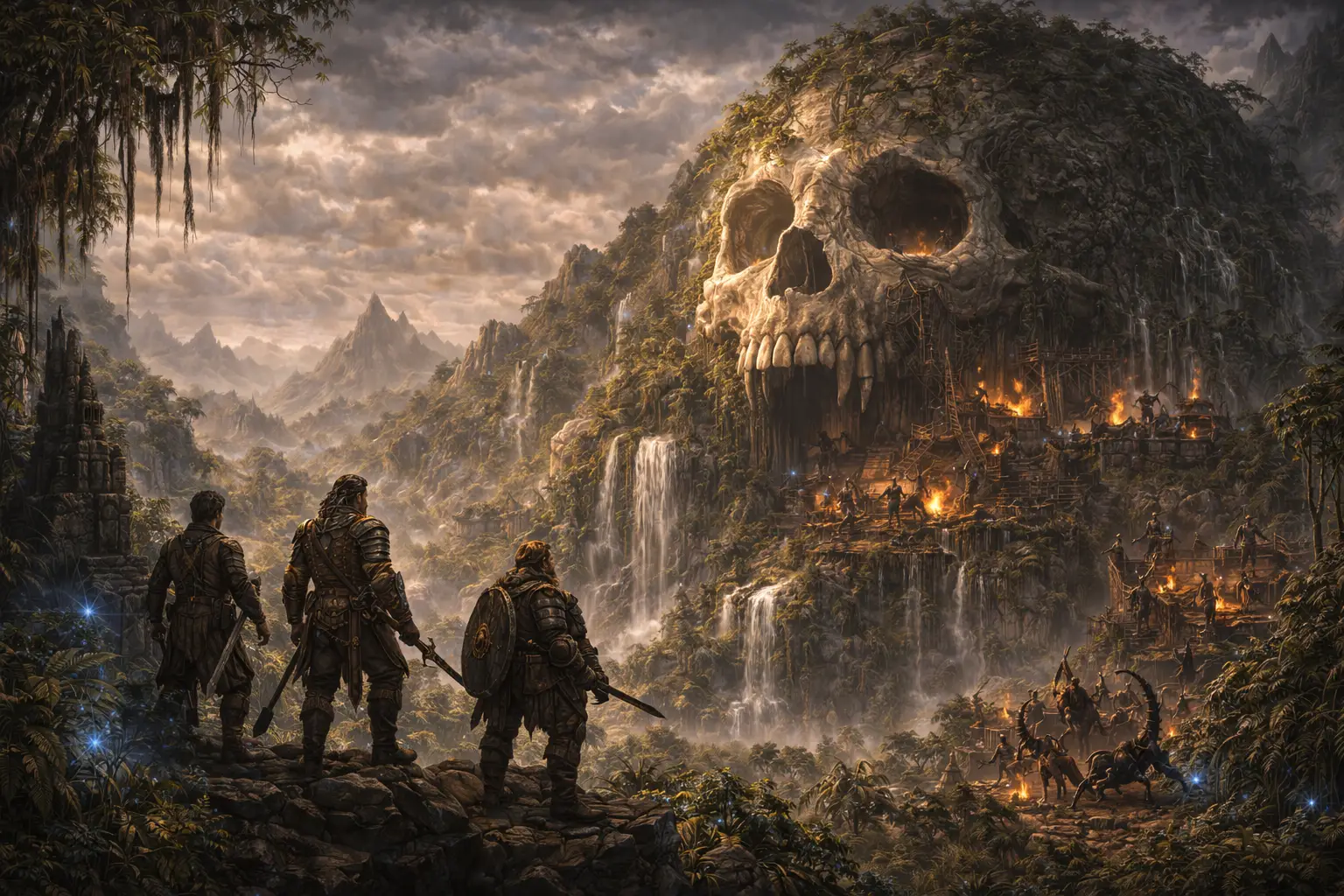
Xen'drik
The Shattered Continent
NOTICE — MORGRAVE UNIVERSITY DEPARTMENT OF ANTIQUITIES "All expeditionary teams are reminded that the University accepts no liability for personnel, equipment, or memories lost beyond the Stormreach perimeter. Maps submitted from previous expeditions are provided as historical curiosities only and should not be relied upon for navigation. Teams that fail to return within the contracted period will be presumed dead after ninety days and their next of kin notified. Salvage rights to abandoned equipment revert to the University after one calendar year."
— Standard Expedition Waiver, Morgrave University, 997 YK
Every Khorvairian schoolchild knows the shorthand — "the land of giant ruins" — and every Morgrave scholar who has actually been there knows how badly that undersells it. South of Khorvaire, across the storm-wracked Thunder Sea, Xen'drik sprawls with the kind of scale that stops being impressive and starts being threatening. It is a continent of impossible extremes: jungles so dense they swallow expeditions whole, deserts where the sand swims like water, mountain ranges belching volcanic lightning, and everywhere — in every direction, at every scale — the ruins of civilizations whose arcane achievements remain unmatched by anything in the modern world. The giants who built those civilizations did not construct cities the way mortals build cities. They engineered climates. They wove planar energy into load-bearing walls. They fought a war against the quori so desperate that they destroyed a moon to sever Eberron's connection to an entire plane of existence. And when they turned those same apocalyptic weapons on their own rebelling slaves, the dragons of Argonnessen came and ended everything.
Forty thousand years later, the ruins are still active. The curses are still in effect. The continent cannot be mapped, cannot be colonized, and has killed every civilization that has tried to rise on it since. Stormreach, the only settlement that has lasted more than a few generations, is built on the foundations of the Cul'sir capital and sits directly above a sleeping overlord. Nobody who lives there finds this reassuring. Everybody who lives there has decided it's somebody else's problem.
What Fell Here
The Age of Giants lasted roughly forty thousand years — from the end of the Age of Demons to the draconic devastation — and produced civilizations whose arcane power dwarfed anything the Five Nations have ever achieved. Understanding Xen'drik requires at least a passing familiarity with what was lost, because the ruins are not inert. They are active, dangerous, and in many cases still functioning on principles that no modern artificer fully comprehends.
The Cul'sir Dominion was the dominant power: a vast empire ruled by mighty titans who explored and exploited the planes as readily as the physical world. Their capital — Cul'sirran, on the site of modern Stormreach — was a city of dream-magic and planar manipulation, built on a connection to Dal Quor that allowed its citizens to live, learn, and train in a realm where time moved ten times faster. Their oneiromantic magic was the most sophisticated in Eberron's history, and their ambition was limitless. They enslaved the elves, sacked a feyspire, and pursued power with the kind of recklessness that eventually provoked the dragons.
The Sul'at League was an alliance of fire-giant cities united by elemental binding, magebreeding, and arcane engineering — a fusion of House Cannith and House Vadalis operating at a scale the modern houses cannot imagine. The League created the drow by binding planar magic to elven slaves, forging living weapons designed to suppress rebellion. Their ruins still burn with elemental fire, and their magebred creations still roam the wilderness in forms that would astonish even Vadalis's most ambitious researchers.
The Group of Eleven was a loose confederation of city-states scattered across central and southern Xen'drik, each specializing in harnessing a specific plane. Migratory cloud-giant merchants, immortal frost-giant artisans, four-armed warriors trained in the wars of Shavarath, interdimensional cyclops explorers — the sheer variety of giant cultures in the Group defies easy summary. Their competitive spirit drove their magic to extraordinary heights, and the ruins of their cities are as diverse as the planes they drew upon: a city of perfect mathematical order, a blazing center of divine fire, fields of golden crops powered by the light of Irian that have become the Wasting Plain.
The Curses
The draconic punishment was not a single act of destruction. It was an ongoing condition — a set of curses designed to ensure that what happened on Xen'drik could never happen again. Whether all of these effects are truly draconic in origin or partly aftereffects of the Moonbreaker itself is debated by scholars, but the practical consequences are undeniable.
The Traveler's Curse. Space itself is unreliable on Xen'drik. Distances shift. Landmarks repeat or vanish. Routes that worked on one expedition fail on the next. Two groups traveling the same path can arrive at the same destination at different times — or at entirely different destinations. Cartographers have published maps that contradict each other within the same expedition season, and it is a standing joke among Stormreach guides that the most reliable map of the interior is a blank page.
The Traveler's Curse is not total chaos; people who know where they are going fare better than those who are wandering, and well-established roads near Stormreach are relatively stable. Native peoples — drow, giants, and especially the thri-kreen, who appear to be completely immune — are far less affected. This makes local guides invaluable, and it explains why the drow of the Vulkoori clans can charge exorbitant fees for their services: they are not merely navigating terrain, they are navigating reality.
Du'rashka Tul — the Madness of Crowds. Any civilization that grows too large or too sophisticated on Xen'drik risks collapsing into sudden, violent madness, its people tearing their own cities apart. This is the reason no advanced culture has endured on the continent for more than a few generations since the fall of the giants. This is the reason the drow live in small communities rather than nations, and why even the most ambitious Stormreach developer eventually stops expanding. Over the last forty thousand years, the archaeological record shows a pattern of civilizations rising, approaching a threshold of size or complexity, and then abruptly self-destructing. The cause is debated — draconic magic, the work of a specific Watcher dragon, or a lingering aftereffect of the Moonbreaker — but the effect is consistent, and it is terrifying in its reliability.
The practical consequence is that Xen'drik cannot be colonized. It can be visited. It can be raided. Individual settlements can even persist at a certain scale. But anyone who dreams of building a kingdom on this continent is dreaming of their own destruction, whether they know it or not.
I've been mapping the Skyfall Peninsula for eleven years. I have forty-seven maps. They agree on the location of the coastline and the existence of Stormreach. After that, it's all improvisation. My colleague Torradan d'Lyrandar claims to have made the same journey from Stormreach to the Throne Gate ruins four times by four entirely different routes, arriving each time in roughly the same place despite traveling in what he swears were four different directions. I have stopped questioning this. The continent does what it wants.
— Professor Kaelys Tela, Morgrave University Department of Cartographic Speculation
The Land Today
Xen'drik's sheer size defies easy summary, but several regions are well-enough known to be worth describing — with the caveat that "well-known" is a relative term on a continent where the geography changes its mind about you.
The Thunder Sea. The ocean crossing between Khorvaire and Xen'drik is treacherous by any standard. Ferocious storms originating from Lamannian manifest zones batter ships with regularity, and the seafloor is the domain of the Eternal Dominion — the sahuagin empire that rules these waters nearly uncontested. Spines of fiendish obsidian and rocky reefs dot the ocean, remnants of the bound overlord known as the Lurker in Shadows. Pirates, smugglers, and merchant ships navigate these hazards in pursuit of the wealth flowing out of Stormreach, and the neutral Karakala merfolk serve as guides and messengers, helping to limit the damage caused by the Lamannian tempests.
The Skyfall Peninsula. The northern jungles of Xen'drik, once the heartland of the Cul'sir Empire. The peninsula was far more extensive before the Moonbreaker shattered its northern reaches; the broken islands of Shargon's Teeth are the remnants of what was once dry land. Countless ruins from the dreaming kingdom still dot the jungle, and the Sulatar drow of the Obsidian City maintain the elemental traditions of the Sul'at League in their fortress of bloodglass. Vulkoori drow range through the surrounding forests — some clans peaceful, some hostile to outsiders, all deeply shaped by the land.
The Menechtarun. A vast interior desert of punishing scale. Thri-kreen communities dot the sands, maintaining hive-cities that carefully limit their size to avoid the Madness of Crowds. The asherati — a people who swim through desert sand as naturally as fish through water — serve as guides, guardians, and traders, living in expansive underground towns shaped by potent geomancy. The village of Gran Gol is built entirely within caverns on the back of a colossal living elemental, with hidden gardens and trained ankheg guard animals. Ruins half-buried in sand hold the remnants of civilizations that predate anything in the archaeological record of the Five Nations.
The Hydra Basin. Xen'drik's tropical heart and its most populous region, surrounded by desert, blasted valleys, and mist-laden forest. Sulatar drow city-states have settled the burning ruins of Grand Ju'qata. Hive Tohr'kreen, one of the largest thri-kreen cities, rises from the trees like a giant amber monument. And in the hidden settlement of Bazek Mohl, deep in the basin's forests, an ancient tradition of the Silver Flame — known locally as the Torch of Progress — has endured since the Age of Demons, tended by monks and warriors who have never heard of Flamekeep.
The Ring of Storms. A perpetual tempest cloaks a mountainous archipelago in the northeast, where the Qabalrin once built their necromantic civilization. The dragons sealed something terrible within the Ring — a gestalt of Qabalrin souls bound into a massive Siberys dragonshard called the Umbra — and posted dragonborn guardians to ensure it stays contained. The guardians are still there, sixty thousand years later, living in fragmented towns built from biological materials produced by organic engines: walls of bone and scale, buildings that grow rather than are built. It is an unnerving sight for visitors, assuming visitors survive the storm to reach the shore.
The Tempest's Spine. A volcanic mountain range along the northeast coast, known for chaotic weather, flowing magma, and buried secrets. The rain that falls on the high peaks feeds the surrounding rainforest and eventually drains into Dread Lake, the mist-shrouded inland sea at Xen'drik's eastern heart.
Beneath the Surface. Xen'drik has an underdark as rich and dangerous as any region on the surface. The Umbragen drow wage an unceasing war against daelkyr and aberrations from their fortress of Taer Umbra — a utilitarian city under perpetual siege in the depths of Khyber. Deeper still, the fomorian city of Vralkast sprawls across the shores of the Sea of Sorrow, a bustling subterranean metropolis of quaggoths, minotaurs, grimlocks, medusas, fomorians, ogres, and dwarves from Sol Udar, all cooperating to survive against the horrors of the Realm Below. It is built from leviathan bone and fungal wood, and it is one of the most cosmopolitan cities in Eberron — if you can get there alive.
Stormreach
The only long-term surface settlement on Xen'drik, Stormreach is a small city of perhaps fifty to a hundred thousand people, built on the ruins of Cul'sirran and governed — loosely — by five hereditary Storm Lords whose only consistent law is that you do not interfere with their business.
The city was founded roughly two hundred years ago when the Kingdom of Galifar legitimized what had been a pirate colony raiding Riedran ships in the Thunder Sea. The four most influential pirate captains were named Storm Lords, with a fifth appointed by Galifar as a liaison. The arrangement has endured, though "endured" implies more stability than the term deserves; Stormreach is a city of competing factions, shifting alliances, and a veneer of law that holds only so long as it serves the Lords' interests.
Every dragonmarked house has an outpost in Stormreach, and — critically — they are not bound by the Korth Edicts here. The laws that restrict house activities in Khorvaire do not apply on Xen'drik, which means the houses can pursue their own agendas with a freedom that would be scandalous back home. House Cannith sends expeditions into the interior to analyze quori technology and giant schematics — research that led directly to the development of the creation forges and, eventually, the modern warforged. House Tharashk maintains the forward outpost of Zantashk in Tempest Bay, mining Siberys dragonshards and losing prospectors with a regularity that would be investigated if anyone were keeping public count. Every other house has its own angle, its own agenda, and its own tolerance for risk.
The city's neighborhoods divide sharply by culture and nationality, with gangs and militia protecting their own districts. There are wards for each of the Five Nations, including Dannel's Pride for the Cyran refugees. A small minority of drow, giants, thri-kreen, and goliaths live in and around the city, trading Xen'drik goods or selling expertise as guides. The druids of the Guardians of Rushemé maintain an encampment outside the city walls, watching for threats both ancient and colonial.
Below street level, Stormreach is even more interesting — and more dangerous. The foundations extend through several civilizations that preceded the current city, each layer holding its own ruins, traps, and secrets. The kobold prince Hassalac Chaar rules a warren of magically trapped tunnels in the undercity, obsessing over a hoard of gold, knowledge, and dragon-related magic items. Those who dare mock the Prince of Dragons do not suffer long before their incineration.
Stormreach is, in essence, a frontier boomtown built on top of an archaeological disaster site. It is the gateway to the Xen'drik interior, the only reliable port of call for expeditions heading south, and a city where the past is not a metaphor but a literal, physical presence beneath your feet.
The Storm Lords keep the peace — by which I mean they keep enough peace that the docks stay open and the dragonshards keep flowing. Everything else is negotiable. If you want justice in Stormreach, bring it with you.
— Overheard in the Wavecrest Tavern, Harbor District
Dar Qat
Riedra's bastion colony on the western coast is everything Stormreach is not: ordered, beautiful, and deeply unwelcoming to outsiders. Sinuous towers of flawless crysteel — grown crystal as strong as steel — rise above the harbor, multicolored orbs of sentira shed psionic light through the streets, and a towering hanbalani monolith looms behind the city, believed to serve as a psychic anchor for the settlement. The population numbers roughly fifty thousand, administered by eleven Inspired lords under the command of Inspired Lord Ralastar, with seven hundred Chosen conducting day-to-day governance.
The Peoples of Xen'drik
The continent is not uninhabited. It is home to dozens of peoples who have lived here far longer than the colonists from Khorvaire, and who regard the treasure-hunters with emotions ranging from cautious tolerance to outright hostility.
The Drow. Three distinct cultures formed after the fall of the giants, and they share almost nothing except ancestry.
The Vulkoori are the most numerous — hunters and druids dedicated to Vulkoor, a scorpion god whose origins may predate the giants themselves. They range across the jungles in communities deliberately kept small enough to avoid the Du'rashka Tul. Some clans, like the Na'qalla, have learned to calm the land and manipulate the Traveler's Curse itself, making them phenomenally valuable guides — and phenomenally expensive ones. Others, like the Hantar'kul, raid ruins for treasure with a proprietary aggression that does not appreciate competition from Khorvairian expeditions. Most Vulkoori see the people of Stormreach as outsiders and looters who have no business on their continent, and they are not entirely wrong.
The Sulatar cling to the elemental traditions of the Sul'at League, maintaining a handful of obsidian cities and specializing in fire magic, elemental binding, and material transmutation. Their Soldiers of Promise, based in the Obsidian City of Gundrak'ul, push the boundaries of the Madness of Crowds by organizing as a military rather than a nation. They have a scornful view of Khorvairian colonizers — especially those who would steal their intricate elemental artifice. Zil explorers are believed to have done exactly this roughly two centuries ago, adapting stolen Sulatar techniques into the derivative elemental binding that now powers Lyrandar airships and Orien vessels. The Sulatar have not forgotten.
The Umbragen descended into Khyber when the giant civilization fell and have been fighting aberrations ever since. They wield sophisticated shadow magic in their unceasing battles against the forces of the daelkyr Belashyrra, and their war is older than most surface civilizations. The Umbragen are the closest Eberron equivalent to the underground drow of other settings — a culturally distinct, technologically advanced, and deeply insular people for whom Khorvaire is an irrelevant backwater and the surface of Xen'drik merely the ceiling of a larger, more important world.
The Giants. Scattered tribes that have never regained the glory of their ancestors. Hill giants, stone giants, storm giants, fire giants — all living among ruins they can no longer fully comprehend. The dragons worked for forty thousand years to erase giant knowledge and culture, and the curses ensure that no recovery is possible. Some tribes trade peacefully with Stormreach; others are hostile. A few — like the fire giants of the Battalion of Basalt Towers — actively pursue the recovery of ancient weapons with dangerous ambition. The Guardians of Rushemé are a druidic giant order that maintains an uneasy peace near Stormreach, honoring the land spirit Kwinharin and watching for dangers both ancient and modern.
The Thri-kreen. Insectoid humanoids who dot the continent in hive-cities carefully limited in size to avoid the Madness of Crowds. The thri-kreen are uniquely and completely immune to the Traveler's Curse, a fact that no one has satisfactorily explained. Their communities in the Menechtarun and elsewhere maintain ancient traditions and, in some cases, possess evidence of technological heights that they have never reached again — perhaps deliberately, given what the Du'rashka Tul does to ambitious civilizations.
The Dragonborn of the Ring. The guardians posted by Argonnessen to watch over the sealed Qabalrin have been at their post for sixty thousand years. They live in fragmented communities built from organic materials produced by biological engines, isolated from the rest of the world by the perpetual storm. They are among the oldest continuous cultures on Eberron, and they take their duty with a solemnity that makes the Ghaash'kala look relaxed.
Other Peoples. The asherati of the Menechtarun. The spiderfolk of Dread Lake, living in silk-woven treetop settlements hidden by perpetual fog. The Simeq elves who rule the flooded ruins of a Sul'at city in the Phoenix Basin, created as oceanic soldiers and now governing their former masters' domain. The yuan-ti, driven from Sarlona and Argonnessen, who arrived roughly twelve hundred years ago and split into those seeking peaceful solitude and those burning with injustice. Xen'drik's population is as diverse as its geography, and just as resistant to easy categorization.
Foreign Interests
Xen'drik's resources — Siberys dragonshards, giant artifacts, lost arcane knowledge, exotic materials found nowhere else — have drawn the attention of every major power in Khorvaire and beyond.
House Cannith has the deepest investment and the most to gain. Cannith expeditions into the Xen'drik interior, analyzing quori technology and giant schematics, led directly to the development of the first derivative creation forges. Aaren d'Cannith's breakthrough in 960 YK — the creation of the first modern warforged — came after contact with ancient quorforged remnants in Xen'drik. The stakes for Cannith could not be higher: the continent holds the keys to the house's past innovations and potentially its future supremacy.
House Tharashk seeks Siberys dragonshards, the rarest and most valuable of the three dragonshard types. The Ring of Siberys circles Eberron above the equator, which crosses over Xen'drik, meaning Siberys shards fall here with some regularity. Tharashk's outpost at Zantashk in Tempest Bay is the house's forward position, and the work is lucrative enough to justify the extraordinary attrition rate.
The Inspired of Riedra maintain Dar Qat for reasons that go beyond resource extraction. The quori are desperate to uncover the truth behind the last Turning of the Age — the cosmic event that, forty thousand years ago, remade their entire species.
Aerenal remembers Xen'drik with the clarity that only deathless elven memory provides. The Undying Court was there when the giants fell. The Tairnadal carry the spirits of the heroes who fought in the rebellion. Neither group has any interest in returning. The elves left Xen'drik for a reason, and the reason is still there.
Morgrave University funds the majority of Khorvairian scholarly expeditions to Xen'drik, operating out of Stormreach with the kind of cheerful disregard for personnel safety that has made the institution both famous and notorious. Morgrave's expedition waivers are legendary for their comprehensiveness and their implication that the University fully expects you to die.
"When I first spoke to the Morgrave board, I hid the details I share with you now. I did this not from malice, nor even from fear that I would be ridiculed, but rather because I could not bear to revisit the horrors I had seen beneath the merciless Menechtarun sands."
— Professor Talbridge, Beneath the Basalt Towers, Sharn Inquisitive
Why Xen'drik Matters
For adventurers, Xen'drik is the ultimate frontier — a continent-sized dungeon where the treasures are real, the dangers are older than human civilization, and the rules of reality are suggestions rather than laws.
The artifacts buried in Xen'drik's ruins are not merely powerful; they are categorically different from anything that can be made in the modern world. Giant-scale spellbooks hold arcane theory that the Arcane Congress has never imagined. Quori creation forges represent the ancestral technology that gave rise to the warforged. Elemental engines still burn with fire bound forty thousand years ago. Weapons forged to fight the overlords in the Age of Demons may be the only things capable of fighting them again if they ever break free.
But Xen'drik is not just a treasure vault. It is a living continent with peoples and cultures that predate Khorvairian civilization by millennia. The drow, the giants, the thri-kreen, the dragonborn of the Ring — these are not obstacles between you and the loot. They are the inhabitants of a land that was theirs long before the first pirate ship dropped anchor in Stormreach harbor, and many of them are profoundly unimpressed by the latest wave of visitors who think they can take what they want and leave before the continent notices.
There's an old saying in Stormreach: "Great power rests in the ruins of the past." There's a newer saying, too, coined by the survivors: "So does great power's bodycount."