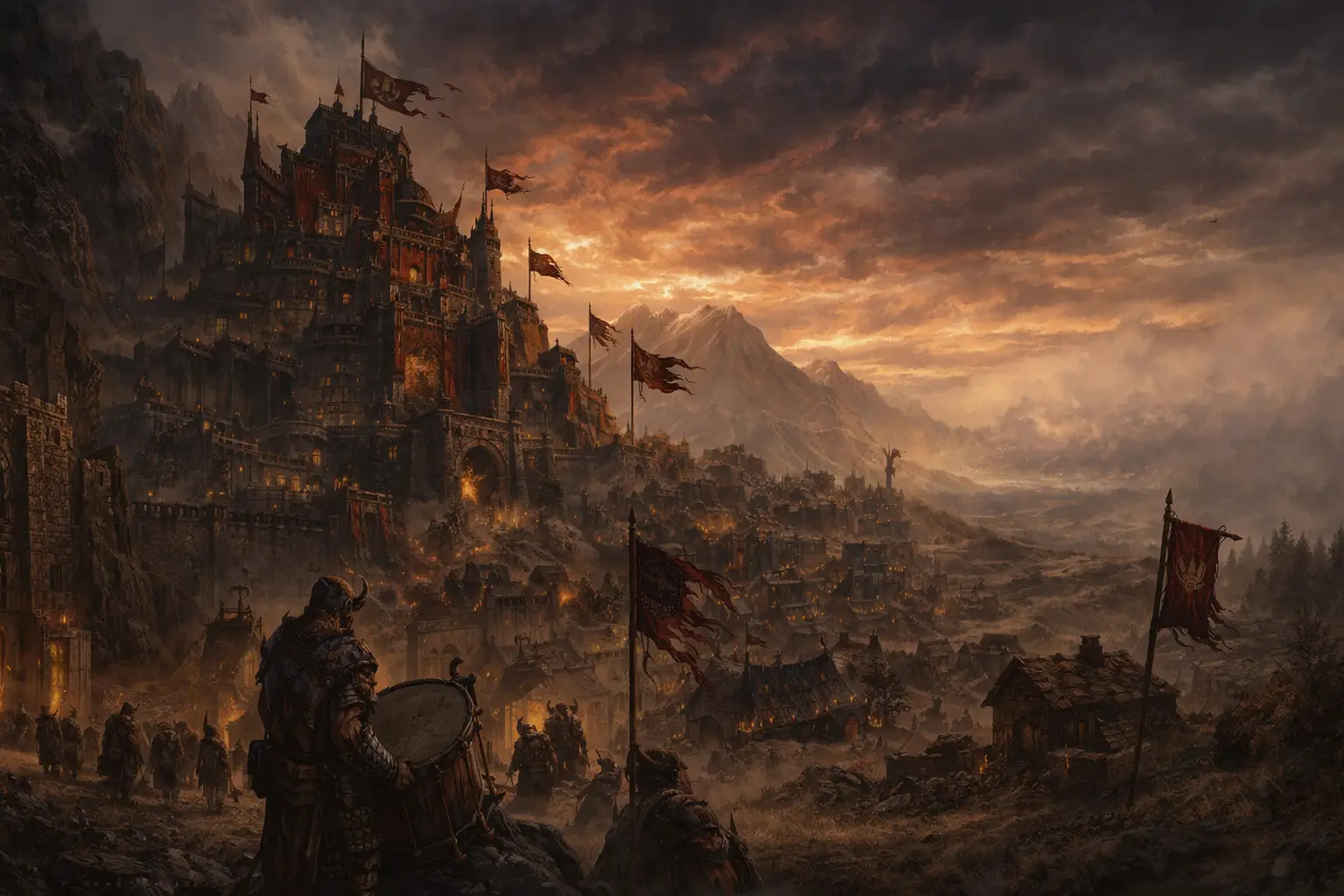
Darguun
Capital: Rhukaan Draal | Ruler: Lhesh Haruuc Sharaat'kor | Government: Tribal federation under a high warlord | Hallmarks: Goblinoid mercenaries, Dhakaani ruins, frontier law
Picking up a ruined helmet, still tied under the chin by a cord, Haruuc raised it in one hand and his bloody sword in the other. "Your lord is dead!" he howled in the human language. "The battle is done! By my sword, I claim this place and name it Rhukaan Draal, the crown city of Darguun, the land of the people!"
Burnt-out Cyran farmsteads standing empty under grey skies. Hobgoblin war banners snapping over towns that were not built by the people who fly them. Ancient fortresses carved into the Seawall Mountains, older than anything in Sharn or Fairhaven, their walls still sharp after sixteen thousand years. Darguun is the nation the rest of Khorvaire does not want to think about — a country born from betrayal and built on stolen land that was stolen land before it was stolen, a place where the ghosts of empires old and recent press against each other in the dark.
The youngest of the Thronehold nations alongside Valenar, Darguun occupies the southeastern reaches of Khorvaire — the territory that was once the southern provinces of Cyre. The Seawall Mountains form the nation's western and southern spine, their peaks riddled with goblinoid clan-holds and Dhakaani ruins. To the north and east lie the Ghaal River lowlands and the Torlaac Moor, a vast stretch of open country that was once productive Cyran farmland and is now a patchwork of reclaimed goblinoid settlements, abandoned villages, and haunted ruins. The Khraal rainforest blankets the southwest, dense and largely unexplored. To the northeast, the dead-grey wall of the Mournland presses against the border like a bruise that will not heal. The Kraken Bay and the Torlaac River provide Darguun's connection to the wider world, with the port town of Wyvernsku'll serving as the nation's primary gateway to sea trade.
This is not a settled nation in the way that Breland or Karrnath are settled nations. Much of the territory beyond the major settlements remains depopulated — whole towns razed during the uprising still stand empty, their Cyran architecture crumbling, their lightning rail stations dark and silent. The goblinoid population has swelled since the founding as tribes and clans from across Khorvaire have migrated to the promise of a homeland, but even so, Darguun remains thinly populated relative to its size, a nation of ruins still being reclaimed.
The Darguul Spirit
The spirit of Darguun is pride with an edge on it — the pride of a people who spent millennia as slaves, refugees, and mercenaries in the ruins of their own civilization, and who now hold sovereign territory for the first time since the fall of the Empire of Dhakaan. Every Darguul, from the lowliest goblin dung-sweeper in Rhukaan Draal to Lhesh Haruuc himself, carries the knowledge that the dar once ruled the entire continent and that the chaat'oor — the foreign defilers, the humans — built their cities on goblinoid foundations and called the work their own. That historical grievance is not abstract. It is the emotional bedrock of the nation, the thing that makes a goblinoid mercenary spit when a Brelish officer talks about "civilization," and the thing that made the uprising not merely a military opportunity but a reckoning.
The dark side of that pride is fragility. Darguun is a nation held together by the personal charisma and tactical brilliance of one hobgoblin, and the Ghaal'dar clans that swear fealty to him have not forgotten how to turn on each other. The concepts of muut and atcha — duty and personal honor, the twin pillars of the ancient Dhakaani way — still resonate among the Ghaal'dar, but only as half-remembered instincts, cultural echoes stripped of the spiritual infrastructure that once gave them weight. The result is a society that prizes martial strength and clan loyalty above all else, where disputes are settled by challenge and bloodshed, and where the wrong word to the wrong clan lord can end a conversation permanently.
INTERCEPTED DISPATCH — Rhukaan Draal to House Deneith staging camp, Olarune 997 YK
Commander,
The Lhesh's court is not a court. It is a fighting pit with chairs. Three clan lords drew blades over a mining claim in the Seawall foothills before the evening meal was served, and Haruuc settled it by breaking the table with his fist and telling all three they could share or he would take it himself. They shared. I have seen nothing in two months here that resembles what we would call law. What they have instead is Haruuc.
Recommend we continue to route all contracts through the Red House directly. The clan lords respect strength, and Haruuc is the only strength that matters here.
— Sentinel Marshal Torrik d'Deneith
Lhesh Haruuc and the Ghaal'dar
Darguun exists because of one hobgoblin. Before Lhesh Haruuc Sharaat'kor, the Ghaal'dar — the "mighty people," the loose federation of hobgoblin-dominated tribes in the Seawall Mountains — were exactly what the Five Nations expected goblinoids to be: fractious, divided, dangerous in small numbers and controllable in large ones. House Deneith brokered their services as mercenaries beginning in 878 YK, and during the Last War, the demand for expendable soldiers drew ever-increasing numbers of goblinoids out of the mountains to fight for Cyre and Breland. The Five Nations paid them, armed them, and trained them — and never once considered that the weapons might be turned around.
Haruuc saw what his employers did not: that by the late stages of the war, goblinoid mercenaries had become the dominant military force in the region, and that the Cyrans who relied on them had bled themselves too thin to resist. In 969 YK, he united the Ghaal'dar under his banner and seized the territory they were supposed to protect. The uprising was swift, brutal, and devastatingly effective. The Ghaal'dar did not conquer and occupy — they lacked the numbers for that — so they razed what they could not hold, driving the Cyran population out or killing those who would not leave. Breland, pragmatic as ever, negotiated an alliance with Haruuc to secure its own border. Cyre fought off and on with the goblinoids until the Day of Mourning made the question moot. When the Treaty of Thronehold was signed, the majority of delegates chose to recognize Darguun rather than risk another war.
Haruuc rules from Khaar Mbar'ost — the Red House — a fortress in Rhukaan Draal that he claimed during the uprising. His title, Lhesh, is an old Dhakaani military rank meaning "high warlord," and his power rests on the same thing that has always sustained goblinoid authority: personal strength, proven cunning, and the ability to keep the clans in line through a web of alliances, rivalries, and the ever-present threat that crossing him is more trouble than it is worth. Haruuc is a brilliant strategist and a shrewd politician — the rest of Khorvaire's continued underestimation of him is, frankly, one of his best assets — but he is mortal and growing old, and no one has yet identified a successor who could hold the Ghaal'dar together after he is gone.
The Shape of the Nation
Rhukaan Draal, the capital, is the largest city in Darguun and the hub for what passes as diplomacy, trade, and law in the nation. It is also a haven for smugglers, fugitives, and anyone whose business does not bear close scrutiny in the treaty nations. The city is a strange layering of Cyran architecture and goblinoid construction — human buildings retrofitted with hobgoblin fortifications, goblin market-warrens sprawling through basements that once held Cyran wine cellars. House Deneith maintains its strongest presence here, and most foreign commerce flows through the capital.
Wyvernsku'll, Darguun's primary seaport on the Kraken Bay, is the closest thing the nation has to a cosmopolitan settlement. The goblinoids who live here are sociable, rowdy, and by and large friendly toward strangers — a commercial port in the most practical sense, where coin matters more than clan. Sailors from Zilargo, Breland, and the Lhazaar Principalities dock here, and the taverns are rough but welcoming in the way that all port taverns are welcoming.
The Gathering Stone, a fortress enclave of House Deneith in the interior, serves as the primary staging area for goblinoid mercenaries seeking contracts through the house. It is the most secure haven for travelers in the region, provided you are on good terms with House Deneith — and if you are not, the roads of Darguun offer very few alternatives.
Gorgonhorn, a fortified village near the Mournland border, guards the nation against whatever crawls out of the dead-grey mist. The garrison there has traded one war for another, and the soldiers of Gorgonhorn are among the hardest and most experienced in Darguun.
Lyrenton, once a thriving Cyran town, is a ruin on the very edge of the Mournland, shunned by the Ghaal'dar, who believe it cursed. At night, a terrible wailing echoes among its broken walls and can be heard for miles across the plains.
Beyond these, Darguun is a land of clan-holds and reclaimed ruins. Any significant settlement is likely the domain of a single Ghaal'dar clan, and the clan lord holds absolute authority within it. Some clans welcome outsiders and trade. Others despise non-goblinoids. There is no reliable way to know which is which until you arrive.
"I asked a Brelish trader what he thought of Darguun. He said it was a country with no laws. I told him it had plenty of laws — they just changed depending on which hobgoblin was standing closest to you." — Caldros ir'Vennet, merchant-captain of the Kraken's Promise
Faith and Culture
The Ghaal'dar and the Marguul both revere the Mockery — called the Lord of Victory in the Cazhaak interpretation — though each tribe and clan has its own traditions falling somewhere on the spectrum between the Sovereign of Betrayal and Bloodshed and the pragmatic warrior-god who teaches that the world is cruel and you must be cunning to survive it. Since taking power, Lhesh Haruuc has promoted the worship of Dol Dorn and Dol Arrah alongside the Mockery, blending the three into a local cult of the Sovereigns of War. This is partly genuine — Haruuc feels a personal affinity for Dol Dorn — and partly diplomatic, since telling the Five Nations that Darguuls worship "all the Sovereigns of War" sits rather better than admitting the Mockery holds pride of place. The worship of Balinor also has a strong following, particularly among the mountain clans.
Beyond organized religion, the Ghaal'dar carry the cultural memory of the Empire of Dhakaan the way a person carries a scar — visible, felt, not fully understood. They know they are the descendants of a civilization that once ruled the continent. They use old Dhakaani military ranks and honor the concepts of muut and atcha, even if these ideals have been reduced to abstract principles rather than the lived spiritual reality they represent among the true Dhakaani. The duur'kala — dirge singers, keeper of oral history — are respected figures among the clans, preserving songs of past glory and shaping the cultural identity of a people still learning what it means to be a nation rather than a collection of warring tribes.
Art and craft in Darguun are functional and martial, leaning toward arms, armor, and fortification. Goblinoid ears are more expressive than human faces — two quick flicks of the ear is a signal to be on guard, and the angle of a hobgoblin's ears in conversation communicates respect, contempt, or threat more eloquently than words. The food is thick, chewy, heavy on sour and bitter flavors, and strongly spiced — campaign rations elevated to cuisine by necessity, since the Ghaal'dar spent centuries in mountain caverns where every meal had to travel.
The Darguul Character
The Darguul character runs on two instincts that outsiders consistently mistake for savagery. The first is an absolute, bone-deep loyalty to clan — not to nation, not to ideology, not to abstract principle, but to the people you fight beside, eat with, bleed for. A Ghaal'dar will challenge their clanmates constantly in peacetime, testing strength and skill in an endless cycle of dominance displays that rarely end in death but frequently end in broken bones. But when blades come out for real — when war comes — that same Ghaal'dar will stand with their clan until the ground gives way under them. This loyalty does not extend to other clans, to foreigners, or to anyone who has not earned it through blood or bond. The Darguul concept of trust is narrow and deep, and if you are inside that circle, there is nothing they will not do for you; if you are outside it, you are a resource, an obstacle, or prey.
The second instinct is a hunger for proof — proof of strength, proof of worth, proof that you deserve the place you hold. Among the Ghaal'dar, nothing is given and nothing is permanent. Rank is earned and must be continuously defended. A clan lord who shows weakness will be challenged. A warrior who fails to prove themselves will be cast down. This produces soldiers of extraordinary tenacity and cunning, mercenaries whose reputation for ferocity is fully deserved, and a political culture that is exhausting, violent, and remarkably effective at ensuring that the people in charge are actually competent — at least at the things goblinoid society values.
The dark side of these qualities is a relentless short-sightedness and a society that grinds its goblins down. Among the Ghaal'dar, hobgoblins dominate, goblins serve, and bugbears enforce — a hierarchy enforced by custom, muscle, and the lingering damage of the Kapaa'vola, the ancient daelkyr curse that severed the goblinoid people from their shared dream and left them fractured. The Dhakaani of old respected every caste; the modern Ghaal'dar oppress their golin'dar and dismiss them as disposable. It is the deepest irony of Darguun that the nation was founded on a dream of reclaiming goblinoid glory, and the first thing its people did was replicate the same hierarchies of cruelty that humans imposed on them for a thousand years.
"The chaat'oor built their towers on our bones and called it progress. We tore those towers down and called it justice. Now we build our own towers, and we will see if we can do it without becoming what we hated." — attributed to Lhesh Haruuc, in conversation with a Brelish envoy
Postwar Pressures
Darguun was recognized by the Treaty of Thronehold, but it does not meaningfully abide by the common laws of the treaty nations. Law enforcement is local, personal, and unpredictable — acts considered criminal elsewhere are part of daily life in much of Darguun. Lhesh Haruuc has abolished slavery in Rhukaan Draal, but some clan lords in the interior continue the practice, and Haruuc lacks the power to enforce his will across every settlement. The broken paths of the lightning rail make interior travel difficult, and most towns offer none of the services that travelers take for granted in the Five Nations.
The Marguul bugbears of southern Darguun remain a persistent challenge. These clans threw off Ghaal'dar authority long ago, seizing territory in the southern Seawall Mountains and raiding from it with impunity. Some Marguul have brokered a grudging truce with the Ghaal'dar; others refuse to acknowledge any authority but their own. Anyone venturing into the Seawall Mountains without a Marguul guide is taking their life in their hands.
Beyond the internal fractures, the Mournland broods on the northeastern border — a source of horrors that crawl into Darguun with grim regularity, keeping the garrison at Gorgonhorn in a state of constant vigilance. And beneath all of it, in the deep places of the Seawall Mountains and in vaults sealed since before humans set foot on Khorvaire, something older stirs. The clans known as the Kech Volaar and the Kech Shaarat have emerged in recent decades, presenting themselves as Darguul clans with unusual traditions — scholars and warriors, respectively. The Ghaal'dar accept them at face value, but travelers who pay attention may notice that these "clan-holds" fight with a discipline the Ghaal'dar cannot match and craft weapons that would make a Cannith artificer weep.
External Relations
Darguun has no embassies abroad and conducts what little diplomacy it practices through House Deneith, which maintains the strongest foreign presence in the nation. No one will hire goblin armies in the wake of Haruuc's betrayal — the word "betrayal" is used in the Five Nations, never in Darguun — but smaller units of goblinoid mercenaries remain in high demand for their ferocity, their willingness to take contracts others refuse, and the simple economic fact that they are cheaper than Deneith's human soldiers. House Deneith's relationship with the Lhesh is the single most important diplomatic channel into and out of Darguun, and both sides know it.
Relations with the former Cyran diaspora are, understandably, toxic. Cyran refugees scattered across Khorvaire carry a particular bitterness toward Darguun — the Mourning destroyed their homeland, but it was the goblinoid uprising that first tore the southern provinces away and drove their people from the land. In the refugee camps of Breland, the name Darguun is spoken with a venom reserved for no other nation.
Zilargo watches the southern border with typical gnomish caution; the Zil and the Ghaal'dar have clashed intermittently for centuries, and the Trust presumably maintains assets in the region. Breland and Darguun coexist in a state of wary pragmatism — Breland recognized Darguun to secure its border and has no particular interest in destabilizing the arrangement, but neither does it trust the Ghaal'dar to remain satisfied with what they have. Valenar, the other nation carved from Cyre's corpse, shares no border with Darguun, and the two largely ignore each other — though the irony of two successor states built on the same stolen land is not lost on anyone.