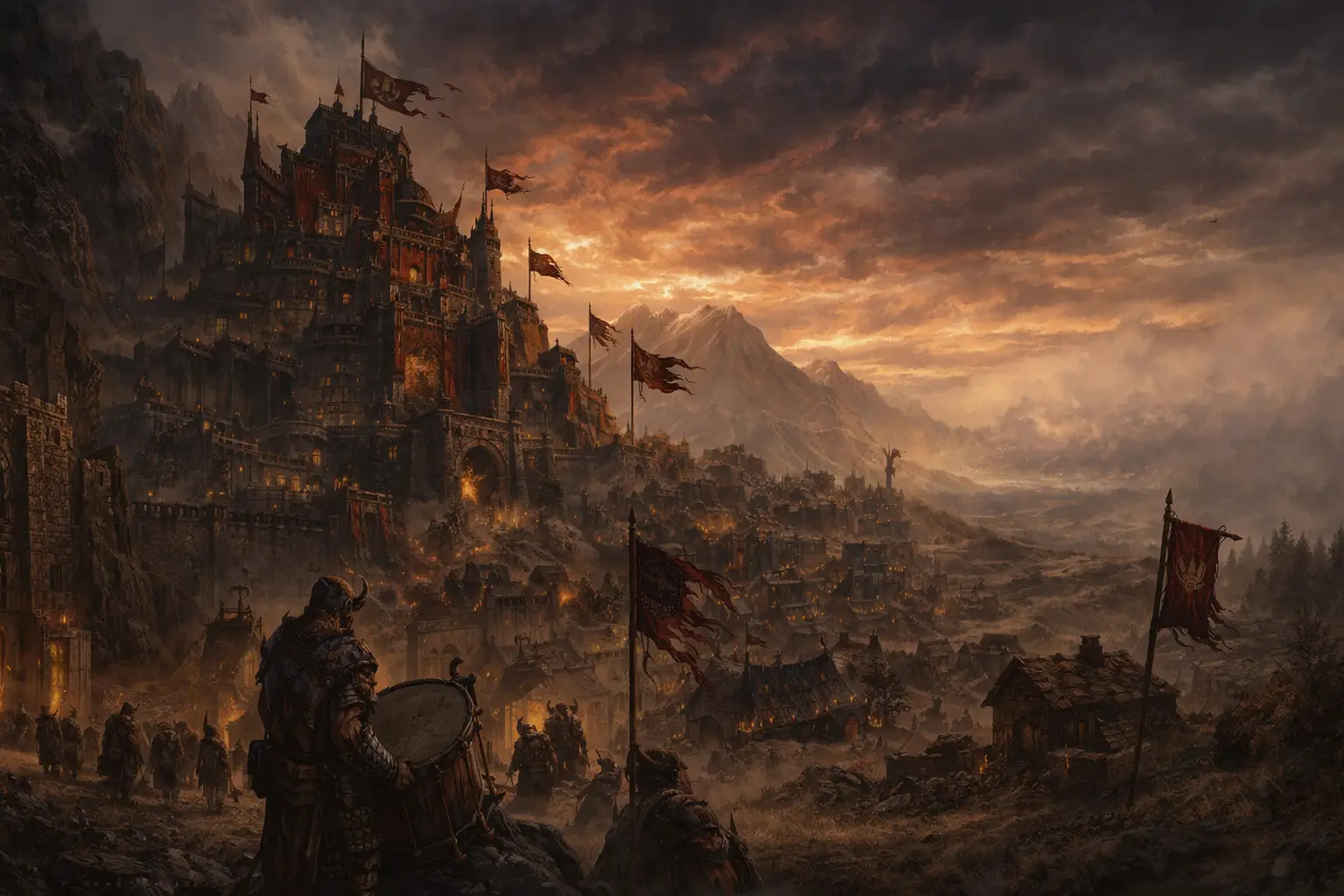
Military & Security of Darguun
FIELD REPORT — Sentinel Marshal Carren d'Deneith, the Gathering Stone, to Sentinel Tower, Barrakas 997 YK
Commander,
I will be blunt. We know exactly what the Darguuls are capable of, because they showed us during the uprising, and because we trained most of them ourselves. They fight the way we taught them to fight — fast, aggressive, comfortable in close quarters, willing to take casualties to close with the enemy — except they do it without supply lines, without medical support, and without any of the institutional overhead that slows our own forces down. A Ghaal'dar war-band can field, march, and fight within hours of receiving an order. An equivalent Blademark company takes three days.
What we do not know is how many of them there are. The Lhesh's court keeps no muster rolls, and the clan lords consider their war-band strength to be a personal secret more closely guarded than their gold. My best estimate is that the Ghaal'dar could field between fifteen and twenty thousand warriors on short notice, with twice that number available if the immigrant clans rallied to the banner. But these are guesses. The Darguuls do not count their soldiers for the same reason they do not count their swords — you don't inventory what you were born holding.
I also recommend we stop using the word "betrayal" in official correspondence. The Darguuls consider the uprising a liberation, and using the other word in earshot of a clan lord is a reliable way to shorten a negotiation.
Darguun has no standing army, no officer corps, no military academy, and no centralized command structure. It is defended — and it threatens — through a loose confederation of clan war-bands united by the personal authority of Lhesh Haruuc Sharaat'kor, supplemented by the mercenary infrastructure of House Deneith and the stubborn geography of the Seawall Mountains. This arrangement sounds chaotic on paper. It produced the only successful military uprising of the Last War.
The Ghaal'dar do not think about war the way the Five Nations think about war. There is no distinction between soldier and civilian in a Ghaal'dar clan — every hobgoblin is a warrior, every goblin can carry a blade and serve as a scout, and every bugbear is a shock trooper whether or not anyone has issued them orders. The clan is the unit. The clan lord is the commander. And the Lhesh is the only authority that can make the clans work together rather than against each other.
The Clan War-Bands
The fundamental military unit of Darguun is the clan war-band — a force of goblinoid warriors who fight under the banner of their clan lord and answer to no other authority except the Lhesh himself. Each significant Ghaal'dar clan maintains its own war-band, equipped with weapons and armor forged in the clan's own smithies or acquired through the mercenary trade. The composition of a typical war-band reflects the goblinoid subspecies hierarchy: hobgoblin officers command, goblin scouts and skirmishers fill the ranks, and bugbear shock troops serve as heavy infantry and enforcers.
War-band size varies enormously depending on the clan's wealth, territory, and the ambitions of its lord. A minor clan might maintain a few dozen warriors; a major clan with territory in the lowlands might field several hundred. The Rhukaan Taash — Haruuc's own clan, the "razor crown" — is the largest single war-band in the nation and forms the closest thing Darguun has to a standing army, garrisoning Rhukaan Draal and serving as the Lhesh's enforcement arm.
Training is continuous and largely informal. Ghaal'dar warriors train through constant sparring, competitive challenges, and the simple reality that a warrior who cannot fight does not eat well. Ghaal'dar rarely kill in casual dominance bouts — you fight to prove a point, not to thin your own ranks — but the line between a practice duel and a lethal encounter is drawn by the participants, and serious injuries are common. The result is a military culture that produces individual warriors of extraordinary ferocity and small-unit tactics honed by a lifetime of intra-clan competition, but that struggles with the kind of large-scale coordination that the Five Nations take for granted.
What the Ghaal'dar lack in institutional discipline, they compensate for with speed, aggression, and an intimate knowledge of the terrain. A clan war-band can mobilize, march, and fight within hours. They carry minimal supplies, forage ruthlessly, and operate without the logistical tail that slows conventional armies. In the Seawall Mountains, where the clans have lived for millennia, they know every pass, every cave, and every ambush site — a tactical advantage that no invading force could replicate.
"A Brelish colonel asked me how long it takes to mobilize a Ghaal'dar war-band. I told him: as long as it takes the clan lord to stand up." — overheard at the Gathering Stone
The Mercenary Trade
The mercenary trade is Darguun's primary export and the economic engine that keeps the clan lords fed, armed, and — crucially — occupied. House Deneith has brokered the services of goblinoid mercenaries since 878 YK, and the relationship survived the uprising largely because both sides need it too much to let historical grievances get in the way.
The arrangement works as follows: a clan war-band that wants to hire out sends a contingent to the Gathering Stone, House Deneith's fortress enclave in the Darguul interior. Deneith officers evaluate the warriors, negotiate contracts with clients across Khorvaire, arrange transportation and translators, and take a commission of ten to thirty percent depending on the complexity of the job. The clan receives coin and — equally valuable — combat experience, intelligence about the Five Nations, and the satisfaction of warriors who might otherwise turn their aggression inward.
No one hires goblin armies anymore. The word "betrayal" has a long memory in the halls of the Five Nations, and no client will contract a goblinoid force large enough to pose a strategic threat. What clients will hire — and hire eagerly — are smaller units: squads and platoons of goblinoid mercenaries valued for their ferocity, their willingness to take contracts that human soldiers refuse, and the simple economic fact that they cost less than Deneith's own Blademark troops. A Ghaal'dar mercenary squad operating under Deneith contract might serve as shock troops in a border dispute, bodyguards for a merchant caravan crossing dangerous territory, or dungeon-delving specialists hired to clear an ancient ruin.
The Blademarks Guild includes significant numbers of hobgoblins from Darguun in its rank and file, fighting alongside human conscripts, Valenar elves, and displaced Cyran veterans. These goblinoid Blademarks undergo the same two-year training period as their human counterparts and are held to the same standards of discipline — which means that a goblinoid who survives Deneith training emerges as one of the most professionally capable soldiers on the continent, blending Ghaal'dar aggression with Five Nations tactical doctrine.
The mercenary trade also serves a subtler political function. Warriors deployed abroad are warriors not causing trouble at home. Haruuc understands this perfectly and encourages the trade for exactly this reason — a clan lord whose best fighters are earning coin in Breland is a clan lord who is not using those fighters to challenge the Lhesh's authority.
The Mournland Border
The northeastern border with the Mournland is Darguun's most dangerous frontier and its most thankless military posting. The dead-grey mist does not respect treaties. Living spells, mutated beasts, animated remnants of war machines, and things that no sage has catalogued crawl out of the Mournland with grim regularity, and the garrison at Gorgonhorn bears the brunt of this unending assault.
Gorgonhorn is a fortified village near the border that once maintained the Darguul front line against Cyre. Now it guards against something worse. The hobgoblins stationed there are among the hardest and most experienced warriors in Darguun — soldiers who have traded one war for another and who regard the Mournland with the same wary fatalism that a sailor regards the sea. Gorgonhorn also serves as a staging point for scavengers and salvagers who venture into the Mournland seeking Cyran artifacts, abandoned weapons, and whatever else can be pulled from the mist and sold.
The border clans receive little support from the lowland settlements, and the imbalance breeds resentment. A clan lord whose warriors die fighting horrors from the Mournland while the clans closer to Rhukaan Draal grow rich on the mercenary trade has legitimate grievances — grievances that Haruuc must manage carefully, since the border clans are also the first line of defense against anything that crawls south. The Lhesh periodically rotates warriors from loyal clans to Gorgonhorn to share the burden, but the arrangement is ad hoc and depends on the willingness of clan lords to contribute troops to a posting that offers no glory and no profit.
NOTICE — posted at Gorgonhorn's gatehouse, in Goblin only
TO ALL WARRIORS OF THE BORDER WATCH:
If it comes from the mist: kill it. If it speaks from the mist: kill it faster. If it wears a Cyran uniform and asks for help: kill it and burn the remains.
Do not enter the mist. Do not follow anything into the mist. Do not listen to the voices.
By order of the garrison commander. No exceptions.
The Marguul Threat
The Marguul bugbears of the southern Seawall Mountains are not technically an external enemy, but they are not reliably an internal ally either, and from a military perspective the distinction matters less than the practical reality: Marguul raiders strike lowland settlements, caravans, and isolated clan-holds with impunity, and the Lhesh does not have the resources to stop them.
The southern Seawalls are Marguul territory in everything but name. The terrain — sheer ridgelines, narrow defiles, cave networks that extend for miles underground — favors defenders absolutely, and the bugbears have been fighting in these mountains since before the founding of Darguun. A hobgoblin army marching into the southern Seawalls would face ambushes at every turn, supply lines stretched to breaking, and an enemy that fights with no concept of honor, no interest in surrender, and a religious conviction (rooted in the Mockery's most brutal interpretation) that victory by any means is the only victory that matters.
Haruuc has brokered a grudging truce with some Marguul clans, but the truce is a ceiling, not a floor — it prevents large-scale war but does nothing to stop the constant low-level raiding that makes the southern lowlands dangerous for anyone without a Marguul guide or a very large escort. The Lhesh treats the Marguul problem the way a sensible commander treats an enemy he cannot defeat: he contains them, negotiates where possible, and waits for an opportunity that has not yet arrived.
The Seawall Mountains as Fortress
The Seawall Mountains are to Darguun what the Towering Wood is to the Eldeen Reaches — a defensive asset so formidable that no invading army has ever successfully conquered them and a source of internal danger that keeps the defenders honest.
The Seawalls run along Darguun's western and southern spine, their peaks honeycombed with ancient Dhakaani fortresses, natural cave systems, and clan-holds that have been continuously occupied for thousands of years. Any force attempting to invade Darguun from the west or south would have to fight through terrain that the goblinoids know intimately and that conventional armies are not designed to operate in. The eastern approach — through the lowlands — is more vulnerable, but an invader from that direction would have to cross the Mournland or traverse Brelish territory, neither of which is a trivial proposition.
The mountains also contain Darguun's deepest secrets. Dhakaani ruins pepper the Seawalls — fortresses, forge-halls, burial vaults, and structures whose purpose modern scholars cannot determine. Some of these ruins have been reclaimed by Ghaal'dar clans; others remain sealed and unexplored; still others are occupied by things that the Ghaal'dar would rather not discuss. The Torlaac Moor and the Khraal rainforest in the lowlands are similarly littered with dungeons dating back to the ancient empire, many of which have never been cleared by anyone — goblinoid or otherwise.
For adventurers, the practical implication is straightforward: Darguun is one of the richest dungeon-crawling environments on the continent, and one of the most dangerous. The ruins are real, the treasures are real, and the things guarding them are real. Clan lords may sell access to ruins in their territory, hire adventurers to clear them, or simply kill anyone who enters without permission. The correct approach depends entirely on which clan you are dealing with.
Law Enforcement
There is no national police force, no centralized court system, and no prison network in Darguun. Justice is clan justice, handled by the clan lord or delegated to a subordinate, and what constitutes a crime depends entirely on which clan controls the territory you are standing in. The Galifar Code of Justice does not apply. The Treaty of Thronehold's common laws are not enforced. Sentinel Marshals of House Deneith are technically authorized to operate within Darguun under treaty law, but in practice a Marshal pursuing a fugitive into the interior needs either Haruuc's personal cooperation, Deneith's logistical support, or the kind of luck that legends are made of.
Within Rhukaan Draal, Haruuc maintains a rough order through his personal guard — warriors of the Rhukaan Taash who patrol the capital and enforce the Lhesh's edicts. Foreign merchants operating under Deneith protection are not to be robbed without consequence. Murders require the Lhesh's sanction or the justification of an honorable challenge. Slavery is formally abolished within the city walls. Beyond the capital, these rules are suggestions at best, and a traveler who relies on them outside Haruuc's direct sphere of influence is relying on a fiction.
Rhukaan Draal also functions as a haven for fugitives, smugglers, and anyone whose activities have made them unwelcome in the treaty nations. The city does not extradite. It does not investigate foreign crimes. And it does not ask questions about where your gold came from, as long as you spend some of it locally. This is not an oversight; it is a deliberate policy that generates revenue and attracts exactly the kind of desperate, skilled, morally flexible individuals that a frontier nation finds useful.
"The Darguuls don't have prisons. They have the Seawall Mountains. If someone is dangerous enough to need locking up, the mountains handle it." — Caldros ir'Vennet, merchant-captain of the Kraken's Promise