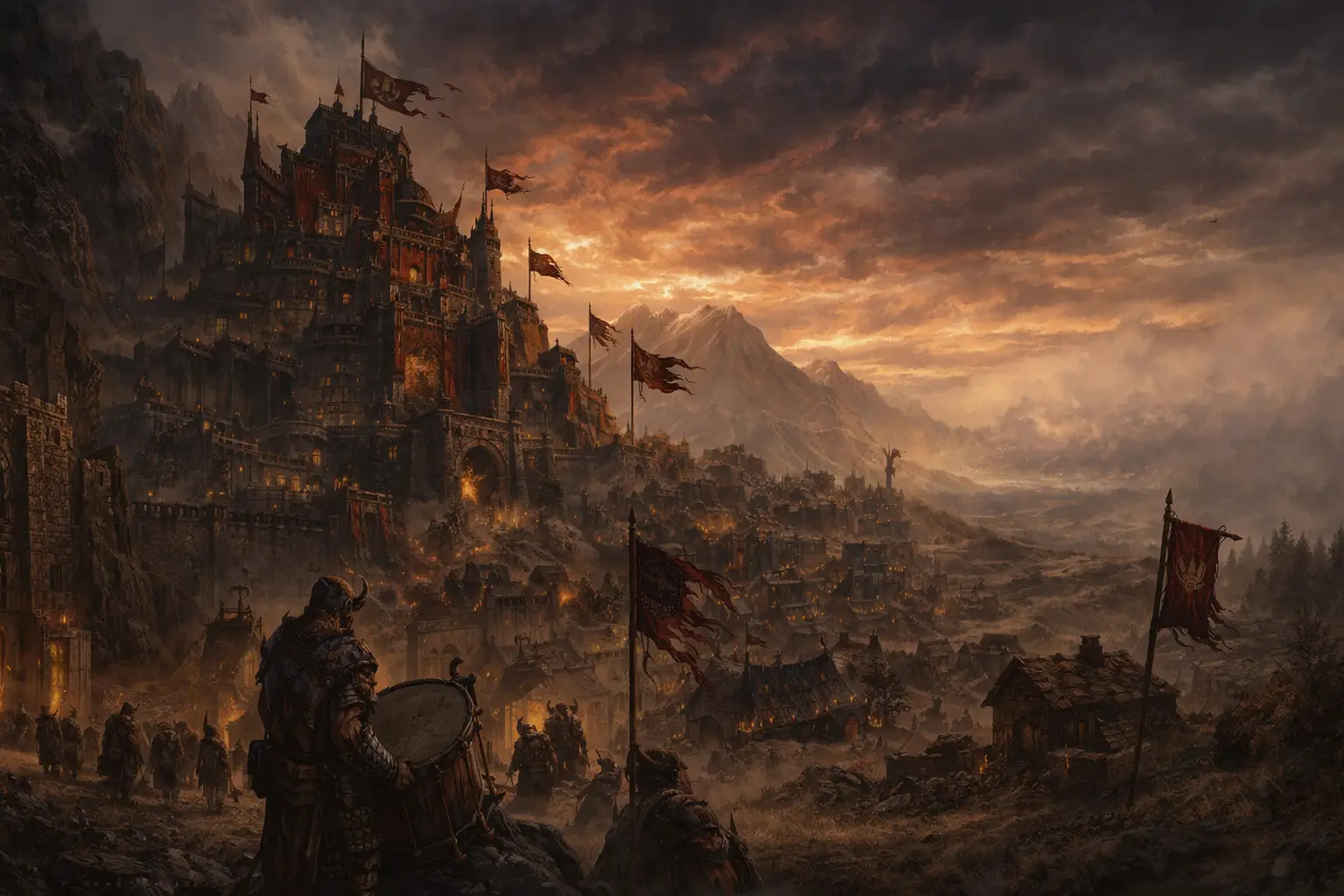
History of Darguun
"Raat shi anaa: the story continues. In the distant past, six mighty kings rose to power. Each sought to do their duty to their people: to bring them prosperity and security, to defeat all who would threaten them. Time and again, the six kings clashed on the field of battle, but the kings were matched in cunning and their warriors were equals in courage and skill. No victory could be won, and no compromise could be found." — opening of the Dhakaani creation legend, as preserved by the duur'kala
Ancient Origins
The history of the land now called Darguun does not begin with Darguun. It does not begin with the Last War, or with Galifar, or even with the arrival of humans on the continent. It begins in darkness — in the vast caverns beneath the earth where the goblinoid subspecies first emerged, some forty thousand years ago, into a Khorvaire that had never seen their kind.
Little is known of the origins of the dar with certainty. Aereni records describe warring goblinoids on Khorvaire around the time the elves settled on Aerenal, but modern scholars disagree about where those goblinoids came from. The common assumption holds that they evolved in the caverns below the surface. Kel Kador of the Library of Korranberg believes the goblinoid subspecies were magebred from a common ancestor that might still lurk underground. Hass Holan of Morgrave University has proposed the more exotic theory that the goblinoids emerged from an undiscovered demiplane within Khyber — a warlike realm whose location has never been found. The goblins themselves have little patience for such speculation. For them, the history of the dar — the "people" — begins with the history of Dhakaan. The two are synonymous.
The Empire of Dhakaan (circa –16,000 to –5,000 YK)
Approximately sixteen thousand years ago, the goblinoid culture that would become the Empire of Dhakaan coalesced on Khorvaire. The Dhakaani creation legend tells of six hobgoblin kings who warred endlessly over the continent until Jhazaal Dhakaan — the greatest duur'kala, or dirge singer, of the age — called them together on a field soaked with blood and strewn with blunted blades. Jhazaal sang the song of the dar, reminding the six kings that they were one people. She sang the song of muut, of the duty all dar share. She sang the song of atcha, of the glory awaiting those yet to come. And with her words, she wove a dream — a shared vision so powerful that it bound the six kings and all who followed them into a single purpose. It was with this song that the Empire of Dhakaan was born.
What followed was the longest and most dominant goblinoid civilization Khorvaire has ever known. The Dhakaani pushed the dwarves back into the depths of Khyber and drove the dragonborn into the eastern jungles. They repelled Tairnadal colonists from Aerenal and forced orcs, gnolls, and other peoples into the wild frontiers. The three goblinoid subspecies — the ghaal'dar (hobgoblins, "mighty people"), the golin'dar (goblins, "quick people"), and the guul'dar (bugbears, "strong people") — worked in concert, each subspecies respected for its particular strengths under a rigid but functional caste system united by muut and the shared dream. The land that would become Darguun was part of the imperial heartland: the Seawall Mountains were riddled with Dhakaani fortresses, and the lowlands to the east and north held some of the empire's most prosperous cities.
The golden age of Dhakaan lasted over five millennia.
FRAGMENT — carved in stone, found in a sealed chamber beneath the Seawall Mountains, translated by Morgrave University, circa 990 YK
Here stood the forge-hall of Duuraan Kol. Seven hundred smiths worked the adamantine seam. The sound of their hammers was the heartbeat of the empire. May it beat again.
The Daelkyr War and the Fall (circa –9,000 YK)
The golden age ended when the lords of the plane of Xoriat — the daelkyr — tore open portals and poured their armies into the material world. Mind flayers, beholders, dolgaunts, dolgrims, and worse boiled out of the rifts. The daelkyr destroyed Dhakaani cities and transformed goblinoids into aberrations, perverting the dar's own people into weapons against them. The Seawall Mountains, the heartland fortresses, the lowland cities — all were scarred or shattered.
But the Dhakaani were not easily broken. Their champions fought the aberrations with a discipline and ferocity that the daelkyr had not anticipated. They blinded the Lord of Eyes and cut the roots of the Rotting Queen. They fought Dyrrn the Corruptor and brought it down. The orc Gatekeeper druids sealed the daelkyr in the depths of Khyber, but it was Dhakaani warriors who scattered their armies and hunted down the horrors that survived.
The dar won the war and lost everything that mattered.
Even as Dyrrn fell, the Corruptor whispered — and the whisper was a weapon more devastating than any army. The Kapaa'vola, the Treacherous Whisper, was a psychic contagion that severed goblinoids from the Uul Dhakaan — the shared dream that Jhazaal had woven, the spiritual bedrock of their civilization. Where the dar had once felt unity and purpose, they now felt only paranoia, irrational impulse, and the slow erosion of everything that had held them together. The discipline of Dhakaan crumbled. The traditions of the daashor artificers and the duur'kala bards were forgotten. New religions and cults sprang up to fill the void — some embracing the Dark Six, others revering stranger things. Under Dhakaan, the subspecies had been united; in the wake of the Kapaa'vola, the strong dominated the weak, and the ancient cooperation between goblin, hobgoblin, and bugbear gave way to a hierarchy of brute force.
The duur'kala identified the threat but could not stop it. Isolation was the only answer. The greatest Dhakaani leaders gathered their forces — soldiers, scholars, artisans — and retreated into deep subterranean fortresses, sealing themselves away from the world above. They called themselves the Kech Dhakaan — the Keepers of the Empire — and they vowed to return only when the Kapaa'vola had faded and the dream of Dhakaan could be restored.
On the surface, the empire did not die all at once. The wider world's history books describe the fall of Dhakaan as a long, ugly decline spanning centuries — a slow collapse into feuding tribes and petty kingdoms. But for the Kech Dhakaan, the empire ended the moment Dyrrn whispered. Everything after was epilogue.
"Our empire was so grand that even the spirits grew jealous. The Lords of Madness crawled out of the shadows. They made monsters of our children and sought to break our people with terror. But no power could stand against the champions of Dhakaan." — from the Dhakaani creation legend
The Long Dispossession (circa –5,000 YK to 1 YK)
In the millennia after the fall, the remnants of the Dhakaani Empire fragmented into scores of warring tribes. In what would become the Darguun region, the Seawall Mountains still sheltered the largest concentration of goblinoid survivors — hobgoblin-dominated clans that remembered fragments of their imperial heritage without understanding the whole. These were the ancestors of the Ghaal'dar, the "mighty people," though that name would not be used as a political identity for thousands of years yet.
When human explorers from Sarlona first arrived on Khorvaire, they found warring goblinoid tribes living in the ruins of grand cities. Many assumed the goblinoids had claimed the remnants of a civilization they had destroyed — a human civilization, naturally. This false narrative was used to justify what followed. Humanity slowly displaced the goblinoids, seizing the lands that once belonged to Dhakaan. Goblins were often enslaved outright, put to work building the human cities that rose on Dhakaani foundations. Bugbears and hobgoblins were driven into the wild lands — the Seawall Mountains, the deep forests, the upper reaches of Khyber — wherever the humans had no use for the territory. In time, scholars discovered the truth: that the foundations were goblin, not human. Few cared. In the eyes of the Five Nations' ancestors, the goblinoids were savages, children of the Dark Six, and it was easier to keep believing that than to reckon with what had been done.
It was during this period that the terms goblin, hobgoblin, and bugbear took root — human words that stripped the dar of their own names. Even the goblinoids themselves eventually adopted them.
Under Galifar (1–894 YK)
When Galifar Wynarn began his conquest of the Five Nations, he made a promise that set him apart from the warlords who had preceded him: freedom to any goblin who fought under his banner. Goblin soldiers played a vital role in the wars of unification, and Galifar remained true to his word. Whether this was genuine compassion for the enslaved or cold political calculation — the scholarly debate continues to this day — the result was the same: goblins were freed, granted nominal citizenship, and then left to fend for themselves in a society that had never wanted them. Freedom without education, without land, without capital, without any of the tools required to build a life. The seeds of modern goblinoid poverty in the Five Nations were sown in the very act of liberation.
The territory that would become Darguun was assigned to the province of Cyre — the central jewel of Galifar's kingdom. The southern Cyran lowlands and the Seawall Mountains were considered a backwater: productive enough for farming, rich enough in minerals to warrant occasional mining operations, but far from the centers of power in Metrol. The Ghaal'dar tribes in the Seawall Mountains were known to Cyran authorities as a nuisance — raiders who occasionally struck at farms and caravans — but not a serious threat. The Cyrans built towns and villages across the lowlands, established lightning rail connections, and largely ignored the mountains except when the goblins came down from them.
In the mountains, the Ghaal'dar developed in ways their Cyran neighbors neither understood nor cared to learn about. Hobgoblins led, goblins served, and bugbears enforced — the same hierarchy of strength that had prevailed since the Kapaa'vola, but tempered by fragments of the old imperial culture that the tribes had never entirely lost. The concepts of muut and atcha — duty and personal honor — survived as abstract principles, half-understood echoes of the spiritual reality they had once been. The duur'kala preserved songs of a glorious past that grew more mythic with each generation. And beneath it all, a slow-burning anger against the chaat'oor — the defilers, the foreign peoples who had stolen their land and enslaved their ancestors — smoldered in every clan-hold in the Seawall range.
The Ghaal'dar fought among themselves constantly — clan against clan, feud upon feud — and when they were not fighting each other, they clashed with Zilargo to the west or raided Cyran settlements to the east. They were, by the standards of the Five Nations, exactly what goblinoids were supposed to be: fractious, violent, and manageable. This assessment would prove to be catastrophically wrong.
"We knew the mountain goblins were dangerous. We simply assumed they were dangerous to each other." — attributed to a Cyran provincial governor, circa 940 YK
The Mercenary Era (878–969 YK)
In 878 YK — sixteen years before the Last War began — House Deneith began brokering the services of Ghaal'dar mercenaries to clients across Khorvaire. The arrangement was straightforward: hobgoblin warriors got coin and weapons, House Deneith took a generous commission, and the Five Nations got expendable soldiers who were cheaper than human conscripts and whose deaths appeared in no memorial rolls back home. For the Ghaal'dar, the mercenary contracts served a purpose beyond income. Hobgoblin warriors who returned from service in the Five Nations brought back intelligence — knowledge of human military tactics, fortification design, supply chain logistics, and most importantly, a precise understanding of just how thin the Five Nations had stretched themselves.
When the Last War erupted in 894 YK, the demand for goblinoid mercenaries surged. Cyre and Breland both hired Ghaal'dar troops from the Seawall Mountains in ever-increasing numbers, pulling goblinoids out of the mountains and into the lowlands where they served as garrison forces, scouts, and frontline troops. The Five Nations armed them, trained them alongside human soldiers, and stationed them across southern Cyre — all without considering the strategic implications of concentrating a foreign military force in a region where it vastly outnumbered the local population.
By the mid-960s, the goblinoids had become the dominant military presence in the region. The Cyran troops who should have been guarding the southern provinces had been redeployed to the front lines against Karrnath and Thrane, and the mercenaries they had hired to replace them answered to their own commanders, not to Metrol. The situation was a sword balanced on its edge. All it needed was someone to push.
The Uprising (969 YK)
The someone was Haruuc, chieftain of the Rhukaan Taash — one of the most powerful Ghaal'dar clans. Haruuc was a brilliant strategist who saw what his employers refused to see: that the goblinoids held the military power, that the Cyrans could not respond in time, and that the moment had come for the dar to take back what had been stolen from them.
In 969 YK, Haruuc united the Ghaal'dar clans under his banner and turned the weapons the Five Nations had given him against the people he was supposed to protect.
The uprising was swift, brutal, and deliberately devastating. The Ghaal'dar did not conquer and occupy — they lacked the numbers for that. Instead, they razed what they could not hold: towns were burned, farms destroyed, temples demolished, lightning rail stations wrecked. The Cyran population was driven out or killed. This was not the restrained warfare of the Five Nations, where the belligerents had agreed on rules of engagement and avoided targeting civilian infrastructure. The uprising was a colonial liberation conducted with the fury of a people who remembered — however imperfectly — that the land had been theirs before it was anyone else's, and who understood that they could not afford to leave a functioning Cyran society behind them to regroup.
By the time central Cyre grasped the scale of what was happening, there was nothing left to save. The southern provinces were gone. The towns were ash. The lightning rail was broken. And a hobgoblin warlord stood in the ruins of the largest Cyran city in the region, holding a dead lord's helmet in one hand and a bloody sword in the other, and naming the place Rhukaan Draal — the crown city of Darguun, the land of the people.
Breland, pragmatic as always, negotiated an alliance with Haruuc almost immediately — not out of sympathy for the goblinoid cause, but because Breland needed its southern border secure and could not afford to fight a war against a new enemy while the old ones still raged. Cyre fought the goblinoids for the remaining twenty-five years of the war, never reclaiming the lost territory, until the Day of Mourning in 994 YK destroyed Cyre entirely and made the question moot.
KORRANBERG CHRONICLE — Excerpt, Barrakas 970 YK
GOBLIN MERCENARIES SEIZE SOUTHERN CYRE — CROWN IN CRISIS
"Reports from the southern provinces confirm what the crown has thus far refused to acknowledge: the goblinoid mercenary forces under the command of the warlord styling himself 'Lhesh Haruuc' have secured effective control of the region from the Seawall Mountains to the Ghaal River. Cyran military commanders describe the situation as a 'temporary insurrection.' The editors note that the insurrection has held its territory for six months and shows no sign of being temporary."
The Treaty of Thronehold (996 YK)
When the Treaty of Thronehold was negotiated in 996 YK, the majority of the delegates chose to recognize Darguun as a sovereign nation. The decision was pragmatic rather than principled — no one wanted another war, and Darguun was a fait accompli. The Cyran diaspora, scattered and homeless after the Mourning, had no voice at the table and no power to contest the legitimacy of the nation that had stolen their southern provinces. In the Five Nations, the word used for Haruuc's actions is betrayal. In Darguun, the word is liberation. The Treaty of Thronehold left both versions of events standing and resolved nothing.
Darguun was granted recognition but not trust. It was acknowledged as a treaty nation but does not meaningfully abide by the common laws of the treaty signatories. Law enforcement within its borders is local, personal, and unpredictable. Lhesh Haruuc abolished slavery in Rhukaan Draal, but some clan lords in the interior continue the practice. The broken paths of the lightning rail remain unrepaired. The institutions that the treaty nations take for granted — courts, constabularies, standardized trade law — simply do not exist in most of Darguun.
The Postwar Nation (996 YK–Present)
The Darguun of the present day is a nation that is still finding its identity — a kingdom that seeks to be more than a seized territory. In the years since Thronehold, the goblinoid population has swelled as tribes and clans from across Khorvaire have migrated to the promise of a homeland. Goblinoids from Zilargo, Valenar, the ruins of central Cyre, and the deep forests have all come to Darguun seeking a place in the new nation. This influx has strengthened Darguun's numbers but complicated its politics: the Ghaal'dar are the largest single bloc and the foundation of Haruuc's power, but the newcomers bring their own traditions, their own ambitions, and their own leaders, and not all of them are content to defer to a Ghaal'dar warlord from the Seawall Mountains.
The Marguul bugbears of the southern Seawalls remain semi-independent, acknowledging Haruuc's authority only when it suits them and raiding with impunity when it does not. Dozens of lesser clans and immigrant groups jockey for influence in Haruuc's court, where politics is conducted through challenge, alliance, and the ever-present threat of violence. The Darguuls are slowly reclaiming ruined Cyran towns and building new settlements on the old foundations — repeating, in a way that few of them consciously acknowledge, the same pattern of building on goblinoid ruins that humans followed millennia ago.
And beneath it all, in the deep places of the Seawall Mountains, clans that call themselves the Kech Volaar and the Kech Shaarat have quietly emerged into the daylight — presenting themselves as Darguul tribes with unusual traditions: scholars and warriors, respectively. The Ghaal'dar accept them at face value. The few outsiders who pay close attention may notice that these clans fight with a discipline the Ghaal'dar cannot match and carry weapons forged with techniques that predate anything in the arsenal of House Cannith.
Lhesh Haruuc holds the nation together through the same qualities that built it — brilliance, ruthlessness, and the personal loyalty of the Ghaal'dar clans. But he is mortal, and no successor has emerged who could maintain the web of alliances that keeps the peace. The rest of Khorvaire watches and waits to see whether Darguun has the will to remain a nation — or whether it will fracture the moment its founder is gone, the way every cynical diplomat in the Five Nations has always assumed it would.
The goblins carry the legacy of a mighty empire and stand in the shadow of the nations around them. Haruuc wants to draw out the best in his people, to harness their strengths and achieve the potential that the world has spent sixteen thousand years telling them they do not have. Whether he can do that — whether anyone can — is the question that defines Darguun in the postwar age.
Scratched into the wall of a Cyran ruin near Gorgonhorn, in the Goblin language, painted over by no one:
RAAT SHAN GATH'KAL DOR.
The story stops but never ends.