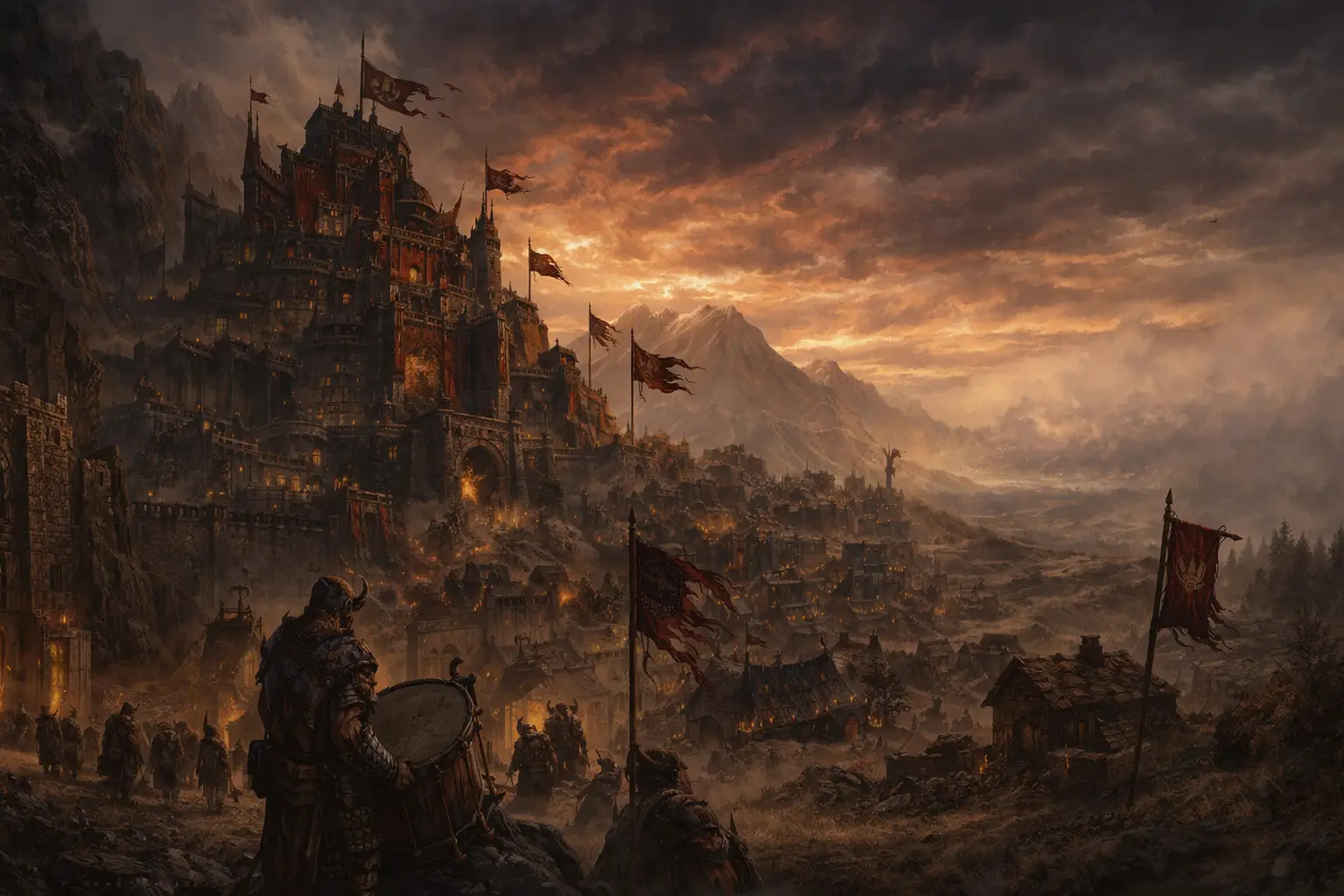
Economy & Industry of Darguun
"A Brelish factor asked me what Darguun's primary export was. I told him: violence."
A Frontier Economy
The economy of Darguun is built on three pillars — the mercenary trade, the salvage economy, and the stubborn refusal of the Ghaal'dar to starve — and held together by the same thing that holds the rest of the nation together: the personal authority of one hobgoblin and the commercial infrastructure of one dragonmarked house. It is not a sophisticated economy. It has no banking network, no codified trade law, no standardized weights and measures outside of the two cities large enough to bother, and no lightning rail. What it has is a population of natural fighters living on top of sixteen thousand years of buried treasure, next door to the richest ruin field on the continent, with a port that connects to the Kraken Bay and a relationship with House Deneith that turns goblinoid aggression into foreign currency.
Thirty years ago, this territory was the southern breadbasket of Cyre — productive farmland worked by Cyran peasants, linked to the national economy by lightning rail, and generating the kind of steady agricultural wealth that keeps a province fed and a capital comfortable. The uprising destroyed that economy utterly; the Ghaal'dar razed what they could not hold, drove the Cyran population out, and wrecked the infrastructure that connected the region to the rest of the kingdom. What remains is a frontier — thinly populated, poorly connected, rich in natural resources and ancient ruins, and governed by clan lords whose economic policy amounts to "take what you can hold and trade what you can spare."
The result is an economy that looks chaotic from the outside and functions through a combination of clan self-sufficiency, mercenary income, opportunistic trade, and the gravitational pull of Rhukaan Draal, where most of the nation's foreign commerce flows through a single chokepoint controlled by the Lhesh.
The Mercenary Trade
The mercenary trade is Darguun's most important source of foreign income and the economic engine that keeps the nation viable as something more than a collection of warring clan-holds. House Deneith has brokered goblinoid mercenary services since 878 YK — nearly a century before the founding of Darguun — and the relationship survived the uprising because both sides need it too much to let it die.
The economics are straightforward. A clan war-band that wants to hire out sends warriors to the Gathering Stone, House Deneith's fortress enclave in the interior. Deneith negotiates contracts with clients across Khorvaire, arranges transportation and translators, and takes a commission of ten to thirty percent depending on the effort required. The clan keeps the rest. For a minor clan, a single successful mercenary contract can fund a season's worth of weapons, food, and trade goods. For a major clan, the mercenary trade is the difference between prosperity and the kind of poverty that leads to internal revolt.
No one hires goblin armies — the uprising ensured that — but smaller units remain in high demand. A Ghaal'dar mercenary squad costs less than an equivalent Deneith Blademark detail and is willing to take contracts that human soldiers consider too dangerous, too distasteful, or too far from civilization to bother with. Dungeon clearing, caravan escort through hostile territory, monster hunting, frontier security — these are the bread and butter of the goblinoid mercenary trade, and the demand has not slackened since the war ended.
The mercenary trade also generates secondary economic effects. Warriors who return from deployment bring back coin, equipment, intelligence about foreign markets, and — increasingly — a taste for goods that Darguun does not produce. This drives demand for imports that flow through Rhukaan Draal and Wyvernsku'll, creating the beginnings of a consumer economy in the larger settlements. A hobgoblin who has spent two years guarding Brelish caravans develops opinions about Brelish steel, Brelish leather, and Brelish whiskey — opinions that translate into purchasing power when he returns home.
NOTICE — posted at the Gathering Stone, in Common and Goblin
HOUSE DENEITH — BLADEMARK GUILD — DARGUUN OPERATIONS
Current contracts available for qualified war-bands (minimum 8 warriors, hobgoblin command required):
— Caravan escort, Wroat to Starilaskur (6 weeks, moderate hazard) — Site security, Morgrave University excavation, Q'barra (3 months, high hazard) — Dungeon clearance, private client, Seawall foothills (duration variable, extreme hazard, bonus for intact artifacts)
All contracts subject to Deneith evaluation. Compensation includes standard commission, equipment maintenance, and return transport. Warriors who desert mid-contract forfeit all compensation and are barred from future service.
Apply to the duty officer. Bring your weapons. Leave your grudges at the gate.
The Salvage Economy
Darguun sits on two overlapping layers of ruin, and both are worth money.
The first layer is Cyran. The uprising razed or abandoned most of the towns, villages, and infrastructure of southern Cyre, but "abandoned" does not mean "empty." Burnt-out farmsteads still contain Cyran metalwork, stonework, and occasionally more valuable goods — alchemical supplies, arcane equipment, personal treasures left behind by fleeing civilians. The broken lightning rail stations contain conductor stones that House Orien would pay handsomely to recover. Cyran military installations, hastily evacuated during the uprising or the Mourning, may hold weapons, armor, and supplies that have sat untouched for decades. Scavengers and salvagers — goblinoid and otherwise — work the Cyran ruins as a secondary industry, selling what they find in the markets of Rhukaan Draal or to foreign buyers who come through Wyvernsku'll.
The Mournland border adds a dangerous premium to the salvage trade. Gorgonhorn serves as the staging point for salvagers who venture into the dead-grey mist seeking the richer pickings of central Cyre — Cannith forges, military depots, noble estates, and the countless artifacts of a destroyed civilization. The returns can be extraordinary. The risks are commensurate. Many salvagers who enter the Mournland do not come back, and those who do sometimes bring things back with them that they did not intend to carry.
The second layer is Dhakaani. The Seawall Mountains and the lowlands are peppered with dungeons, ruins, and sealed vaults dating back to the ancient goblin empire — forge-halls, burial chambers, fortified outposts, and structures whose purpose no living scholar can determine. These ruins are found throughout the Torlaac Moor, beneath the Khraal rainforest, and deep in the Seawall peaks. Some have been picked clean by millennia of casual looting; others remain sealed and unexplored, their wards and guardians still functional after sixteen thousand years.
Dhakaani ruins are valuable because Dhakaani craftsmanship was extraordinary. Adamantine weapons and armor forged in the imperial age are immune to the ravages of time and command staggering prices in the markets of Sharn and Wroat. Artifacts of the duur'kala — magical instruments, warhorns, and items crafted with techniques that predate the Arcane Congress by ten millennia — are even more valuable, and considerably more dangerous to possess. A clan lord who controls territory containing a significant Dhakaani ruin sits on a resource more valuable than a gold mine, and the politics of ruin access — who can enter, what they can take, and who gets paid — are among the most contentious economic disputes in Darguun.
Adventurers seeking access to Dhakaani ruins should expect to negotiate with the local clan lord, pay a substantial access fee or agree to a percentage split on recovered goods, and accept that anything identifiably Dhakaani may attract the attention of parties who consider it stolen property — whether that means a Ghaal'dar clan that claims the site or something older and more disciplined emerging from the deep mountains to reclaim what it considers the heritage of the empire.
"The dungeons are the only honest business in Darguun. The dungeon doesn't care what clan you belong to. The dungeon just wants to kill you equally." — overheard in a Rhukaan Draal tavern
Rhukaan Draal and Wyvernsku'll
Rhukaan Draal is the economic as well as the political capital — the hub through which most foreign commerce enters and exits the nation. The city's markets are a strange layering of Cyran architecture and goblinoid construction: human market squares retrofitted with hobgoblin stalls, goblin warrens sprawling through basements that once held Cyran warehouses. The goods available range from standard provisions and weapons to salvaged Cyran artifacts, Dhakaani relics of varying authenticity, smuggled goods from across Khorvaire, and services that would be illegal in the treaty nations.
Rhukaan Draal is also a haven for smugglers and black-market traders. The city does not extradite, does not investigate foreign crimes, and does not ask where your goods came from. Dreamlily, dragon's blood, stolen artifacts, forged documents, and goods subject to trade restrictions in the Five Nations all move through Rhukaan Draal's markets with minimal interference, provided the traders pay their respects — and their cut — to the Lhesh's functionaries. This is not an oversight; it is economic policy. The grey market generates revenue, attracts skilled and desperate individuals, and gives Darguun a commercial niche that no treaty nation can openly compete with.
Wyvernsku'll, on the Kraken Bay, is Darguun's primary seaport and the gateway for maritime trade. The goblinoids who live there are sociable, rowdy, and notably friendlier to outsiders than most Darguul settlements — a port town in the most practical sense, where coin matters more than clan. Ships from Zilargo, Breland, the Lhazaar Principalities, and occasionally Karrnath dock at Wyvernsku'll, and the taverns and markets cater to a mixed clientele of sailors, merchants, and goblinoid traders. The port handles exports of salvaged goods, raw materials from the Seawall Mountains, and whatever the clans have to sell, and imports of finished goods, weapons, tools, and luxury items that Darguun does not produce domestically.
The Dragonmarked Presence
House Deneith dominates the foreign commercial presence in Darguun and functions as the primary intermediary between the goblinoid economy and the continental market. The Gathering Stone is the house's operational headquarters in the region, and all mercenary contracts flow through its offices. Deneith also provides the most reliable security for foreign merchants operating in the interior — a service that is not optional so much as essential, since a merchant traveling without Deneith protection outside the major cities is gambling with their life and their cargo.
Beyond Deneith, the other dragonmarked houses maintain a cautious and minimal presence concentrated almost entirely in Rhukaan Draal and Wyvernsku'll. House Sivis operates translation services and a small message station in the capital — vital in a nation where Goblin, Common, and a dozen clan dialects compete for primacy. House Jorasco maintains a healing enclave, doing steady business in a nation where combat injuries are a daily occurrence. House Orien has explored the possibility of repairing the broken lightning rail, but the project remains in the survey phase — the conductor stones were badly damaged during the uprising, and the interior clans have shown no particular eagerness to restore infrastructure that would make their territory more accessible to outsiders.
House Kundarak has not established a formal presence. In Darguun, your wealth is what you can carry, and banking is a concept that the Ghaal'dar find either irrelevant or suspicious. The closest thing to a banking system is the practice of depositing valuables with Deneith at the Gathering Stone, where they are secured by the house's military garrison rather than by vaults and wards.
Clan Economics
Outside the two cities, the Darguul economy operates at the clan level — subsistence supplemented by trade, raiding, and whatever resources the clan's territory provides. Each clan is functionally self-sufficient: they grow or hunt their own food, forge their own weapons, build their own shelters, and trade surpluses with neighboring clans or with merchants passing through on the roads between Rhukaan Draal and the interior.
The lowland clans that occupy reclaimed Cyran farmland have the most conventional economies — agriculture, herding, and light manufacturing in the ruins of Cyran workshops. The mountain clans of the Seawalls rely more heavily on mining, hunting, and the extraction of resources from Dhakaani ruins. Some clans have developed specialized crafts — particular styles of weapons-smithing, leather-working, or stonecraft — that give them a trade advantage, and inter-clan commerce in these specialties is one of the few economic activities that crosses clan boundaries without generating violence.
Goblins occupy the lowest rung of the Ghaal'dar economic hierarchy. They perform the menial labor — farming, hauling, cleaning, cooking — that keeps clan settlements functional, and they receive the smallest share of the clan's wealth. A goblin artisan with a genuine talent for smithing or leatherwork may earn a measure of respect, but the default position of goblins in the Darguul economy is servitude in all but name. Haruuc's abolition of formal slavery in Rhukaan Draal has not changed the economic reality for most goblins in the interior, where the distinction between "servant" and "slave" is largely theoretical.
Bondage and Forced Labor
The economy of Darguun runs partly on slavery, and any honest account of the nation must say so plainly.
When the Ghaal'dar seized southern Cyre in 969 YK, most of the Cyran population fled. Those who remained — those who could not run, or chose not to, or were simply too slow — were killed or enslaved. The Cyrans who survived as captives became the property of the clans that took them, put to work in fields, forges, mines, and households under conditions that varied from brutal to merely grim depending on the temperament of the clan lord. Some captives were worked to death. Others adopted Darguul customs and, over the years, earned a grudging place in the clan structure — not freedom in any sense a Brelish lawyer would recognize, but a status closer to "valued servant" than "expendable resource." Their children, born in captivity, have known no other life.
Lhesh Haruuc has formally abolished slavery within Rhukaan Draal, and in the capital, the edict is enforced — no open slave markets operate, and captives brought within the city walls are technically free. This is one of Haruuc's concessions to the treaty nations and to House Deneith, which has made it clear that its continued partnership depends on the appearance of reform. But the Lhesh's authority does not extend uniformly across the interior, and many clan lords continue the practice without apology. Some hold Cyran captives taken during the uprising — humans who have now spent nearly thirty years in bondage, and whose children have never known anything else. Others have acquired new captives through raiding, through the slave trade that moves quietly through Rhukaan Draal's grey market despite the Lhesh's edict, or through the simple exercise of clan authority over anyone too weak to resist.
The slave economy is not formalized in the way that, say, the Riedran labor system is formalized. There are no slave codes, no legal framework governing the treatment of captives, and no mechanism for appeal. A captive's fate depends entirely on the clan that holds them. In some clans, particularly those with regular contact with the Five Nations through the mercenary trade, captives are treated as low-status workers — fed, housed, and kept functional because a dead laborer produces nothing. In others, particularly among the Marguul and the more isolated mountain clans, captives are disposable assets whose lives are worth less than the tools they use.
The non-goblinoid population of Darguun is small — perhaps six percent, mostly humans — and a significant portion of that number consists of people who came to Darguun voluntarily after the war to do business. But an unknown number are captives or the descendants of captives, and the distinction between the two groups is not always visible to an outsider. A human working in a Rhukaan Draal market stall might be a free merchant, a former captive who has earned a measure of autonomy, or a person who is technically someone's property and has learned to smile about it. The Darguuls do not draw the lines where the Five Nations would draw them, and the Darguuls do not consider this a problem.
The irony is not lost on anyone who cares to notice. The Ghaal'dar — a people who were themselves enslaved by humans for over a millennium, whose rage at that history fueled the uprising — have built a nation in which slavery is an open practice. The duur'kala sing songs of the chaat'oor defilers who stole the dar's land and forced them into bondage, and those songs are true. They simply do not mention what the dar did next.
"The Brelish ambassador asked the Lhesh about the slaves. Haruuc told him to ask the Cyrans what they called the goblins who built their cities. The ambassador did not raise the subject again." — attributed to a Deneith officer present at the exchange
Trade and Transit
Darguun's trade connections are limited by geography, damaged infrastructure, and the simple fact that most of its neighbors regard it with suspicion.
The broken lightning rail is the most visible infrastructure gap. King Jarot's pre-war public works project connected southern Cyre to the national rail network, but the uprising destroyed the conductor stone paths, and they have not been repaired. Travel into the interior relies on roads — many of them former Cyran roads in various states of disrepair — and river routes along the Ghaal and Torlaac rivers. Overland travel is slow, dangerous, and entirely dependent on the attitude of whatever clan controls the territory you are passing through.
Maritime trade through Wyvernsku'll connects Darguun to the wider Khorvairian market via the Kraken Bay. This is the nation's most reliable trade route, and most imports and exports flow through the port. The Torlaac River provides some internal water transit, but it is not navigable for large vessels in its upper reaches, and the lower stretches pass through territory that is not always friendly to commercial traffic.
Darguun's primary trade partners are Breland (which buys mercenary services and salvaged goods and sells finished weapons and manufactured items), Zilargo (cautious, maritime-focused, conducted through intermediaries), and the Lhazaar Principalities (who will trade with anyone and ask fewer questions than most). Karrnath maintains a vestigial trade relationship dating from the wartime exchange of goblinoid mercenaries for Karrnathi arms. The Cyran diaspora does not trade with Darguun. The other treaty nations deal with the goblinoid nation only through Deneith or not at all.
From the ledger of a Zil merchant, name withheld, recovered by the Trust, Nymm 997 YK:
"Delivered to Wyvernsku'll: 40 casks Korranberg brandy, 12 bolts Trolanport silk, 6 cases Zil glasswork. Received in exchange: 200 lbs. salvaged Cyran copper, 14 Seawall iron ingots, 1 adamantine dagger of uncertain provenance (authenticated by Sivis scryer — Dhakaani, estimated age 9,000 years — do NOT declare at Zilargo customs).
Profit: considerable. Risk: also considerable. Will return in Olarune."