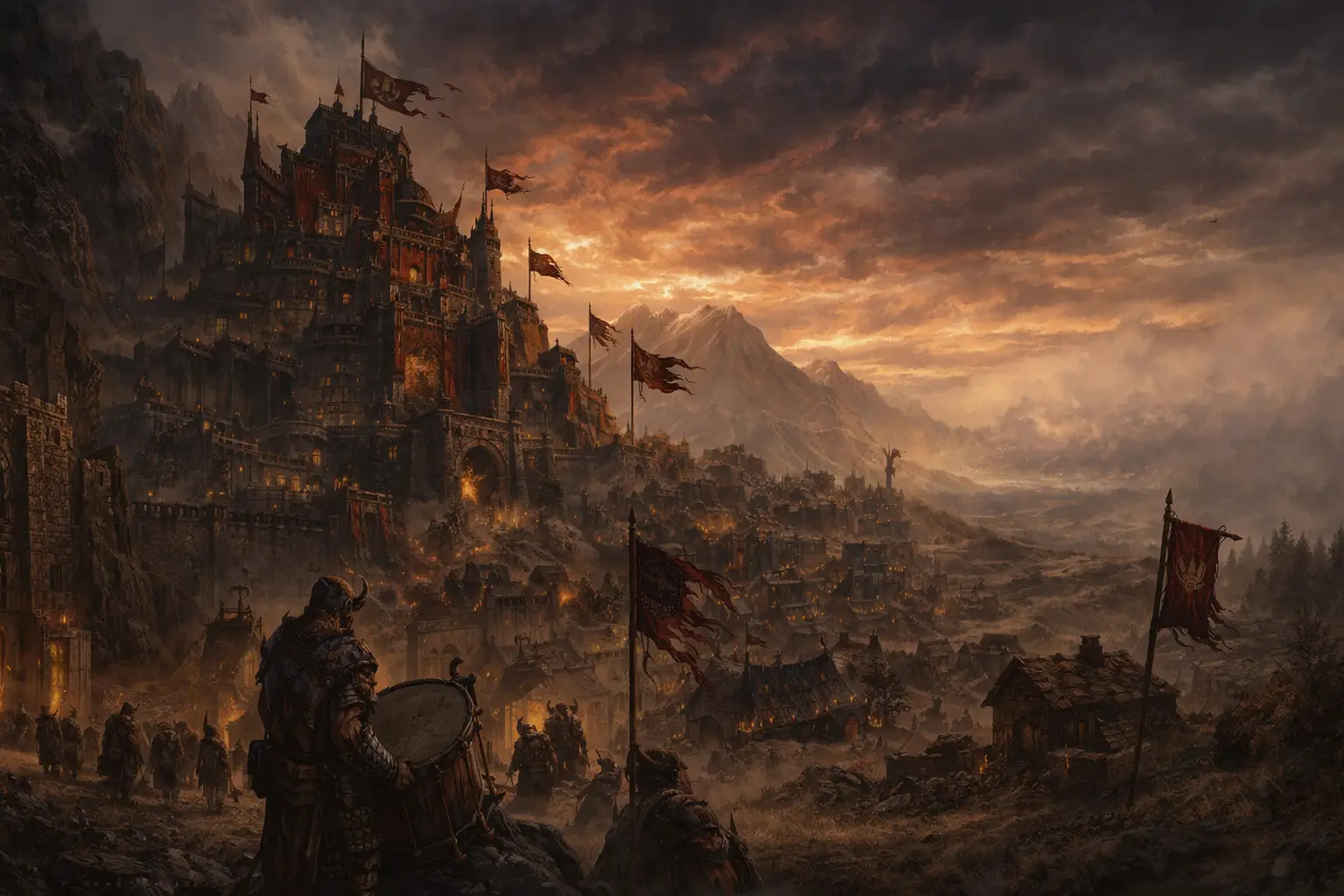
Art & Culture of Darguun
"A Brelish scholar came to Rhukaan Draal to study goblin art. She expected cave paintings. She found a hobgoblin smith forging a sword so precisely balanced that a Cannith artificer wept when he examined it — and when she asked the smith whether the blade was art or craft, he looked at her with genuine confusion and said, 'It is a sword.'" — from the travel journals of Selen Harlas, Korranberg Chronicle correspondent
It Is a Sword
The smith's confusion is the key to everything. In Darguun, the question "Is it art?" has no meaning, because art is not a category the Ghaal'dar recognize as separate from the thing itself. A beautifully balanced sword is a sword. A precisely fitted set of armor is armor. A war chant that synchronizes forty warriors into a single striking body is a war chant. The beauty is in the function — not in any ornament added after the fact — and the finest Darguul objects are those where form and purpose are so perfectly united that the thing seems inevitable, as though it could not have been made any other way. The Brelish scholar expected cave paintings. She found a civilization whose entire aesthetic tradition is built on the principle that if you have to explain why something is beautiful, you made it wrong.
This does not mean the Darguuls lack an artistic life. It means their artistic life is organized around principles so different from human assumptions that the visitor must recalibrate before they can see it. The ghaal'ruk war display is art. The duur'kala's dirge is art. The angle of a hobgoblin's ears as she communicates contempt without moving her mouth is art. The pattern of scars on a Marguul raider's chest is art. None of these are called art. All of them are practiced with a seriousness and precision that would impress a Thuranni costumer, and all of them serve a function that the practitioner considers more important than impressing outsiders.
The culture is not one thing. The Ghaal'dar lowland clans carry the broadest tradition — martial, clan-centered, shaped by centuries of mountain living and decades of mercenary service in the Five Nations. The Marguul bugbears of the southern Seawalls follow a harsher variant stripped of what they consider pretension. The immigrant clans bring customs from Zilargo, Valenar, and the Khraal rainforest. And threading through it all, the duur'kala preserve a tradition of oral history and magical music that stretches back to the Empire of Dhakaan — the one thread of high culture that survived the long dark, diminished but unbroken.
Built on Bones
The lowland towns were built by Cyrans, and the Ghaal'dar who live in them inhabit human architecture that was never designed for goblinoid bodies — doors too tall, ceilings too high, rooms proportioned for a species that stands a foot taller and doesn't think in terms of communal sleeping quarters. Some clans have modified the structures: lowered ceilings, partitioned rooms, Cyran decorative elements ripped out and replaced with clan insignia. Others have simply moved in and left the proportions as they stand — treating the human scale as a minor inconvenience, or as a trophy.
The Dhakaani layer is older, deeper, and more spiritually charged. The Seawall Mountains are riddled with ancient fortresses and forge-halls whose engineering surpasses anything in the modern Five Nations — structures that have endured sixteen thousand years without significant degradation. These are not abstract history to the Darguuls. They are physical proof that the dar once built something magnificent. A clan-hold built into a Dhakaani fortress uses the ancient walls for defense while storing grain in a chamber that a Morgrave archaeologist would weep over. The goblinoids do not see a contradiction. The fortress was built to be used. They are using it.
The Duur'kala: The Voice That Carries
The duur'kala — the dirge singers — are the keepers of the only unbroken artistic tradition connecting the modern Ghaal'dar to the Empire of Dhakaan. The word duur means "dirge" or "song of the past," and the duur'kala are exactly that: singers of history, voices that carry sixteen thousand years of goblinoid civilization through an oral tradition that has never been written down and never needed to be.
Among the Ghaal'dar, the duur'kala tradition survives in diminished but vital form. Ghaal'dar dirge singers do not wield the deep magic of their Dhakaani ancestors — the Kapaa'vola severed the spiritual connection that made the strongest duur'kala spellwork possible — but they remain honored figures. A skilled duur'kala commands respect from even the most brutal clan lord, because the dirge singer remembers the clan's deeds, sings the songs that make warriors fight harder, and knows the names of the dead. To silence a duur'kala is to erase the history of the people, and even the most blood-soaked warlord understands that some things are sacred.
The primary instrument is the duum — a large goblin drum with a deep, resonant voice, played with short thick rods of brass or heavy wood. The sound carries for miles across the lowlands, and the rhythms encode messages that goblinoid ears read as clearly as written text. A duum sounding from a distant clan-hold might announce a victory, summon warriors, mourn the dead, or warn of approaching danger — and anyone who has lived in Darguun for long enough can tell the difference. The kiirin, a traditional stringed instrument, accompanies the voice in more intimate settings: clan feasts, council gatherings, the long nights when the dirge singers tell the old stories by firelight.
SONG — traditional Ghaal'dar war chant, sung before battle; many clan variants exist
Khaar ran muut, khaar ran atcha — Blood is the price of duty, blood is the price of honor. Raat shi anaa, raat shi anaa — The story continues, the story continues. Let the chaat'oor hear our names.
The Ghaal'ruk
Among the Ghaal'dar, no tradition captures the intersection of warfare and culture more viscerally than the ghaal'ruk — the war display. Performed before battle, at formal feasts, during clan gatherings, and on any occasion when a warband wishes to announce itself, the ghaal'ruk is a collective performance of stomping, chanting, chest-beating, and weapon-striking that builds from a low rhythmic pulse into a thunderous crescendo of coordinated movement and voice.
The performers — typically an entire warband, or guests of particular honor — arrange themselves in tight formation, stamp their feet in unison to establish a driving beat, and then layer vocal calls, guttural shouts, and percussive strikes on armor and shields over the rhythm. The chants vary by clan and occasion: a Rhukaan Taash ghaal'ruk before battle recounts the deeds of Haruuc's uprising; a Gantii Vus display at a feast might challenge a rival clan to match their honor; a Ja'aram performance for visiting dignitaries declares the warband's lineage and dares the audience to question their worth. The ghaal'ruk is many things at once. It is a martial warm-up, synchronizing the warband's movements and breathing before combat. It is a display of unit cohesion — a warband that performs a tight, coordinated ghaal'ruk is advertising that they fight as one body, and a warband that stumbles through it is advertising the opposite. It is an act of intimidation, intended to shake the nerve of anyone watching who might be considering a fight. And it is, unmistakably, art — a form of communal expression that the Ghaal'dar take as seriously as any court poet in Fairhaven takes a sonnet, and that they practice with a dedication that would surprise anyone who assumes goblinoids lack an aesthetic life.
The performances are not gentle. Dancers split knuckles on their breastplates and draw blood from their own forearms with open-palmed strikes. The eye contact is unflinching — performers lock gazes with specific members of the audience, daring them to look away. The tongue is extended, the eyes are widened, and the face is contorted into expressions of exaggerated fury and contempt. Among the Ghaal'dar, who can read the subtleties, each gesture carries specific meaning: the extended tongue is a challenge to the enemy to taste their own defeat; the widened eyes announce that the warriors see everything and fear nothing; the rhythmic stomping declares ownership of the ground beneath their feet. Foreign visitors who have witnessed a full ghaal'ruk at court report that it is one of the most physically intimidating experiences available on the continent, and that the line between performance and genuine threat is vanishingly thin.
KORRANBERG CHRONICLE — cultural correspondence, Nymm 998 YK
Your correspondent attended a formal reception at Khaar Mbar'ost at which the Lhesh Haruuc introduced a delegation from House Deneith. Before the delegation was presented, a war-band of the Rhukaan Taash performed what the goblinoids call a ghaal'ruk — a war display of approximately ten minutes' duration. The war-band stamped, chanted, beat their fists against their armor, extended their tongues, and produced facial expressions that I can only describe as weaponized. The Deneith factors, to their credit, did not flinch; the rest of us certainly did.
I am told that the performance was considered moderate by local standards. I would not care to witness the immoderate version.
What the Ears Say
Goblinoid body language is alien to human observers and far richer than most outsiders realize. The pointed ears of the dar — more flexible than human ears — function as a primary channel of emotional and tactical communication. A skilled observer can read a hobgoblin's mood, intent, and attitude entirely from the angle and movement of the ear tips, the way a human reads a face.
Two quick flicks: alert signal among allies, be on guard. Ears pressed flat: suppressed anger or readiness to fight. Ears angled forward: attention and interest. Ears rotated outward, exposing the inner surface: contempt — the goblinoid equivalent of turning your back on someone without the vulnerability of actually doing so. Dropped gaze while speaking: respect. Looking over your head: disdain. Closed eyes while facing you directly: trust — the most intimate gesture in goblinoid body language, because it means they are relying on their ears alone and have chosen to lower their guard.
Soldiers in the field use ear signals the way human soldiers use hand gestures — silent coordination that can move a squad without making a sound. Deneith officers who train alongside Ghaal'dar mercenaries learn the basic ear vocabulary early, because misreading a goblinoid's ears in a tense situation can be fatal.
Dressed to Fight, Marked to Remember
Ghaal'dar fashion is martial, functional, and clan-specific. Most goblinoids wear what they can fight in — leather, hide, and metal that doubles as everyday clothing, supplemented by clan tokens: dyed arm-wraps, painted shields, specific patterns of scarification, and the distinctive armored half-masks covering the lower face. Higher-ranking warriors personalize the mask design — an honored ancestor, an imposing beast, a reputation made visible. Rank-and-file wear masks tied to clan identity. Officers sport hornlike protrusions on helmets or shoulder plates indicating rank through a system immediately legible to any goblinoid and completely opaque to outsiders.
Tattoo and scarification are widespread. The Ghaal'dar favor clan symbols, kill-tallies, and stylized depictions of the Mockery's war-aspect. The Marguul practice more extreme scarification, treating the body as trophy display — scars from defeated enemies worn with the pride a Karrnathi knight wears medals.
Color in Darguul design operates by different rules. Goblinoid darkvision perceives color in shades of grey, and Dhakaani art was designed for dim subterranean tunnels. Color combinations that seem garish to human eyes are intentional — chosen for how they contrast in darkness, not in full light. A warrior whose armor is painted in what a Brelish merchant calls "hideous" shades of orange and purple has chosen those colors because they produce a striking pattern in darkvision. If the merchant wants to understand Darguul aesthetics, he needs to blow out the candle first.
What the Mountain Feeds
Ghaal'dar cuisine descends from Seawall mountain cooking — calorie-dense, heavily spiced, thick, chewy, built to travel, and built to share. The dar palate favors sour and bitter flavors over sweet, with strong spices used for preservation and to mask the taste of ingredients a Brelish diner would politely decline. Waste is a moral failing.
The staple is noon — a starchy grain pressed into compact balls and eaten with broth, pickled vegetables, or smoked meat. Lizard and snake provide protein and eggs; dehydrated lizard jerky is the trail staple every warrior carries and most human visitors describe as "challenging." Pickled everything — vegetables, eggs, fish, fungi — is ubiquitous, the primary preservation method for a culture that spent millennia in mountain caverns without cold storage.
The golin'dar — goblins — have a pronounced sweet tooth that their hobgoblin overlords consider undignified. Goblin cooks produce small honey-cream buns called shaat'aar that are privately beloved across all three goblinoid subspecies, though a self-respecting hobgoblin will not admit to enjoying them in public. Goblinoid stomachs are often lactose-intolerant, which means that the dairy-heavy cuisines of Breland and Aundair are genuinely uncomfortable — a biological fact that has contributed to the widespread goblinoid conviction that human food is fundamentally untrustworthy.
Korluat — "hero's blood" — is a Seawall clan-hold brew best described as "aggressive." Rhukaan Draal's taverns serve it alongside looted Cyran wines, imported Brelish ale, and whatever the smugglers bring through Wyvernsku'll. A feast at a clan-lord's table features communal platters of noon-balls, roasted snake, pickled mountain vegetables, and enough korluat to incapacitate a regiment.
MENU — feast of the Rhukaan Taash, Khaar Mbar'ost, Barrakas 997 YK
Noon-balls in bone broth. Roast mountain lizard with charred pepper and bitter root. Pickled cave-fish eggs. Snake jerky in spiced oil. Grilled worg-flank (reserved for officers and honored guests). Shaat'aar honey buns (served last).
Korluat: unlimited. Visitors are advised to dilute with water.