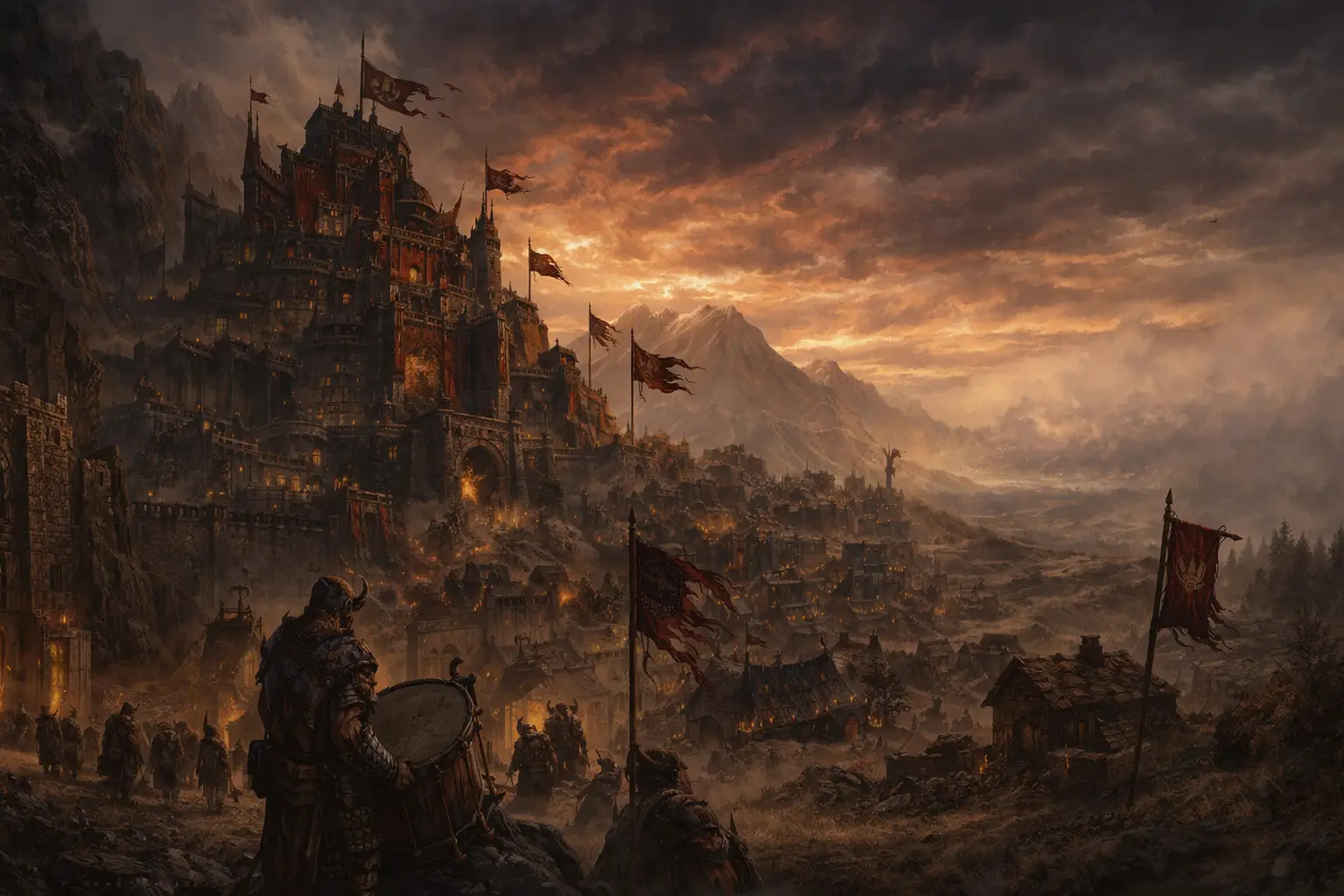
Politics of Darguun
From the field notes of Sentinel Marshal Torrik d'Deneith, seconded to the Gathering Stone, Olarune 997 YK:
I have been in Darguun for four months. In that time I have witnessed six challenges for clan precedence, two blood feuds settled by single combat, and one argument over a mining claim resolved when the Lhesh broke a table with his fist and told all three parties they could share the ore or he would take it himself. They shared.
There is no code of law here. There is no bureaucracy. There are no courts. What they have is Haruuc. The Lhesh's word is the only law that functions across clan boundaries, and it functions because every clan lord in the hall has personally seen what happens when someone defies it. This is not governance. It is managed violence. And it works — until it doesn't.
I recommend we continue routing all contracts through the Red House directly. Dealing with individual clan lords is a game with rules that change depending on who is standing closest to you.
The Governing Structure
Darguun has no parliament, no constitution, no codified body of law, and no civil service. It is governed — to the extent the word applies — through the personal authority of Lhesh Haruuc Sharaat'kor, whose power rests on a shifting web of alliances, rivalries, and debts among the Ghaal'dar clan lords who swore fealty to him during the uprising of 969 YK. The Treaty of Thronehold recognized Darguun as a sovereign nation in 996 YK, but the treaty's assumption that Darguun would eventually develop the institutions of a normal state has not materialized. What the Ghaal'dar have instead is a tribal federation held together by one hobgoblin's brilliance and the clans' collective memory that being united is more profitable than being at war with each other.
The system works because Haruuc is exceptional — a strategist, a politician, and a fighter whose personal authority is reinforced by thirty years of demonstrated competence. When those qualities produce results, the clans cooperate, trade flows, and Darguun functions with a rough efficiency that outside observers consistently underestimate. When they don't — when a clan lord sees more advantage in defiance than in loyalty, or when the Lhesh's attention is elsewhere — the seams show immediately, and the only recourse is the same one that built the nation in the first place: force, or the credible threat of it.
The critical fact of Darguul governance is that every person in Darguun knows this arrangement depends on one mortal hobgoblin. Every clan lord is, consciously or not, already positioning for the day when that hobgoblin is gone.
Lhesh Haruuc Sharaat'kor
The title Lhesh is an old Dhakaani military rank meaning "high warlord" — a general given command of a significant portion of an army for a set duration. That Haruuc has held the rank for nearly three decades, and that he uses it as the title of a head of state rather than a military commission, tells you most of what you need to know about how Darguun translates its imperial heritage into modern governance.
Haruuc rules from Khaar Mbar'ost — the Red House — a fortress in Rhukaan Draal that he claimed during the uprising. He holds court in the manner of a warlord receiving his vassals: clan lords attend to present grievances, negotiate disputes, and demonstrate their continued loyalty. The court has no formal schedule, no written agenda, and no rules of procedure that a Brelish parliamentarian would recognize. What it has is Haruuc in a chair at the center of a room full of armed hobgoblins, listening to whoever has earned the right to speak and settling disputes with a combination of shrewd diplomacy and the ever-present understanding that his personal authority is backed by the largest and most experienced war-band in the nation.
Haruuc is a warrior first and a diplomat second, but that framing undersells his political acuity. He negotiated the Treaty of Thronehold to Darguun's advantage when the Five Nations expected a goblin savage they could outmaneuver. He has maintained the Ghaal'dar federation through three decades of internal pressure, external skepticism, and the constant temptation for individual clan lords to splinter off. He has used House Deneith to project Darguun's economic power through the mercenary trade while keeping the house at a distance that prevents it from becoming a rival center of authority. He has promoted religious reform, legal reform within Rhukaan Draal, and the beginnings of a diplomatic identity — all without the institutional support that any other head of state on Khorvaire takes for granted.
The question that defines Darguul politics is not whether Haruuc is competent. The question is what happens next.
"In Wroat, the king has advisors. In Fairhaven, the queen has generals. In Rhukaan Draal, the Lhesh has his sword and his voice, and both of them cut." — overheard in a Wyvernsku'll tavern
The Clan Lords
Beneath Haruuc, the nation is organized around the Ghaal'dar clan structure. Each significant settlement in Darguun is the domain of a single clan, and the clan lord — a hobgoblin warlord who has earned or seized the position through strength, cunning, or both — holds absolute authority within it. The clan lord collects tribute from the inhabitants, maintains the local war-band, settles disputes among clan members, and answers to Haruuc in matters that cross clan boundaries. In practice, "answers to Haruuc" means "obeys Haruuc when the Lhesh is watching and does whatever serves the clan's interests when he is not."
This structure is not feudalism in the way that the Five Nations practice it. Clan lords do not inherit their positions by blood; they hold them by proven competence and the willingness of their warriors to follow them. A lord who shows weakness will be challenged, and challenges are not metaphorical — they are duels, sometimes to first blood, sometimes to the death, and always conducted in front of witnesses whose respect must be earned and maintained. The Ghaal'dar rarely kill in casual dominance disputes, but the line between a casual dispute and a serious one is drawn by the participants, not by law.
The result is a political landscape that shifts constantly. Alliances form and dissolve based on shared interests, personal grudges, and the relative strength of the clans involved. A clan lord who was Haruuc's staunch ally last season may be testing the limits of the Lhesh's authority this season, and a clan that was marginal a year ago may have grown powerful enough to demand a seat at the court table. Travelers who visit the same settlement six months apart may find it under different management entirely.
Some clans are welcoming to outsiders and actively seek commerce with the Five Nations. Others despise non-goblinoids and will rob, enslave, or kill foreigners who enter their territory without the protection of a powerful patron. There is no reliable way to know which kind you are dealing with until you arrive, and the Lhesh's edicts regarding the treatment of visitors are enforced only in Rhukaan Draal and the settlements closest to his direct influence.
Law and Justice
Darguun does not operate under the Galifar Code of Justice or any equivalent legal framework. The Treaty of Thronehold recognized Darguun as a sovereign nation, but the treaty's common laws are not enforced within its borders. Acts considered criminal in the Five Nations — assault, theft, extortion, slavery — are part of daily life in much of Darguun, and what constitutes a crime depends entirely on which clan controls the territory and what the local lord considers unacceptable.
In Rhukaan Draal, Haruuc has made some effort to establish a legal baseline. He has formally abolished slavery within the capital — though enforcement beyond the city walls is another matter. He has established that murder within the capital requires the Lhesh's sanction or the justification of an honorable challenge, and that foreign merchants operating under House Deneith's protection are not to be robbed without cause. These are not laws in the codified sense; they are the Lhesh's personal edicts, backed by his personal authority, and they last precisely as long as that authority holds.
Outside Rhukaan Draal, justice is clan justice. A goblin who steals from a clanmate answers to the clan lord. A goblin who steals from a member of another clan has started a feud. A foreigner who is wronged has no recourse unless they have the strength to take it or a patron powerful enough to demand it on their behalf. House Deneith's Gathering Stone and its associated outposts are the only places in the interior where a consistent standard of conduct applies — and that standard is Deneith's, not Darguun's.
The concepts of muut and atcha — duty and honor — provide an informal ethical framework that most Ghaal'dar recognize, but these are cultural values, not enforceable rules. A hobgoblin who violates muut by betraying a sworn oath may lose standing among the clans, but there is no court that will hear the case and no sentence that will be imposed. Honor is its own currency in Darguun, and like all currencies, its value fluctuates.
NOTICE — posted in Goblin and Common at the gates of Rhukaan Draal, Aryth 997 YK
BY WORD OF THE LHESH:
Merchants bearing the seal of House Deneith may conduct business within the walls of Rhukaan Draal without interference. Those who break this peace will answer to the Red House.
Those who cannot read may ask any warrior of the Rhukaan Taash for a translation. Ignorance is not a defense. Stupidity is not an excuse.
Clans & Tribes of Darguun
Darguun is not a nation of citizens — it is a nation of clans, and the political landscape of the country is impossible to navigate without understanding who those clans are, where they sit, and what they want.
The three broad factions of Darguul society are the Ghaal'dar — the hobgoblin-dominated lowland federation that forms the political backbone of the nation; the Marguul — the bugbear-dominated highland clans of the southern Seawall Mountains who acknowledge Haruuc's authority only when it suits them; and the strange clans — groups that have appeared since the founding, presenting themselves as isolated tribes with unusual traditions, and whose true nature is a matter of considerable interest to those paying close attention. Beyond these, a growing number of immigrant clans — goblinoids who have migrated to Darguun from across Khorvaire since the founding — add further diversity and political complexity.
The Ghaal'dar
The Ghaal'dar — "mighty people" — are the dominant political force in Darguun and the foundation of Lhesh Haruuc's authority. The name originally referred to hobgoblins as a subspecies in the old Dhakaani tongue, but in the modern context it describes the loose confederation of hobgoblin-led clans that inhabit the lowlands, the northern plains, and the more accessible reaches of the Seawall Mountains. The Ghaal'dar are not a unified body — they are a federation of rivals held together by the Lhesh's personal authority, shared history, and the understanding that being united is more profitable than being at war. Each Ghaal'dar clan is led by a hobgoblin warlord, controls a specific territory, and maintains its own war-band, customs, and internal politics.
Rhukaan Taash ("Razor Crown") — The largest and most powerful of the Ghaal'dar clans, and the political heart of the nation. The Rhukaan Taash is Haruuc's own clan, and its warriors form the garrison of Rhukaan Draal and the closest thing Darguun has to a standing national army. While not the most individually skilled fighters in Darguun, their sheer numbers make them a force that no rival clan can challenge alone. A distinctive ring of ritual scars encircles the head of each Rhukaan Taash warrior just above the eyes — the mark of an initiation rite that tests readiness for adulthood and service. Most goblinoid mercenaries employed abroad belong to the Rhukaan Taash or one of its subordinate clans. Internally, the clan is not monolithic: some lesser chieftains within the Rhukaan Taash agitate for expansion, urging preemptive strikes against Breland or Zilargo and arguing that the humans and gnomes will come for them eventually if they do not strike first. Haruuc has held these voices in check, but they represent a real pressure within his own power base.
Gan'duur — A prominent Ghaal'dar clan whose name appears in Haruuc's court and in the political maneuvering around the succession. The Gan'duur are associated with the mercenary trade and maintain close working relationships with House Deneith. Their warriors are frequently deployed on Deneith contracts, and the clan's wealth derives primarily from the income those contracts generate.
Gantii Vus ("Hungry Fire") — A mid-tier Ghaal'dar clan known for aggressive posturing and a fierce sense of honor. The Gantii Vus are rivals to several other clans of similar size, and their ghaal'ruk war displays at court feasts are considered some of the most intense in Darguun — often explicitly challenging rival clans to match their deeds. They are proud and contentious, the sort of clan that makes enemies easily and allies reluctantly.
Ja'aram ("Bright Wrath") — A Ghaal'dar clan with a reputation for militant traditionalism and deep pride in their Dhakaani heritage. The Ja'aram are vocal advocates of goblinoid supremacy and are among the clans most hostile to non-goblinoid residents. Their ghaal'ruk performances before foreign dignitaries are deliberately provocative, declaring lineage and daring the audience to question their worth.
Mur Talaan ("Horn of the People") — A Ghaal'dar clan with holdings in the Seawall foothills. The Mur Talaan maintain a reputation as reliable warriors and pragmatic negotiators, and they have historically been among Haruuc's steadier allies — not the most powerful clan at court, but consistently loyal and competent. Their territory includes access to several minor Dhakaani ruins, which they exploit for both salvage income and political leverage.
Ja'khor ("Blackbloods") — A Ghaal'dar mercenary troop based primarily in Sharn, operating out of the Bloodstone Inn in Malleon's Gate. The Ja'khor are led by the war leader Margaash, who relies on House Deneith to negotiate contracts on his behalf. Margaash is a practical hobgoblin who respects strength above all else — fighters get better results with him than wizards. The Ja'khor represent the increasingly common phenomenon of expatriate Darguul war-bands operating permanently outside Darguun, maintaining clan loyalty at a distance while building their own power bases in the cities of the Five Nations.
"In Darguun, every clan is the most important clan in Darguun. Ask any of them." — overheard in Wyvernsku'll
The Marguul
The Marguul are the bugbear-dominated clans of the southern Seawall Mountains — a collection of highland tribes that threw off Ghaal'dar authority generations before the founding of Darguun and have never fully accepted it since. Where the Ghaal'dar are a federation of hobgoblin-led clans in which goblins and bugbears serve subordinate roles, the Marguul invert the hierarchy entirely: bugbears rule, and members of other goblinoid subspecies — including goblins and hobgoblins — are kept as subordinates or outright slaves. Only bugbears can be full members of a Marguul tribe.
The Marguul worship the Mockery in its most uncompromising interpretation — the Sovereign of Betrayal and Bloodshed, not the Lord of Victory — and they believe in victory by any means necessary. They are infamous raiders who wear the tanned hides of their defeated enemies as trophies and make no apology for it. Some Marguul clans have brokered a grudging truce with the Ghaal'dar, accepting Haruuc's nominal authority in exchange for being left alone. Others refuse to acknowledge any authority but their own and raid the lowlands with impunity.
Individual Marguul clans are not well documented in the lowlands — the Ghaal'dar tend to speak of "the Marguul" as a collective, which the bugbears find both insulting and useful, since it obscures their internal divisions. What is known is that the Marguul are not monolithic: some clans are more willing to trade and negotiate than others, and a few Marguul war leaders have shown enough pragmatism to serve as intermediaries between the southern mountains and the lowland settlements. Anyone venturing into the Seawall Mountains without a Marguul guide — or a very large escort — is gambling with their life.
The Strange Clans
Since the founding of Darguun, numerous previously unknown clans have emerged from the mountains, the deep forests, and the underground to take a place in Haruuc's court. Most of these are exactly what they appear to be: isolated goblinoid groups that had been living in the Seawall caves or the Khraal rainforest for centuries and migrated to the new nation when word spread that a goblinoid homeland existed. Two, however, have drawn particular attention from sharp-eyed observers — though the Ghaal'dar themselves consider them unremarkable.
Kech Volaar ("Wordbearers") — Present themselves as an isolated clan of scholars with unusually talented duur'kala. Their dirge singers know songs that the Ghaal'dar bards have never heard, and they possess a knowledge of Dhakaani history that exceeds anything available on the surface. Kech Volaar duur'kala have been traveling among the Ghaal'dar clans, sharing songs of ancient glory and teaching the traditions of muut and atcha — an activity that appears generous and scholarly. The Kech Volaar have sent representatives to Haruuc's court and pledged nominal support to the Lhesh. Most Ghaal'dar consider them a small, somewhat backward clan of lore-keepers, out of touch with the practical realities of modern Darguun.
Kech Shaarat ("Bladebearers") — Present themselves as a clan of proud and deadly warriors who follow archaic traditions and refuse to hire out as mercenaries to the Five Nations. Their warriors fight with a discipline that the Ghaal'dar cannot match, and their weapons are forged with techniques unfamiliar to any smith in Khorvaire. The Kech Shaarat have sent representatives to Rhukaan Draal and pledged to support Lhesh Haruuc. House Deneith has expressed keen interest in recruiting Kech Shaarat warriors, but the clan has refused all dealings with outsiders. The Ghaal'dar regard them as skilled but arrogant — an unusual clan with strange customs that keep to themselves and clearly think they are better than everyone else.
The Immigrant Clans
Since 969 YK, the goblinoid population of Darguun has swelled as tribes and clans from across Khorvaire have migrated to the promise of a homeland. These immigrant groups have come from Zilargo (where goblinoids lived on the margins of gnomish society), from Valenar (where they were displaced by the Tairnadal conquest of eastern Cyre), from central Cyre (refugees who fled before or after the Mourning), and from the deep forests and wild lands where isolated goblinoid communities had persisted for millennia without contact with the wider world.
The immigrants have introduced new subcultures, new traditions, and new political expectations that do not always align with the Ghaal'dar system. Some have been absorbed into the existing clan structure, swearing fealty to a Ghaal'dar lord and accepting a place in the hierarchy. Others have maintained their independence, occupying territory in the Khraal rainforest or the remoter stretches of the Seawalls and governing themselves by customs the Ghaal'dar find unfamiliar.
The immigrant clans are a political wild card. They strengthen Darguun's numbers, but they complicate Haruuc's ability to govern — the Ghaal'dar are the largest single bloc and the foundation of the Lhesh's power, but the newcomers bring their own leaders, their own ambitions, and their own ideas about what Darguun should be. In the succession struggle that everyone knows is coming, the immigrant clans represent a pool of potential support — or potential chaos — that no aspirant to the throne can afford to ignore.
The Khesh'dar
The Khesh'dar — the "Silent Folk" — occupy a unique position in Darguul society. They are known to the Ghaal'dar as a shadowy and ancient tradition of goblin scouts and assassins whose services can be hired for a price, though few clan lords fully understand who they are dealing with. The Khesh'dar operate through two primary orders: the Taarka'khesh ("Silent Wolves"), swift scouts and wilderness specialists who often ride worgs as mounts, and the Shaarat'khesh ("Silent Blades"), spies and assassins trained to operate within cities. A clan lord with coin and the right contacts might be able to hire a Khesh'dar operative — though the operative may know considerably more about the clan lord's business than the clan lord realizes.
The Khesh'dar take no sides in disputes between clans, and they do not seek to rule. They set their own price, choose when to offer aid, and will refuse any mission they judge to be against the interests of the dar as a whole. This neutrality has made them valuable to every faction in Darguun — and deeply unsettling to anyone who thinks carefully about what a neutral intelligence network with agents in every corner of the nation might actually be doing.
House Deneith and Foreign Influence
House Deneith is the most significant foreign power operating in Darguun and the only reliable channel for diplomacy between the goblinoid nation and the outside world. Haruuc is a warrior first and a diplomat second, and under his rule Darguun has not established embassies abroad. Most diplomatic contacts with Haruuc's court are routed through Deneith, which maintains close ties with the Lhesh to broker the services of goblinoid mercenary troops.
The relationship is symbiotic and cautious. Deneith provides Darguun with its primary source of foreign income: the mercenary contracts that keep the clan lords fed, armed, and occupied. In return, Deneith gets access to soldiers whose ferocity and willingness to take dangerous contracts make them invaluable to clients who cannot or will not pay for the house's more expensive human units. No one hires goblin armies in the wake of Haruuc's uprising — the word betrayal is long-lived in the halls of the Five Nations — but smaller units of goblinoid mercenaries remain in high demand.
Deneith's Gathering Stone fortress in the interior serves as the primary staging area for mercenary operations and the most secure haven for foreigners in all of Darguun. A Sentinel Marshal posted to the Gathering Stone functions as the closest thing to a diplomat that most outsiders will encounter in the region. The house is careful to maintain its neutrality between clans and to avoid any appearance of trying to influence Darguul internal politics — a posture that is more pragmatic than principled, since Deneith understands that its commercial relationship with Darguun depends on Haruuc's continued authority and the stability he provides.
Beyond Deneith, the other dragonmarked houses maintain a minimal presence, concentrated almost entirely in Rhukaan Draal and Wyvernsku'll. The Reaches' suspicion of concentrated economic power is nothing compared to the Ghaal'dar's visceral distrust of foreign institutions operating on goblinoid soil. House Sivis provides translation services in the capital, House Jorasco operates a small healing enclave, and House Orien has explored the possibility of repairing the lightning rail — but none of these efforts have extended significantly beyond the major cities, and all of them depend on the Lhesh's personal goodwill.
Foreign Relations
Darguun's diplomatic relationships are minimal, conducted almost entirely through House Deneith, and shaped by two overriding realities: the Five Nations do not trust the goblinoids, and the goblinoids do not trust the Five Nations.
Relations with the Cyran diaspora are toxic. Cyran refugees scattered across Khorvaire carry a particular bitterness toward the nation that tore their southern provinces away before the Mourning destroyed the rest. In the refugee camps of Breland, the name Darguun is spoken with a venom reserved for no other nation.
Breland and Darguun coexist in a state of wary pragmatism. Breland recognized Darguun to secure its border and maintains the relationship for the same reason. Neither side trusts the other, but both understand that the alternative is worse. Zilargo watches Darguun's western flank with typical gnomish caution — the Zil and the Ghaal'dar have clashed intermittently for centuries, and the Trust presumably maintains assets in the region. Valenar, the other nation carved from Cyre's corpse, shares no border with Darguun, and the two largely ignore each other.
Karrnath maintains a distant but functional relationship — a remnant of wartime commerce when Karrnathi arms flowed south and Darguul muscle flowed north. The relationship has not deepened into a formal alliance, but neither side has any particular reason to let it lapse.
Darguun has no presence at the island of Thronehold and has made no effort to establish one. The Lhesh's position is that the treaty recognized Darguun's sovereignty, and Darguun's sovereignty means that what happens within its borders is no one's business but the Lhesh's.
From a letter intercepted by Zilargo's Trust, origin unknown, Zarantyr 998 YK:
"The Lhesh holds the sword. The clan lords hold the settlements. Deneith holds the coin. And beneath the mountains, something old holds its breath. It matters not who holds the power at the end of the day, so long as they will do business with us."