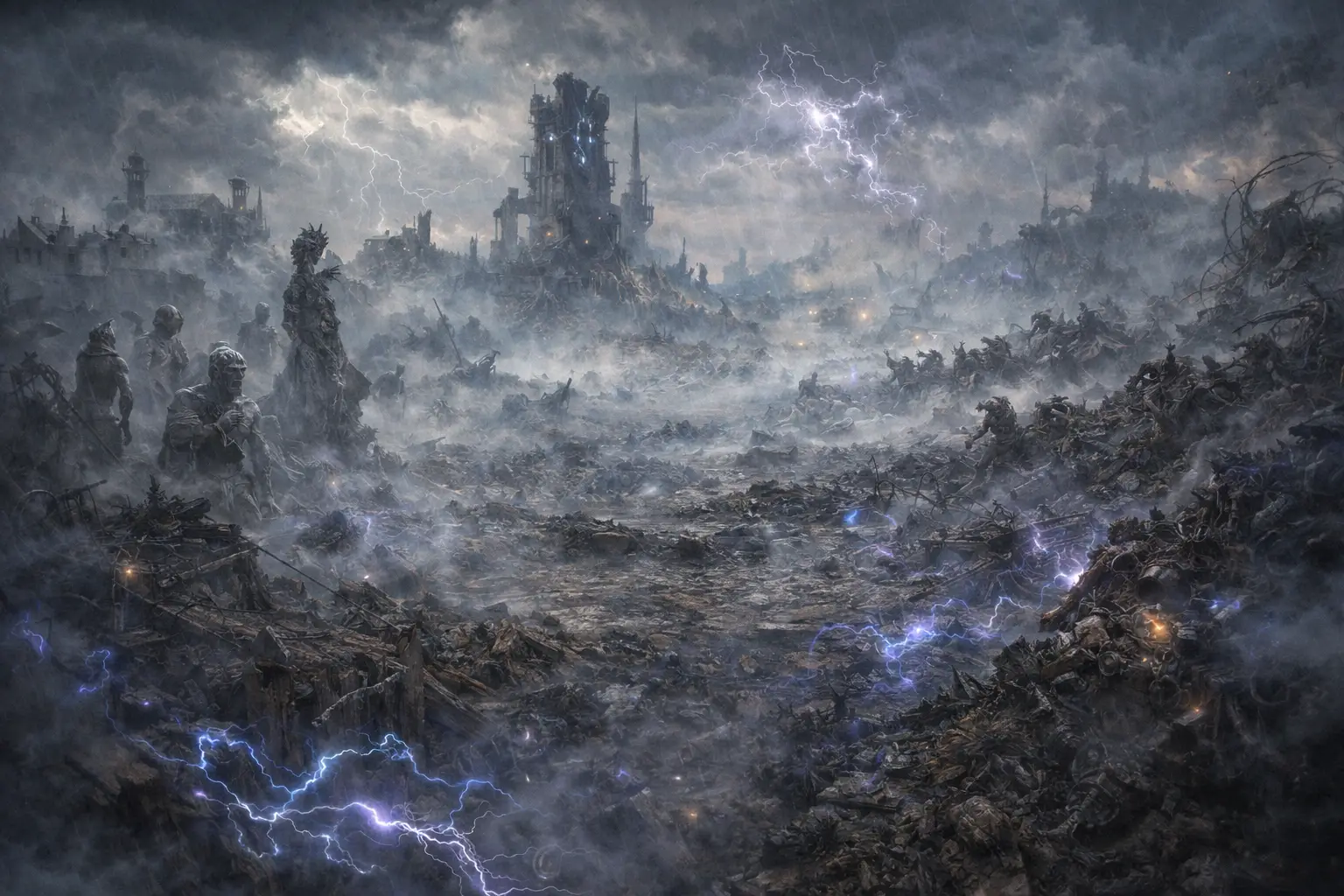
The Mournland
Once the jewel of Galifar. Now a wound the world cannot close.
A magical catastrophe of unknown origin engulfed the nation of Cyre yesterday, bringing a century of war to an explosive climax. Surely when the children of King Jarot began their squabbles over succession a hundred years ago, they could not have foreseen the horror that would engulf the home of Queen Mishann. Our reporters are still sifting through accounts of what has happened, but it is clear at this point that beautiful Cyre, the jewel of Galifar's vast holdings, has disappeared behind a churning cloud of dead-gray mist.
— Front page of the Korranberg Chronicle, 21 Olarune 994 YK
On 20 Olarune 994 YK, the richest and most culturally vibrant nation in Khorvaire ceased to exist. In less than a day, the kingdom of Cyre — ancestral seat of the Galifaran crown, birthplace of the warforged, center of arcane innovation and artistic achievement — was consumed by a rolling catastrophe that left over a million dead and an entire country transformed into something terrible and strange. No one knows what caused it. No one has been able to reverse it. And no one can promise it will not happen again.
What remains is the Mournland: a nation-sized scar of twisted geography, dead-gray mist, and arcane horrors, sitting squarely at the geographic heart of Khorvaire like a wound that refuses to heal. Four years later, it defines the postwar world not through conquest or diplomacy, but through absence — through the constant, gnawing fear that whatever happened to Cyre could happen to anyone, anywhere, at any time. The Mourning ended the Last War not because anyone won, but because everyone was suddenly too terrified to keep fighting.
What Cyre Was
To understand what was lost, you have to understand what Cyre was, because the Mournland is not simply a wasteland. It is the corpse of the greatest nation in Galifar, and most of its treasures, its secrets, and its dead are still in there.
Cyre was the traditional seat of the kings and queens of Galifar. By the old laws of succession, the eldest scion of the ruling monarch governed Cyre and inherited the crown — the wealth, culture, and prestige of the entire kingdom flowed through Cyre as a matter of course. Its capital, Metrol, was known as the Rising City for the great columns of natural rock — the Vermishards — upon which soaring palaces stood. The Cathedral of the Sovereign Host was the spiritual center of Galifar's dominant faith. The Vault served as the kingdom's mint and treasury, said to contain cultural artifacts deemed too precious to be displayed publicly. Floating gardens orbited the Royal Vermishard itself. Cyre was not merely wealthy — it was the living symbol of everything Galifar aspired to be.
The nation was also the ancestral home of House Cannith, the House of Making. Cannith's foundries, creation forges, and research laboratories spread across Cyre like a second nervous system, and the house's centuries of innovation reached their apex there. The city of Eston, where Cannith was born, was famed for its clockwork menagerie — a public showcase of generations of construct design, from singing clockwork birds perched in silvery steel-barked trees to skycoaches ferrying magewrights from forge to forge beneath an iridescent protective dome. The city of Making, deeper in the interior, was home to Cannith's most sensitive research, including the creation forges that gave birth to the warforged. These facilities represented some of the most advanced arcane engineering ever achieved on Khorvaire, and all of it was still operational on the Day of Mourning.
Cyran culture prized diversity, versatility, and refinement. Cyrans could not match Karrnath in martial discipline or Aundair in raw arcane scholarship, but they cultivated a cosmopolitan flexibility that let them draw on the best of every tradition. Cyran fashion was famous: bright colors, glamerweave fabrics that shimmered and shifted, garments cut to suggest elegance and ease whether worn in a ballroom or on a battlefield. The nation produced artists, artificers, diplomats, and scholars in abundance, and Cyrans carried themselves with the quiet confidence of people who believed — with some justification — that their civilization represented the best Galifar had to offer.
By tradition and by law, Cyre held the strongest claim to the throne when King Jarot died and the Last War began. Princess Mishann ir'Wynarn was the rightful heir. Every Cyran knew this, and many still carry the conviction that Cyre alone was in the right — that the other nations were thieves and usurpers, and that everything that followed was the fruit of their betrayal.
It is important to remember all of this, because the Mournland is not an abstract horror. It is the ruin of this — of universities and art galleries, of well-kept estates and bustling market towns, of a living civilization with a million inhabitants. Every broken street in the Mournland was once someone's home.
The Day of Mourning
No one agrees on what happened.
Some survivors swear the dead-gray mist began in Metrol itself, flowing first from the royal palaces of the Vermishards, rolling outward through the streets while people stood bewildered or fled screaming toward the Cyre River and the docks. Others insist the disaster originated in the Cannith stronghold of Making, deep in the interior, and spread outward from there. Still others say they saw a blinding light engulf the battlefield near the Saerun Road in the southwest, where Brelish and Thranish forces were locked in combat with a badly outnumbered Cyran army. House Medani investigators who examined the bodies left behind found evidence just as contradictory as the testimonies — many victims fled in different directions, while others appeared to have died with no awareness of what was happening at all.
What is known is that the mist spread with terrifying speed. Within a single day, it had consumed the entire nation. Millions of people died — nearly all of the inhabitants of central Cyre, along with tens of thousands of foreign soldiers who had been fighting on Cyran soil. Karrnathi forces, who had seized territory in the north and were using it as a staging ground for a push into Breland, were caught in the disaster in enormous numbers. Brelish and Thranish soldiers died alongside the Cyrans they had been fighting. The Mourning did not discriminate.
Those who survived fell into a few categories. Soldiers fighting beyond Cyre's borders — holding sections of the Brelish front, for example — watched the mist halt mere feet from their encampments and simply stop. Civilians living in the borderlands sometimes heard warnings in time to flee. A small number escaped by magical means. And some few, caught within the mists themselves, lived through the event for reasons no one can explain. Most of these survivors have no clear memory of the experience. The superstitious whisper that anyone touched by the Mourning is cursed, an agent of some nameless darkness — a cruel rumor that has followed survivors like a second shadow.
Queen Dannel ir'Wynarn was in Metrol. She is presumed dead. Her son, Prince Oargev ir'Wynarn, survived because he was serving as an ambassador to Breland at the time. He now attempts to lead the Cyran people in exile.
I was holding the western line near Kennrun when the sky turned the color of old bone. We could see the mist coming across the fields — not fast, not like a storm, but like the tide. Steady. Patient. My sergeant said to hold position. We held. And we watched it stop, maybe thirty feet from our forward trench, as if something had drawn a line in the dirt and said: this far. No farther. We stood there all night, staring into it. Nobody slept. By morning, three men in my company had deserted and one had gone completely mad.
— Corporal Aesha Turani, 4th Cyran Frontier Infantry, Mourning survivor
The Fear That Ended the War
The immediate aftermath of the Mourning threw Khorvaire into a state of shock that transcended political allegiance. Every nation asked the same questions simultaneously, and none of them had answers: What happened? Was it a weapon? If so, who built it, and would they use it again? Were the borders of the mist stable, or would they keep expanding?
Intense panic slowly turned to cautious observation as the mist wall held its position over the following days and weeks. But the fear did not dissipate — it merely changed form. The Mourning had demonstrated that a force existed capable of destroying an entire nation in less than a day. Every general, every monarch, every common soldier understood the implications. If this was a weapon, then continuing the war meant risking the total annihilation of one's own people. If it was a natural disaster, then the world had just revealed that it could kill on a scale no one had previously imagined, and no army could protect against it.
Within two years, the Treaty of Thronehold ended the Last War. It is no exaggeration to say that the Mourning accomplished what a century of bloodshed could not: it frightened the warring nations into peace. Whether that peace will hold is another question entirely.
Beyond the Mist Wall
The borders of the Mournland are defined by a wall of thick, dead-gray mist that rises thousands of feet into the air and forms a canopy that hides the ruined realm even from above. Airships flying over the Mournland see only a featureless ceiling of gray. The wall of mist ranges in thickness from a few hundred feet to as much as five miles, and entering it is an experience that few forget.
The mist is not merely fog. It is heavy, clinging, and oppressive, swallowing all light and muffling all sound. Travelers who linger in it report a growing sense of claustrophobia and despair, a feeling of being watched that deepens the longer they remain. Orientation becomes nearly impossible — the mist offers no landmarks, no sense of direction, no horizon. People have wandered in circles for days, unable to find their way forward or back, until their supplies ran out or they blundered into the path of something that had already adapted to the darkness. Those who enter unprepared risk becoming simply another set of remains that will never decompose.
Patches of mist and lighter fog appear throughout the Mournland's interior, but the worst effects are concentrated at the border. Once through the wall, the mist thins, though the sky above remains a perpetual, uniform gray. There is no sun in the Mournland. There is no weather, not in any natural sense. There are only the dead-gray sky, the twisted land, and whatever is living — or not living — down there with you.
The Shape of the Ruin
The Day of Mourning rewrote the geography of Cyre. The cataclysm raised land and swallowed it, moved whole cities, and transformed the terrain in ways that follow no natural logic. In some places the earth has been torn open as if by some colossal beast, leaving jagged trenches that descend into darkness. In others, it has fused into iridescent glass or collapsed into pools of semiliquid sludge. Forests have been turned to crystalline onyx. Fields of wildflowers buzz with an eerie, insectile hum when touched by the faintest breeze, though no insects are visible. Nothing in the Mournland is as it was. The entire land is a scar left by whatever happened, and the wound shows no signs of healing.
Several major terrain features dominate the altered landscape.
The Mist Wall. The border itself, already described. It is the most visible feature of the Mournland from the outside and the first obstacle any expedition must overcome.
The Glowing Chasm. A great jagged crack in the earth that dominates the northern reaches of the Mournland, emitting a cold purple light from deep below. The source of the glow has never been identified — it originates so far beneath the surface that no expedition has reached it. Mutated creatures throughout the Mournland seem drawn to the Chasm, and prolonged exposure to its light accelerates their transformation, twisting already misshapen beings into something even more alien. The Glowing Chasm is one of the most dangerous locations in the Mournland, and most experienced salvagers give it a very wide berth.
The Glass Plateau. Many believe the city of Making — Cannith's primary research stronghold — sat at the epicenter of whatever caused the Mourning. The terrain around Making was reshaped into a vast, elevated plain of glass. The central portion is dark obsidian shot through with occasional bursts of fiery light visible deep beneath the surface. Toward the edges, the glass becomes paler and more transparent, almost white along the jagged cliff faces at the plateau's rim. Nothing grows on the Glass Plateau. Few creatures haunt its flat expanse. The ruins of Making still peek through the obsidian surface, and new fissures occasionally open, leaking strange magma that slowly expands the plateau's boundaries. Traversing it is an adventure in itself — the mist dome blocks celestial navigation, and conventional orientation magic is wildly unreliable on the plateau.
The Crimson Water. In eastern Cyre, a spring once fed the Rushing River on its short, fertile path south to Kraken Bay. The riverbed is now as dry and barren as the rest of the Mournland. Where the spring once flowed, there is now only the Crimson Water — a stagnant lake of blood-colored liquid. Its shores are littered with the remains of animals and travelers who entered the Mournland desperate for water and made the fatal mistake of drinking from it. Beneath the surface lies the drowned town of Eastwood Springs, once a resort for Cyre's leisure classes. No one has yet been foolish enough — or perhaps brave enough — to search for lost treasures in those crimson depths.
The Field of Ruins. Along the Saerun Road in the southwest, where the combined forces of Thrane and Breland were fighting a desperate battle against a Cyran army on the Day of Mourning, the fallen lie preserved exactly as they fell. Thousands upon thousands of corpses — Thranish, Brelish, Cyran — scattered across the field, facedown in the dirt or staring lifelessly at the gray sky, without any sign of rot or decay. In other battlefields across the Mournland, armies caught in the Mourning were transformed in stranger ways: some became stone statues frozen in mid-swing, others were crystallized, still others reduced to ash in their armor. Even hardened treasure hunters are reluctant to enter the Field of Ruins.
Unusual Locales. At smaller scales, the Mournland is studded with inexplicable phenomena. A pool of glowing water in a ruined village that shows reflections of the dead going about their daily lives. A perfectly preserved carnival carousel that, when ridden, projects vivid visions of Cyre before the war. A forest turned entirely to white stone flecked with red, like marble veined with blood. A battlefield carpeted not with bodies but with empty clothing and abandoned weapons, every soldier simply gone. These anomalies have no pattern and no apparent logic; they simply are, as if the Mourning was not a single coherent event but a million separate nightmares layered on top of one another.
The Rules of the Ruin
The Mournland does not follow the rules of the natural world, and the most dangerous thing about it may be that it does not follow its own rules, either.
The dead do not decay. This is one of the only reliable constants. Corpses in the Mournland are preserved in a terrible, indefinite stasis — no rot, no decomposition, no return to the earth. Bodies lie where they fell four years ago, looking as fresh as the day they died. For salvagers and treasure hunters, this is both a practical navigation aid (the dead mark battlefields and settlements) and a source of profound unease. The Mournland is a vast open grave in which nothing is buried and nothing rests.
Healing is unreliable. In earlier years, it was widely believed that healing magic simply did not function within the Mournland — that wounds could not be mended, diseases could not be cured, and natural recovery was impossible. The reality appears to be more complex and more insidious: nothing about the Mournland is predictable, and that includes healing. There are places where restorative magic works normally, places where it functions at reduced effectiveness, and places where it fails entirely or produces unexpected side effects. A cure wounds spell might knit a gash closed in one ruin and do nothing at all a mile down the road. This unpredictability makes every injury potentially lethal and every expedition a calculated gamble. Experienced Mournland travelers carry mundane medical supplies in abundance, and treat magical healing as a hope rather than a guarantee.
Magic is unreliable. The same principle extends to magic more broadly. Spells may function normally, behave erratically, intensify wildly, or fail without warning. Divination magic is particularly suspect. The Mournland seems to actively resist being understood, and scrying or augury attempts frequently return garbled, contradictory, or outright deceptive results. Dangerous magical phenomena — arcane storms, bursts of wild magic, fields that suppress or amplify certain schools of spellcraft — roam the landscape like weather patterns, arriving without warning and departing just as unpredictably. These effects are not the same as manifest zones or planar influences; they appear to be something entirely new, a form of ambient magical contamination for which no theoretical framework yet exists.
Living spells. Among the most distinctive and alarming phenomena of the Mournland are living spells — war magic that has somehow taken physical form and gained a kind of animalistic sentience. A living cloudkill drifts through the ruins of a town, poisoning anything organic that strays into its path. A living fireball rolls across a blasted field, incinerating brush and bone indiscriminately, then rebounds off a ruined wall and goes hunting for more. These entities behave like predators or scavengers, drawn to motion and life, and while most appear to lack true intelligence, they are relentless. The city of Eston is said to be especially overrun with them — not only destructive spells but stranger manifestations, including living continual flames that crawl along lampposts and flee from strangers, and living scrying spells that shimmer like soap bubbles, displaying distant scenes on their amorphous surfaces.
Mutation. Creatures that survive prolonged exposure to the Mournland often undergo physical transformation. Some mutations are cosmetic — eyes that resemble gemstones, bioluminescent patterns on fur or skin. Others are substantial and grotesque, reshaping a creature's body in ways that defy biology. Prolonged proximity to the Glowing Chasm accelerates this process dramatically. The Mournland is home to things that were once wolves, bears, or horses and are now something else entirely — twisted, misshapen, and often dangerously aggressive.
The Ruins of Cyre
Perhaps the greatest tragedy of the Mournland is that it contains not alien wastelands but recognizable cities — the homes, markets, theaters, and temples of a living civilization, depopulated in a single day and preserved in various states of ruin. Some have been shattered, reduced to rubble by the cataclysm. Others are eerily intact, their buildings standing undamaged, their streets clean, their shops still stocked — as if the entire population simply stepped out and never came back.
Metrol, the Rising City. The former capital of both Cyre and, before it, the kingdom of Galifar. The great Vermishards — seven towering natural rock columns capped with palaces — still stand, though accounts conflict about whether they remain in their original positions; some salvagers report that the Vermishards have been rearranged, that buildings and entire city blocks have been moved without apparent cause. The grand Orien lightning rail station, once the finest on the continent, sits empty. The warforged colossus known as Norr — designated WX-5, the most humanoid of Cannith's great war machines — lies slumped against one of the Vermishards like a fallen titan. During the day, Metrol is quiet, almost peaceful in its emptiness. At night, misshapen creatures emerge from the ruins to prowl and hunt one another through the darkened streets, filling the dead city with sounds that no one was meant to hear.
Eston, Birthplace of House Cannith. The city where Cannith began as a mining settlement and grew into a wonder of arcane engineering. Before the Mourning, clockwork birds sang in silver trees, an iridescent dome shielded the city from weather, and the proving grounds of the creation forges rang with the training of newborn warforged. Today, Eston is overrun by living spells, and the constructs of the clockwork menagerie — twisted by the Mourning into deadly parodies of their original forms — roam the streets. Stories tell of an enormous gorgon golem, of razor-winged swarms of silver songbirds turned lethal, and of the Steel Gardens, where techniques used to create living constructs were successfully applied to trees that grew metal bark and renewable ore. Since the Mourning, the Steel Gardens have grown wild, overtaking a significant portion of the city; some speculate this unchecked expansion may be powered by one of Eston's creation forges, still running somewhere beneath the ruins.
Making and the Glass Plateau. If Eston was where Cannith was born, Making was where it worked — the site of the house's most advanced and most secret research. The city now rests beneath (and partially within) the vast obsidian expanse of the Glass Plateau, its ruins poking through the fused glass like bones through skin. An enormous pillar of glass juts from somewhere in the city's heart, reaching an impossible height and occasionally crackling with volatile arcane energy. The fabric of reality is said to be thin around this spire, potentially allowing glimpses of — or passage to — other planes. Making's infrastructure extended deep underground through ancient Dhakaani tunnels, but earthquakes have largely sealed the undercity. Rumors persist of secret Cannith laboratories in those buried depths, still holding valuable secrets.
Seaside. A coastal resort town in southern Cyre, Seaside was a popular vacation spot even during the war — a place of merchants, nobles, and warm memories. On the Day of Mourning, the population panicked and fled to the sea. Wealthy boat owners took only friends and family; more conscientious captains made agonizing choices about whom to leave behind. Many never reached a ship at all. Investigators who entered Seaside on the second day found an eerily empty city — unlike much of Cyre, the buildings were largely undamaged. And unlike anywhere else, not a single corpse was found within the city limits. Seaside's Kundarak bank was sealed from the inside on the Day of Mourning by branch manager Turanank d'Kundarak, who ordered all employees to lock down the vaults and wait out the mist. Those doors remain shut, and whatever treasures lie within are anyone's guess.
Dollen on the River. Once one of the richest ports on Scion's Sound, Dollen was transformed by war into a naval fortress. Castle Dollen was rebuilt multiple times after devastating Karrnathi raids, and the harbor bristled with Cannith-Lyrandar military collaboration: arcane lightning cannons, warforged sentries watching for undead walking the riverbed, and experimental mephit-powered watercraft. A century of siege mentality had already hollowed out the town's civilian economy before the Mourning finished the job.
What Lives There Now
The Mournland is not uninhabited. It is merely uninhabitable — for most.
Mutated creatures of every description roam the blasted terrain. Some were animals or monsters before the Mourning and have been transformed; others appear to be entirely new life forms, spawned by the cataclysm itself. There is no reliable taxonomy for Mournland fauna. A creature encountered one day may bear no resemblance to anything seen before or since.
Undead are abundant. The Mourning had no effect on pre-existing undead, and it created a great many new ones. Ghosts and specters linger near the places where they died. The preserved corpses that litter the battlefields sometimes rise to continue fighting when living creatures draw near, animated by whatever residual energy saturates the land. Some of these undead are conventional; others exhibit mutations or behaviors tied to the unusual manner of their deaths.
Warforged are, notably, among the few beings who can function in the Mournland with relative comfort. Most warforged were unaffected by the Mourning itself, and as a race they appear largely immune to many of its lingering effects. They do not need food, water, or sleep — three resources that are desperately scarce and unreliable in the Mournland — and they can endure the harsh terrain without succumbing to the mutations that afflict organic life. This resilience has made the Mournland a de facto homeland for warforged who have no wish to live among the fleshborn nations, and the followers of the Lord of Blades have established the closest thing to an organized society within the ruins. (See: Warforged, The Lord of Blades)
Constructs and golems, similarly, were largely unaffected by the Mourning. The clockwork menagerie of Eston, the steel constructs of Cannith's forges, and whatever other artificial creatures survived the cataclysm continue to operate — though many have been twisted in ways their creators never intended.
The Lord of Blades and the Warforged Nation
The most significant political entity within the Mournland is the warforged movement led by the figure known as the Lord of Blades — a warforged insurgent who did not appear in the world until after the Day of Mourning. His followers patrol the devastated terrain, salvage weapons and arcane resources from the ruins, and attack organic creatures on sight. To the flesh-and-blood citizens of Khorvaire, the Lord of Blades is a figure of terror. To the warforged under his sway, he is a liberator — a champion whose rage is fueled by the injustices the warforged suffered as disposable soldiers during the Last War, and by the postwar political arguments over their rights that conspicuously gave the warforged themselves no voice.
The Lord of Blades preaches an apocalyptic future in which warforged will overthrow or enslave the nations of flesh and blood. His followers — who call themselves Blades — are organized along military lines, with captains, lieutenants, and squads numbering in the hundreds. They maintain warforged ossuaries throughout the Mournland: repurposed temples, crypts, or warehouses that now house the remains of fallen warforged, serving as places of honor, reflection, and strategic storage.
His identity before the Mourning is unknown. Theories abound: that he was originally a warforged named Bulwark, once the personal bodyguard of King Boranel of Breland; that he was the last warforged to emerge from the creation forges of Eston, completed in the final moments before the catastrophe; or even that he is not a true warforged at all but the consciousness of Aaren d'Cannith, the artificer who created the first warforged and grew furious when his children were turned into weapons. Some scholars dismiss the search for a single identity entirely and theorize that the Lord of Blades is a title carried by whichever warforged leader claims it — that any squad encountered in the Mournland might contain the Lord of Blades, even though none of them actually are him.
Not all warforged in the Mournland follow the Lord of Blades. A separate community — the Godforged — has gathered around the belief that warforged possess true souls, bestowed by a divine being they call the Becoming God. The Godforged are dedicated to building a physical body for their deity, a vessel of perfection that would allow their god to walk the world. They search for the Firstforge — a damaged Cyran creation forge rumored to be under the Lord of Blades' control — believing it may be the key to their divine project. The Godforged movement is notably less violent than the Blades; they believe in peaceful coexistence with organic races and see harmony as preferable to war, though they are no less determined to protect their people. The relationship between the Blades and the Godforged is tense: the Lord of Blades tolerates the movement for now, but if the Godforged ever threaten his dominance, he will not hesitate to act.
Salvage, Expeditions, and the Treasure of a Dead Nation
The Mournland is lethal. It is also, by any measure, the single richest trove of lost wealth on Khorvaire.
Everything that belonged to the wealthiest nation in Galifar is still in there — the contents of museums, treasuries, noble estates, Cannith workshops, university libraries, and dragonmarked enclaves. Family heirlooms, experimental artifacts, classified military research, works of art, magical prototypes, entire stockpiles of House Orien trade goods stranded mid-transit on the lightning rail. The Vault in Metrol, Galifar's legendary golden treasury, has never been found. The creation forges of Eston and Making, with their unparalleled secrets of construct engineering, lie buried in ruins but presumably intact. For treasure hunters, the Mournland is a dungeon the size of a nation — and unlike ancient ruins in Xen'drik or the Demon Wastes, everything lost here is recent. People on the outside know exactly what's in there because they remember putting it there.
Ikar the Black leads the most well-known professional salvage operation in the Mournland. A Karrnathi orc-kin with a wicked scar and a reputation for ruthlessness tempered by competence, Ikar runs crews into the ruins on a regular basis, extracting goods for sale on the open market. The work is extraordinarily dangerous and the turnover in personnel is high, but the profits are substantial, and Ikar's operation is one of the few that has managed to sustain repeated expeditions. Salvagers and treasure hunters are the most common visitors to the Mournland, and their moral landscape is as blasted as the terrain — alliances of convenience today may become betrayals tomorrow.
House Cannith has an obvious and desperate interest in recovering its lost property. The creation forges, foundries, and secret laboratories that vanished on the Day of Mourning contained trade secrets, experimental artifacts, and magic items that represent centuries of accumulated research. The three surviving branches of Cannith — under Jorlanna, Merrix, and Zorlan — are all independently interested in Mournland recovery, and the competition between them adds a layer of political intrigue to any Cannith-sponsored expedition. Recovering the knowledge needed to replicate the Genesis forges of Making, in particular, could tip the balance of power within the house decisively.
House Orien has a more infrastructural concern: the lightning rail line that once crossed Cyre connected western and eastern Khorvaire, and its destruction has been a logistical nightmare. Baron Kwanti d'Orien has spent years trying to raise the funds and political support needed to rebuild the line across the Mournland, though the technical and safety challenges are immense. An operational rail crossing would be enormously lucrative and would reconnect communities that have been effectively severed for four years.
Prince Oargev ir'Wynarn funds expeditions into the Mournland in search of the lost regalia of the Cyran crown and, more broadly, any clues that might explain the cause of the Mourning. He is obsessed with the mystery of what happened to his homeland and regularly debriefs anyone who returns from the ruins. Oargev's public face is diplomatic and patient, but behind the optimism is a man consumed by grief and driven by a need for answers — and, if the truth points to a responsible party, for vengeance.
Cyran refugees of every station — former nobles hoping to recover family artifacts, common folk seeking heirlooms or simply closure, veterans who want to see the place where their comrades fell — represent a steady if heartbreaking stream of people willing to risk the Mournland for deeply personal reasons. Some hire adventurers to go in their place. Others insist on going themselves, even when they lack the skills or equipment to survive. The grief of the Cyran diaspora is a powerful and sometimes reckless engine.
Wanted: Experienced guides for Mournland transit. Party of four seeking passage to Eston vicinity. We have maps (pre-Mourning), supplies for ten days, and a wand of cure wounds that we understand may not work. Compensation negotiable. No questions about our cargo on the return trip. Inquire at the Cracked Mirror, Lower Dura, after second bell.
— Handbill posted in Sharn, 998 YK
The Mourning and You
Every person in Khorvaire has been shaped by the Mourning, whether or not they have ever set foot in the mist.
If you are from Cyre, the Mourning is the defining event of your life. You may have lost family, friends, wealth, status, or all of these at once. Former nobles live in refugee camps. Scholars and artists sleep in alleyways. Soldiers without an army carry skills that no one wants to hire them for and memories that no one wants to hear about. As a Cyran, you must decide what drives you: the hope of rebuilding, the hunger for answers, the desire for revenge, or the simple need to survive. You may hold tight to your national identity, wearing Cyran-cut clothing in the traditional bright colors — or you may wear Mourning black, the increasingly common fashion among refugees who have exchanged the brightness of the old life for a permanent statement of loss. Do you dream of recovering something from the Mournland — a family sword, a research journal, a loved one's remains? Or would you rather never set foot in Cyre again?
If you are not from Cyre, the Mourning still looms. Are you afraid that it could happen to your homeland — that Sharn or Korth or Flamekeep could vanish tomorrow behind a wall of gray mist? Do you treat Cyran refugees with compassion, suspicion, or indifference? If you are religious, did the annihilation of an entire nation shake your faith, or did it reinforce it? If you study magic, does the Mourning terrify you, fascinate you, or both? Do you see it as a tragedy, a mystery, a warning, or — in your most private thoughts — a potential weapon?
The Day of Mourning is observed every year on 20 Olarune. It is a day when Cyrans come together to share stories, sing traditional songs, and ensure that their culture is not forgotten. But it is also a day tinged with anger. Violence against perceived enemies of Cyre has historically spiked around the anniversary, and the holiday serves as a reminder that for all the diplomatic language of the Treaty of Thronehold, a million people are still dead and no one has been held accountable.
What Caused the Mourning?
Nobody knows.
This is not a simplification. It is the literal, unadorned truth, and it is arguably the most important fact about the postwar world. Four years of investigation by the finest minds in Khorvaire — royal intelligence agencies, dragonmarked house researchers, university scholars, independent arcanists, religious authorities, and desperate refugees willing to try anything — have produced no definitive answer. There are only theories, and the theories are terrifying, because every plausible explanation carries implications that would reshape the political landscape of Khorvaire if confirmed.
The common folk of the Five Nations whisper dozens of possibilities. Was it a weapon developed by one of the warring nations — Cannith's research pushed too far, or Karrnath's necromancers losing control of something they should never have summoned? Was it an accident of arcane engineering, a creation forge meltdown, a planar breach? Did it originate from the Draconic Prophecy, or from the machinations of the Lords of Dust? Was it divine punishment for the folly of the Last War, or the first tremor of some larger catastrophe still to come?
Every answer raises more questions. If it was a weapon, who built it? Why has no one claimed responsibility — or issued demands? If it was an accident, what exactly went wrong, and could it happen again anywhere that similar conditions exist? If it was a natural phenomenon, what does it mean that the mist has remained stable for four years rather than expanding — and can that stability be trusted?
The uncertainty is, in many ways, worse than any specific answer would be. As long as the cause remains unknown, no one can rule out any possibility, and every nation must proceed as if all potential threats are real. This is the true shadow the Mourning casts over Khorvaire: not the horror of what happened, but the unbearable suspense of not knowing if it's over.
We've had a hundred theories and not one damn answer. That's what keeps the generals awake, you know. Not the dead. The dead are in the ground — or they would be, if the ground would take them. It's the not-knowing that kills you. Because you can plan for a weapon. You can plan for a natural disaster. But you can't plan for "we have no idea," and four years in, that's exactly where we stand.
— Augusta Wainwocket, Korranberg Chronicle senior correspondent
Practical Considerations for Travelers
For those foolish, desperate, or well-paid enough to enter the Mournland, a few hard-won pieces of practical wisdom circulate among the salvage crews and expeditionary companies that operate along its borders.
Supply heavily. Assume that magical healing will fail. Carry mundane medical supplies — bandages, poultices, splints, and strong spirits — in quantities that would be excessive anywhere else. Bring at least twice the food and water you think you need. Nothing edible grows in the Mournland, and what water exists may kill you faster than thirst.
Move with purpose. The Mournland rewards speed and punishes lingering. Get in, reach your objective, and get out. Extended stays increase the risk of encountering roving dangers — living spells, mutated predators, or arcane weather phenomena — and prolonged exposure may carry its own risks of physical or mental alteration.
Trust nothing familiar. The Mournland mimics normalcy in places that are deeply abnormal. A perfectly preserved inn with a warm fire burning in the hearth is not a safe haven. A field of untouched wildflowers is not a meadow. A figure glimpsed in the mist wearing your grandmother's face is not your grandmother. The Mournland lies, not with malice but with the indifference of a fever dream, and the greatest danger is often the moment when a traveler lets their guard down because something looks right.
Know the warforged. Warforged patrols loyal to the Lord of Blades operate throughout the Mournland. Most are hostile to organic life. Running is often wiser than fighting.
Respect the dead. The corpses of the Mournland do not always stay dead. Do not disturb battlefields without need. Do not loot bodies casually. And if the dead begin to stir, leave immediately — not because the undead of the Mournland are unbeatable, but because the sound of fighting draws worse things.
Hire a guide. A handful of individuals — warforged, human, and otherwise — have made enough trips into the Mournland to develop a working knowledge of its more stable regions. Their services are expensive. They are worth every copper.