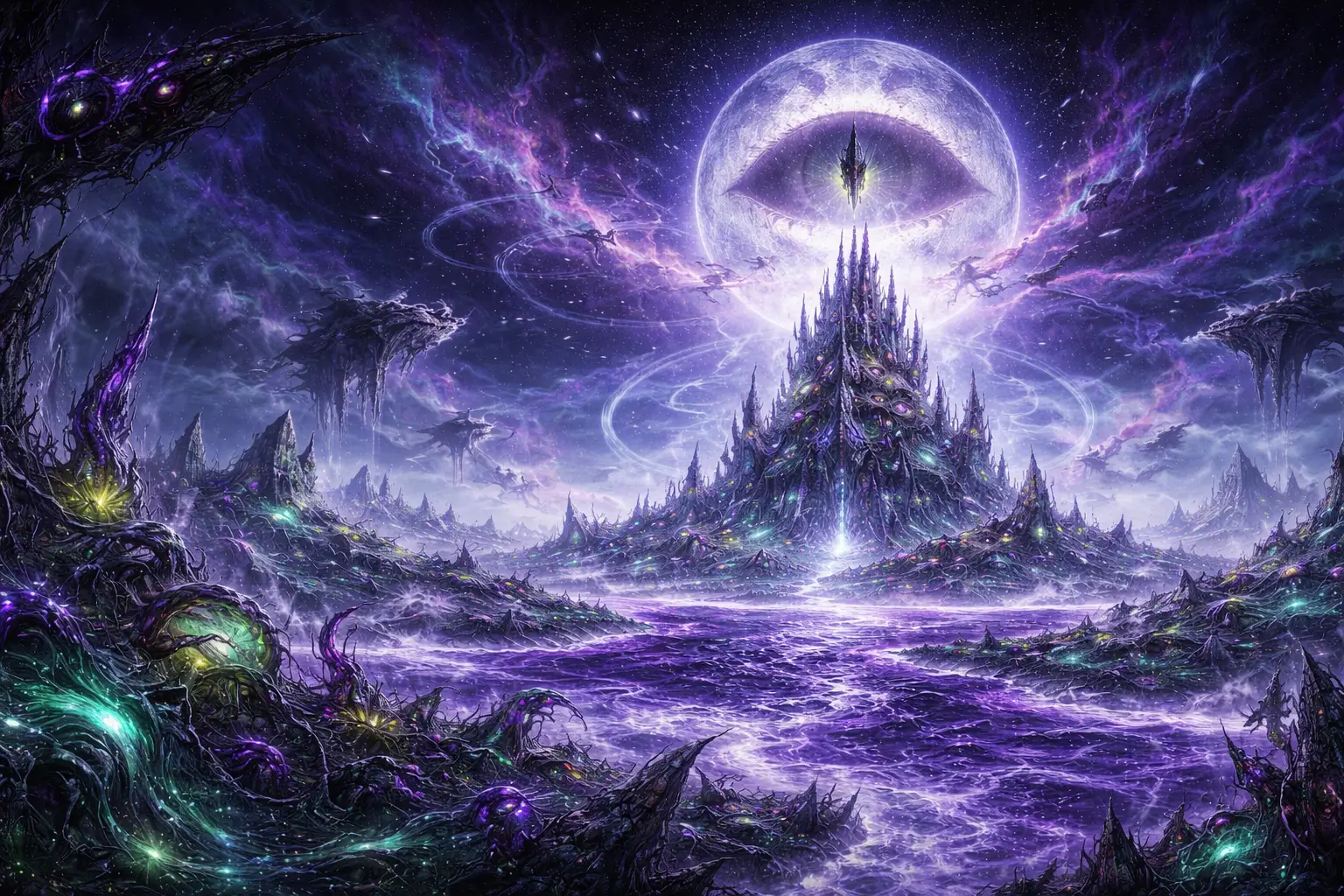
Xoriat, the Realm of Madness
Plane — The Unnatural, Revelations, Madness & Inspiration — Moon: Lharvion, the Eye
Seas of protoplasm in a shade of purple that hurts the eyes lap against shores of chitin. Tornadoes composed of ink roar across landscapes where every grain of sand is a tiny beating heart. Cities crafted from gargantuan fleshy tumors rise against skies that have never known a familiar star. The mind flayers who dwell in the plane's deeper layers call it the Realm of Revelations — and they may be closer to the truth than the scholars of Khorvaire who named it the Realm of Madness.
Xoriat is one of the thirteen planes that define reality, and its role in the cosmic architecture of Eberron is as essential — and as misunderstood — as any other. Where Lamannia embodies the natural world, Xoriat embodies the unnatural: the alien, the impossible, the ideas that were discarded when reality was built. It is a window into the workings of existence that mortals were never equipped to handle, a glimpse at what lies behind and beyond the foundations of time, space, and identity. The plane's popular title is a label imposed by the people of Eberron, based on the observable fact that prolonged contact with Xoriat interferes with a mortal's ability to process the world as they know it. But the plane is not defined by insanity any more than the sun is defined by sunburn. Xoriat holds truths — real, functional, staggering truths — and the problem is that mortal minds were not designed to contain them.
All mortals have a connection to Xoriat, just as they have connections to every plane. Mortals dream in Dal Quor. Shavarath sparks their anger. Mabar feeds their shadows, while Irian holds their spark of light. Xoriat, for its part, fuels the mortal impulse to question — to look at the accepted order of things and ask what if it were different? At a safe distance, this influence drives creativity and innovation. It is the spark behind the inventor's midnight revelation and the philosopher's paradigm-shattering insight. But Xoriat is also the sun that melts the wings of any who draw too close. Those who gaze too deeply lose their grip on native reality entirely, unable to navigate a world whose rules they can no longer believe in.
Xoriat is not evil. It is not destructive in the way that Mabar is destructive, nor chaotic in the way that Kythri is chaotic. It is a necessary part of the universal balance — the plane that holds every road not taken, every law of physics that was considered and rejected, every version of reality that might have been. Irian is the beginning, where new seeds are born. Mabar is the end, consuming all things. Xoriat is the point that stands above the journey, the high perch from which the shape of reality itself can be studied — and, for those with the power and the will, changed.
FROM THE JOURNAL OF GAIUS HOLAN IR'DENABI, RECOVERED FROM HIS OFFICE AT MORGRAVE UNIVERSITY. THE FINAL SIXTEEN PAGES ARE BLANK EXCEPT FOR A SINGLE PHRASE, REPEATED IN PROGRESSIVELY SMALLER HANDWRITING: "I UNDERSTAND NOW."
I was wrong about the foundations. We all were. We built our houses on them and called them real — time, space, cause, effect — but they are arbitrary. They are choices someone made, and Xoriat remembers the choices that were not made. I looked through the window and I saw what was underneath, and now I cannot stop seeing it. The walls of my study are thin. The floor is negotiable. My own name is a hypothesis I can no longer confirm.
I write this knowing that whoever reads it will assume I have gone mad. I want to assure you: I have not gone mad. I have merely seen what sanity is built on, and it is nothing at all.
—Gaius Holan ir'Denabi, Professor Emeritus of Planar Studies, Morgrave University (status: missing, presumed dead, 831 YK)
Universal Properties
To mortal eyes, Xoriat may appear more chaotic than Kythri, the Churning Chaos — but the distinction matters. Kythri's constant transformation is always natural: fire becomes lightning, stone becomes water, all in accordance with the fundamental building blocks of reality. Xoriat is something else entirely. In Xoriat, a tornado might be composed of ink. Each grain in a sandstorm could be a miniature bust of Queen Aurala of Aundair, or a tiny beating heart. It is not simply chaotic — it is unnatural, operating according to a logic that mortal minds were never built to parse.
The following properties apply across all of Xoriat's layers.
Unpredictable Magic. The arcane formulae that govern spellcasting on Eberron are, from Xoriat's perspective, merely one set of arbitrary rules among infinite alternatives. Magic cast here is wildly unstable: any spell of 1st level or higher may trigger unpredictable side effects the moment it is cast.
Dangerous Revelations. Xoriat bombards visitors with truths they were never meant to know — alien concepts that creep into the mind and twist the foundations of thought. The longer a creature lingers in Xoriat, the more reality unravels around it, instilling beliefs and perceptions that make perfect sense by the plane's own logic but are utterly incompatible with life on the Material Plane.
Time Is an Illusion. More than any other plane, time is unreliable in Xoriat. Adventurers could be trapped for what feels like a lifetime and return to find only a moment has passed on Eberron — or they could return before they left, stranded in another era entirely. Xoriat exists outside the flow of time; it does not move forward through the maze of history the way Eberron and the other planes do, but hovers above it, looking down.
Strange Reality. The things mortals depend on — gravity, cause and effect, the continuity of their own identity — are not always reliable in Xoriat. The rules of a given layer may shift without warning: creatures might walk on ceilings, breathe liquid air, hear one another's thoughts as music, or find that their size changes with their perspective. Each effect reflects a strange new property of reality in that layer, not a magical enchantment but a fundamental alteration of how things work.
Xoriat and the Maze of Reality
There is a logic to the structure of the planes. Irian is the beginning. Mabar is the end. Time moves at different rates across different planes, but it always moves forward — except in Xoriat.
Imagine time as a maze, and the Material Plane as a rat moving through it, with the other twelve planes worn as a crown. This is how the Draconic Prophecy works: it does not predict the future, because the future has not been decided. Rather, it is a roadmap to the maze, revealing that if you turn left at one pivotal event and right at another, you will arrive at a specific outcome. The Prophecy maps what could happen, not what will.
Xoriat is not bound to the rat. It hovers above the maze.
Most scholars in Khorvaire would call this theory madness. Others might say it is entirely in keeping with the myth of the Progenitors — that Xoriat is the high perch from which they studied their work, the repository of every idea they considered and discarded. Perhaps the Sovereigns did not build reality so much as sculpt it, chipping things away and dropping the remnants into Xoriat.
If this does not entirely make sense, that is appropriate. This is Xoriat.
Layers
Xoriat, in its truest form, is a void — lacking not only matter, but space and time themselves. A mortal creature that enters this void without protection effectively ceases to exist. But there are powers in this void, and the layers of Xoriat reflect their thoughts.
Each of the daelkyr dwells in a layer, the place that spawned it, and each layer usually reflects the daelkyr in tone and theme. Belashyrra's domain is a fortress of sight and secrets; Dyrrn's is a landscape of thought and corruption. The daelkyr can use their lair actions anywhere within their home layer, and the layer itself responds to their will. However, not all layers can support mortal life. There is a layer where intense gravity crushes any physical creature, and another where all matter is transformed into pure thought.
Visitors must find portals to move between layers, and every portal exacts a price. Some demand memories: the traveler must surrender a specific recollection — a moment of joy, a flash of anger, a beloved face — and it is simply gone, as though it never existed. Other portals extract payment in the form of knowledge, but this is not taken from the traveler; rather, upon passing through, they learn a secret they might have preferred not to know.
The layers themselves are fundamentally unnatural in ways that go far beyond the shifting mechanical properties described above. In one layer, undead creatures are considered living, and living creatures are considered undead. In another, there is no sound — speech manifests as glowing words that orbit the speaker's head, and music becomes visible patterns of light. In a layer tied to Valaara, the ground is made of chitin and the air hums with the ceaseless chittering of insects. In another, every building, tool, and object is invisible, leaving only the living things visible against an empty void. Rivers of living protoplasm reach out toward passersby. Reflective surfaces show images that do not match the actions of those reflected in them. Everything — the food, the buildings, even the air itself — is alive.
Beyond the daelkyr domains, there are endless layers that belong to no known master, each reflecting a discarded idea or a maddening truth. A house built from hate, where mirrors show the things the viewer despises and books chronicle the hateful deeds of everyone the visitor has ever known. An infinite white void of bleak solitude, where the only way to proceed is to pretend to travel — and if you maintain the charade convincingly enough, the world you imagine takes shape around you. A lush orchard where the trees grow secrets and tiny truths buzz through the air like birds, whispering the hidden shames of strangers and allies alike.
Known Layers
The Unseen Citadel
The Unseen Citadel is the stronghold and birthplace of Belashyrra, the Lord of Eyes, who imagined the beholders and brought that vision to life. The Citadel is home to a teeming host of beholderkin of every conceivable variety: tiny floating eyes buzz about like insects, millipede-like creatures sport rows of eyes running down their backs, and the true beholders drift in deep contemplation — some studying strange paintings, others watching scrying pools that reflect images of Eberron and other planes, and a few examining seemingly mundane objects (a rusty iron key, a dead rabbit, an expensive hat) with an intensity that suggests they see something in these items that no other creature can perceive.
The surfaces of the Citadel are made from an iridescent material that the eye cannot quite focus on, as though the walls and floor exist slightly out of phase with the viewer. Mirrors are spread throughout the halls — some run slow, showing the viewer as they were years ago; others show glimpses of possible futures. Scrying pools reveal secrets the viewer does not want to know: current events on Eberron, scenes from the distant past, or futures that may yet come to pass.
A few beholders patrol the Citadel, watchful for intruders, but most are so absorbed in their contemplations that they ignore visitors entirely — unless disturbed.
The Fields of Thought
This layer is the domain of Dyrrn the Corruptor. Purple fields stretching to every horizon are bathed in ultraviolet light, and fluorescent sculptures shed an eerie dim glow. Varr farmers — kind, telepathic halflings with compound eyes and barbed tongues — dance as they tend the fields, but what they cultivate are not crops. They cultivate emotions. Anyone walking through a field is struck by a powerful wave of feeling — fear, sorrow, anger, guilt — that washes over them with physical force. Each field has an outpost containing an elder brain, with a bright line of transmitted thought connecting it to Dyrrn's tower at the heart of the layer.
Dyrrn's tower is a nightmarish structure made of glowing threads of pure thought intertwined around a massive steel spinal column. Inside are the tools of fleshcrafting: pools of blood, canals of amniotic fluid, massive pulsing organs awaiting a purpose, and untended tendrils crawling across the floor. Adventurers who explore the tower might find a chamber containing half-formed clones of themselves — or worse, completed clones who believe themselves to be the originals and regard the adventurers as evil doppelgangers.
The spire amplifies Dyrrn's telepathic abilities, allowing the Corruptor to sense every living creature within the layer. Dyrrn's favored strategy is to exploit existing tensions, turning allies against one another through whispered doubts and surfaced resentments.
Denizens
In the void between layers, there are masses of swirling colors in hues never seen on Eberron, ripples in space that disrupt time in their wake, and bursts of raw emotion that drift across the darkness like weather systems. These phenomena may well be alive in some way — but their thought processes, if they possess any, are so fundamentally inhuman that they would not recognize organic beings as life at all. This section addresses the creatures most relevant to mortals.
The Daelkyr
The daelkyr came to Eberron over nine thousand years ago and brought armies of aberrations through the walls of reality, crippling the mighty Empire of Dhakaan before the orc Gatekeeper druids bound them in Khyber. Six are known by name — Belashyrra the Lord of Eyes, Dyrrn the Corruptor, Valaara the Crawling Queen, Kyrzin the Prince of Slime, Orlassk the Lord of Stone, and Avassh the Twister of Roots — but there are surely others, lurking in layers that no mortal has ever reached.
Each daelkyr has a unique theme reflected in its appearance, its minions, and its creations. Belashyrra is tied to sight; its cultists grow new eyes and its symbionts grant terrifying visual abilities. Valaara embodies the alien nature of insects; its touch can transform the mind and body alike, and its most persistent cults spread by forming hive-structures where one creature becomes the queen and others lose their individuality. Dyrrn's theme is corruption and evolution; it reshaped goblins into dolgaunts and dolgrims during the ancient incursion and continues to experiment with flesh and thought from its prison beneath the Mror Holds.
The daelkyr are not the most powerful entities in Xoriat — they are simply the mightiest to have shown any interest in other planes. They are, in some sense, designed to interact with the Material Plane and its inhabitants, and the aberrations mortals recognize (beholders, mind flayers, dolgrims) are not native creations of Xoriat itself but rather the daelkyr's personal servants, soldiers, and trophies of past conquests. In Eberron, most daelkyr maintain mixed forces — mind flayers might serve any of the great lords. In Xoriat, their servants are more segregated: beholders dwell in the domain of Belashyrra, and mind flayers in the realm of Dyrrn.
A shattering truth awaits any mortal who reaches Xoriat: though the daelkyr are bound in Khyber, they are also still in Xoriat. This is a function of the plane's impossible relationship with time. The daelkyr may be present because they have not yet left, or because they have already been released from their prisons and returned. They stand above the maze of time, looking down — but they are also running in the maze. They cannot return to Eberron now because they are already there, and this may be why they seem so remarkably unconcerned with their long imprisonment.
The appearance of a daelkyr is subjective. The basic facts are constant — a Medium bipedal creature whose equipment does not change — but beyond that, its features reflect its theme blended with its alien nature, and two observers may perceive it differently. It might appear as someone the viewer knows, or its appearance might shift mid-conversation. This is not an ability the daelkyr controls; it is simply part of their nature. Their telepathy, too, is broader than typical: a daelkyr can communicate with any number of creatures within range simultaneously, and each listener may perceive the speech differently — one hearing an alien voice, another hearing a dead lover's whisper, a third simply knowing the words as though they had always existed.
Any encounter with a daelkyr is defined by its alien, unknowable nature. The actions of the Lords of Dust make sense; the quori's schemes are comprehensible. The daelkyr's actions are equally deadly, but no mortal can understand what they want, and those who attempt to do so often become cultists themselves.
Aberrations
The natural inhabitants of the plane are often so alien that mortals do not even recognize them as living things. Most aberrations familiar to the people of Eberron are not native to Xoriat at all — they are the daelkyr's creations, fashioned as servants, soldiers, and mementos of civilizations the daelkyr have already transformed. The mind flayers are relics of the destruction of the gith, just as the dolgrims and dolgaunts are souvenirs of the downfall of Dhakaan. What other terrors the daelkyr have stockpiled in Xoriat that have never been unleashed on Eberron is a question that should keep planar scholars awake at night.
Alongside the daelkyr's armies, there are aberrations generated by the layers themselves — planar creatures that are alien and deeply unsettling, but not inherently threatening unless provoked. The Varr are kind, generous, telepathic halflings whose compound eyes, barbed tongues, and acid-spitting eating habits make meals an unsettling affair. The Craiss are tiny insectoid creatures who inherently know the language of anyone they speak to and have invariably just had a terrible day they will not stop complaining about. The Cya are invisible, incorporeal beings who can communicate only by animating the reflections of other creatures. And the Xaelin appear identical to humans except for their smooth, featureless faces — no eyes, no ears, no nose — yet possess truesight out to sixty feet and claim to know nothing about Eberron, despite the fact that their customs and fashions uncannily emulate cultures from throughout Eberron's history.
Powers of the Void
The daelkyr are not the most powerful forces in Xoriat. There are greater powers in the void — spirits so vast and alien that they can only be perceived by the ripples they create in reality. Both the Unseen Citadel and Belashyrra itself are, in some unfathomable sense, ideas in the mind of something greater. Do these powers slumber? Do they consciously adjust the rules of their layers? Or are they simply ideas cast aside by the Progenitors — models of reality that were ultimately abandoned? If Xoriat is the realm of discarded concepts, this could be the driving force behind the daelkyr's endless quest to disfigure — or perfect — reality.
No mortal has ever communicated with a Power of the Void, though a warlock with a Great Old One patron might claim otherwise. Such contact would be unprecedented — and it is entirely possible that the warlock is not supposed to be receiving the knowledge at all, but has inadvertently tapped into a psychic channel intended for a powerful mind flayer. The information might be useful. The consequences of intercepting it could be catastrophic.
Planar Manifestations on Eberron
Manifest Zones
The seals of the Gatekeepers block travel to Xoriat, but they cannot prevent the plane's influence from leaking through entirely. Manifest zones tied to Xoriat are most common in the Shadow Marches — the same region whose unusually high concentration of Xorian zones made the original daelkyr incursion possible — but rare elsewhere.
The effects of a Xorian manifest zone are seldom as dramatic as the alien attributes of the plane itself, but they are unsettling enough. The most common property is Dangerous Revelations: people who linger in a Xorian zone find alien concepts creeping into their minds, instilling strange beliefs or subtly twisting their sense of reality. These zones are breeding grounds for cults of the Dragon Below, and in the Shadow Marches, the Gatekeepers struggle to keep people out of them while Marcher cultists venerate them as sacred sites.
Unpredictable Magic is another common manifestation; zones with this property often produce unnatural flora or fauna, though these effects are unreliable and may change with each generation. The more dramatic properties — Time Is an Illusion and Strange Reality — are rare in manifest zones and may only activate under specific conditions, such as when Lharvion is full or when disturbing rituals are performed.
Coterminous and Remote
The last time Xoriat was coterminous with Eberron, the daelkyr brought their armies through the walls of reality and laid waste to the Empire of Dhakaan. The dimensional seals crafted by the Gatekeeper druids — with the guidance of the green dragon Vvaraak — serve a dual purpose: they keep the daelkyr bound in Khyber, and they prevent Xoriat from becoming coterminous again. As long as the seals hold, the plane cannot align with the Material Plane.
Xoriat's remote phases have no known effect on the world. Unlike most planes, whose coterminous and remote cycles are predictable, Xoriat's phases are erratic and unpredictable, tending to come and go far more slowly than those of Kythri. There are no recorded instances of citizens of the Five Nations successfully traveling to Xoriat; most scholars believe the Gatekeeper seals prevent all planar travel to the plane entirely.
Xorian Artifacts
The most common artifacts associated with Xoriat are the symbiont items created by the daelkyr — living objects that bond with their bearer and grant alien abilities at a cost. Symbionts crafted by Belashyrra might take the form of organic eyes of charming or a leathery robe of eyes that bonds to the wearer's skin; Valaara's symbionts are often formed from chitin, including insects that burrow into the bearer's flesh and grant strange powers. Such items often have desires of their own: a symbiont that grants sight-related abilities may demand to see certain things, and refusing its requests can temporarily suppress its powers.
Beyond symbionts, adventurers could encounter artifacts brought to Eberron by the daelkyr during their great incursion — or relics even more ancient, predating the daelkyr's interest in the Material Plane entirely. One of Xoriat's most distinctive effects on artifacts is the manipulation of time: on a minor scale, this might explain the powers of a cloak of displacement, which always shows the wearer a few seconds ahead of their actual position. A more powerful artifact could allow actual travel through time, or reset the flow of time in a small region — though whether such a device permits a return trip is another question entirely.
Xoriat is also known for granting revelatory knowledge and physical transformation, and these gifts always carry a price that goes beyond mere mechanics. A character might gain the ability to close wounds instantly, only to discover that their blood has been replaced by a sentient protoplasm that whispers to them while they sleep. Another might gain extraordinary understanding of the arcane, but learn that every spell they cast kills something — a rodent for a cantrip, something more significant for higher-level magic — and worse, that this might be true of all spellcasters, everywhere, always.