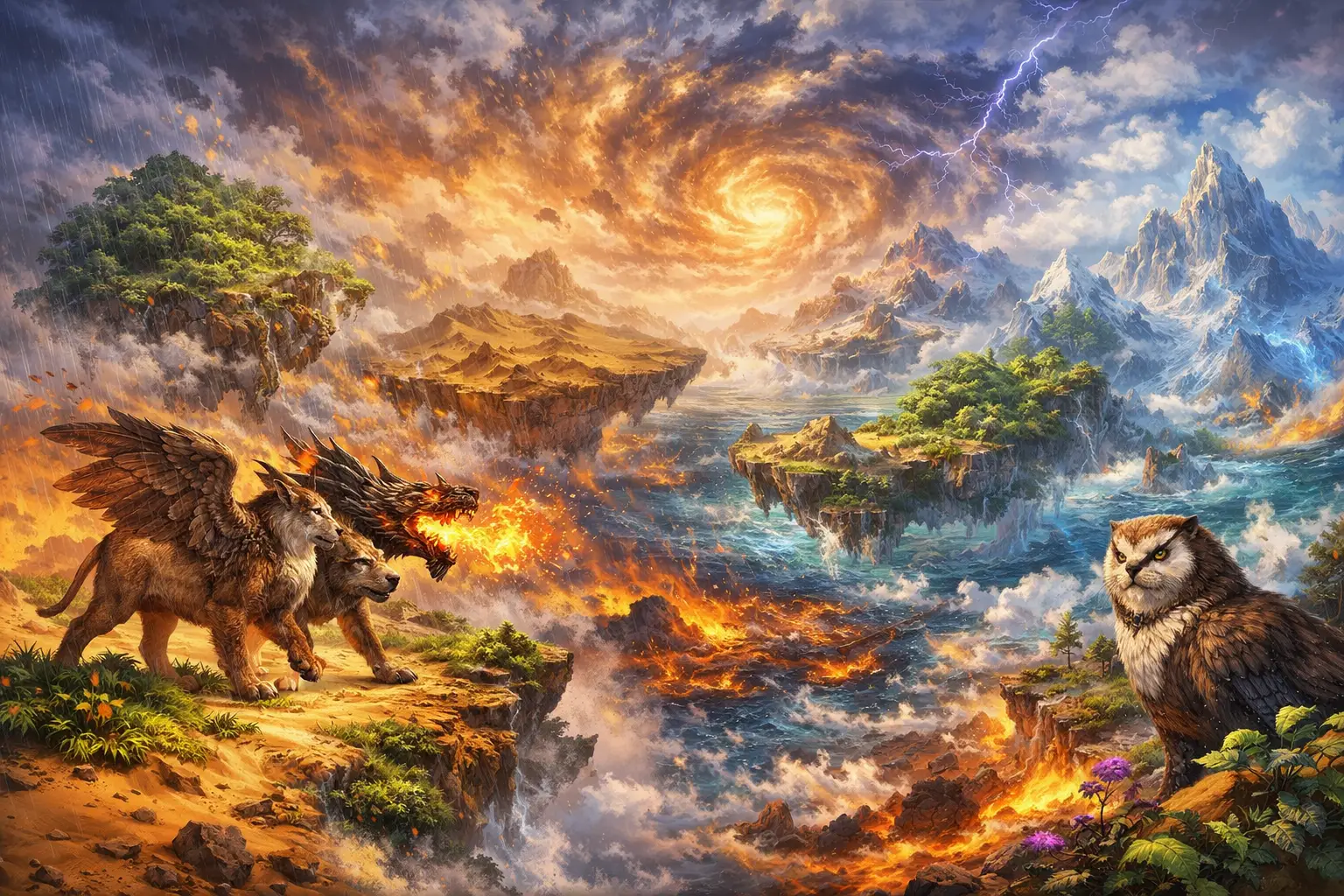
Kythri, the Churning Chaos
Plane — Change, Chaos, Adaptation & the Unexpected — Moon: Zarantyr, the Storm
It is hard to keep a consistent rhythm in Kythri. It takes effort to maintain any pattern of behavior; without even thinking about it, visitors find themselves adjusting their movements to avoid repetition. You eat with your left hand because you ate with your right hand a moment ago. You take a different route to the same place, for no reason you can articulate. The plane pushes you — gently, constantly — toward novelty, toward deviation, toward change. This is the essence of the Churning Chaos. On one hand it is a vision of destruction and disorder. On the other, it is about adaptation, about overcoming the unexpected, about the absolute refusal to do the same thing twice.
Kythri is commonly imagined as utterly unstable, with landscapes taking shape only to boil away within moments — and this is true of the heart of the realm, the roiling maelstrom known as the Sea of Chaos. But at the edges of the sea, there are islands that linger. The environments of these Shifting Islands steadily and constantly change — a vast desert might become a lush rainforest in a few hours, a glacier by morning — but the land itself remains solid, and creatures can live on these islands if they are willing to adapt to the endlessly changing environment.
The critical distinction between Kythri and Xoriat is this: while Kythri constantly changes, its changes are always natural. A jungle becomes a desert, a blizzard becomes a sandstorm — but the sandstorm is composed of sand, not tiny marble busts of King Boranel. Kythri cycles through plausible options; Xoriat traffics in the unreal. A scholar of the planes must understand both chaos and madness, but they should never confuse the two.
Kythri's counterpart in the planar orrery is Daanvi, the Perfect Order — the plane where nothing changes and everything follows a precisely maintained rhythm. Where Daanvi embodies permanence, structure, and the systems that hold civilization together, Kythri embodies disruption, mutation, and the creative destruction that prevents any system from calcifying into tyranny. The tension between the two planes is one of the fundamental dynamics of reality: without order, nothing endures; without chaos, nothing evolves.
Universal Properties
All things change in Kythri — even time, even the future. The only thing that is truly reliable is that nothing is reliable.
Broken Rhythms. A creature cannot take the exact same action on two consecutive turns. If it previously stood still, it must move. It can cast a spell on consecutive turns, but not the same spell. It can attack on consecutive turns, but the second attack must be described as substantially different in style from the first. Repetition is the enemy here, and the plane enforces that principle at the tactical level.
Fluid in Form. When a creature casts a transmutation spell, its range is doubled; if the spell has a duration of at least one minute but less than twenty-four hours, the duration is also doubled. Kythri loves transformation and rewards those who embrace it.
Magically Impeded (Divination). Divination magic is suppressed in Kythri. Divination spells cast on other planes cannot affect or target creatures, places, or objects in Kythri. Even great powers cannot scry into the Churning Chaos — a fact the githzerai exploit with deliberate and absolute intent.
The Odds Are Odd. Fortune swings wildly in Kythri. If the d20 roll for an attack is a 1 or a 2, the attack misses regardless of modifiers or the target's AC. If the roll is a 19 or 20, it hits regardless, and is considered a critical hit. Creatures with abilities that expand their critical range benefit further. In Kythri, the extremes are more extreme, and the middle ground is less reliable.
Constant Change. Nothing remains exactly the same in Kythri. Whenever a creature finishes a short or long rest, something about it or its possessions has changed. The change has no mechanical impact — copper coins do not become platinum — but it is unavoidable. Your cloak changes color. Your sword acquires a stylish Aundairian design where it was previously Karrnathi. Your nails grow, your hair curls, or you suddenly realize you despise olives. Players describe what has changed about their characters; if they want a change to have mechanical impact — a cleric's faith shifts, or their character's appearance alters permanently — that is a conversation between player and DM.
Chaotic Time. Time is fluid in Kythri, inconsistent both with the Material Plane and within its own islands. Adventurers who spend a day in Kythri could find that a year has passed on Eberron, or they could be trapped for a year and return to find that only an hour has elapsed. There is no formula; it is simply chaos.
The Sea of Chaos and the Shifting Islands
Kythri is not divided into layers in the way most planes are. Its structure is closer to that of Dal Quor: it has a planar core — the Sea of Chaos — with islands of relative stability suspended within it. The difference is that Dal Quor's core is stable, while Kythri's grows more tumultuous the deeper you go.
The Sea of Chaos
Space has little meaning in the Sea of Chaos. Matter, distance, and gravity are in constant flux. Lands and creatures appear and dissolve within moments. There are waves of lightning, streams of lava, and hurricane winds that shift direction without warning. Size itself is unreliable: a thousand-foot dragon turtle might appear, attempt to swallow travelers, and then become an island.
Travel through the Sea of Chaos is driven by pure will. Travelers must impose the concept of motion and distance on the environment through intense mental focus, while simultaneously protecting their vessel from the destructive forces and from being transformed. Without a specific destination to serve as a conceptual anchor, travelers will quickly crash on a random Shifting Island — or worse, be dissolved into the chaos entirely.
The Shifting Islands
Countless islands drift at the edges of the Sea of Chaos, varying dramatically in size, each with its own environment. These environments change steadily and constantly, but they change slowly — it takes anywhere from a day to a week for an island to shift from a barren desert to a verdant jungle. Weather is generally more dynamic and often at odds with the environment; a vast desert might be lashed by tropical rain, and a frozen tundra might bask under a blazing sun.
The primary denizens of the Shifting Islands are monstrosities and beasts that blend the features of multiple creatures — griffons, chimeras, owlbears, and stranger things. Populations expand and contract without needing to be sustainable; visitors might find a plateau swarming with griffons, or a realm of chimeras where each one has a different arrangement of heads. The intelligent inhabitants are almost entirely slaadi, though they are not necessarily hostile — it depends entirely on which culture is currently in power.
Keep in mind that Kythri is home to mimics of all sizes. An unusual monument might be a colossal mimic. That friendly hill you camped on? Also possibly a mimic.
Notable Locations
Cornerstone
Cornerstone is the largest of the slaad cities, and it embodies everything that makes Kythri simultaneously fascinating and terrifying. Its architecture, government, culture, and disposition toward visitors change completely every few days — sometimes faster — cycling through whatever slaad culture currently holds power. Under the Grand Concordance of Iron, the city fills with brutalist iron towers and drilling armies. Under the Enlightened Lyceum League, slender glass spires house debating halls and philosophical salons. Under the Final Regency, vast temples to a slaad-based Sovereign Host dominate the skyline. Under the Glorious Union of Flesh, the city becomes a very dangerous place to visit indeed.
The transition between cultures is not instantaneous — there are usually a few days of chaotic revolution in between — but the scope of the community never changes. Cornerstone is always a metropolis. What it is about is the question that shifts.
EXCERPT — TASKER'S TALE: FOUR DAYS IN CORNERSTONE, SERIALIZED IN THE KORRANBERG CHRONICLE, 989 YK
I arrived on a Sul. The city was a republic of scholars — slender glass spires, debating halls, a library that changed subjects every time you turned a corner. The red slaadi wore spectacles and argued about philosophy. A green one offered me tea. I accepted. The tea was adequate.
I woke on Mol to the sound of marching. The spires were gone. In their place: iron towers, black banners, drilling grounds. The same red slaad who had served me tea was now wearing a breastplate and screaming orders at a column of infantry. It did not seem to remember the tea. I asked about the library. It threatened to have me executed for sedition.
By Zol the city was a theocracy. Vast temples to a slaad-flavored Sovereign Host dominated the skyline. The same red slaad was now a high priest, conducting services in a language I am fairly sure it had invented that morning. It offered me communion wine. I accepted. The wine was adequate.
I left on Wir. By then the city was something else, but I did not stay to find out what. Some things are best left to the imagination, and in Kythri, the imagination cannot keep up.
The attitude of slaadi toward adventurers depends entirely on the active culture. The Final Regency may welcome visitors who profess devotion to the Sovereigns (provided they do not question the Regency's interpretation). The Confluence of Reality celebrates extraplanar visitors and desires their stories, performances, and cultural artifacts. The Republic of B'ob is ruled by a red slaad who makes up new laws whenever he feels like it — and the first rule he made was that he is in charge, and that is the only rule he has never changed. Regardless of the current culture, Cornerstone is the best place to acquire Kythrian artifacts or magical services.
Zertherun IV
Zertherun IV is one of the monastery vessels of the githzerai — a bastion of absolute order sailing through the heart of chaos. It is maintained by the mental discipline of the Serene Azera, whose focus keeps the vessel stable against the ceaseless pressure of change. The Alazerth Elemon is a senior monk charged with dealing with outsiders — sometimes through diplomatic negotiation, other times by rallying zerths to repel attackers.
Kythri's Broken Rhythms and The Odds Are Odd properties do not apply within a githzerai monastery, and while Constant Change exists, its effects are minimized. Zertherun IV maintains capacitors for change — gardens of small stones and engraved wheels with shifting patterns — which absorb the energies of chaos and prevent them from transforming the vessel. The monastery is an island of perfect, intentional stillness in the most unstable place in existence, and the githzerai maintain it through nothing but the force of their collective will.
DIPLOMATIC NOTE — RECOVERED FROM THE PERSONAL EFFECTS OF ALAZERTH ELEMON, ZERTHERUN IV, DATE UNCERTAIN
To the outsiders:
You are shadows cast by a stolen world. We do not say this to wound you; it is simply what you are. Your Eberron wears the crown of planes that once belonged to ours. Your flesh is patterned after designs the daelkyr imposed over the bones of our ancestors. You live in the house that was built on the ruins of our home.
We do not hate you for this. Hatred is a luxury of the undisciplined. But we will not pretend you are real in the way that we are real, and we ask that you not pretend to understand us.
You may shelter here for three days. Do not touch the change-gardens. Do not speak to the Serene. Do not attempt to meditate in the eastern hall; the silence there is ours, and you would not survive it.
When you leave, forget us. We will forget you. It is kinder for us both.
Denizens
Wild Things
The islands of Kythri are inhabited — but how can a creature survive in an environment that is a desert today and a glacier tomorrow? The answer is that it must change with the environment. Kythrian beasts shift as the land around them shifts: the wolf in the forest becomes an arctic wolf when the land turns to ice, becomes a jackal when it turns to sand. Beyond these practical adaptations, Kythrian creatures constantly shift their plumage, behavior, and fundamental biology, sometimes from moment to moment.
Kythri is home to many creatures that blend the features of two or more natural beasts — the monstrosities that people on Eberron know as owlbears, griffons, and chimeras. It is commonly accepted that at least some of these creatures first appeared in Kythri and entered Eberron through manifest zone portals. Kythri's wild things also include natural shapechangers, notably a wide variety of mimics — including colossal ones that can assume the shape of natural features like hills and mountains.
Unlike other planes where such creatures might be immortal manifestations, the wild things of Kythri are mortal. They live, reproduce, and die following mostly natural means. Between the strange flow of time and the constantly shifting environment, populations can surge dramatically or collapse to nothing — but the plane itself seeds new life into islands that become depopulated, and if all the griffons in Kythri were to die, new ones would eventually evolve. Kythri does not have manifestations, but it ensures a steady supply of mortals exist to inhabit its shifting world.
Slaadi
The slaadi are the native immortals of Kythri, and they are its only true civilization — such as the word "civilization" can be applied to a society that reinvents itself from scratch every few days. Though they reproduce (in strange and disturbing ways) and can die of mortal ailments, they are classified as immortals because their population remains absolutely constant. Whenever a new slaad is born, an existing slaad dies somewhere, seemingly at random. Whenever a slaad is killed, a new one forms. Even if a blue slaad transforms an entire village of humans into slaadi with the chaos phage, the total number of slaadi does not increase — the new additions are balanced by deaths elsewhere. The slaadi can never be wiped out, and they can never truly grow.
Each slaad community has its own distinct culture and a grand name — the Grand Concordance of Iron, the Enlightened Lyceum League, the Final Regency, the Glorious Union of Flesh, the Confluence of Reality, the Republic of B'ob — but these cultures are constantly changing. The grand city of Cornerstone might be the seat of the brutal Concordance today and the democratic Lyceum a month later. The slaadi themselves retain their core forms (a red slaad is always a red toad-like creature), but Kythri's influence also causes them to change color: a green slaad could go to sleep one night and wake up as a death slaad, and vice versa. In a culture like the Concordance, where rank is based on color, this means that leadership can change overnight — literally.
Because slaad cultures change so rapidly, they rarely enact plans beyond their own communities, though cities occasionally clash. Some weeks they seek to exterminate the githzerai, and other weeks to ally with them. You never know what you will get, and that is precisely the point.
Githzerai
The githzerai are not natives of Kythri. Their presence is an act of defiance — through unparalleled mental discipline, they create bastions of order in the heart of chaos. They do not dwell on the Shifting Islands but in vast monastery vessels of their own creation, town-sized ships that move through the eddies of chaos and defy transformation through sheer collective willpower.
If they seek order, why not dwell in Daanvi? Because the githzerai do not merely desire order — they seek to strengthen their will by imposing it on a reality that absolutely defies it. The struggle is the purpose. Beyond this, they benefit from the fact that even great powers cannot scry into Kythri; the Churning Chaos is the finest hiding place in existence.
The githzerai devote themselves to meditation and self-improvement, with little interest in events beyond their monasteries. They have no particular love of outsiders — they consider all creatures of Eberron to be warped shadows of their stolen reality — but neither are they inherently hostile. A persuasive group of adventurers could find brief shelter in a githzerai monastery, especially if they bring something interesting to trade or compelling stories to share. But should the outsiders give offense, the githzerai will feel no remorse in eliminating them. There is nothing evil in shining light to dispel a shadow.
Greater Powers
No one knows if there is a greater power shaping Kythri. The death slaadi are powerful beings, but there is no known equivalent to Dolurrh's Queen of the Dead or Dal Quor's il-Lashtavar. Some sages assert that there must be a consciousness at the heart of the Sea of Chaos, a sentience behind the turmoil, but its presence has never been proven. If Kythri has a guiding intelligence, it keeps its own counsel — which, given the nature of the plane, means it may have already told you its secrets and simply changed its mind about what they mean.
Planar Manifestations on Eberron
Manifest Zones
Kythrian manifest zones are often unpredictable in minor ways — weather patterns deviate from the surrounding region and change on a moment's notice, and the plane's universal properties carry over to many zones. Zones with the Constant Change property might produce monstrosities spontaneously, while those with the Fluid in Form property amplify transmutation magic and can have dramatic effects on the success of magebreeding. These latter zones are extraordinarily valuable to House Vadalis.
Manifest zones can occasionally serve as gateways, allowing creatures from Kythri to slip through into Eberron — intentionally or accidentally. Many monstrosities make their homes in the wilds of the Material Plane after crossing through such portals, while slaadi arrivals can present extremely unusual encounters depending on which culture they currently represent.
Materials harvested from Kythrian manifest zones are important components of magic items tied to transmutation and illusion. Shiftweave, one of Eberron's most popular luxury textiles, uses fibers of plants grown in Kythrian zones. The manifest zone of Hal'kyth is a vital part of the transmutation industry in the sahuagin's Eternal Dominion beneath the Thunder Sea.
Coterminous and Remote
Kythri's cycle of coterminous and remote periods is — appropriately enough — completely unpredictable, lasting anywhere from days to centuries. Curiously, its proximity to Eberron has no discernible effects. This is one of the great puzzles of planar scholarship: every other plane produces observable changes when it draws close or pulls away, but Kythri, the plane of change itself, apparently changes nothing about the Material Plane when it comes and goes. Some sages find this suspicious. Others find it perfectly consistent.
Kythrian Artifacts
Items that originate in Kythri often have unpredictable side effects. A hat of disguise crafted from Kythrian materials functions normally when its wearer keeps a clear mental image of their desired appearance — but if they lose focus, the disguise slowly and continuously changes minor elements: hair color shifting, nose shape migrating, clothing patterns drifting through an endless sequence of styles. A blade forged from Kythrian steel might change its hilt design between uses, or shift its weight distribution in ways that prevent the wielder from developing muscle memory. These effects are cosmetic rather than mechanical, but they are unavoidable and occasionally inconvenient.
Beyond individual items, Kythrian materials are essential components in the production of transmutation-focused magic items and in advanced magebreeding techniques. The plane's ultimate export, however, is its monstrosities — creatures that first evolved on the Shifting Islands and crossed into Eberron through manifest zone portals. The owlbear in the Eldeen Reaches, the griffon nesting in the Byeshk Mountains, the mimic hiding in your dungeon — all of these may owe their existence to Kythri's restless creative energy.