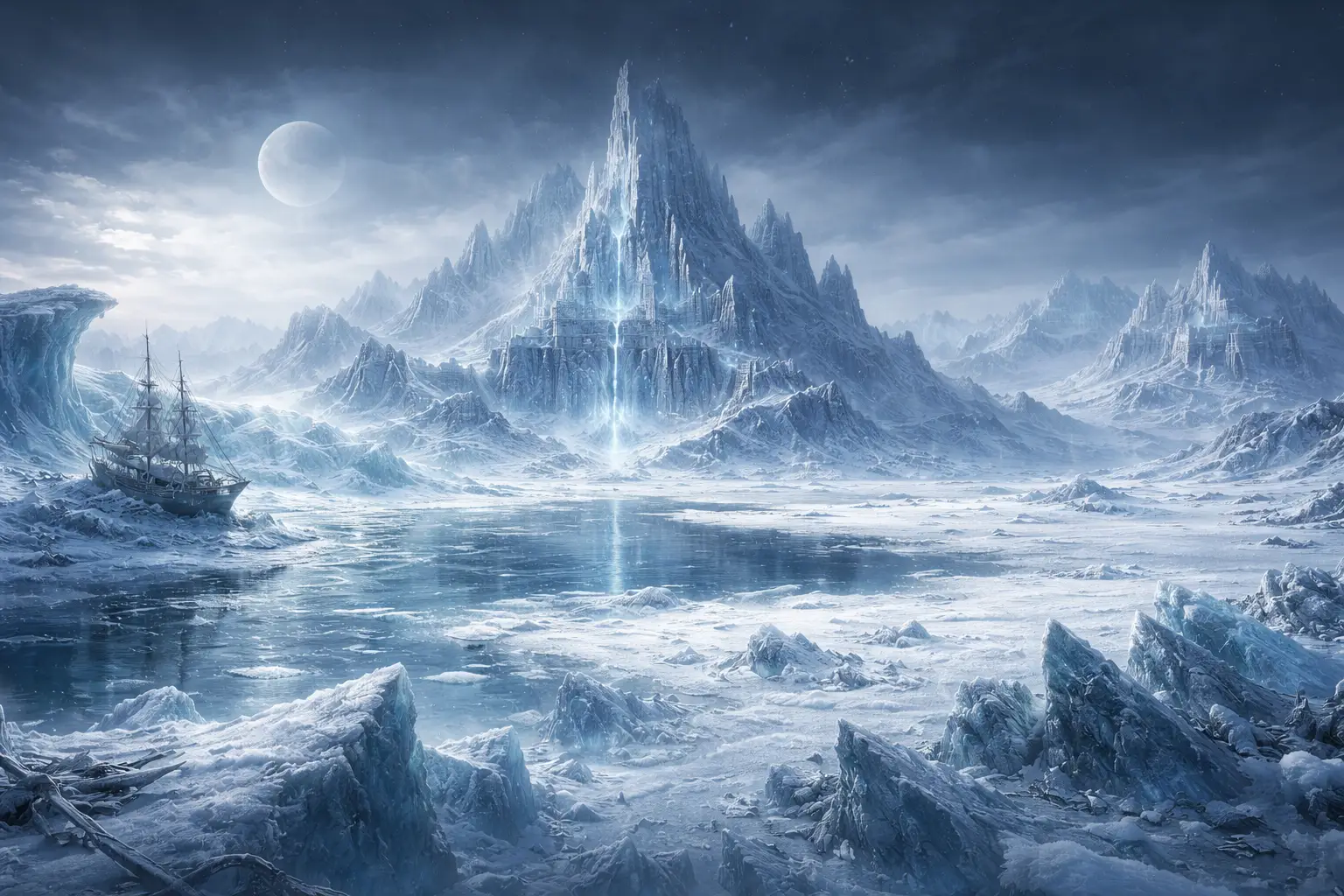
Risia, the Plain of Ice
Plane — Isolation, Stagnation, Preservation & the Killing Cold — Moon: Dravago, the Herder
Risia is known as the Plain of Ice, and the vast majority of what is found within it is exactly that — endless arctic wastes where what appear to be mountains are peaks of solid ice, and the silence is so absolute it presses against the eardrums. But like Fernia, Risia's appearance is deceiving. Because it is filled with glaciers and snow, many sages assume that cold is its defining principle. It is not. In Lamannia, there are also endless blizzards and majestic glaciers — ice in its natural state, beautiful and dangerous and wild. By contrast, the core ideas that define Risia are isolation, stagnation, and preservation. The frozen landscape is not about snow; it is about utter stillness, the empty and unchanging expanse. Where a desert of sand can at least shift in the breeze, the frozen landscape of Risia is fixed, permanent, and profoundly uninterested in change of any kind.
Risia is sparsely populated, because that is the point of it. It is bleak and lonely, a realm where you could walk for days and never see another creature — and where the plane itself seems to prefer it that way. Yet unlike a dead plateau, Risia's frozen substance reflects something that could change, that was once fluid and dynamic, but is now caught, frozen, and stagnant. Water that was once a river. A wave that was once in motion. A life that was once being lived.
Though this isolated and unchanging plane might not seem appealing to adventurers, it holds one property of extraordinary value: preservation. Ancient secrets forgotten for ages could be frozen within the ice. Ships lost centuries ago sit in the Frozen Sea, their crews perfectly preserved, their cargo intact. The frost giants who fled here from Xen'drik forty thousand years ago still live, immortal and unchanged, whiling away the millennia by sculpting ice into works of art that take centuries to complete. And somewhere, deep in the ice, there may be things that were deliberately hidden — because in Risia, nothing is ever truly lost. It is only frozen, waiting.
Universal Properties
Risia is bitterly cold, and unprotected creatures succumb quickly. The following properties apply across all layers.
Lethal Cold. A creature exposed to the cold of Risia must periodically resist or gain levels of exhaustion. A creature adapted to cold climates or wearing appropriate protective gear is safer, but even the prepared find the cold relentless. All creatures gain resistance to fire damage while on the plane, and those that are normally resistant to fire become immune to it entirely.
Empowered Ice. When a creature casts a spell of 1st level or higher that deals cold damage, the spell strikes as though cast at one level higher than the slot expended.
Preservation. If an unconscious creature remains in contact with the ground for more than one minute, it is drawn beneath the surface and encased in ice-encrusted stasis. While encased, time ceases to flow for the creature — it does not grow older, and it remains in perfect condition until freed. This is the mechanism by which Risia preserves the things it claims: not by killing them, but by stopping them.
Stillness of Flesh. Time passes at the same pace as on the Material Plane and is consistent across all layers. However, the passage of time has no effect on a mortal creature's body — creatures do not age, grow, or change while in Risia. Exhaustion and other conditions still apply, but the biological clock simply stops. Creatures native to Risia are immune to this effect and can age and die normally. Mysteriously, all dwarves — whether native to Risia or visitors from Eberron — are also immune to Stillness of Flesh. They age just as they would on the Material Plane. No one has ever adequately explained why.
Layers
The layers of Risia are few in number but vast in size, connected by great archways of ice. Sometimes travelers find pools of ice that show images from other layers; breaking through this ice may allow passage, or the images may simply be reflections of the lost. While depictions of Risia often show terrifying storms, these are found only in the Boundless Blizzard; most of Risia is utterly still, silent, and deadly.
Frostmantle
A seemingly endless range of mountains formed of solid ice, surrounded by a sea of dense mist. Perhaps land lies somewhere far below, or perhaps the mountains continue downward indefinitely into the darkness. Frostmantle is the primary home of the frost giants of Il'Ara, who have carved citadels from the ice over forty millennia. The three largest fortresses are Freehearth, Remorse, and Winter.
Freehearth is the communal heart of Il'Ari culture — part artist's commune, part giant tavern. When the isolation grows unbearable, giants come here to socialize, trade stories, and show off their work. Ancient notices are pinned to the frozen bar, each an artist's request for collaborators. Trophies hang on the walls, including an entire Lhazaar boat pulled from the Frozen Sea and a corner devoted to hunting kills that giants drag here over weeks of travel to prove they made them.
Remorse is a somber crypt. Not all giants can withstand the tedium of eternity, and those who cannot travel to Remorse to enter icy stasis — frozen in unconsciousness until the day they wish to be freed. For many, that day has yet to come. The fortress halls are formed from crystal-clear ice in which giants sleep in endless rows, watched over by a single caretaker.
Winter is the abode of Il'Ara herself, where the archarcanist continues her arcane research after forty thousand years — goals unknown, patience infinite.
Clouds hide the sky above Frostmantle, but the light is steady and unchanging. Night never falls here. Travelers must contend with high altitude as well as lethal cold.
INSCRIPTION — CARVED INTO THE ICE WALL OF FREEHEARTH, THE LARGEST FROST GIANT CITADEL IN FROSTMANTLE. LANGUAGE: GIANT. TRANSLATION BY HOUSE SIVIS.
We came here to survive. We stayed because leaving would mean admitting that forty thousand years of survival was not the same thing as forty thousand years of living.
The Boundless Blizzard
Chill winds howl as snow and hail fill the air. Visibility is limited to sixty feet, and there is no knowing what lies ahead. Adventurers may find occasional caves or shelters, but these may already be occupied by remorhazes or other stranded monstrosities. The storm never ends, and the layer is permanently caught between night and day — dim light at best, with areas of intense snowfall that are heavily obscured. This is one of Risia's most dangerous layers, and a good place to find the frozen bodies of other adventurers, held in stasis beneath the ice.
The Frozen Sea
Imagine an ocean frozen in a single instant. No shore in any direction — just waves caught mid-crest alongside the frozen funnels of maelstroms. Scattered across this impossible seascape are countless ships, vessels pulled from the oceans of Eberron in moments when the moons aligned and Risia was coterminous. Some are shattered, caught halfway through sinking. Others are in perfect condition, sealed under the thinnest layer of ice. Ships from throughout history can be found here — Lyrandar elemental galleons alongside massive vessels built by the ancient giants of Xen'drik. There could be survivors sheltering in their trapped vessels, preserved for centuries, or a frost giant might have raised a tower of ice above the frozen water.
The spirits of the Killing Cold are strong here, preying on survivors and pulling them into the frozen depths. It is always night on the Frozen Sea; the moon Dravago is fixed in a cloudless sky, shedding dim light across the water.
RECOVERED EXPEDITION LOG — WAYFINDER FOUNDATION VESSEL NORTHERN STAR, FOUND FROZEN IN THE FROZEN SEA OF RISIA. ESTIMATED DATE OF ENTRY: 873 YK. RECOVERED: 996 YK.
Day 1. Fog came out of nowhere. When it cleared, the sea was ice. Not frozen over — frozen mid-motion. Waves caught at their crests. A maelstrom locked in place, its funnel open and still. The ship is intact, sealed under a thin layer of ice so clear it looks like glass. The crew is alive. We are not cold — or rather, we are cold, but it does not seem to matter. No one is hungry. The sun has not moved since we arrived. I do not think it will.
Day 14. We found another ship today. A Lyrandar galleon, elemental ring dark and still, locked in a wave trough a quarter mile to starboard. The crew is aboard, frozen in their positions. The captain is at the wheel with her mouth open, mid-order. She has been dead for a very long time, but she does not look it. Nothing decays here.
Day 14 (continued). Kael says it has been longer than fourteen days. He has been counting heartbeats. He says we have been here for months. I told him that was impossible. He showed me his tally marks. There are thousands of them.
Day ?. I have stopped counting. Nothing changes. Nothing will ever change. The ice goes on forever. The silence is perfect. I am writing this because I am afraid that if I stop, I will sit down on the ice and never stand again, and in a thousand years someone will find me the way we found the Lyrandar captain — perfectly preserved, mid-sentence, with nothing left to say.
Other Layers
One layer is a vast, featureless glacier — possibly the inspiration for the title "Plain of Ice." A small layer holds immense ice sculptures of unknown humanoids, which could be reflections of primal beings or the work of a frost giant artisan who has been sculpting for thousands of years. Another layer contains rivers flowing over an icy plain, but the liquid is so cold it shatters any mundane material placed within it.
Denizens
Spirits of Ice
At first glance, Risia appears barren and empty. But some travelers describe a presence — a sense of being watched — and most feel this presence is malign. There is nothing inherently evil about ice, yet there is a hunger to Risia, an innate desire to consume warmth and bury living things. In the Planar Codex, Dorius Alyre ir'Korran calls this force the Killing Cold — the greatest power of the plane of isolation, uninterested in being known and never having interacted directly with outsiders, but felt through its manifestations.
These manifestations include bheur hags, frost salamanders, ice devils, chain devils, and the Lonely (a sorrowsworn). Their appearance reflects Risia's themes — a chain devil might be shrouded in frost-mist, binding enemies with chains of ice. Regardless of their form, these spirits do not speak. Their intelligence is the cunning of a predator, nothing more. When not active, they are absorbed into their layer, perfectly content to sit in silence for centuries before something compels them back into physical form. They are spirits of stagnation and isolation, and waiting is what they do best.
Frost Giants and Dwarves
The archarcanist Il'Ara was one of the empyreans of the Group of Eleven, the alliance of giant titans who ruled Xen'drik in the Age of Giants. She was devoted to the study of Risia, and over millennia she magebred her own lineage of frost giants. When the forces of Argonnessen began to destroy Xen'drik, Il'Ara gathered her children and passed through to Risia, certain they could find sanctuary in the plane's isolation.
Her children have since established themselves across the layers. Some have become artists, writing poetry or sculpting massive works of ice that take centuries to complete. Others pursue physical diversions — wrestling, hunting fiends, crafting ornate games. The crueler giants hunt newcomers for sport, but many are excellent hosts, starved for novelty after millennia of stillness. Artists in particular yearn for an audience, though a genteel giant host can become deadly if guests fail to properly appreciate their work. As these giants are remnants of a grand civilization, they possess intelligence, arcane knowledge, and cultural sophistication far beyond what their frost giant statistics might suggest.
The frost giants of Risia have dwarf servants — and their origin is one of the plane's deepest mysteries. The giants know that Il'Ara produced the first dwarves, but they do not know whether she created them from nothing or pulled them from Eberron. These dwarves know no other existence than their servitude, and Risia offers few other options. The treatment they receive varies enormously from giant to giant: some are treated as equals and trained as artistic collaborators, while others are treated as disposable property. With no knowledge of any other life, their immortal masters may as well be gods.
Mysteriously, all dwarves — including these Risian-born ones — are immune to Stillness of Flesh. They age normally, give birth to children who grow and mature, and die natural deaths. Every giant in Risia came from Xen'drik, and as they die, no new giants replace them. But the dwarves were born here, generation after generation, for forty thousand years.
Planar Manifestations on Eberron
Manifest Zones
Manifest zones tied to Risia are often found in cold or arctic regions, where their impact is not immediately obvious. In warmer climates, most Risian zones create areas of unnatural cold, often possessing the Lethal Cold and Empowered Ice properties regardless of the local climate. In a few zones, the effects of Stillness of Flesh can be felt — slowing or completely stopping the aging, growth, and reproduction of all creatures, except for dwarves. While a manifest zone that prevents aging might seem a remarkable boon, such zones are typically small and bound to deadly cold that makes them difficult to inhabit.
It is unusual for a Risian zone to transport people to Risia itself, though this can occur during coterminous periods.
Coterminous and Remote
While Risia is coterminous, temperatures drop sharply across Eberron, and areas that would normally be chilly but safe can take on the Lethal Cold, Empowered Ice, and Stillness of Flesh properties. On rare occasions, creatures caught in areas of exceptionally intense cold can be unexpectedly transported to Risia — though this is unpredictable and not something most people actively fear.
When Risia is remote, intense cold loses some of its force, and cold-based magic is diminished.
Traditionally, Risia becomes coterminous once every five years for the full month of Zarantyr, and remote for the month of Lharvion two and a half years later. However, this cycle is not always reliable: in 657 YK, Risia entered a coterminous phase that lasted for three years.
Risian Artifacts
Risian ice is vivid blue and charged with the essence of the plane. It maintains its temperature under any conditions and never melts, even on the Material Plane. It is a potent component for creating magical effects related to cold or stasis, though it is relatively rare even within Risia — you cannot simply harvest giant sheets of it from Frostmantle's peaks.
The frost giants possess magic items and artifacts brought with them from Xen'drik, and Il'Ara has surely created new wonders over her forty millennia of research. Adventurers could also find treasures from any civilization trapped in the ice — buried in the Frozen Sea, clutched in the hands of people entombed for centuries, or locked in the cargo holds of ships that have been perfectly preserved since the day they were taken.