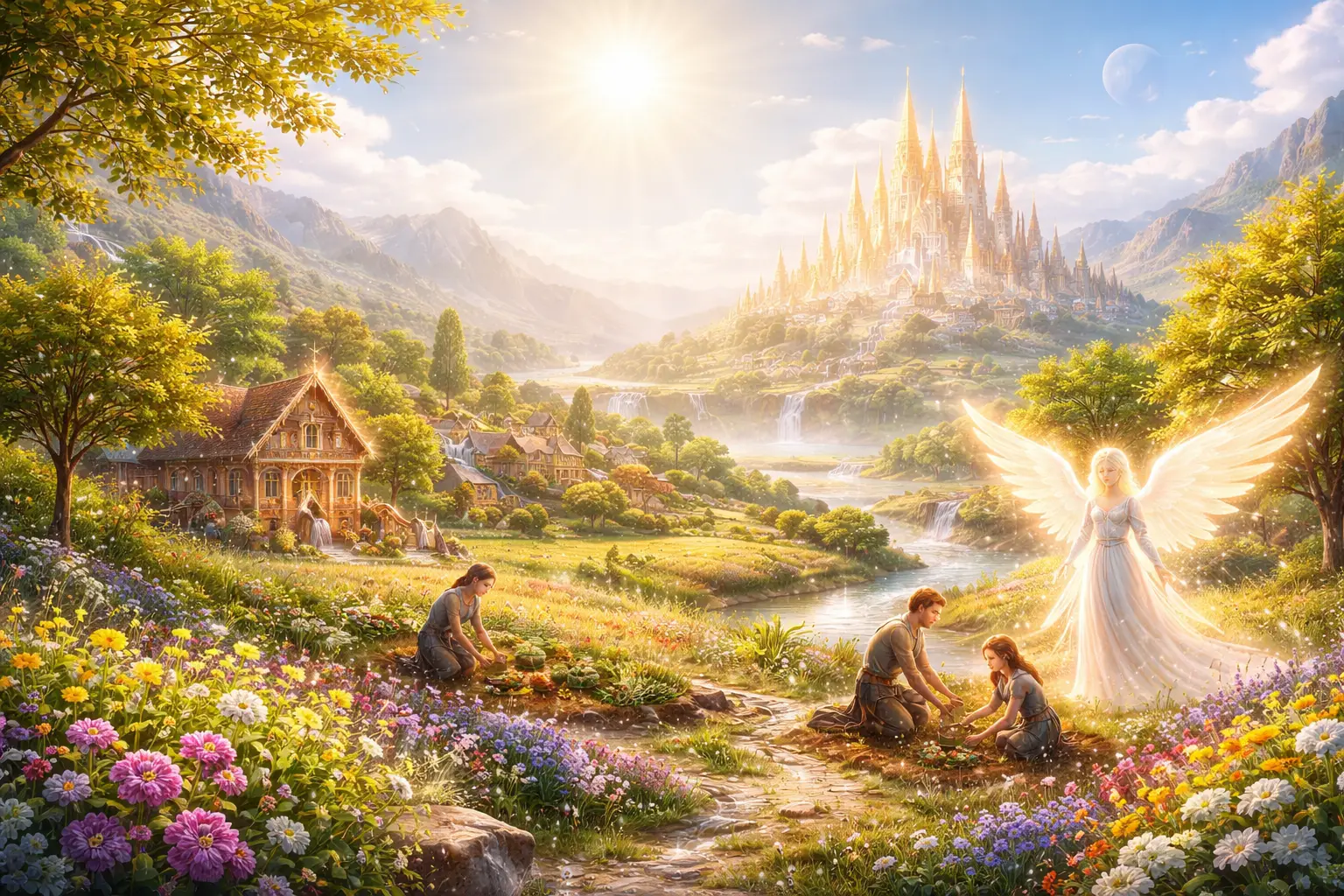
Irian, the Eternal Dawn
Plane — Life, Light, Hope & Creation — Moon: Barrakas, the Lantern
Birds sing in a fertile valley while a group of settlers work together to raise their first home. Moving further in, you find the gleaming capital of a new empire, where cheering throngs celebrate in the streets. There are dozens of layers in Irian, and each one is a vision of life triumphant — the dawn that inevitably banishes even the darkest night, the promise of spring triumphing over the coldest winter, the bastion of hope, the assurance that life will always find a way.
In his Planar Codex, Dorius Alyre ir'Korran calls Irian the Plane of Light, and indeed its light is so prevalent that there is no full darkness anywhere within its borders. But Irian is also the plane of life — the source of positive energy, the force that sustains living things and underlies most healing magic. It is the cosmic counterpart to Mabar, the Endless Night: as Mabar tears fragments from other planes and unmakes them, Irian generates new planar seeds to fill the void. Without this balance — the Dawn restoring what the Night consumes — Mabar would eventually swallow reality entire. The planes exist in equilibrium: Mabar is the end, and Irian is the beginning.
What differentiates Irian from Lamannia is optimism. Both planes contain verdant valleys and thriving ecosystems, but Lamannia embodies the raw, untamable power of nature — beautiful but threatening, indifferent to mortal welfare. Irian is a celebration of life, a plane where things are growing, people are prosperous, and the future is always bright. It is not nature as it is; it is nature as we hope it could be.
Irian is not easy to reach. Its manifest zones rarely serve as gateways, and traveling there typically requires plane shift or similar magic. But for those who manage the journey, the plane offers something no other plane can match: genuine, unconditional healing — of body, of spirit, and sometimes of hope itself.
RECOVERED INSCRIPTION — CARVED ABOVE THE GATE OF THE CITY OF THE DEAD, SHAE MORDAI, AERENAL. TRANSLATION FROM AERENI BY HOUSE SIVIS LINGUISTS.
The dawn is not a promise that the night was gentle. The dawn is a promise that the night is over.
Universal Properties
The light of the Eternal Dawn strengthens the living. Darkness and disease have no place here, and minor injuries melt away. The following properties apply across all of Irian's layers.
Radiant Power. When a creature casts a spell that restores hit points or deals radiant damage, the spell is treated as if cast at one level higher than the spell slot expended.
Impeded Magic (Necromancy). Necromantic magic struggles in Irian. A creature attempting to cast a necromancy spell must succeed on a check, or the spell fails without expending its slot.
Pure Light. There is no darkness in Irian. Any spell, effect, or situation that would normally create darkness only reduces the lighting to dim light. Shadows here are faint and warm — suggestions of shape rather than the creeping gloom of other planes.
The Light of Life. Irian's light restores vitality to all living creatures. Periodically, living creatures in Irian regain hit points simply by being present. They have resistance to poison damage and advantage on saving throws against disease, poison, and fear. These benefits extend to undead creatures sustained by Irian — such as the deathless elves of Aerenal — but have no effect on Mabaran undead or constructs.
Standard Time. Time passes at the same pace as on the Material Plane and is consistent across all layers.
Planar Rebirth
Most planes are fixed in their form. Mabar is the great exception — the Endless Night steals and corrupts fragments of other planes, adding them to its layers. Left unchecked, Mabar would consume reality. But as the Night consumes, the Dawn creates.
Whenever Mabar tears a fragment from another plane, a new planar seed appears in Irian. Initially, this seed is a small layer populated by embers and lumi, bearing Irian's own planar properties. Over time, the seed grows and evolves, and its environment and inhabitants take on the character of the void it is meant to fill. Little by little, it loses the properties of Irian and adopts the properties of its destination plane; when it finally loses the Light of Life property, its ties to Irian are severed and it fully becomes part of the other plane, replacing the region lost to Mabar.
The seed is rarely a perfect match for the fragment that was lost. For fragments torn from the Material Plane, a planar seed does not replace sentient creatures or buildings — it restores the land and wildlife, creating a welcoming environment rather than reconstructing what was there before.
Most planes maintain a fixed population of immortals who are reborn if killed. Irian breaks this rule: it creates new immortals to populate the planar seeds, replacing those corrupted by Mabar. These begin as lumi and angels, but as the seed loses its Irian properties, they evolve into the denizens of that plane — potentially including demons for a fragment of Shavarath, or yugoloths for a piece of Mabar. Irian makes no moral judgment about the spaces it fills. These seed-immortals cannot leave their layer until it is fully bound to its destination plane, so they cannot wreak havoc in Irian — but they could be quite a surprise for adventurers who stumble into the wrong layer.
The cultivation of planar seeds is the central purpose of Irian's inhabitants. It is the most important task they could perform, and the reason Irian's immortals rarely interfere in the affairs of other planes.
Layers and Realms
It is always morning in Irian. The skies are clear, the sun is fixed in the sky, and the moon Barrakas is faintly visible. The plane contains many layers and is always growing new ones. While the setting of a layer varies — a verdant valley, a growing city, a newly established farm — the story is always about life, growth, and hope. Things are growing, people are prosperous, and the future is bright.
The layers are linked in realms, each bound to one of the Architects. The denizens and themes of a layer reflect the influence of its Architect: all layers of the Garden have a focus on rustic nature, while those tied to the Amaranthine City reflect its rising imperial power. Some layers are bounded by physical barriers, but most loop back on themselves or end in walls of warm mist — anyone who wanders into the fog reemerges elsewhere in the same layer. Within realms, layers are connected by physical portals such as a massive gate or a pool of light. Moving between realms requires plane shift or a ritual tied to the destination. These rituals need not be magical; they are simply secrets that must be learned. To travel from the Amaranthine City to the Garden, all you have to do is plant a flower and reflect on its beauty; those thoughts will carry you there.
The Amaranthine City: Growth
This immense metropolis fills an entire layer — the capital of an empire in its first bloom of glory. Gilded banners catch the wind. Armored angels and pegasus patrols pass overhead. People laugh in the streets, healthy and happy. Artisans create mosaics depicting glorious victories. While this is an empire, the message is not about oppression but about potential — a civilization where all citizens are prosperous and all have equal opportunities.
The Amaranthine City is widely considered the heart of Irian. Its ruler, the Dawn Empress, is the first and greatest of the Architects. Her defining principle is growth — the opportunity to reach your full potential. She presides over festivals, tends the needs of her people, and devotes much of her time to the cultivation of planar seeds. She occasionally works with mortal warlocks, giving them tasks designed to help them with their own growth and evolution while also advancing the work of the seeds.
Experienced planar travelers may recognize the Amaranthine City as a mirror of its counterpart in Mabar — where Mabar's version is a haunted ruin of faded grandeur, Irian's is the same city at the peak of its promise. For every yugoloth in Mabar's Amaranthine City, there is an angel in Irian's. Some sages believe this symmetry simply reflects the complementary concepts of the two planes. Others have proposed something more unsettling: that the Dawn Empress and the Empress of Shadows might be two aspects of a single spirit, one representing a beginning and one representing the same spirit's end.
The Garden: Life
The Garden is a vast zoological wonderland — every plant that can be found on the Material Plane grows here, alongside many that cannot. Winding paths lead through peaceful pools, wondrous topiaries, and complicated hedge mazes. In contrast to the wilds of Lamannia, this is carefully cultivated — suffused with a sense of peace, beauty, and the wondrous things life can create.
The Gardener is the Architect whose principle is life. He is a blend of angel and plant — more humanoid than treant, but with skin of bark, a beard of leaves, and a crown of flowers. He appreciates those who nurture and heal others, and this is the behavior he expects of any mortals he associates with. Ki-rin are the most common celestials in the Garden's layers, and most embers here take animal form.
A few layers of the Garden are slightly darker than the rest of Irian — not because they embody despair, but because they reflect the principle that life overcomes hardship. A ruined castle overgrown with flowers is not a symbol of destruction; it is a symbol of what grows afterward.
The Refuge: Hope
The Refuge is a vast fortress-monastery with aspects of a spa — tranquil groves, soothing baths, and quiet places to rest and reflect. Its fortress walls do not represent potential conflict; they speak to the absolute security of the place. Within these walls, you are safe from all threats. The Refuge holds healers who can treat your injuries, mediators who can talk through your problems, and sages who may not know the answers you need but can point you in the right direction.
Araam is the Architect of the Refuge and embodies the concept of hope. She is a wise advisor, and while she does not always have answers, she helps people see their problems in new ways and understand that all problems can be solved. She is the finest healer in Irian, and there are few injuries she cannot mend or curses she cannot break. There is no monetary cost for the services of the Refuge — but Araam charges those who benefit to give hope to someone who needs it, and they will not be allowed to return to the Refuge until that debt is paid.
For adventurers seeking a place to recover from terrible injuries, break a powerful curse, or simply catch their breath between crises, the Refuge is unparalleled. But you get one free visit. After that, you pay forward.
FIELD REPORT — LUMI DESIGNATION "CANDLE," DISPATCHED TO THE MATERIAL PLANE BY THE ARCHITECT ARAAM. DELIVERED VERBALLY TO A PARTY OF ADVENTURERS IN THE ELDEEN REACHES, 997 YK. TRANSCRIBED AFTERWARD FROM MEMORY.
I was not always me. I am made from the brightest parts of people who are gone — a soldier's last act of courage, a mother's fiercest love, a child's first wonder at falling snow. They gave these things to me when they died, and I carry them forward. I do not grieve for them. I am them, in a way that matters. The light they gave the world does not end when they do.
I bring you a message from the Refuge. Araam says: there is a wound in the world that only you can heal. She cannot tell you where it is, because hope does not work that way — it must be found, not delivered. But she asks that you go looking for it. She promises you that it exists, and that when you find it, you will know what to do.
That is the message. I will travel with you as far as you will have me. I am not much use in a fight, but I am very good at believing things will work out. In my experience, that helps more than you would think.
Denizens
Embers
Irian is bursting with life — songbirds, rabbits, happy citizens on every street. But if you glimpse one out of the corner of your eye, you might see it differently: an outline of pale white light, a glowing shadow. These are not living creatures. They are embers, manifestations linked to sparks — tiny echoes of mortal souls, each tied to a living creature somewhere in the world. Through this connection, mortals draw inspiration and hope, and remain linked to the positive energy that flows to and from all living things.
An ember resembles the mortal whose spark fuels it, but it is not fully conscious. It holds only echoes of that mortal's brightest joys, deepest hopes, and greatest deeds. Embers follow basic scripts, cannot improvise, and are happy because they do not know any other way to be. An ember cannot be truly killed — its body dissolves, but the spark that fueled it remains safely within Irian's deep well of light.
While adventuring in Irian, you might encounter an ember that resembles you. It will not recognize you, and might not even appear the same age. It is merely your light-shadow, channeling the essence of your best moments.
Lumi
When a mortal dies and their soul goes to Dolurrh, the thread connecting them to Irian is severed. The ember fueled by their spark dissolves, and the spark — the essence of their hopes and brightest moments — begins to fade. But the sparks of the dead can merge together before they are lost, creating a new entity: a lumi, formed from the same positive energy as the embers, but possessing true consciousness and life.
Unlike embers, lumi are sentient creatures with unique identities, though their sparks give them fragments of many mortal lives. Adventurers may meet a lumi who recognizes them — who carries a few memories and traits of a fallen friend, woven into an entirely new being. Lumi appear to be formed from solidified light, generally taking a body shape similar to the strongest of the sparks that formed them. Their most distinctive feature is their head — a sphere of suspended light that they can consciously sculpt into a face.
Lumi serve as caretakers of the embers, believing that by helping the embers play their roles, they strengthen the light in the mortals the embers are connected to. They help develop and maintain the planar seeds, and some even surrender their identity to become new creatures within a seed — believing that in doing this, they sow the new layer with light. On rare occasions, lumi travel to the Material Plane in service of the Architects, and they are brave, compassionate, and ever prepared to lay down their lives for the greater good.
Celestials
Irian's immortals are spirits of light and hope. The plane is notably home to ki-rin, majestic creatures that often serve as emissaries for the Architects; each planar seed has a ki-rin assigned to monitor its development. Angels of Irian embody the principles of hope and compassion — less violent than the angels of Shavarath, less individualistic than those of Syrania. Devas assist the lumi and sustain the different layers, often changing their form to play multiple roles; adventurers may think they have met several people when in fact it was a single deva. Planetars serve as champions and ministers, and each Architect has a single solar that serves as its right hand.
The angels of Irian have wings formed of light, which they can conceal if they wish. In their true form, they are luminescent humanoids of indeterminate species, but they can appear as a generic member of the viewer's species.
The Architects
The Architects are the most powerful spirits of Irian. Each embodies an aspect of the plane and oversees a realm, devoting most of their time and energy to the planar seeds — guiding growth, smoothing problems, and adding personal touches. Their power is largely bound to their realms; they cannot directly intervene in the Material Plane, though they can work with warlocks as Celestial patrons or dispatch lumi. Their missions often involve the reintegration of a planar seed or examining regions where Mabar has removed a fragment.
The Dawn Empress, the Gardener, and Araam are the three Architects described in detail, but there are many more — each tending its own realm, each nurturing its own seeds, each working quietly to ensure that the balance between creation and entropy tips, however slightly, toward the light.
Planar Manifestations on Eberron
Manifest Zones
Manifest zones tied to Irian are wellsprings of positive energy. Plants and animals thrive in these zones, people find it easier to embrace hope and joy, and negative emotions feel muted and distant. Irian zones often possess one or more of the plane's universal properties: those with the Radiant Power property support healing magic and may enable rituals or eldritch machines that cannot be built elsewhere. The City of the Dead in Aerenal — Shae Mordai — is built on a strong Irian manifest zone, which sustains the deathless councilors of the Undying Court.
Common benefits found in Irian manifest zones include advantage on Medicine checks, maximized healing dice, and immunity to disease, poison, and fear. For all these reasons, Irian zones are valuable natural resources and often become the foundations of villages, towns, and Jorasco healing houses.
Plants that grow in Irian manifest zones can have remarkable properties. Many of Aerenal's exotic lumbers — notably livewood — only grow in Irian zones. Araam's crown is a flower with extraordinary medicinal properties; House Jorasco requires a steady supply for their healing potions. Another flower, dawn's glory, has euphoric properties and is used to make a drug called fool's hope or liquid courage, which grants temporary immunity to fear but encourages reckless and dangerous behavior. It is strictly illegal in Sharn, for obvious reasons involving bridges and overconfidence.
Irian manifest zones rarely serve as gateways to the plane itself; traveling to Irian almost always requires plane shift or similar magic.
Coterminous and Remote
Life blossoms when Irian is coterminous. Health and fertility are enhanced, positive energy flows freely, and living creatures are infused with hope. Healing magic is strengthened, and creatures gain additional resilience against disease, poison, and fear.
When Irian is remote, colors seem to fade and a sense of psychic numbness pervades the world. Healing magic — including spells and spending Hit Dice — restores only half the usual amount, though creatures still regain full hit points after a long rest.
Traditionally, Irian is coterminous for ten days in the month of Eyre and remote for ten days in the month of Sypheros. These effects occur once every three years; the remote cycle comes a year and a half after the coterminous period.
Irian Artifacts
Industry is not one of Irian's core concepts, and relics from the plane itself are relatively rare. Those that exist tie to the effects of positive energy: healing, radiant damage, generating light, bringing hope, or overcoming fear. A scroll providing a single trip to the Refuge would be an invaluable boon for any adventuring party.
The Aereni have learned to harness Irian's energy to create many of their tools and weapons, and the ancient giants of Sohl'aran — the City of Gold — pushed this further, developing medical knowledge and regenerative magic of extraordinary power. Everbright lanterns that channel the pure light of creation, periapts of wound closure inset with Siberys shards attuned to Irian, and sun blades forged from giant-scaled surgical scalpels have all been recovered from the ruins.
REPORT — MORGRAVE UNIVERSITY EXPEDITIONARY SURVEY, IRIAN MANIFEST ZONE (DESIGNATION: SWEETWATER BASIN), TALENTA PLAINS, 992 YK. FILED BY EXPEDITION QUARTERMASTER DARSHA COLWEN. STAMPED "INTERNAL REVIEW ONLY" BY THE DEPARTMENT CHAIR.
Week 1. Survey team of thirteen arrived at the basin and established camp per standard protocol. Water table analysis, soil sampling, flora cataloging. Zone properties confirmed: accelerated plant growth, enhanced vitality, mild euphoria consistent with Irian influence. Morale is high. Requisition filed for additional sampling jars.
Week 6. Morale is unreasonably high. Professor Tallek has stopped taking soil samples and started composing poetry about the wildflowers. It is not good poetry, but we do not care. He reads it aloud at mealtimes and everyone applauds. Harren and Syll from the cartography team have begun "co-authoring field notes" in a single tent. Their maps have not been updated in nine days.
Week 14. I need to be direct. Half the expedition's women are pregnant or actively trying to become so. Professor Tallek has married surveyor Ioenne in a ceremony he wrote himself, conducted under an oak tree that I swear was not that large when we arrived. The remaining cartographers have platted the basin into homestead lots. Someone has planted a kitchen garden. We were not issued seeds. When I asked where they came from, Ioenne smiled and said "the soil didn't need seeds to grow life."
Week 20. Requisition request redacted and replaced. We no longer need sampling jars. We apparently need cradles, a midwife, and lumber. Three expedition members have sent letters of resignation to Morgrave. Two more asked me to forward requests for their families to join them. Harren has started building what he calls a "community hall." It is, I am forced to admit, quite well constructed.
Week 26. I am filing this report from the only tent that has not been converted into a permanent dwelling. The expedition is effectively over. In its place there is a village of eleven people, one goat of uncertain origin, four new marriages, and a community garden that produces high-quality vegetables at a rate I would call impossible anywhere else. They have named the settlement Sweetwater.
I should leave. I know I should leave. My report is finished and there is nothing more to quartermaster. But the air smells like morning, and Tallek's poetry has gotten better, and this morning I caught myself thinking about where I would put a cottage if I were to stay.
I have decided to stay one more week. For observation purposes.
ADDENDUM — MORGRAVE UNIVERSITY RECORDS OFFICE, 995 YK. Sweetwater Basin now has a population of twenty-four, including nine children under the age of two. Quartermaster Colwen did not return. She serves as the village's unofficial mayor and has declined three separate recall notices. The Department of Planar Studies has reclassified the expedition as "ongoing."