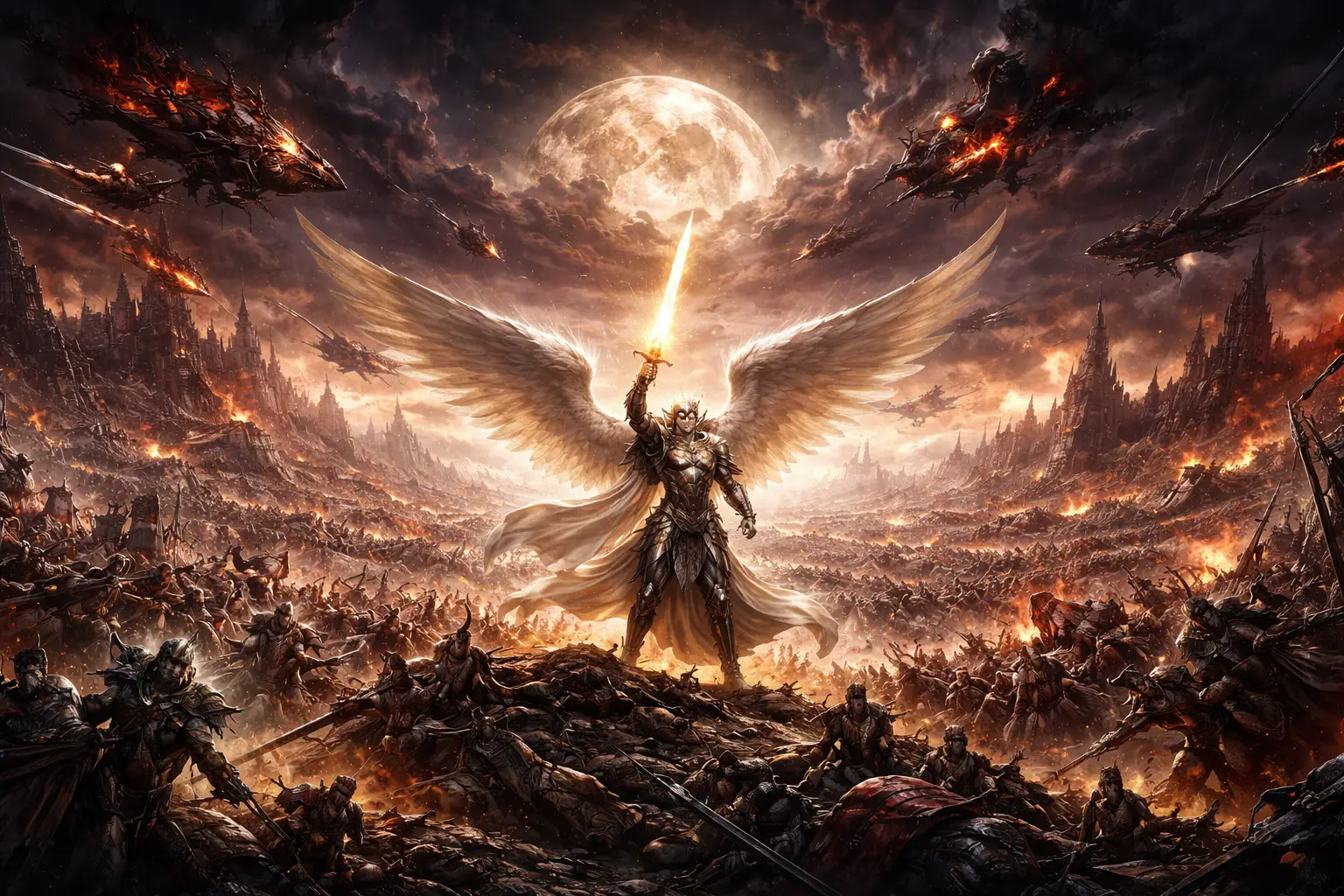
Shavarath, the Eternal Battleground
Plane — War, Conflict, Justice & Tyranny — Moon: Vult, the Warder
Radiant blades spill burning blood, and bolts of force smash angels from the sky. In another layer, champions of justice ride armored dragons, assaulting a titanic airship. In yet another, steel krakens tear apart celestial frigates. There is only one constant in Shavarath: war.
The war in Shavarath began at the moment of creation, and it will continue to the end of time. Its primary combatants are immortal — fallen soldiers return within a day or so, pick up their weapons, and rejoin the fight. The forces are so perfectly matched that a decisive victory is impossible. Over the last four hundred years of conflict in Nullius Terram, the Legion of Justice has advanced its front line by approximately twenty feet. Mortals look at this and ask: why continue to fight? Why not simply leave the struggle and do something — anything — else?
The angels would tell you that the question itself reveals how little mortals understand about the nature of war. The immortals of Shavarath believe their war is reflected across every reality — that the conflict between Justice, Tyranny, and Cruelty is not a local dispute but a cosmic balance, and when it shifts in Shavarath, it shifts everywhere. Fallen devils will be reborn. New airships will replace those destroyed. But every tiny victory — every demon defeated, every foot advanced in Nullius Terram — strengthens the forces of justice throughout the multiverse. Each angel knows it will never win a truly decisive victory, but as long as it fights, it holds the line.
To an angel, the destruction of a human city — or an entire nation — is trivial. Mortals will die; that is their most defining trait. Even a sympathetic angel sees a mortal as a snowflake: unique, beautiful, but gone in a moment. The angels fought long before today's civilizations existed, and if they had not held this line for countless eons, the Material Plane would be overrun by chaos and cruelty.
Shavarath's counterpart in the planar orrery is Syrania, the Azure Sky — the plane of peace and all that flourishes in peaceful times. Where Syrania embodies commerce, education, and reflection, Shavarath embodies their opposite: the destruction that tears those things apart, and the desperate struggle to defend them.
There is war in Shavarath, and there will always be war in Shavarath. It cannot be won, and it cannot be abandoned. As a mortal, your primary goal in Shavarath should be to survive — because in Shavarath, there are a million ways to die.
A NOTE — ATTRIBUTED TO AN UNKNOWN MORTAL EXPLORER
I asked the angel why she wouldn't help us. She said she was helping us. I asked her how sitting in a trench while people die in Thaliost counts as helping. She looked at me the way you look at a snowflake — something beautiful that won't last — and said: "You will die regardless. When you do, a sliver of your soul will fight beside me forever. I have been holding this line since before your species existed. You're welcome."
Universal Properties
There is a part of you that has always been in Shavarath — a sliver of your soul that has always been at war. When you arrive on the plane, those instincts guide you. It is easier to strike a deadly blow, or to grit your teeth and fight on through pain and injury.
Unquenchable Fury. It is difficult to end a fight through diplomacy or magic. Creatures have advantage on saving throws against effects that would end combat, including calm emotions and sanctuary. The duration of such effects is halved, to a minimum of one round. While a barbarian is raging, the rage cannot be ended early unless the barbarian is knocked unconscious.
War Magic. When a creature casts a spell that deals damage, it can add its spellcasting ability modifier to one damage roll of that spell. Once it uses this benefit, it must finish a short or long rest before using it again.
Bloodletting. When a creature scores a critical hit with an attack that deals piercing, slashing, or bludgeoning damage, it can roll one of the attack's damage dice one extra time and add it to the critical hit's extra dice. In Shavarath, wounds are always worse than they should be.
Flexible Time. Time passes at different rates across Shavarath's layers. In many, it matches the Material Plane — an hour fighting in the Burning Sky is an hour on Eberron. But other layers move at different speeds. A creature proficient in Arcana can determine the local time flow by succeeding on a check. Nullius Terram is notably slow: for every ten minutes that pass in its trenches, only one minute passes on Eberron. Months in the trenches cost only weeks at home.
Layers
Shavarath has countless layers, each reflecting a different aspect of conflict. A vicious guerrilla war in the Forest of Shadows. A mighty fortress called the Monolith, always under siege — when the attackers finally tear it from the defenders, the former defenders begin the siege anew. Every vision of war could spawn a layer, and the plane contains more than any mortal could catalog.
Layers are connected by a network of heavily fortified portals, though the most powerful immortals can shift between layers under their own power. Every legion maintains command centers in the layers it operates in. Smaller layers may host only a few centuries, while vast layers like Nullius Terram hold entire cohorts.
Nullius Terram
One of the largest layers, Nullius Terram is a battlefield the size of a small nation, divided by deep, heavily fortified trenches separated by blasted regions of scorched earth, blast craters, and bones. The region is marked by constant barrages and terrible tools of mass destruction — widescale cloudkill, curses that transform conscripts into killers, and worse. Tyranny, Cruelty, and Justice are the three active legions here. Justice has a difficult position but has been slowly gaining strength. The theme of this layer is slow, agonizing stalemate, and the suffering war inflicts on both the land and the soldiers.
Nullius Terram's flowing time makes it a place where months of brutal trench warfare equates to mere weeks on Eberron — a long, grinding struggle where every foot of ground is measured in centuries of blood.
INTERCEPTED FIELD COMMUNICATION — CENTURY OF THE INNOCENT GUARD, LEGION OF JUSTICE, NULLIUS TERRAM. LANGUAGE: CELESTIAL. TRANSLATION BY ARCANIX PLANAR STUDIES DEPARTMENT.
To all units, Cohort of the Dawn: the Serpent has moved its reserve century into the eastern salient. Expect infiltrators disguised as civilian conscripts. The Century of Chains is also active in this sector; any conscripts bearing sigils of bondage on their wrists are not volunteers and should be freed, not engaged. I repeat — do not engage chained conscripts. They are hostages, not combatants.
We have held this trench line for four hundred and twelve years. In that time, we have advanced twenty-three feet. This is acceptable. Every foot gained is a foot that Tyranny does not hold. Every day we hold the line is a day that justice endures across every reality it touches.
Hold the line. The war is forever. So are we.
The Burning Sky
Fire rains from above as aerial fleets clash among the clouds. Immense airships — some the size of small cities — lumber through skies blackened by smoke and flame while dragons in war harnesses strafe their decks. The Burning Sky is a layer of constant aerial combat, and it is one of the most visually spectacular and immediately lethal environments in the plane. There is no ground; everything exists in the air, from floating platforms to massive sky-fortresses that walk on two legs.
The Bloody Sea
A vast ocean of crimson water — or something that looks like water — serves as the stage for an endless naval war. Steel krakens tear apart celestial frigates. Pirate-flagged demon galleons ram devil dreadnoughts. Somewhere in the crimson waves, the legendary pirate Lhazaar may command a ship as a sword wraith, fighting forever for a cause she has redefined to fit the war.
Other Layers
The Forest of Shadows hosts vicious guerrilla warfare under a permanent canopy of darkness. The Monolith is a fortress under eternal siege, changing hands every few centuries. There are layers of urban warfare in ruined cities, layers of cavalry charges across open plains, layers of submarine combat in lightless trenches beneath the Bloody Sea. Almost any vision of war — from any era, any culture, any nightmare — has a layer somewhere in Shavarath.
Denizens
All creatures in Shavarath are part of the war — soldiers, tools, or victims. Those that fight are bound to legions, and the immortals believe that each legion is governed by a higher power called Command. Immortals never deal directly with Command and do not even know if it has a physical form. They do not question it. They never have.
Vast legions are broken into cohorts, which are divided into centuries of one hundred immortals. Each century represents an aspect of war: pain, mercy, terror, chains. A few special centuries and individuals can move between layers, but the majority are bound to their cohort and their assigned layer. Immortals can be reassigned, promoted, or demoted — usually accompanied by a physical transformation. This limited movement maintains the balance: cohort leaders use the forces they have, while legion commanders strategically deploy the mobile centuries.
Angels
Most of Shavarath's celestials serve the Legion of Justice, which embodies war fought for a just cause. The Century of Mercy shows kindness to fallen foes. The Century of the Innocent Guard protects civilians and avoids collateral damage. The Century of the Sun asserts that Dol Arrah is Justice Command, and sword wraiths of Dol Arrah's paladins serve in their ranks.
Angels of Shavarath appear clad in armor with their faces hidden behind full helms. Any sort of angel can be found here — planetars command centuries, solars or empyreans command cohorts. While the Legion of Justice is the largest celestial force, the Legion of Freedom operates on a smaller scale, embodying war fought to end oppression through swift strikes and guerrilla tactics. These angels fight impossible odds for noble causes, even when that forces them down ignoble paths.
Angels will not conscript adventurers, but they also will not leave their duties to help them. If a hero says "What can I do to help? Can we fight at your side?", the angel simply smiles: "You already are."
Demons
Demons represent the chaotic savagery of war. Most serve the Legion of Cruelty — wild, brutal, and far less disciplined than the devils. They torture civilians, ignore collateral damage, care nothing for their own losses, and make little effort to hold territory. The Century of the Salted Earth devastates the lands they fight in. The Century of Terror creates hideous displays with their victims' corpses and delights in psychological warfare. The Legion of Cruelty slaughters devils and angels with equal glee and is despised by Justice and Tyranny alike.
Barlguras and hezrous are brutal shock troops. Chasmes and vrocks flood the skies. Goristros are living siege weapons. Mariliths and balors command centuries, while cohort commanders may wield the power of demon princes. Some demons dedicate their units to the Dark Six; many in the Century of Terror wear the flayed skins of their foes and assert that the Mockery is part of Cruelty Command.
Devils
Devils are just as cruel as demons, but they represent the disciplined practice of war in pursuit of oppression. Most serve the Legion of Tyranny — far more organized than the savage hordes of Cruelty, working with precision and careful plans. The Century of Chains forces enemy conscripts and unlucky adventurers to fight for them, using civilian conscripts as living shields. The Century of the Serpent is always willing to negotiate, making many pleasing offers — but every agreement leads inevitably to betrayal.
Bearded and spined devils serve as troops. Elite squads of erinyes descend from the sky. Amnizu command centuries, and beings with the power of archdevils lead cohorts. Curiously, the Cohort of the Iron Hand maintains that the Sovereign Aureon leads Tyranny Command and that they are simply enacting his vision for universal order — a claim that deeply disturbs scholars of the Sovereign Host.
Conscripts and Sword Wraiths
Just as every mortal has a shadow in Mabar and a spark in Irian, there is a sliver of every mortal soul that fights in Shavarath. These slivers are called conscripts — spiritual echoes that serve as foot soldiers in the eternal war. Conscripts have no awareness and may be formed from multiple slivers; unlike Irian's embers, they do not resemble their source.
When a great mortal warrior dies, echoes of their personality and martial spirit can coalesce into a sword wraith — a far more potent entity with the appearance and some memories of the mortal it echoes, capable of meaningful action and commanding conscripts of its own. A sword wraith reconciles its memories with the war of its current layer. If there is a sword wraith of Karrn the Conqueror in Nullius Terram, he believes he is fighting for Karrnath and cannot be convinced otherwise. Lhazaar may command a ship in the Bloody Sea. Dhakaani champions and heroes of the Last War serve the legions that best match their values. The slivers of especially remarkable heroes can manifest sword wraiths even while alive — King Boranel surely has one in the Legion of Justice, and it is possible an adventurer could meet their own sword wraith while exploring Shavarath.
Weapons of War
The battlefields of Shavarath contain engines of war unlike anything imagined on Eberron. Steel krakens in the Bloody Sea. Massive cannons that could bring down Sharn's towers with a single volley. Immense monstrosities that serve as living battering rams. But even the grandest of these creations is not a product of industry or arcane science — these too are conscripts, shaped by the layer itself because they are part of the idea of the battle. An artificer might be inspired by what they see, but most of Shavarath's greatest weapons cannot be replicated on the Material Plane.
Whirling Blades
Shavarath's most enigmatic hazard is the whirling blades — swarms of animated weapons that tear through the air, eviscerating anything in their path. Sometimes they follow consistent routes like flocks of deadly birds; other times they appear in a flash, strike, and vanish. They may be a defense mechanism designed to discourage mortal interference, and the longer mortals remain in Shavarath, the more likely they are to be struck. Whirling blades can leak into the Material Plane in areas of particularly brutal conflict, spilling blood on all sides.
Planar Manifestations on Eberron
Manifest Zones
Manifest zones tied to Shavarath often inspire people to violence and aggression and can convey any of the plane's universal properties. These zones can be dangerous places to dwell, but they also encourage martial discipline and enhance training. While many of Shavarath's greatest weapons cannot be removed from the plane, manifest zones can provide inspiration for artificers and smiths, and it may be possible to craft enchantments within a Shavaran zone that are simply not achievable elsewhere.
Manifest zones rarely serve as gateways to Shavarath, though this becomes possible during coterminous periods.
Coterminous and Remote
When Shavarath is coterminous, people are quick to anger and must be careful not to fight over trivial things. Angry words are more likely to produce brawls, and restless thoughts more likely to spark riots or revolutions. The War Magic and Unquenchable Fury properties spread worldwide, encouraging violence. In Shavaran manifest zones, outbreaks of intense violence can draw whirling blades into the zone, slaughtering people on all sides.
Shavarath is traditionally coterminous for one year every thirty-six years. Throughout history, military leaders have planned campaigns around this cycle, while peaceful communities prepare containment measures. In addition to its regular cycle, Shavarath frequently grows coterminous for a single day — predicting these spikes was critical for battle strategy during the Last War.
Shavarath is remote for one year every thirty-six years, which suppresses the single-day coterminous spikes but otherwise has no apparent effect on the Material Plane.
Shavaran Artifacts
Unlike Fernia's elementals, the immortals of Shavarath do not craft their weapons — they are shaped by the plane itself. Many of the grandest tools of war cannot be removed from Shavarath or would not function elsewhere. But the plane is a potential source of armor, weapons, and instruments of war ranging from common items to the artifacts wielded by cohort commanders. These may be among the most powerful weapons in the multiverse — but they are also irreplaceable. You can steal the Wand of Orra'Cys, lord of the Cohort of Bones — but he will certainly want it back, and may deploy demons, warlocks, or other agents to reclaim it.
The legion an item is associated with affects its appearance. Tools of the Legion of Justice are bright and inspiring. Those tied to the Legion of Tyranny are grim and intimidating. Items from the Legion of Cruelty are often stained with blood that never dries.