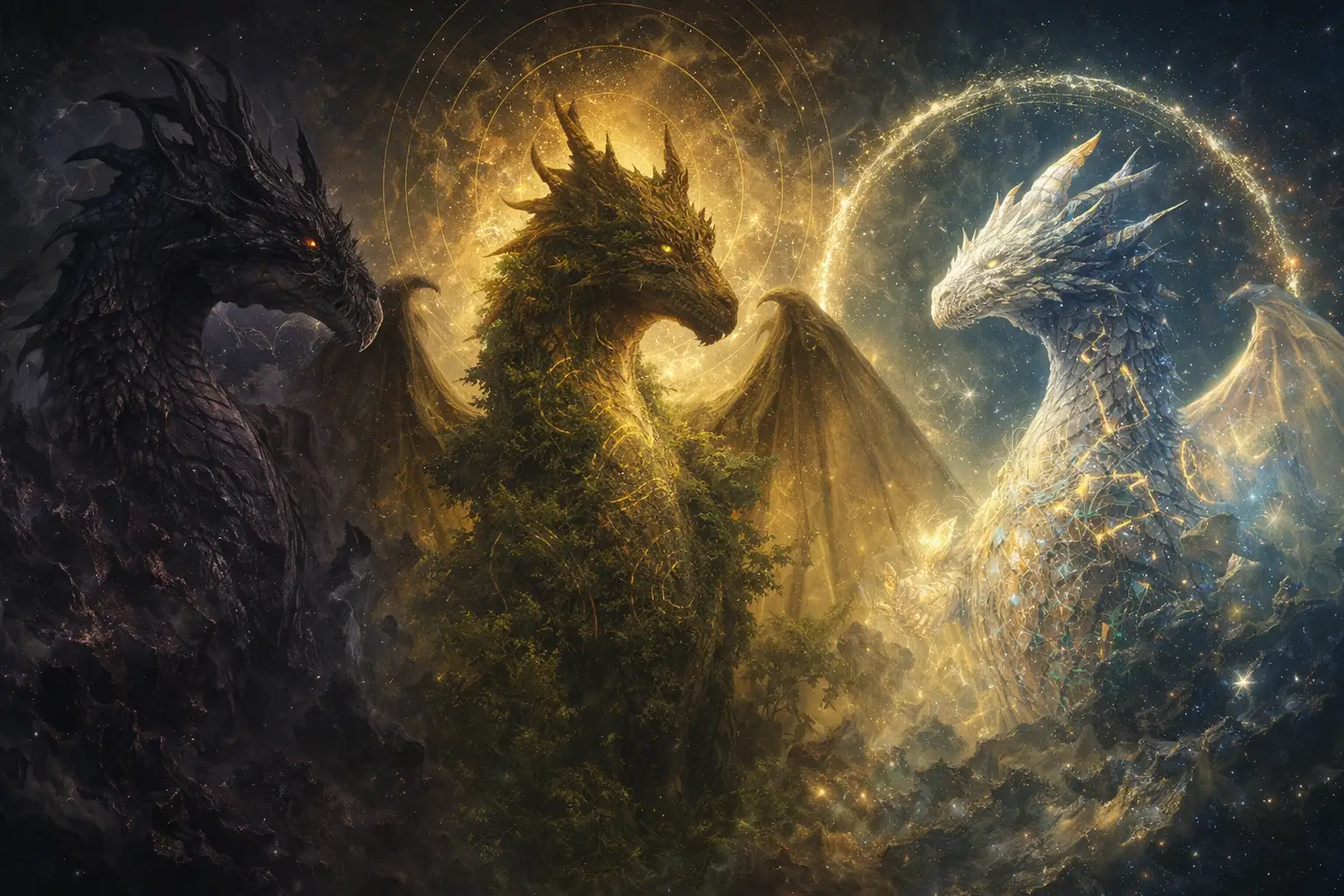
The Progenitor Dragons
The foundations of existence
INSCRIPTION — CARVED INTO THE WALL OF VVARAAK'S CAVE, THE SHADOW MARCHES
Three who were one made all that is. One gave light. One gave life. One gave hunger. The light was broken. The life became the cage. The hunger still waits.
Every child in Khorvaire knows the story. In the dawn of time, three cosmic beings — golden Siberys, the source of all magic; gentle Eberron, the fountain of life; and dark Khyber, master of secret knowledge and the powers that lurk in darkness — pondered the proper shape of the universe. Together, they created thirteen planes of existence, each embodying a concept: war and peace, dreams and madness, light and shadow, order and chaos. Their final work was the Material Plane, where all these ideas would become manifest in a single realm.
But as they moulded reality, rifts formed between them. Dark Khyber grew greedy, and noble Siberys responded by becoming more forceful, each seeking greater influence in the work. Eberron sought to mediate but could not bridge the divide. When it came time to shape the final, central plane, the tensions could not be contained. Khyber struck Siberys without warning and tore him apart, scattering his scales across the sky. Eberron knew that Khyber could not be allowed to benefit from her deeds, but the gentle one refused to fight with claw and tooth. Instead, Eberron embraced Khyber, calling on the powers of life to give birth to soil, tree, and ocean, transforming herself into a living prison that Khyber could never escape.
Shattered Siberys became the Ring of golden dragonshards wrapped around the planet, said to be the source of all magic. Eberron became the world — the source of all natural life. And Khyber was bound within, the Dragon Below, the Mother of Monsters, forever struggling against her bonds and yearning to destroy the world above.
Almost every culture shares this story: humans and dwarves, elves and goblins, the giants of Xen'drik (who insist the Progenitors were a form of titan rather than dragon), and the dragons of Argonnessen (who contend that the world was born in battle and claim the Progenitors as their own ancestors). Whether the three were literal cosmic dragons, symbolic forces, or something that does not map cleanly to mortal categories is debated by scholars across the continent and has been for millennia. What is not disputed is the structure they left behind — and the material remains they left within it.
"Students ask me whether the Progenitors were real. I tell them to hold up a Siberys shard, look at the Ring in the sky, and then ask themselves whether the question matters." — Provost Hammond Faurious, Morgrave University, introductory planar theory
Siberys, the Dragon Above
Siberys was killed. What remains of him is the Ring of Siberys — a brilliant equatorial band of golden light that dominates the sky of Eberron, visible from every point on the surface. Its golden colour suggests the entire ring may be comprised of Siberys dragonshards, the same crystals that fall from it as meteoric fragments and serve as vital components in dragonmark focus items, eldritch machines, and the helms of elemental vessels.
The Siberyan Theory, as taught at Arcanix and the Arcane Congress, postulates that all arcane magic manipulates energy that radiates from the Ring. Magic itself, in this view, is the Blood of Siberys. This is the dominant framework for arcane theory in Khorvaire, and while it is not universally accepted — scholars in Zilargo and Aerenal have competing models — it is what gets taught in schools, what informs house production standards, and what underpins the institutional understanding of how magic works as a science.
The draconic creation myths go further. According to the tradition known as Thir, which the dragons of Argonnessen hold as their foundational faith, Siberys fell in battle but power remained within his blood. Filled with the purest essence of magic, that blood fell on the new world, merging life and magic to produce the first dragons — creatures possessing both the mystical power of Siberys and the vibrant life force of Eberron. Where the blood struck the clouds, silver dragons were born. It fell on cold peaks, and white dragons rose from the ice. It struck the swamps, and black dragons emerged from the dark depths. The dragons were not the only beings born of Siberys's sacrifice: the couatl, the feathered celestial serpents, are said to have formed from the pure blood of Siberys before it struck the earth — truly immortal, reborn after death so that their numbers remained constant, and possessed of a celestial nature that would ultimately save the world during the Age of Demons.
Siberys does not speak. He does not act. His role in the modern age is entirely residual — his power persists through fragments, systems, and the Ring overhead. But those fragments run the world. The lightning rail, the speaking-stone network, the creation forges, the elemental airships, the dragonmark focus items that give the houses their economic dominance — all of it traces back to energy that, according to the dominant theory, radiates from what remains of the first of the three.
RESEARCH NOTE — ARCANIX, ARCANE CONGRESS, UNDATED
Siberyan radiance measurements taken at equatorial latitudes in Xen'drik consistently exceed those recorded at comparable elevations in Khorvaire by a factor of 1.7 to 2.3. This is consistent with the Ring's equatorial position but does not explain why Siberys shard-fall density in Xen'drik exceeds the statistical mean by an even greater margin. Either the Ring is not uniform, or something about the equatorial region actively draws the shards downward. Neither explanation is currently satisfactory.
Eberron, the Dragon Between
Eberron is the world itself. The land, the seas, the living ecosystems — all exist within or upon her bound form. As far as anyone has determined, Eberron is the sole planet in its Material Plane and the fulcrum where the thirteen planes come together. She is the reason the material world holds together. She is also the prison that keeps Khyber contained.
Whether Eberron chose her role or was trapped in it by circumstance is one of the creation myth's unresolved ambiguities — and it matters more than it might seem, because the answer determines whether the world is an act of love or a desperate improvisation. Some druidic sects in the Eldeen Reaches treat her as a living presence — not a personality, but a condition of existence to be respected and maintained. The Wardens of the Wood draw on her power through primal magic. The Greensingers acknowledge her as the ground of being from which all natural life springs. She does not actively intervene in the world, and she is not worshipped in most traditions — but the Eberron dragonshards found in shallow soil throughout the continent are understood to be part of her, in the same way that the Ring overhead is understood to be part of Siberys.
The Draconic Prophecy — the vast, shifting pattern of signs scattered across the world in stone, sky, and living things — is said by the dragons of Argonnessen to be authored by Eberron and Siberys themselves: the very blueprint of reality, twisting and shifting because the two surviving Progenitors desire such different things. Whether this is literally true or a draconic conceit is, like everything else about the Progenitors, a matter of interpretation.
"People treat the ground like it's nothing. It's the most important thing there is. She holds everything together and asks nothing for it." — Sariel, Warden of the Wood, Eldeen Reaches
Khyber, the Dragon Below
Go below the surface of Eberron and you find not a molten core but the demiplanes of Khyber — an endless array of pocket realities, each stranger than the last.
Any time someone descends beneath the surface, they enter Khyber. The underworld takes two forms. First is the natural realm — networks of tunnels and caverns formed from stone and soil. These passages are dark and dangerous but follow the laws of nature. They might be home to carrion crawlers, giant beetles, or clans of kobolds. Then there is the other Khyber. Go deep enough and you find demiplanes where natural laws may not apply — where time runs backward, where gravity pulls sideways, where the walls are made of flesh or crystal or nothing at all. Some sages say these demiplanes are Khyber's dreams. Others believe they are unfinished ideas — early drafts of reality or seeds that never quite became planes. What is known is that Khyber shards grow on cavern walls near magma in these depths, and the children of Khyber — fiends, aberrations, and other horrors — emerged from these places to claim dominion over the world in the Age of Demons.
The greatest of Khyber's children were the overlords, thirty immortal archfiends who each embodied a specific evil: tyranny, cruelty, fear, deception, war. They ruled for untold millennia until the couatl sacrificed themselves to bind them, their spirits combining into the Silver Flame — a prison of pure celestial energy that holds to this day. Each overlord is sealed in a Khyber dragonshard and held by the Flame. Though bound, an overlord can influence the region around its prison, and there is no complete, public list of all overlords or where they are imprisoned. The Lords of Dust — the rakshasa and other fiends who once served the overlords — still work to free their masters, reading the Draconic Prophecy for the conditions that will weaken the seals.
Khyber also holds the daelkyr — alien beings from the plane of Xoriat, the Realm of Madness, who invaded Eberron during the Age of Monsters and were driven underground by the Dhakaani Empire and the Gatekeeper druids. The seals that hold the daelkyr are separate from those that bind the overlords, maintained by the dwindling Gatekeeper sect rather than by the Silver Flame — and the distinction matters, because if those seals fail, the consequences would be catastrophic in an entirely different way.
The same Khyber shards that grow in these depths — deep blue or dark violet, laced with gleaming veins — are the material that powers elemental binding. The shards that hold the overlords in their prisons are the same type of crystal that holds the bound elementals in every airship and lightning rail car. This irony is not lost on the people who work with them.
"I've been mining Khyber shards for twenty years. You get used to the dark. What you don't get used to is the feeling that the walls are listening." — Durrak d'Torrn of House Tharashk, prospector, the Shadow Marches
Cultural Interpretations
The Progenitors are not worshipped in the way gods are worshipped. Most traditions treat them as facts of existence rather than objects of devotion — the ground beneath your feet, the ring overhead, the darkness below. You do not pray to the weather. You account for it.
The Sovereign Host incorporates the Progenitors into its cosmology indirectly. The creation myth is the backdrop for the story of the Sovereigns fighting the overlords in the Age of Demons. Vassals know the story but focus their faith on the Nine and Six, who are believed to be present in daily life — Onatar at every forge, Arawai in every field, Aureon in every library. Whether the champions who defeated the overlords were the Sovereigns themselves or heroic dragons whose deeds were mythologised is a question the Host does not encourage its followers to dwell on.
The dragons of Argonnessen have their own answer. The faith of Thir holds that dragon spirits who embody primal concepts in life can ascend to become Sovereigns in death — replacing an existing Sovereign, who in turn ascends further to a higher realm beyond the thirteen planes. The forces that the people of Khorvaire separate as Nine and Six are a single host in the eyes of the dragons: good or evil, they are all Sovereign archetypes and valid paths to immortality. Thir doctrine holds that the Draconic Prophecy is the manifestation of the Progenitors' will, and that when it runs its course, this creation will end and a new set of Progenitors will be chosen from among the Dragon Gods to begin again. This is not widely known outside draconic scholarly circles.
The Church of the Silver Flame has no unique creation myth and does not particularly concern itself with the Progenitors as theological figures. What matters to the Church is that supernatural evil exists, it threatens the world, and good people should work together to fight it. The Silver Flame is a concrete force of celestial energy, and the Church treats it as a resource for protecting the innocent — not as a lens for interpreting cosmological origins.
"Khyber, Siberys, the creation of the world — that's all very interesting. Truly. But there are ghouls in a basement in Starilaskur, and someone has to deal with them tonight. That's what we do." — Templar Cassia ir'Andras, Church of the Silver Flame
The Blood of Vol does not worship the Progenitors. Seekers believe the gods are cruel, the afterlife is a lie, and all mortals have a spark of divinity within their blood. Their concern is mortality, not cosmology.
Druidic traditions vary. Some Eldeen sects treat Eberron as a living presence to be respected and maintained. The Gatekeepers are more concerned with the seals that contain Khyber's influence than with the Progenitor myth itself — their practical focus is preventing the things in the depths from reaching the surface.
The kobolds are the exception to the general rule that the Progenitors are not worshipped directly. Legend holds that kobolds were born from the blood of the Progenitors as they fought for control of reality, predating even the dragons. Three distinct kobold cultures have formed around this belief: the Irvhir ("ones below") live in the deep caverns of Khyber and worship the Dragon Below; the Iredar ("ones of earth") dwell in mountain caverns and revere Eberron; and the reclusive winged Irsvern ("ones above") are said to live atop the highest peaks and serve as disciples of Siberys. Each culture produces sorcerers — called Iejirastrix, "blood seers" — whose powers are linked to their cultural Progenitor and who serve as religious leaders, oracles, and interpreters of the Draconic Prophecy. Some dragons respect this gift enough to protect kobold communities.
The Dragon Below cults take the most radical positions. Some assert that the daelkyr are simply trying to restore the original balance of reality — that Xoriat once encompassed everything, and the current arrangement is the aberration. Others, followers of the overlord known as the Daughter of Khyber, believe that dragons themselves were creations of Khyber, stolen by Siberys and Eberron, and that the Daughter is not corrupting dragons but restoring them to their rightful role. Loyalist doctrine maintains that Khyber did not betray Siberys — she was the one betrayed, imprisoned by inferiors who did not understand her grand vision for reality. These are fringe positions. They are also, in some cases, sincerely held by people who can do a great deal of damage.
What Remains
The Progenitors do not speak. They do not intervene. They do not demand worship. Whether they were conscious beings, metaphysical forces, or something the mortal mind cannot properly categorise has not been resolved, and scholars of Khorvaire have found no relics or records from the time before time. If an object from that deeper past were ever discovered, it would possess vast power and be of tremendous scholarly interest.
What is not in question is their continued material presence. The Ring overhead, burning with golden light. The world underfoot, holding everything together. The demiplanes below, where bound things strain against their cages. The dragonshards that fall from the sky, crystallise in the soil, and grow on cavern walls near magma — fragments of three beings whose conflict made the world and whose remains keep it running.
And the Prophecy. The vast, shifting pattern of signs in stone and sky and living things, written in a language that only the contemplative mind — or the ancient dragon — can hope to read. The Prophecy does not tell the future. It maps the myriad paths the future might follow, and those who can read it gain the power to nudge reality toward one path or another. It is authored, according to the dragons, by the Progenitors themselves — and it is the single most contested resource on the planet, fought over by the Lords of Dust and the Chamber in a shadow war that has lasted a hundred thousand years and shows no sign of ending.
"People ask whether the Progenitors are dead. Siberys is the source of all magic. Eberron is the ground you're standing on. And Khyber is the thing underneath it that hasn't stopped trying to get out. 'Dead' is the wrong word for all three of them." — Professor Maren ir'Daresh, Morgrave University, public lecture series